Second battery economics

79 comments started 2024-12-03 last 2025-01-27
GivEnergy Products
J
#1 Josephiah

Hi all,

I'm idly wondering about whether a second battery makes sense, and wondered how those of you who went for one made that decision...? Current system is a 5kW inverter + 1x 9.5kWh battery, on Agile and automated with HA/Predbat, which I've generally been very happy with. (Also have solar and a heat pump, but keeping things a tad simpler for now.)

My rough starter-for-ten calc is as follows:
Payback period = purchase price / (battery capacity x (normal rate - cheap rate) x 365)
Essentially this just assumes that every day I can shift a battery's worth of normal rate electricity onto the cheap rate, and that my first battery already deals with the major peak every day (it does in our case). Ignoring round-trip efficiency for now, which would make the calc a bit worse. Purchase price is a bit of a guess based on wholesale prices, and assuming not much work to install (mount, plug in, phone GE).

My conclusion is that this is very specific to tariff, as the scenarios below illustrate:
A. Octopus Intelligent Go - I've seen a few people on this forum doing this:
PP = £3,500 / (9.5 kWh x (£0.265 - £0.07) x 365) = 5.2 years - tempting.

However, our situation is more like the following:
B. Octopus Agile, weighted average unit price for us this year = 17.7p/kWh. Rough guess at what average minimum rate across the year might be = 10p/kWh.
PP = £3,500 / (9.5 kWh x (£0.177 - £0.10) x 365) = 13.1 years - much less tempting.

Does that make any kind of sense? Have I missed anything obvious/important?
With 15p/kWh export, I'm not seeing a massive benefit to storage over export for excess solar...


B
#2 browellm

Adjust your figures for round trip losses (you say ignore it, but why?) and probably some accommodation for battery cycling.

W
#3 Weasel

I am looking at the same scenario from a different perspective and my post it note calculations are as follows

I have a 13.5kWh AIO and gateway

My annual usage is about 12,000 kWh (rounded to make calculations easier)

If I were using a "standard" tariff of 25p, my usage would amount to £3,000

Using Cosy Octopus, I can buy and use all my power at about 12.5p, but let's call it 14p to account for losses. This amounts to £1,680, so I save £1,320 annually. My AIO cost £8,000 so payback is about 6 years.

If I could add a 2nd AIO, I could run all day from a single overnight charge at 7p per unit - let's call that 8p to allow for losses and that gives a total usage cost of £960, an incremental saving of £720 per year. At an incremental cost of £6,500, the extra battery pays for itself in 9 years

Based upon this very simplified model, I can see that there is a diminishing return with the extra AIO, but it still represents an 11% return on capital employed which is not bad assuming I have the capital to buy the additional AIO (fortunately, I do)

B
#4 browellm

Weasel Using Cosy Octopus, I can buy and use all my power at about 12.5p, but let's call it 14p to account for losses. This amounts to £1,680, so I save £1,320 annually.

You also have to remove the approx kWh that you would use on cheap rate hours without storage from the calculation.

W
#5 Weasel

browellm i am assuming that without a battery, I was not on a smart tariff, but you make a good point.

I would also need to add in the extra cost of units bought at peak time. Cosy Octopus has 3 hours at 36.46p. The weighted average assuming flat usage over a day is about 22p. Therefore my annual usage cost originally would be about £2,640, so my saving for a single AIO is now only £960 and the payback period is 8.33 years rather than 6.

Without a battery at all, I could make savings by load shifting, but that's why I bought a battery in the first place

G
#6 geoffreycoan

Josephiah I’ve looked at this myself in the past and concluded that depending on the assumptions being made, additional battery storage for my hybrid inverter came with a payback of between 7 and 22 years !

I calculated it depended on the tariff, the charge rate of your inverter, the time you have on the cheap rate to charge, and the difference between cheap and non-cheap rates. Adding more storage to a single inverter often meant you hit one or more limitations. With a 5kW inverter you’ll have at best 3.6kWh charge rate, so will fill your existing 9.5 in about 3 hours. Adding a further battery, will you find another 3 hours of similarly cheap rate overnight?

Other scenario to consider is peak rate export if you are on Flux for example, more battery storage will enable you to store more and discharge more in the peak rate, but again, time duration of the peak period and inverter throughput can become limiting factors.

My conclusion was that having some battery storage makes quite a difference to getting the best out of smart tariffs, but adding more gets to diminishing returns. Last year I ran my heat pump through the winter with just a single 5.2 (4.2 usable) battery which basically only lasted the Agile peak rate. More storage would have been great but the actual average import rate wasn’t all that bad despite the high consumption I incurred

P
#7 Pete UK

Josephiah

It’s a tricky one. You really need a crystal ball. The only way you’ll figure out the real payback time is with the benefit of hindsight AFTER the event. For example; Try applying electricity import/ export/ installation/ purchase prices from 2, 3, 5 or 10 years ago - or even 18 months ago. 10 years ago the efficiency of panels was way different to the modern ones today and there was limited or no “storage” batteries available and no one was talking about getting solar panels or home batteries.
Also how long will your system work? Will it pack up after exactly 10 years or will it be ‘ok’ for 20? When will you have to fork out for a new one? No one really knows !
You’ll get totally random results. Right now it’s 7p import on IOG and 15 export so extra batteries make perfect sense and will pay back fast (just recently it was 10p import and 4p export) so a massive difference. Probably not worth it!
There is a lot of intangible stuff like this to consider; charging/ discharging rates and do you have an EV/ will you be getting one?? Which enables access to the much cheaper off peak rates which benefit extra batteries and could cut your average import rate massively!
If say 25-50% of your import usage is for an EV that changes things massively.
Are you a high user or low user? 5,000kWHr a year or 25,000 ?
I think the only constant for the next 5-10 years is that there will still be an off peak over night rate and a more expensive day rate. Although some say that’s debatable.
Not very helpful probably I know but food for thought!

D
#8 DD

Pete UK do you have an EV/ will you be getting one?? Which enables access to the much cheaper off peak rates which benefit extra batteries and could cut your average import rate massively!

Don't forget that EON offers even better rates without the need for an EV. (Can't remember if daytime rate or standing charge are worse, but if you are considering extra batteries, day rate may not matter.)

There seems to be a lot of noise about V2H/V2H at the moment - not sure if it's worth waiting to see if anything comes of that. Though if extra support is needed in the car, it will take a while for to trickle down to the used market. (Leaf already does it, but investing in chademo seems a bad move. No standards yet for bidirectional CCS AFAIK.)

V
#9 Vestas

Given the recent (GE sanctioned) furore about Agile users killing inverters I think buying any further GE products would be an unwise investment.

#10 Windy Miller

I also considered a second battery with a payback time of at least 7 years. Three reasons I decided against it.

  1. The kit may only last 7 years - despite being guaranteed for longer I don't expect to get much with an early failure like this.
  2. Smart tariffs are becoming less competitive with time so basing payback on today's tariffs is like too optimistic.
    3.
L
#11 Luxo

Vestas get it correct at least, people using 3rd party control software that does excessive instructions and is wearing out the flash.

#12 Windy Miller

Hit return too early!

  1. I think being able to use an EV to power the house is less than 5 years away and this would be my preferred using my primary battery to power the house whilst the car was away from home.
D
#13 DD

Luxo get it correct at least, people using 3rd party control software that does excessive instructions and is wearing out the flash.

not on batteries, though...

J
#14 Josephiah

Thanks all.

geoffreycoan My conclusion was that having some battery storage makes quite a difference to getting the best out of smart tariffs, but adding more gets to diminishing returns. Last year I ran my heat pump through the winter with just a single 5.2 (4.2 usable) battery which basically only lasted the Agile peak rate. More storage would have been great but the actual average import rate wasn’t all that bad despite the high consumption I incurred

Yes, this is pretty much where I've landed. Definitely diminishing returns with no guarantee of the economics remaining the same over time, so tending to shy away from this option.

DD There seems to be a lot of noise about V2H/V2H at the moment - not sure if it's worth waiting to see if anything comes of that. Though if extra support is needed in the car, it will take a while for to trickle down to the used market. (Leaf already does it, but investing in chademo seems a bad move. No standards yet for bidirectional CCS AFAIK.)

Windy Miller I think being able to use an EV to power the house is less than 5 years away and this would be my preferred using my primary battery to power the house whilst the car was away from home.

Interestingly, this is what kicked off the whole thought process: looked into Octopus EV salary sacrifice scheme for my business, and whether and sensible vehicle options exist -> for us, now, literally only the ID Buzz LWB would be suitable (and even with all the benefits, prob out of reach price-wise) -> noted V2H listed as feature and wondered how that would shift the total economics of combined motoring+home energy -> looked into V2H in more detail (seems to be in the "industry fights about standardisation" phase of innovation!) -> "hmm, what could I get now for the rumoured cost of a bidirectional charger (~ £6k, though will obviously drop in time)...?"

Luxo people using 3rd party control software that does excessive instructions and is wearing out the flash.

Interesting/slightly concerning. Do we have a feel for what constitutes "excessive" here...?

J
#16 Josephiah

Weasel

browellm Adjust your figures for round trip losses (you say ignore it, but why?) and probably some accommodation for battery cycling.

Quick first pass! But yes, it's the obvious next easy thing to add in.

Weasel I am looking at the same scenario from a different perspective and my post it note calculations are as follows

I like this approach too - we're fairly heavy users (HP, but no EV as yet) - so will give that a bash too and see if the numbers end up similar.

D
#18 DD

Luxo vestas is talking about killing inverters, my point stands...

And this is a thread about adding additional batteries to existing inverters, so no.

R
#19 Rbor

2nd battery is a difficult one.
In August 2022, I had 15 solar panels installed with one GE 8.2 kWh battery. No HP.

In April 2023, I had 10 additional panels installed to use all my possible roof space. Wish I had done this the previous year (scaffold costs). I was intending to get a HP installed in 2023 and I made the decision to get a 2nd 8.2 kWh battery with the extra panels to support the forthcoming HP. I would have delayed but I could get the battery to support the solar and no VAT. That rule has now been relaxed.

I am not convinced that a 2nd battery was the right decision. So many tariffs have appeared in the last year and there is a lot to be said for using the grid when rates are lower anyway (Agile). I have learnt about 'round trip losses' now and batteries are expensive. Technology is also changing so rapidly and we may all end up using grid as our battery if moves towards compulsory smart meters and DFS materialise.

Still, I have 16.4 kWh of batteries and I still run out sometimes when temperatures are low, little solar (HP can be ultra thirsty when it's really cold).

What would I do now? I would probably stick with the one battery but tomorrow, I might go with an extra!
This seems to be the general consensus!

Rob

P
#20 Pete.J

I have Hybrid 5kW inverter and 2x9.5kWh batteries and PV arrays East and West. - bought with the intention of running on Agile and using Home Assistant and PredBat. I went for two batteries from the start because we use an average of 13kWh per day and I wanted to be able to cover a whole day if I needed to. An All In One would do this but with no reserve, and given the number of houses nearby with solar installations I might have struggled to get the higher export permission.
The key disadvantage is that I rarely cycle the battery system fully. Also, the secondary battery is wired in series with the first, so it never charges quite as well as I'd like. But I do like being able to coast through an expensive Agile day if I need to.

#21 PianSom

Rbor What would I do now? I would probably stick with the one battery but tomorrow, I might go with an extra!
This seems to be the general consensus!

That chimes very well with my thinking!

If I had ever got Island Mode to work properly I would have got another AIO by now. As you say, the economic case is shaky, but an extended battery use in an outage has value for me. And an extended battery that doesn't work in an outage is of no value.

P
#22 Pete UK

Josephiah

Just another thought…

Have you considered simply swapping to a different tariff?

As @DD says there are better/ other tariffs available that don’t require and EV.

You don’t say what your yearly usage is (only high). So I assume it’s about 10-15kWh a year?

If I’m understanding this right… your average is 17.7p import right now but you could potentially cut that to 7p on IOG (or less on EON without an EV) instantly; running entirely from stored 7p off peak from two batteries.

So if you’re currently importing say 10,000kWh a year at 17.7p) there alone you’d save £1,070 a year.
And if it’s 15,000kWh a year you’d save £1,605 a year (but you might need 3 batteries??). This is of course ignoring exporting all solar or excess afternoon/evening export. Which I don’t know what that is for you. But would be where the calcs above come from - just importing at cheap rate and exporting all at 15p)

It’s pretty much a case by case assessment dependent on;
1) Your import amount
2) Your export amount
3) Your annual usage
4) How you run your heat pump. (Low and slow (highest SCOP, or do you boost it slightly at night on the cheap electricity (lower SCOP but the electricity is overall far cheaper), or do you just run it in the day like traditional heating ?)
5) Would two batteries last you the whole 18 hour ‘on peak day’ (ie on IOG/ EON without agile top ups?)

You say your single battery lasts you all day at the moment on agile - but isn’t that because it’s being topped up during the day multiple times at the cheaper (but not super cheapest) times on agile?

A second battery may mean that you can top them both up overnight at 7p for example (or less on EON) AND they both truly last you the whole day (without being charged up inbetween (on agile) outside of the 23:30-05:30 period).

The most important cost analysis thing with an extra battery is that it may allow you to use 100% off peak import from an overnight tariff that you couldn’t make work financially before with a single battery. And that alone will drop your average import cost dramatically. I think people tend to do a cost comparison of one battery vs 2 batteries on the same tariff. But what you really want to consider is comparing the cost of one battery on your current tariff with the cost of two batteries on the cheapest overnight tariff you can now get on.

And then there are the summer and winter scenarios which are totally different usage patterns as well !

In summer; you’ve got all your solar to export plus twice the amount of two batteries to export (+19kW) at 15p/kWh.

In winter; hardly any solar to export but your two batteries last you all day and it’s all at 7p.

In between seasons; you’ve got excess solar and battery to export but not as much as a full summers day.

T
#23 TimHutchings

The other option to ask yourself is would the money you spend on a battery, be better spent on solar panels if you had the roof or garden space.
The pros are that you finish up getting more solar in poor light and short days, can export more kWhs so make more money in summer, less conversion losses in/out of a battery, solar panels last 25-30 yrs (battery 15?), and batteries daisy chained together never seem to fully charge or discharge, meaning you don't get the full power from either.
The cons would be that you need an inverter capable of outputting hight amounts of solar.
If I had a bigger roof or garden, that's probably where my money would go.
Just food for thought!

P
#24 Pete UK

TimHutchings

Good point. I’m actually quite impressed with my north facing panels. (I’ve got South, east and North facing; basically just filled every roof from the start, the majority are east facing). I don’t have an ideal roof !!!
Impressed; not when it’s sunny but impressed when it’s overcast and dull. I reckon I get about 15% of max power from all my panels when it’s overcast/ dull, whatever direction they are facing. About 1/4 of production comes from the North ones on these types of day. Which to be honest, it’s far more overcast and dull days in the UK than the full sunny ones. Throughout the whole year, the majority of the time in the UK, solar panels are not in full sun. Despite winter production being only about 10% of summer production this is all a very valuable addition. It can make a difference between covering your base load or not. The difference between the batteries holding their charge or getting slowly depleted. Or them slowly depleting instead of more rapidly depleting in winter. So I’m with you on that. Fill your roof !

Would I add North facing panels to an existing system at a later date? Possibly not because of the separate install cost/ scaffolding etc but as a relatively small incremental cost to an initial install, yes, I’d definitely do it again.

I possibly went a bit too large on the panels and batteries (I don’t think I did) but I’ve now got a net £zero electricity bill, including free “fuel” for the car doing about 14,000 miles a year. So that is quite a nice feeling. Likely tariffs will change and that may not always be the case for ever. But for now I’m very happy with my decision.

For info;
(Still on gas CH)
Usage: 19,000kWh a year (4,500 is the car: 14k miles pa)
I’ve got 27 panels (5 South, 14 East, 8 north)
Generates about: 5,600kW a year
2x hybrid Gen3 5.0 inverters
4x 9.5kW batteries
Export limit: 10kW
99.3% IOG off peak usage at 7p. (Calibrations 🤦🏻‍♂️!)
System cost: £35k
Savings pa: ~ £7k
Electricity: £4.2K at todays rates compared to being on an EV tarif with SVR and no solar/ batteries.
Was spending £6,500pa a few years back though!
EV: ~ £3k
Payback time: 5 years, 8.33 years? who knows 🤷🏼‍♂️ depends if I include the car savings or not and what electricity prices are in 5 years time….??? It might be 50p/ kWh in 5 years time !

G
#25 geoffreycoan

Pete UK Agree, more panels and if necessary a bigger/secondary inverter has a much better payback & system life than extra battery storage.

Only caveat to that is DNO export limit and/or practicalities of grid output voltage.

Like you I aimed to maximise on the panels whilst I had the scaffolding up, in hindsight I realise I could have fitted a few more to the house if they were juggled around a bit, but I’ve probably got enough now …

Usage ~ 13,000 kWh/year, ASHP heating (6,500) and home use (8,500). No gas. no EV
I have 44 panels in 3 arrays, 22 East facing, 22 West facing
Generates about 10,500kWh a year
4kW Growatt FIT inverter and 2x 5kW Gen 1 Hybrid inverters
9.5 and 5.2 batteries for 10.4kWh usable storage
No export limit
System cost £18,100
Net zero electricity bill per year
Saving approx £3,500 per year being on SVR with no solar/batteries
Payback time about 5 years

The limiting factor is the grid export. Despite having no DNO export limit (thanks UK Power Networks !), in practice when it’s sunny I pump so much out to the grid that it pushes the grid voltage up and one of my inverters will repeatedly stop generating, pause, then restart. So I probably would generate more if the grid could handle it.

And this was after I got the DNO to turn the grid supply down as I was getting shutdowns all the time in the summer, now it’s just in the middle of the day. I try to leave space in the batteries to part charge to prevent this happening

#26 Tenkaykev

Pete UK Would I add North facing panels to an existing system at a later date? Possibly not because of the separate install cost/ scaffolding etc but as a relatively small incremental cost to an initial install, yes, I’d definitely do it again.

That's the conclusion I came to because of cost. I have 13 SE facing panels, our NNW facing roof gets a fair bit of sun in the late afternoon. There's a 6kW Solis inverter with the existing panels all on one string, so a spare string that new panels could use. The economics would work with decent panels available for £60 from City Electrical, if I could chuck them on the roof and use the spare string. All the benefits of hindsight.

C
#27 CW

Pete UK I’m actually quite impressed with my north facing panels

For reference, I have 10 x 445w SE and 10 x 445w NW facing and from my data, the NW panels are producing around 60% of the SE output. I have to say I am pretty impressed with that as well.

System was installed mid April this year.

Gas CH, No EV
Usage 4,000 kWh/year Electric
20 panels (see above)
Generated 5.64 mWh in 8 months
GE 5kW Hybrid inverter
GE AIO 6kW battery
DNO restricted to 8kW
System cost £16,000
Currently in credit but need to wait a full year for reference.

R
#28 Rbor

CW To add to the general conclusion: Get as many panels onto your roofs as you can.
I have 25 panels (3.9 kWp) scattered around E, S and W roofs (main roof and extension) so 9.7 kWp in total.
Last 2 years panels produced about 7 Mb each year, ranging from 110 MWh in Dec to 1.1 MWh in May/June. 5kW Solar inverter and GE AC3.0 inverter feeding two 8.2 kWh batteries.
Inverters aren't big enough!

No gas, an ASHP and low mileage EV.
Over the last year, I am £40 in credit for all my energy (including SC).

So pleased.

Rob


N
#29 Newman

Ed Milliband intends to permit massive PV installations on agricultural land. There will then be excess daytime electricity during the summer. I can imagine that electricity price will fall during daytime making PV investments less profitable. The next consequence could be negative export pricing during surplus PV electricity periods.
Load shifting from economy 7 (or similar) means batteries can save money over winter, less so during summer.
I could be wrong, just my thoughts.

C
#30 CW

Newman Gary Does Solar did an article on this, where IIRC in California they will charge you for any energy exported!

R
#31 Rbor

Make the most of it while the sun shines (for us).

Rob

P
#32 Pete UK

Newman

Yep - for sure things can change and probably will. If that happens then I guess we go back to the strategy of charging the car and home batteries in the daytime and try not to export anything again.

R
#33 Rbor

Newman Ed Milliband intends to permit massive PV installations on agricultural land.

Maybe but how long will this take to get through planning and then connected to the grid?
Octopus have planning permission for a solar farm in Co Durham and have been given 2035 or so for connection to the grid.
Hopefully this installation will move up the queue as there have been recent changes to the rules for grid connections: https://www.neso.energy/industry-information/connections/queue-management

Rob

J
#34 Josephiah

Pete UK Just another thought…
Have you considered simply swapping to a different tariff?
As @DD says there are better/ other tariffs available that don’t require and EV.

Fair point. From a look around, I didn't find any particularly cheap non-EV tariffs - is it just that the EON Next Drive one doesn't demand an EV (despite its name)? Even using that rate, but adding in a bit of conversion loss allowance this time, I'm still hitting around 10 year payback.

EDIT: Ah, hang on, don't think I'd quite absorbed the point about if I was on an EV tariff, I could do both green export and brown import/export in summer. Hmm, will have a think about that. Also have to say I've found Octopus to be far better than any previous energy company I've had to deal with, so wouldn't be in a hurry to leave without good reason...

TimHutchings The other option to ask yourself is would the money you spend on a battery, be better spent on solar panels if you had the roof or garden space.

Pete UK Good point. I’m actually quite impressed with my north facing panels.

From a look at my spreadsheet, our usage for the year Dec '23 to Nov '24 was 8,321 kWh.

We did all of our improvements about a year back, catching the Home Energy Scotland scheme at just the right moment (albeit with one cliff-edge rule change redesign in the middle - vexing at the time, but worked out well in the end):

  • Insulation and 12kW HP installed end of Oct '23. Did a lot of tuning in the early days for an estimated combined SCOP so far of about 5, running constantly except for a setback across the Agile peak.
  • 6.56kWp solar (16 panels) / 5kW Gen 3 hybrid inverter / 9.5kWh Gen 2 battery installed end Jan '24. Total generation over the last 10-and-a-bit months = 5,018kWh, which I'm pretty pleased with. However, over half of that was exported (at 15p/kWh) - another thing to factor in somehow!

No, battery doesn't last all day, but is big enough to span the Agile peak period and a chunk of the evening, so avoids the worst of the costs.

SE-facing roofspace is maxed out, as is the inverter. In our long highland summer evenings, I have thought some NW facing panels would actually boost the evening's takings rather nicely, but would need another inverter, and the scaffolding challenge round the back of our house would be daunting - 2 storeys + big conservatory which would have to be bridged somehow.

As I hinted at earlier on, an EV is probably the next priority, but the 7-seater options are pretty woeful (either nasty van conversions with tiny batteries, reverse-Tardis SUVs, and/or supercar money - bring back proper MPVs, I tell you!). Have been looking at Octopus EV salsac semi-seriously for our business, but all the benefits don't wipe out the new car price premium.

Complicated! But hey, that's half the fun... I'm getting on for a having a complete year's data from all my systems to work with, so looks like a month-by-month analysis may be in order...

D
#35 DreadorUK

Whilst Im not on the same setup as I don't have solar, I have played with the idea of a second battery as I was considering A2A and that one battery alone overnight would not suffice in winter or summer.

My problem or not a problem but an alternative is the EV so Ive put it on hold for now though

Im hoping that GE spot an opportunity to add hardware to feed from an EV as some are now able to accept a draw of about 3kWh thus allow me to tap into that power to keep the battery topped up.

P
#36 Pete UK

Josephiah

I see. Thanks for the extra info.

IOG (or similar) is obviously a slightly different operating strategy to agile - but on a cheap off peak rate such as IOG (6 hours) or EON (7 hours IIRC) what you do to get minimum cost bills (currently) is charge your solar batteries fully overnight at 7p (2x 9.5’s will just fit nicely into 6 hours off peak with a 5.0kW inverter.) If you later get an EV you set it to charge at the same cheap time overnight. So all your overnight import; house, heat pump, car, batteries is at 7p. Then the daytime heat pump use and house load is also drawn from the fully charged batteries stored at 7p. Assuming (and) hopefully 19kW of batteries lasts you the remaining 18 (or 17) hour day in the depths of the winter (?). On occasion it may not but that’s still ok on the odd few days a year. Only you will know if 19kW will be enough to last you but sounds like it should…?). Get the HP to heat the hot water tank overnight as well! (SCOP will be lower but electricity is almost 1/4 of the price!).

In the summer and a fair bit of the shoulder seasons, all solar generated then gets exported because the batteries are full. Which in summer is pretty much all of it. In the winter not so much. But ideally that means you’d export far closer to all of the 5,000kW you generated at 15p, instead of only exporting half of it at whatever your average agile export rate is at the time (or are you on fixed rate export? Not sure if that’s a thing with agile..?). So you’ll ‘almost’? double your solar export payments by doubling your solar export.
Also, as well as getting 15p for almost all of your solar exported in the day, in the summer (and likely a large part of the shoulder seasons) your batteries will still be full or near full in the evenings, so you can export all of that 19kW for 15p/kWh every evening (to finish by 23:29 !).

You’ll have to get your fine tipped pencil out to work out if 19kW stored in two batteries would last you the whole 18/17 hr day or not.

Basically the way things stand at the moment, you only need to export roughly half of what you import to break even annually on IOG.

Between reducing your average agile import cost from 17.7p to 7p/kW and exporting almost double your current annual solar export at 15p and exporting up to 19kW extra a day at 15p/kW (minus 7p battery import cost) for a lot of the year except winter, how does it stack up financially now?

Looks like on the face of it you could save circa £1,200 - £1,500 a year. Not just from the one extra battery on the same tariff in itself - but by the combination of the extra battery and it then allowing you to get on a far better import and export tariff combo. (3%-9% Losses excluded!).

I’ll let you do the calculations !

Good Luck

A
#37 Al E.Gator

Josephiah I think also you need to consider the wear rate of the battery. I'm seeing a few instances now (including my own) where the LV batteries seem to be losing around 4-5% of their capacity per 300 cycles (or around 5% a year if you cycled it every day). If you're trying to maximise the payback and are doing any kind of grid trading or charge and export, you'll degrade that battery very quickly. Personally I would say that if the payback isn't 7 years or less almost guaranteed then it's probably not worth it compared to just sticking the money in the bank at a decent interest rate. If you put the £3,500 ish that it would cost to add a new battery into savings, you'd have about £4,600 after 7 years, so that's the figure you're really after when calculating if it is worth it. If it beats it though then it's a good investment!

#38 Windy Miller

Another way of determining what you might save...

My 2x5.2KWh batteries (usuable around 8Kw) combined with the Agile tariff is saving me an average of £50/month over the flexible tariff. I push an average of 8Kw through the batteries each day i.e. 1 cycle per day.

The batteries were around £2200 each in 2023 (not counting the inverter cost). If I invested this it might be worth £5800 after 7 years. £50 per month for 7 years is £4200 meaning the payback period is in excess of 7 years (it's nearer 10 years). This is also the guarantee period of the batteries (in my case). So having batteries at all is not necessarily a good investment unless they do last 10 years (especially as I also have a separate battery inverter from the solar inverter which was an additional £1200 cost).

If I added another battery I couldn't fully utilise it so the payback period must be in excess of 10 years.

To my mind batteries are barely worth considering at all let alone me adding any more. If I had a heat pump the economics might be more favourable. Similarly if the cost of the batteries dropped. But, as I said earlier in this thread, waiting for my EV to power the house is probably the best for me with my house usage.

P
#39 Pete UK

Above two posts are valid. It may/may not be worth it on paper depending on your assumptions! Highly depends on so many factors for each person.

It is very much a crystal ball guessing game. A real leap of faith. One can only try to predict using todays numbers with an educated guess of how much electricity prices will increase per year.

It’s impossible to predict;

1) if interest rates will drop further again.
2) if electricity prices will rise and by inflation?/ higher? (Probably likely they will continue to rise though)
3) realistically how long your batteries will last/ how much they will degrade.
4) How long are to staying in the house? Might you move?
5) If/when future V2H/ V2G becomes an affordable widespread reality?

Given that a decent, modern, properly sized solar and battery system will potentially add 3-5% onto the sales price of your home and power your EV for free, do we include that in the payback calculation? And the extra house price growth on that increased value pa?
If that’s the case then the payback time might be as short as the time it takes to install, commission and pay the invoice !

If there are two identical houses for sale next door to each other. Which one would you choose? The one with the zero electricity bill and free EV fuel or the one with the £4k/ £5k/ £6k pa electricity bill (+ extra £3k pa car running costs) but it costs 3-5% less?
I’d suck up the extra cost and go for the latter one every time. But others may not. Some will argue it’s irrelevant because you don’t plan to ever move.

One battery might work well now but if it’s degraded by 50% in 15 years time but still working then maybe two was the right choice today? Or maybe you just replace that single one at the cost of a new battery 10 years down the line? Or maybe tech has moved on significantly by then and everyone has V2H who knows !

You can argue all sorts of stuff to justify whatever you want really regarding payback time and everyone can agree or disagree but you’ll only truly know as it gets towards the end of the actual payback time and if/ what broke along the way. 🤔

J
#40 Josephiah

Pete UK Thanks for the detailed pointers - really helpful, and confirmed / challenged various bits of the method I was working on. I ended up having to calculate on a daily basis, as the combination of usage and solar generation gives a highly variable set of inputs (I was suspicious about my initial stab at a month-by-month basis version, and it turned out to be way off).

With the heat pump, our daily consumption varies from a minimum of 9-10kWh on certain summer days right up to 60-70kWh on a cold winter day (worst day was 84kWh in the middle of last January's cold snap).

As far as I can work out (and taking into account charge rate limits and round trip losses, but ignoring all of the future uncertainties you list in your latest post), on IOG tariff or similar:

  • with my current 9.5kWh battery, we would more or less break even compared to my current Agile strategy (IOG ~ £10 more than Agile, so rounding error territory);
  • with an additional 9.5kWh taking us up to 19kWh of storage, we might realistically hope to save about £400/year, giving a payback period (ignoring degradation) of ~ 9 years assuming at £3.5k installation cost (TBC - I've asked my installer for a quote);
  • with a V2H/G-capable EV and 7kW charger, we could shift a max of 42kWh per night, at which point we could hit a far more interesting saving of ~ £1200/year. Even with the currently eye-watering costs of bidirectional chargers (and leaving aside current lack of availability and support from the grid) that's starting to look much more tempting.

I think this confirms the thoughts I had following my investigation of Octopus EV: V2H/G, done well, could be an absolute game-changer. And I'm now unconvinced of the value - in our specific situation, with prices as they are currently - of getting a second battery. So I reckon I'll be running our diesel Galaxy for another couple of years, after which maybe/hopefully there'll be a little progress on cheaper (or nearly new) 7-seater options, and V2H/G might have made some headway.

Thanks all for your input, that's been a really interesting and useful exercise.

P
#41 Pete UK

Josephiah

You’re welcome. Sometimes it doesn’t always make financial sense. Especially, I suppose if you have a heat pump that’s using a lot in winter.

Don’t mean to throw another spanner in the works but some people are also swapping tariffs between winter and summer. But that’ll make your head explode when trying to calculate things !

Certainly a massive amount of variables to consider; too many really ! Really good to think about all the “what if’s” though. You just have to go with what seems best at the time.

I think as was said somewhere else on the forum, inverters should really be bigger and battery charging and discharging should be faster !

J
#42 Josephiah

Pete UK yeah, I previously looked at swapping between Agile and Cosy, but Agile tended to win out every time. Of course, that's not a static picture as the rates change over time...

S
#43 SteveCook

The simplest calculation for me is that I switch to Eco7 over the 6 winter months.
Off peak import 12.76 p
Peak import 27.64p
Even with 27 panels, there is little excess for export. Any sun just goes back into battery.
Typically use say 20kwH/24h period.

Very rough calcs - so please excuse inaccuracies
I have a single 9.5kkWh battery (say 10kWh).
If I had 2 batteries I could have another 10kWhr at off peak 10* ( 27.64-12.76) say £1.50/day saving
6 months saving £1.50/day say £250/year saving (with a bit of inefficiency built in)
I am sure with another battery I could do a bit more off peak/PV generation in the 6 summer months with peak export, but I think HMGov may start to make that less attractive. The real saving for me would come if I ripped out my boiler and went to a Heat Pump, but until that "wild west" of contractors calms down i will stay on gas.
I could probably run on the 6 summer months purely on 2 batteries and PV solar charge and save another £500 year by not having any import for 6 months

Problem is I only have a single Gen1 Hy5.0 (I was promised Gen2, but dont go there), so I cannot get 20kWh into the 2 batteries in the 7hr Eco7 slot.
My installer said he could do me another 9.5 battery for for £3k plus £250 setup if it was delivered to my house and I did the lifting and shifting so all he had to do was connect and commission.
Ignoring any DCF ,potential energy price rises, interest rises etc it is over 10 years payback for me, and so whilst my heart says it is a good idea, my heads says do something else with the £3k.
If I factor in the summer savings by just running on solar/battery for 6 months I am still circa 3-4 years payback and so will ride things out and see how battery tech/tariffs etc change and if my 10 year GivEnergy warranty has any value before I shell out any more money

P
#44 Pete UK

SteveCook

Hi,

Yep - but you’re comparing apples to oranges there.
This was the point I was trying to make.

You’re comparing having two batteries and remaining on the same tariff which might not make any sense at all because the savings will be way way less!
The reason to add another battery is to get on IOG (or similar; EON without an EV?). So you can get the very cheapest import cost. Whilst retaining the valuable 15p export price. This is where you’ll save a lot. Adding a second battery and staying on the same tariff has far more diminishing returns. And I can see why it obviously gives a much longer payback time.

For your import cost;
You should to be using 7p x 20kW a day (Or the cheaper EON off peak rate)
Instead of 12.76p x20kW a day !

Try your calcs using off peak import at 7p and ‘zero’ peak import with 2 batteries instead of your current almost 13p import cost with one battery👀 (or the cheaper EON rate) then add on all the extra battery export and solar export at 15p and see what you get !

If the extra battery allows you to shift onto IOG (or similar) you’d be paying almost half for all your imported electricity!! And that is assuming you don’t have any peak import currently which you would no longer have either. Thats a huge saving.
That’d be £930pa cheaper for starters using your figure of 12.76p average import cost and usage of 20kWh a day.
Then you’ve got the extra left over from the two batteries for evening export in the shoulder months and summer (even some in winter!), plus all your solar is exported at 15p. In the summer and shoulder months, all solar is exported AND you can export the entire 19kW in the summer for 15p/kW !

I assume your charge rate is 2.6kW on the gen1?
If it is; Charging from 4% to 100% is +96%.
96% of 19kWh is +18.2kWh at 2.6 kW, which takes exactly 7 hours. So it would work on 7 hours of off-peak. Or even 6hr off peak if the batteries weren’t discharged all the way down to 4%.

With the longer 7 hours off peak you only have to survive on batteries for 17 hours (not 24), so your 20kWh a day usage per 24 hours doesn’t need all of the 19kWh of stored battery power. Maybe only 15.5kWh-17kWh? Depending on your base load. If it’s about 300w /24hrs you’d only use 17kW in the 17 hour peak period (20-3 base load during off peak) if it’s 500w you’d only use 15.5kW. So it’d work for you.

I’m not trying to convince or persuade anyone here that two batteries will save you more and payback quicker. (Although in a lot of cases they will pay back far quicker than you think). But you have to use the correct numbers to compare - the new cheaper tariff you’d now be on with 2 batteries to compare not your current more expensive import tariff. On the much cheaper import tariff two batteries would now allow you to access, the payback time might surprise you (- it’ll be far far quicker). Also peak import cost becomes practically irrelevant and you may very well be able to get to a net zero or negative bill.

D
#45 DD

SteveCook Typically use say 20kwH/24h period.

How does that split day/night ? Do you shift heavy loads to run overnight ? Do you have storage heating ?

Very rough calcs - so please excuse inaccuracies
I have a single 9.5kkWh battery (say 10kWh).
If I had 2 batteries I could have another 10kWhr at off peak 10* ( 27.64-12.76) say £1.50/day saving

That assumes you need to import 10kW at the day rate. At least some of your 20kW must already be overnight ?

Problem is I only have a single Gen1 Hy5.0 (I was promised Gen2, but dont go there), so I cannot get 20kWh into the 2 batteries in the 7hr Eco7 slot.

But 7*2.6kW is 18.2kWh so you could get pretty close. Or did you price up a 5.2kWh battery ?

Is economy 10 still around ? According to
https://selectra.co.uk/energy/guides/tariffs/economy10
the 10 hours are not contiguous, so no need to fit it all into the battery in one go.

Or Tomato Energy seem to do a "Lifestyle" tariff with one deep dip and a couple of shallower dips.

S
#46 SteveCook

Thanks eveyone. I do move my tariff from Flux to Eco 7 between summer and winter.
I do factor in 7 hours of my off peak import is just supporting the base hose load of approx 500w.
I have gas boiler, thermal store and all underfloor heating.
I do want to add another 9.5 but reading the posts about cell balancing and what GivEnergy seem to be doing/not doing is making me nervous. I did get a quote to go SolarEdge but that was about twice the price .

J
#47 Josephiah

Hi all,

Finally got prices from my installer for an additional 9.5kWh battery, installed and commissioned:

  • £3,818.75 for Gen 2
  • £4,031.25 for Gen 3

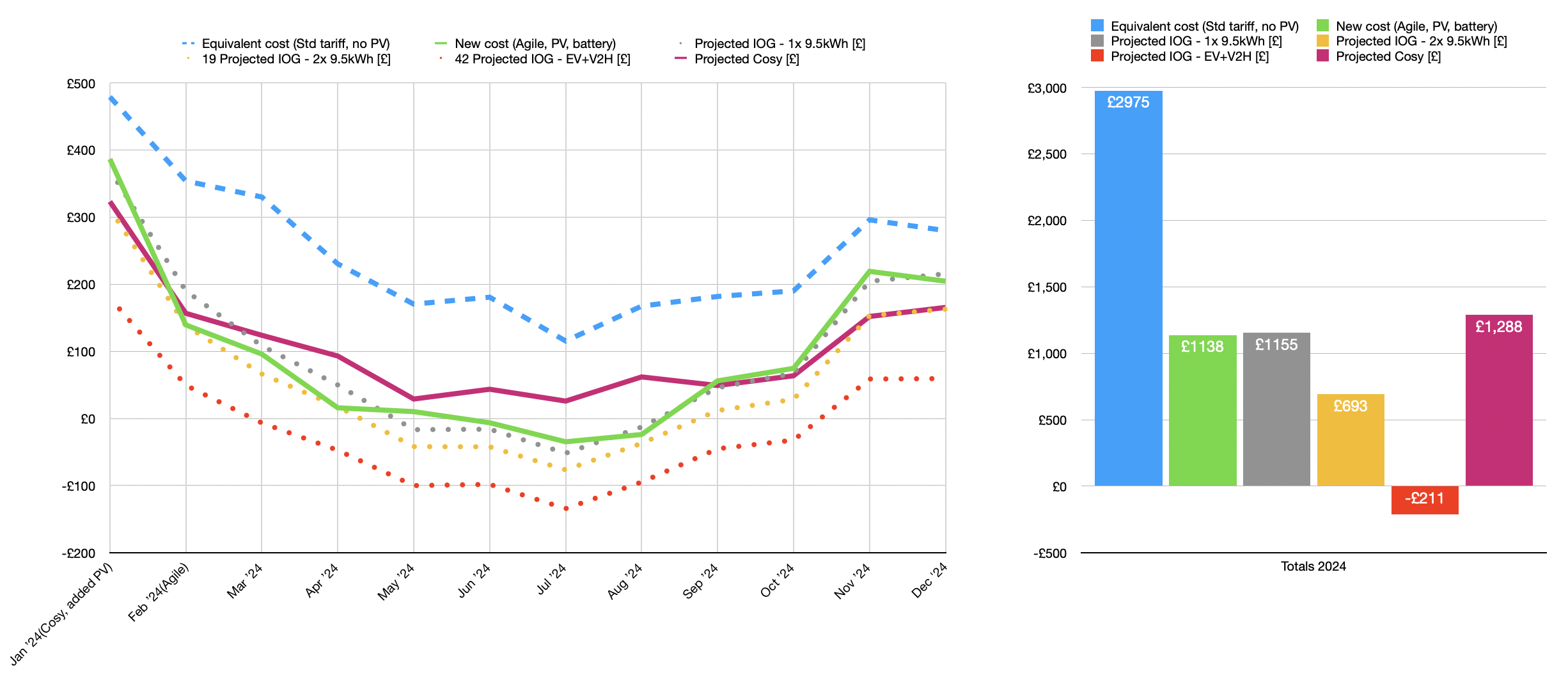
This prompted me finish off/add to the modelling exercise I started:

  • Uses data for an almost full year mid-January to end of 2024;
  • All of these include a 15% price uplift where appropriate for electricity going through the battery to account for round trip losses;
  • Calculated for every day; presented as monthly totals here for ease of reading;
  • Obviously all based on current prices and usage.

Here's roughly what it all means:

  1. [Blue dashed] Baseline - what I would have spent had I still been on my old setup (standard Flexible tariff, nothing smart/renewable) - really just included here for that smugness bonus;
  2. [Green solid] This year's actual data - Cosy for Jan; Agile since then;
  3. [Grey dotted] My projection of IOG (if I had an EV, which I don't yet) using my existing 9.5kWh battery. Assumes a strategy of filling up in the cheap slots every night. More or less level-pegs with Agile;
  4. [Yellow dotted] Projected IOG with additional 9.5kWh battery (19kWh total).
  5. [Red dotted] Projected IOG with EV with V2H capability. Assumes cheap slots only with 7kW bidirectional charger, so effectively a 42kWh useable capacity. (I guess I should also add my existing 9.5 back in...);
  6. [Purple solid] My projection on Cosy. Assumes a strategy of fully charging at full rate in all 3 cheap slots (I can hear it complaining already!) where necessary, with all additional spend at the base rate.

So, I think this more or less confirms where I had got to in my thinking:

  1. On the whole across the year, Agile has worked really well for me on my existing setup;
  2. That said, this confirms my suspicions (and many peoples' observations) that Agile prices in Nov/Dec(/Jan'25) have been poor. I'd have done better to switch to Cosy over the winter. Remains to be seen whether they will come back down again in the spring;
  3. Switching to IOG on my existing setup would be pretty close again;
  4. Adding another 9.5kWh battery and switching to IOG would give a decent £450 annual saving, but still something like a 8.5-9 year payback period - don't think that's quite there for me on its own;
  5. IOG combined with a V2H-capable EV and charger is clearly where we need to get to, but we're just not there yet. Maybe in a few years;
  6. The missing piece here is to try to model the effect of my extra battery with Agile pricing, but that's a massive step up in complexity, and I'd be surprised if it was as effective as switching to another tariff, as we'd be into diminishing returns in terms of how cheap the next cheapest 6 slots are on a given day...

So, that all leaves me swithering - not over the battery purchase (probably not) - but over whether to switch to Cosy or hang on for a bit longer on Agile. Will see how the last few days of January pan out, at the very least...

#48 hoggy

Ouch - 4k for a Gen 3 9.5 installed. Walled garden ecosystem tax unfortunately.

G
#49 geoffreycoan

Josephiah Nice analysis

Like you I suspect that adding a second battery to a single inverter won't give as much benefit on Agile as it would on a known-pattern tariff like Cosy or IOG as you get into diminishing benefits the more slots you are charging over.
Adding a second inverter with the battery would remove that restriction and give you better peak output than you get from your single inverter. Even with our two inverters when we've got the heat pump on and the cooker or kettle we end up grid importing a bit.

And adding an extra battery to Cosy is of limited benefit with a single inverter because of the inverter charge rate; you just can't charge the batteries up enough.

Another option you could model which does have a different payback scenario with a second battery is Flux or IOF. The more battery storage you have the more you can export in the peak rate and gain the peak rate export premium. When I have modelled an extra battery I have looked at that as well.
Trouble is Flux isn't as good as it was 15 months ago. For my region the day-rate export is 13.8p so all the excess solar when the batteries are full is paying less than the 15p fixed export you get with Agile, IOG or Cosy, and the overnight import rate on Flux isn't good either.

I've run the numbers myself and concluded that its only on the days that Agile is expensive is Cosy is cheaper for me, and for other 'normal' Agile rates, Agile is on a par or beats Cosy.

V2H is ultimately the solution we need to get to.

J
#50 Josephiah

geoffreycoan I've run the numbers myself and concluded that its only on the days that Agile is expensive is Cosy is cheaper for me, and for other 'normal' Agile rates, Agile is on a par or beats Cosy.

Yeah, I think that fits with my observations - it's just that we've had a few too many of those days over the last 3 months!

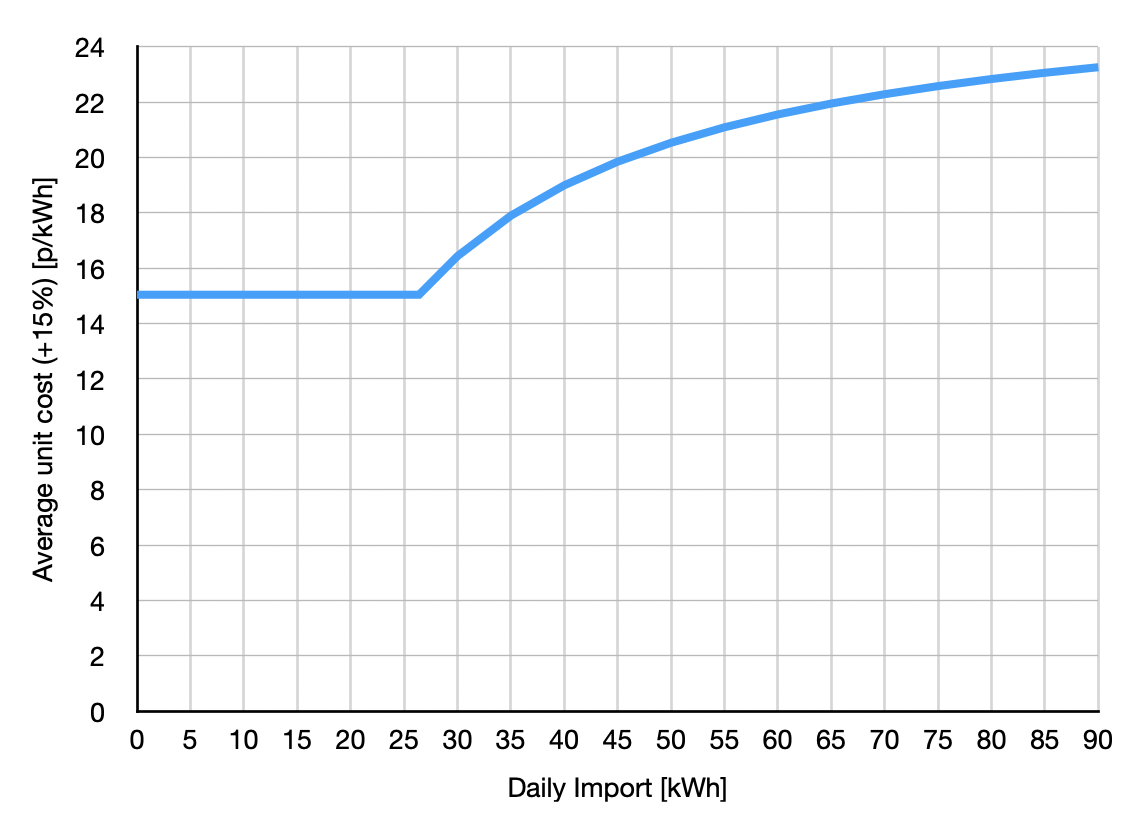
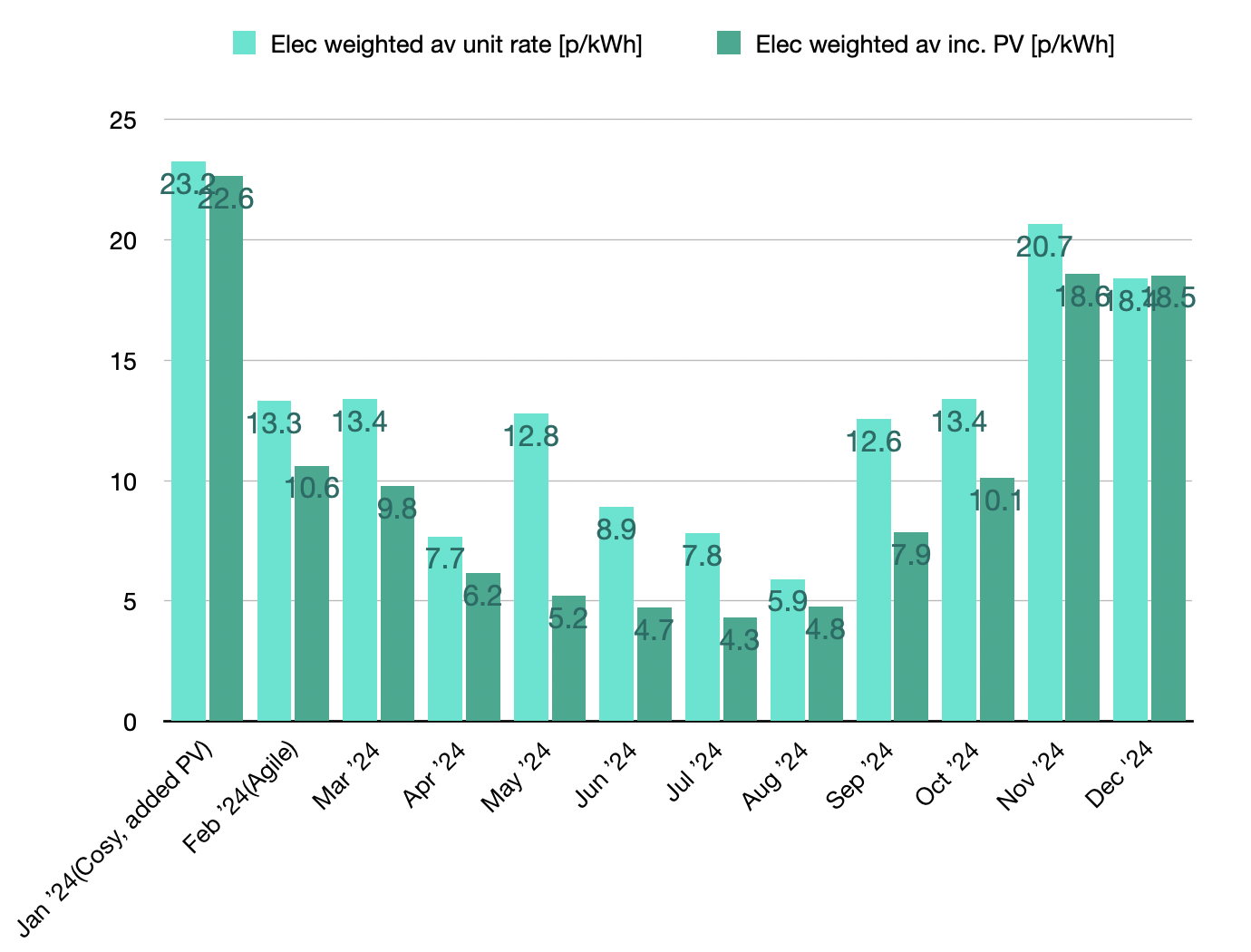
In the course of this I did come across this curious relationship, which is the average unit cost you need to be under for a given day's energy usage for Agile to be better than Cosy (in my setup with 1x 9.5kWh battery):

This seems to fit the average unit cost rates I'd worked out previously for each month:

R
#51 Rbor

geoffreycoan Adding a second inverter with the battery would remove that restriction and give you better peak output than you get from your single inverter.

This is my quandary also. There is an inbuilt road block using a single AC3.0 daisy chained to two 8.2 kWh batteries that a 2nd AC3.0 would unblock, with double the throughput.
I worry about cross charging though.
Should I then plan to get an EMS if it ever materialises?
And could I then be able to set up an island mode for possible power cuts (rare here)?

Rob

J
#52 Josephiah

Meant to add, there are also a couple of 'softer' benefits to the 2nd battery, which are harder to quantify:

  1. Lower charge rates on the battery(/ies). The converse of this is also a slight negative when thinking about switching to Cosy: 3 full pelt charging runs every day is a lot more exercise than its current regime.
  2. We currently set back the heat pump a degree over the Agile peak to help tide us over, which is definitely noticeable by 7pm on a cold day - a second battery would remove the need to do this. Then again, the minor, temporary discomfort is only really an issue in a few days per year.
R
#53 Rbor

Josephiah November 2023 to mid January 2024, I was on 2 slot Cosy with Heat pump. I couldn't make it through the day without having to top up batteries from Cosy 'normal' rates.
In mid January, I changed to Agile and saved a lot over 2 slot Cosy. The 3rd slot for Cosy looks to be a game changer, bringing it more on par, or better than Agile, depending on Agile rates.

The crunch with Cosy is whether you are able to make it through the day on the 3 slot cheaper rates.

Rob

J
#54 Josephiah

Rbor yes, agreed, I was on 2 slot Cosy across a very similar timeframe last winter, then actually did my research/comparisons and jumped to Agile at the start of Feb. 3rd slot would help a lot, albeit another battery cycle per day.

J
#55 Josephiah

geoffreycoan Flux always looked good to me in theory, but I could never get the maths to work out favourably. I don't know if that's universal, or whether there are certain combinations of kit (loads of excess solar/no HP, perhaps?) where it would really fly...?

R
#56 Rbor

Josephiah I was on flux in summer 2023 when the prices were sky high. Flux certainly flew for me. Looking back at my old energy accounts, In June 2023, I made £234 on exports. 'Normal' export rate was 21.36p with 4-7pm at 34.31p.
'Normal import' rate was 18p

I don’t think we’ll see those days again.

Rob

G
#57 geoffreycoan

Josephiah Hmm, interesting .. it looks deceptively simple but the mathematician in me feels like it must be more complicated than that. Predbat for me will charge the batteries overnight at the cheapest rate it can, then hold them during the day when the rates are higher (so grid importing), then release them in the evening peak to ride out the Agile peak prices (with a few bits of inevitable import when the heat pump, cooker and kettle combined exceed the inverter output).

So not convinced that a simple average daily rate works. But having spent the evening grappling spreadsheets, SQL queries and Jinja templates all in the name of automating the restoration of missing Energy dashboard data in Home Assistant, my brain is fried and I can't think about it properly. Wet tea towel jobbie

Rbor a 2nd AC3.0 would unblock, with double the throughput.
I worry about cross charging though.

I don't find the cross charging on my Gen 1 hybrid's is too bad. It mainly occurs at night time when the inverters are in Eco mode and there's no solar generation. One inverter starts discharging to meet house load, the other sees it as excess export and starts charging, etc. It doesn't happen all the time and with the Gen 1's it doesn't ramp up aggressively. I suspect this is due to the relative slowness of my older inverters and your AC3 would act the same.
When Predbat is controlling the inverters to charge, discharge, Eco during the day when there's solar, its OK.

Given the choice I would get the EMS though if I was getting a second inverter.

Josephiah We currently set back the heat pump a degree over the Agile peak to help tide us over, which is definitely noticeable by 7pm on a cold day

When the agile rates are really high I set my heat pump back the maximum I can, 5 degrees, but trying to work out the actual correlation on flow temperature and consumption is not clear. It also doesn't seem to change quickly either, if I change the weather charge curve then I would expect the target rate temperature to change, but it often doesn't.
Just another part of the weirdness of LG heat pumps. So I don't bother with a peak setback.

What I have done though is to turn one of my two heat pumps off on the 21st. That has made a huge difference to the power consumption particularly at startup. It now much better fits within the capacity of my inverters. Will doubtless need to turn the second one on when it gets really cold but for now am trying it with just one running

Rbor The 3rd slot for Cosy looks to be a game changer, bringing it more on par, or better than Agile, depending on Agile rates.
The crunch with Cosy is whether you are able to make it through the day on the 3 slot cheaper rates.

I'm not convinced by the 3 slot Cosy (04:00 - 07:00, 13:00 - 16:00 and 22:00 - 00:00). Its better than it was but I don't think the 22:00-00:00 slot is much use as we wouldn't be running the heat pump after about 23:15 and there isn't enough load between 00:00 and 04:00 to drain the batteries. I see it more as a 2 and a bit slot Cosy.
In my case we can drain the batteries in the 16:00 to 19:00 peak so my calculations assumed that I would have to pay the Cosy day import rate from 19:00 to 22:00. The morning would probably be OK as we generally don't start the heat pump up until about 10:00, so breakfast and the morning heat pump would be on stored battery charge.

Josephiah Flux always looked good to me in theory, but I could never get the maths to work out favourably.

I started on Flux when I first got the export tariff and the day rate export was (I think) 18p and the peak even higher. Progressively though Flux has got worse, the day rate export for me is 13.5p so worse than I get with Fixed Outgoing, and the night import rate means its not worth charging the batteries overnight.
The only upside is the peak rate export but you don't want to export so much that you have to grid import at all until the start of the next solar day - this limits the amount I could export in the peak to a few kWh. If I had loads of battery storage and a lower daily consumption then maybe the maths would add up

R
#58 RBisset

My experience with a second battery has been very disappointing. The batteries refuse to charge at 3kw/hr on the overnight low rate. Last night when the batteries were 8-11c the best rate of charge I achieved was 450watts/hr meaning I am unable to top up the batteries to even 30% after 5hrs. Something changed with the firmware/software and the rate of charge is killing the economics of a 2nd battery.

G
#59 geoffreycoan

RBisset 450w is far worse than normal temperature limited charging. I think I saw someone else who reported similar and givenergy support fixed something that improved the charge rate.

I'd contact givenergy support if it's as low as that

R
#60 Rbor

geoffreycoan Given the choice I would get the EMS though if I was getting a second inverter.

Would predbat work with an EMS or would it need tweaking by Trefor?

Rob

G
#61 geoffreycoan

Rbor Would predbat work with an EMS or would it need tweaking by Trefor?

Predbat can control the EMS via the GE Cloud integration. It's down as one of the supported inverter types in the voluminous documentation!

#62 nophead

geoffreycoan Yes below 20C is should be C/3 and above C/2, so for my 5.2kWh battery it is 1.7kW or 2.6kW. Fortunately C/3 is still enough to charge it in 3 hours because only 4.2kWh is useable.

G
#63 geoffreycoan

nophead Yes below 20C is should be C/3 and above C/2, so for my 5.2kWh battery it is 1.7kW or 2.6kW. Fortunately C/3 is still enough to charge it in 3 hours because only 4.2kWh is useable.

Yes that’s exactly what I get with BMS 3015 on my 5.2 on a Gen 1 hybrid (max 2.6kW charge rate). My 9.5 still charges at the full rate because C/2 is still above the inverter max output.
The temperature thottling affects those with smaller batteries much worse

V
#64 Vestas

geoffreycoan BMS 3015 doesn't have temperature charge throttling so I'm not sure what you're getting at?

G
#65 geoffreycoan

Vestas BMS 3015 doesn't have temperature charge throttling so I'm not sure what you're getting at?

That was my belief as well, that the temperature throttling was introduced in BMS3017 and this was the principle reason why I have not upgraded my BMS above 3015.
But after looking at my battery behaviour I am definitely seeing throttling on my 5.2 on BMS3015

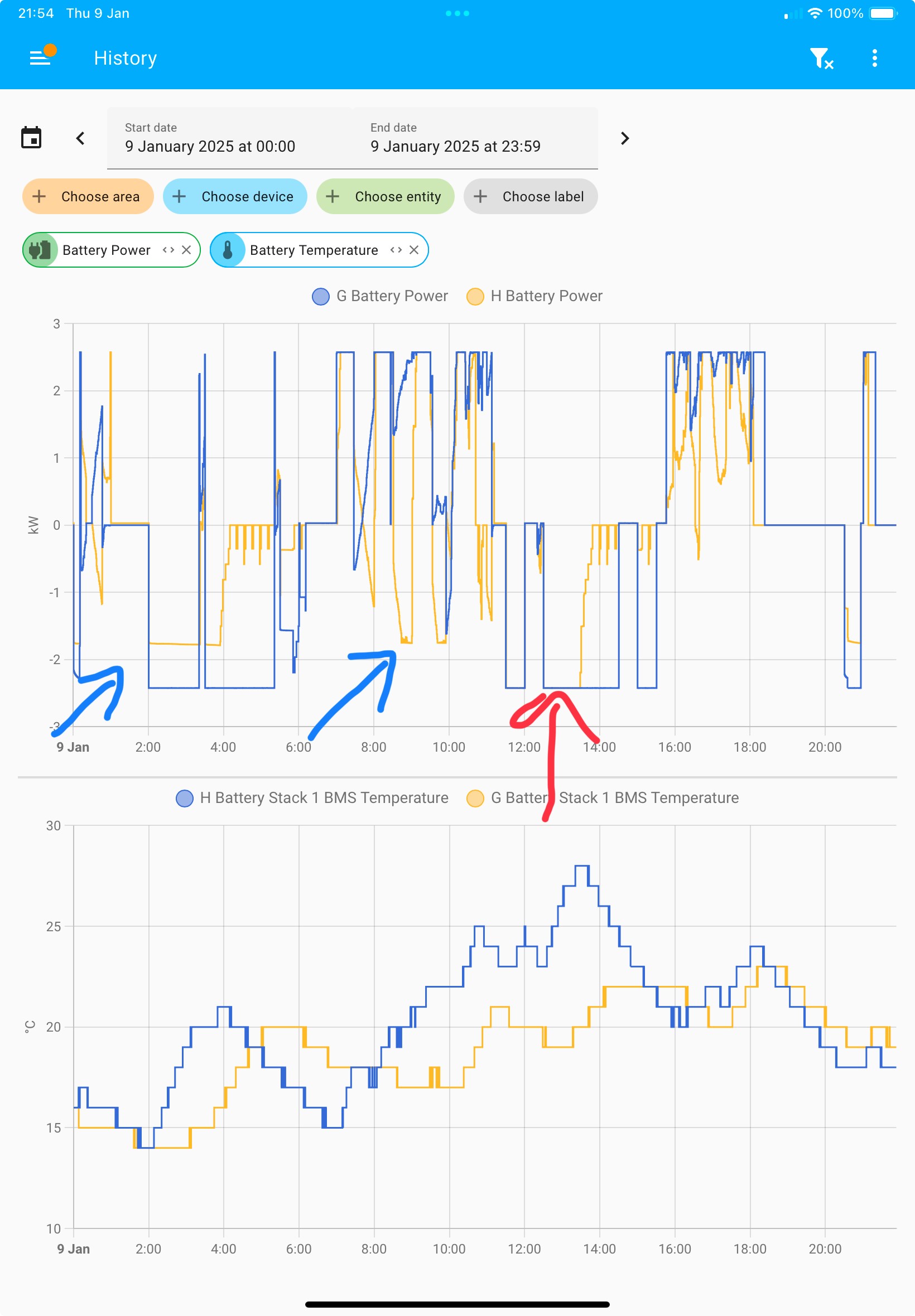
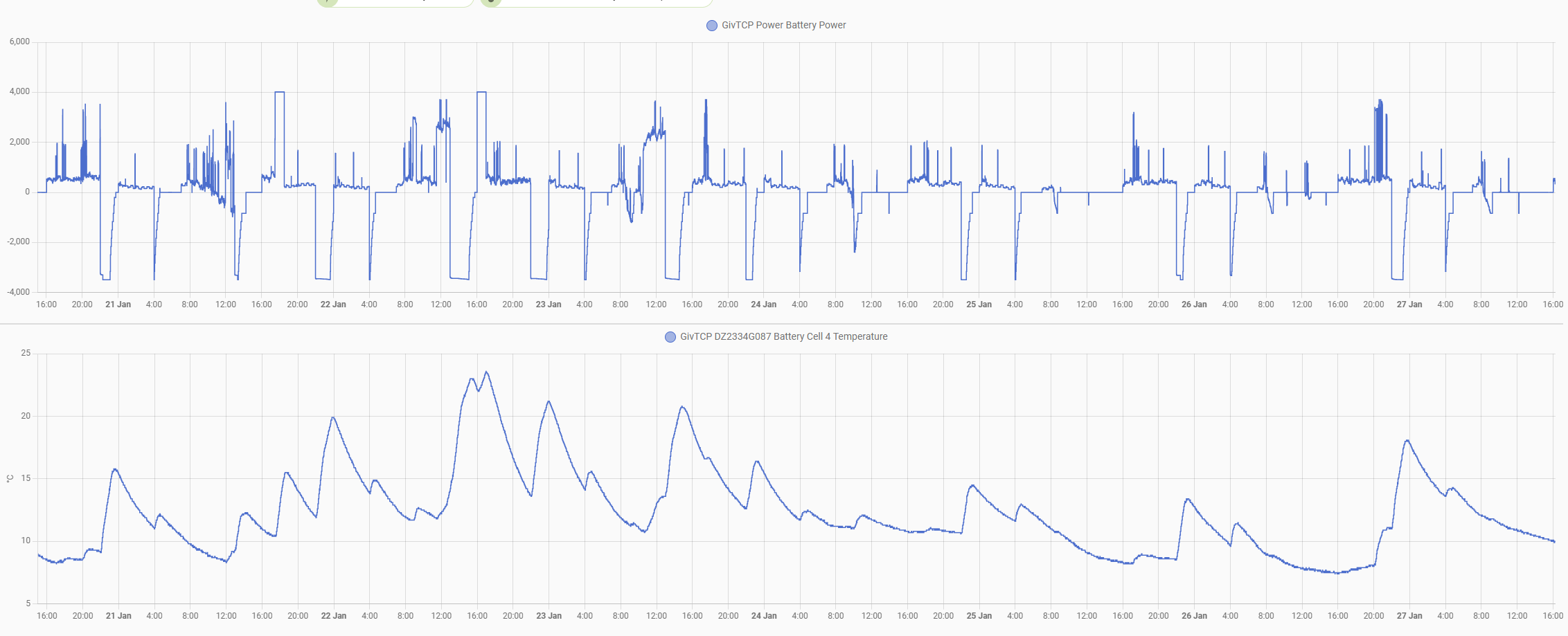
The top graph shows charging on my two inverter/batteries, blue is the 9.5, orange is the 5.2.
Bottom graph shows the cell temperatures, annoyingly the opposite way round, orange is 9.5, blue is 5.2

When the 5.2 battery is below 20 degrees I see throttling of that battery, but not the 9.5, the blue arrows

And when the 5.2 battery rises above 20 degrees the red arrows the 5.2 charges at the same 2.4kWh rate as the 9.5

V
#66 Vestas

geoffreycoan Your 5.2 is below 20C where the red arrow is and still charges at full rate?

You mentioned in another thread a cell divergence of 100mV. That would definitely rate limit charging. Sure its not that?

G
#67 geoffreycoan

Vestas Your 5.2 is below 20C where the red arrow is and still charges at full rate?

You mentioned in another thread a cell divergence of 100mV. That would definitely rate limit charging. Sure its not that?

The red arrow, the 5.2 is around 20-25 degrees - its the blue line in the lower temperature chart.

The cell divergence problem (when on low SoC) is on my 9.5 not my 5.2. The 5.2 cells track pretty close together.

I don’t understand the behaviour on my 5.2 either, there is definitely some temperature related throttling going on, I only get 1.7kWh when its cold, and 2.4 (same as the 9.5) when its warmer. Whether this is a feature of the 191/193 fast response firmware so its the inverter limiting it, I don’t know, but I have observed it lots of times.
Precisely what temperature is being measured to apply the throttling I also don’t know because the different behaviour is “around” 20 degrees, its not an obvious hard line.

V
#68 Vestas

geoffreycoan What do the battery pack temperatures look like? ie the cell 1-4 temperature sensors. Cell 4 will likely be the coldest.

I wonder if this is because of 191/193 - the old production firmware never had the 10 step charge throttling from 90-100% so maybe temperature throttling came in then as well.

You didn't have this problem last winter I assume?

V
#69 Vestas

geoffreycoan The cell divergence problem (when on low SoC) is on my 9.5

Do you mean flat - below 49.5V? If so then that's normal. Do they pull back more into line when you start charging?

G
#70 geoffreycoan

Vestas Do you mean flat - below 49.5V? If so then that's normal. Do they pull back more into line when you start charging?

The divergence is most pronounced on the 9.5 is when the battery is empty and then as the battery charges up the cells come into very close alignment

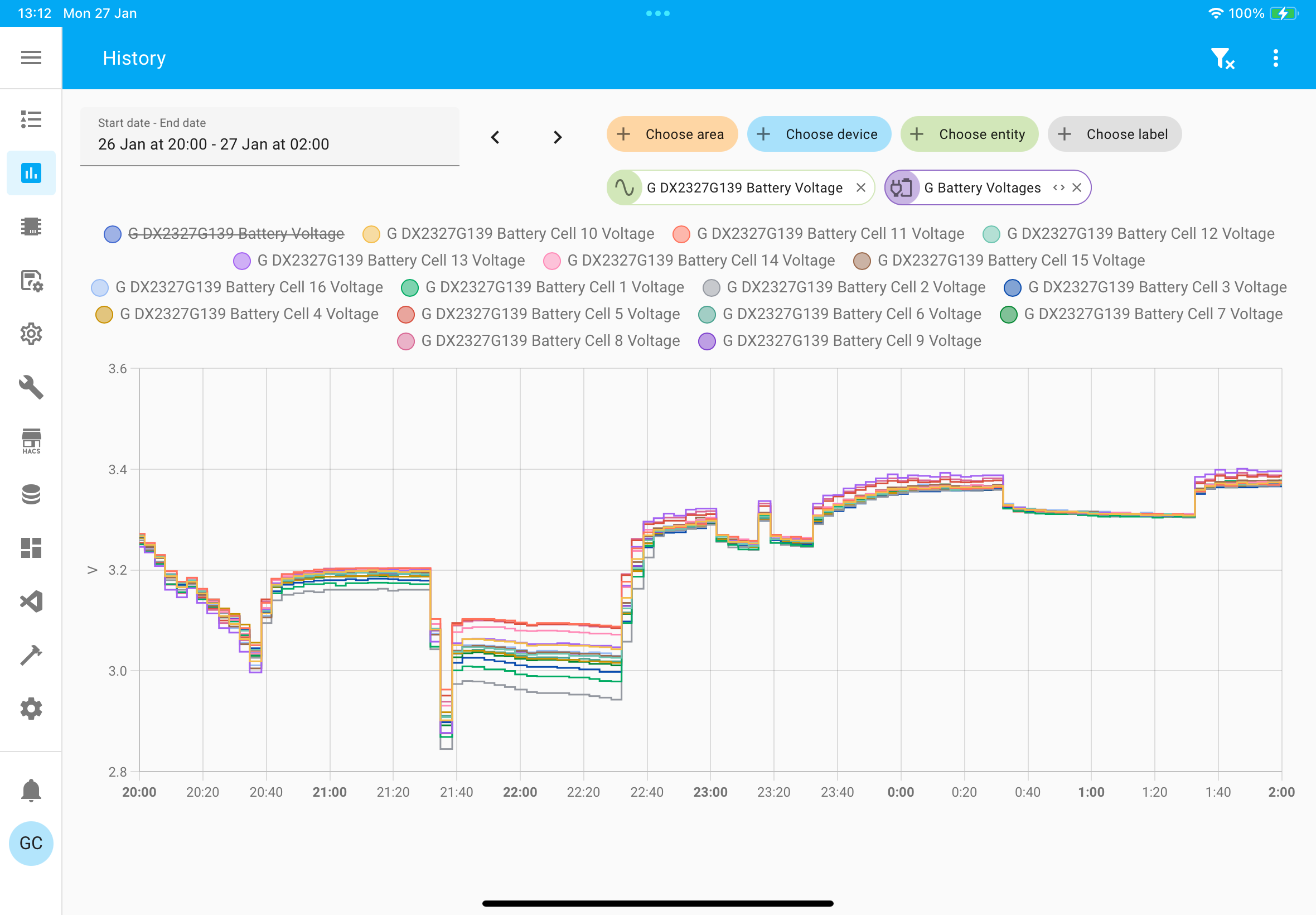
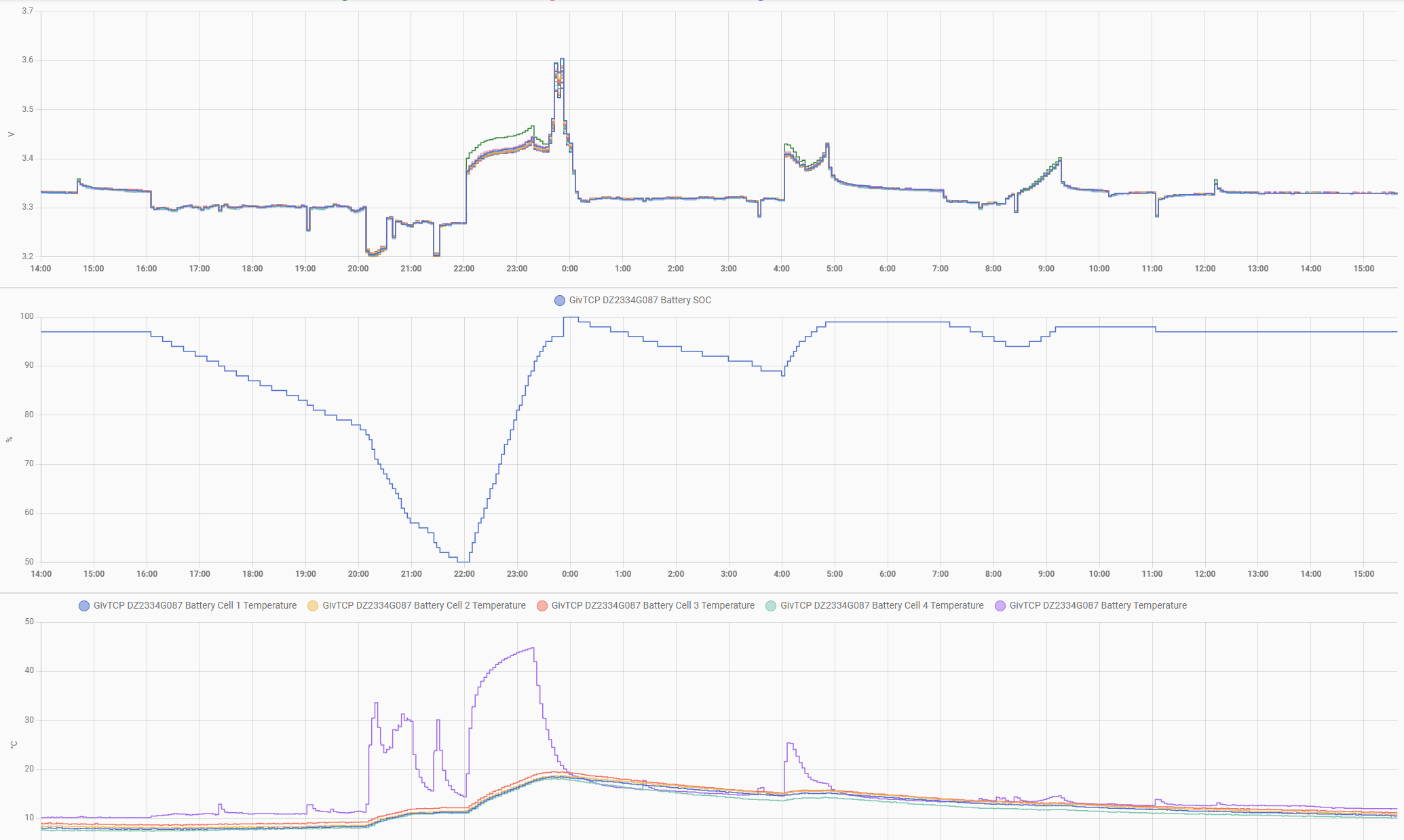
e.g. last night, cell divergence looks to be about 0.1V just before 21:40:

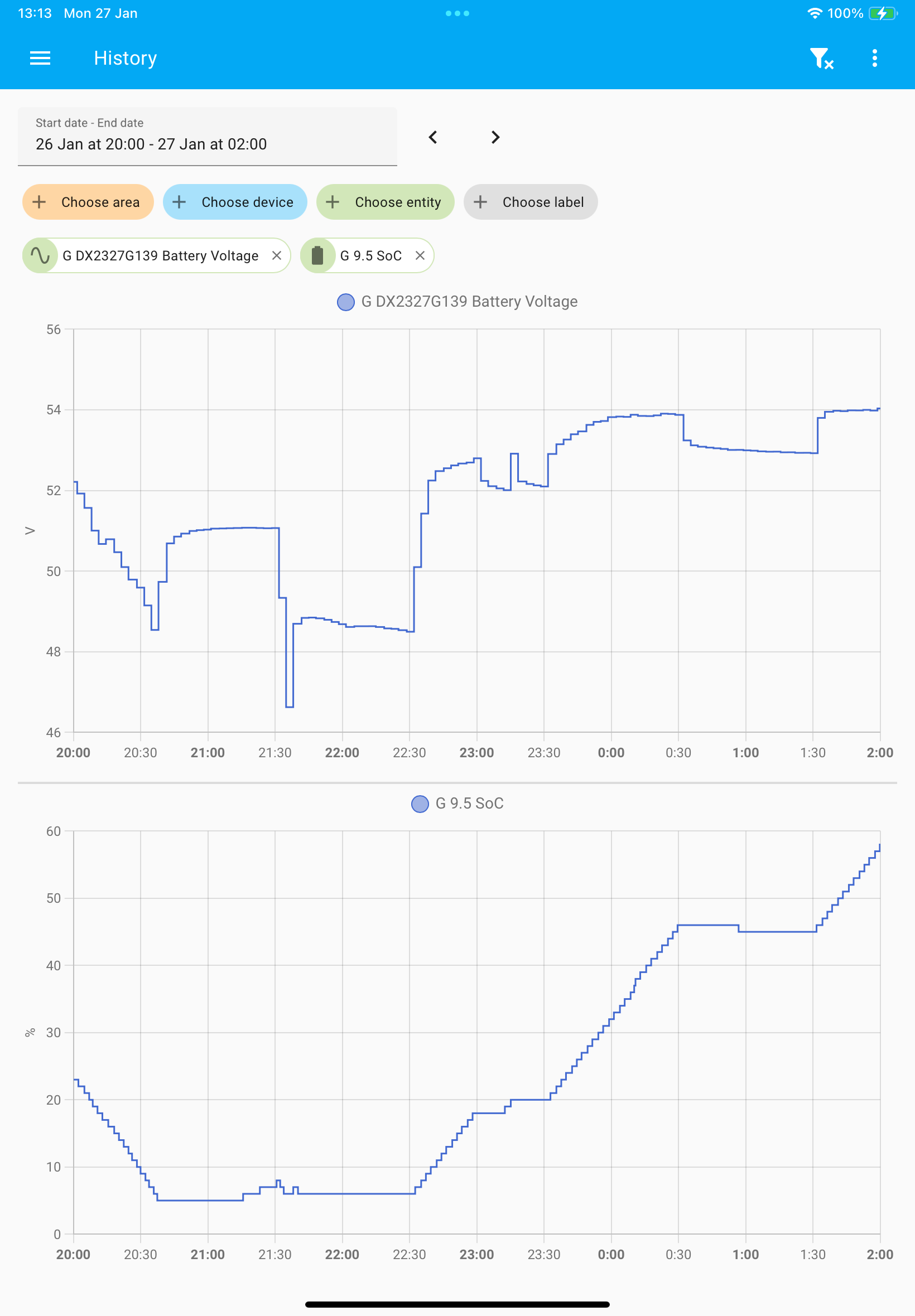
The SoC (bottom graph) shows the battery is empty between 20:35 and 22:30, firstly at 5% SoC and then it creeps up to 6% SoC (it rarely stops at 4% nowadays).

But the top graph, overall battery voltage show a huge variation over that time period, from 48.5V to 51V then dropping down to 47V and then climbing to 48.5V - all when the battery is idle in Eco mode.

With that kind of behaviour I am amazed that the BMS manages to track the SoC at all!

It was suggested a while ago that the size of the cell divergence on the 9.5 was a problem and that I ought to try a slow recalibration to improve it. Just really waiting for some good agile rates to do that. The battery hasn’t been calibrated since initial install 10 months ago; and I hope that the recalibration improves the lower end SoC stop as well.

Vestas I wonder if this is because of 191/193 - the old production firmware never had the 10 step charge throttling from 90-100% so maybe temperature throttling came in then as well.

I too wonder if this is 191/193. I definitely see the 10 step charge throttling occurring on my batteries as well.

Don’t recall this happening on the production firmware last winter. Not sure what BMS I was on then, maybe 3012, can’t remember for sure

V
#71 Vestas

geoffreycoan Doesn't look that bad. I'm assuming its cells 5, 8 and 13 - can't really tell with the colours?

G
#72 geoffreycoan

Vestas At that 21:40 dip the lowest cells in order are cell 2 on 2.85V, 1 on 2,87V, then 13/15 and 16 all on 2.88V. The highest cell is cell 11 on 2.96V - so 110mV difference between highest and lowest cell voltages which I think you said before wasn’t good

V
#73 Vestas

geoffreycoan I think the last time you had that sort of variance under load/charge though? If so it seems to have improved somewhat. I was referring to the 3 cells which are outliers when you're charging, normally 5, 8 & 13.

R
#74 Rbor

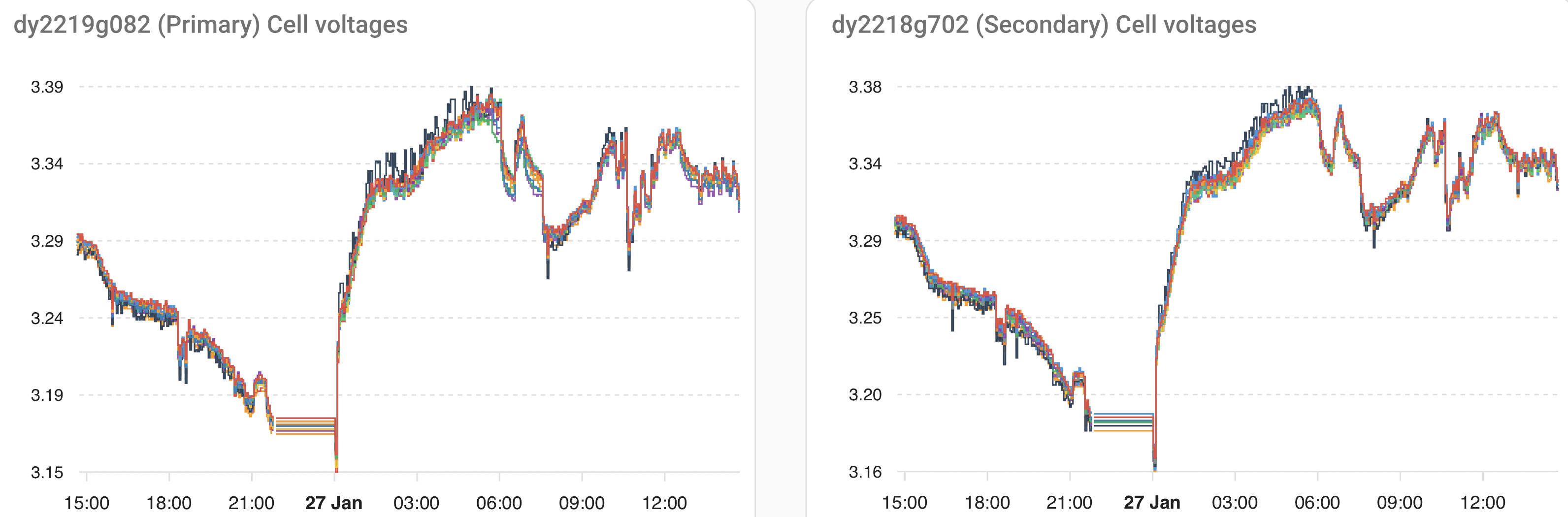
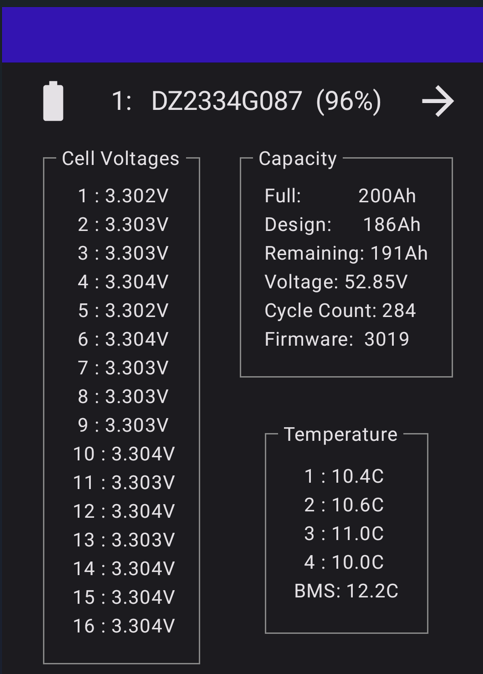
geoffreycoan For comparison, these were my two 8.2 kWh batteries last night, daisy chained to my AC3.0 inverter. SOC about 15% but this corresponds with the time that my dongle lost connectivity. You can see the SOC dropping sharply to about 7% when I finally get the dongle to respond again.

Although atypical, it does give a clear view of my variation in cell voltages. By eyeballing, the variation is about 0.009V, about 1/10th your variation.

My AC3.0 inverter is on firmware: D0.205-A0.205
Batteries on Firmware: 3017
Inverter is using givTCP 3.0.4 and is later than week 10 2022, allowing firmware updates to be installed.

Rob

W
#75 wrighar

geoffreycoan
I'm on BMS3019 now, and have seen a massive improvement in battery cell voltage matching, only 0.02V variance what charging, and mostly single cell.
Also the <20C charge limit has been fixed.

G
#76 geoffreycoan

wrighar that’s good to hear, when you say <20C charge limit has been ‘fixed’ what do you mean?

I had heard that there was still a charge limit applied but it was now “more intelligent” in its application??

Personally as I said I didn’t want to go to 3017 because of the battery charge throttling (even though I seem to have it already) and was waiting until a later better version. 3019 sounds like it could be it !

R
#77 Rogerbu

I can't see this thought above - re the financial bedate about a second battery.

If a battery is worked hard using the full charging/discharging rate of the inverter, then this will probably bring forward the end of life of the battery.

However, with two batteries on the same inverter, the charging / dischaging rate experienced by each battery will be (roughly) halved, so two batteries are not being worked as hard and should last longer than one.

W
#78 wrighar

Under 20c was being limited to 0.25C (2.7kWh), now corrected to 0.333C (3.6kWh), which is pretty much the inverter limit anyway.

Even below 10c I was seeing 3.6kWh charge rate, not sure how far down though as I only got down to 6c

Battery cell voltages under no load and discharge are within 1-2mV !!

V
#79 Vestas

Frankly I don't think there are any sensible economic arguments for a second GE battery. Edit - maybe if you have a 2.6kWh on a single inverter it'd make sense to double up? 5.2kWh double up to 10.4kWh is probably OK too, anything above that....

It either involves two inverters (to keep a reasonable charge/discharge rate) or two AIOs.

Neither of those options is (IMHO) sensible in terms of "upgrade" costs.

Unless you already own (not PCP rent) an EV then its probably best to await V2H (vehicle to home) developments unless of course your batteries are indoors...

New building regs are going to make second batteries impossible for a lot of people given the location of the first battery. Building regs are retrospective so the existing installation is legal, additions to it would not be so that may be a factor.

Personally I think 10-15 years from now people will view "home batteries" much like they view MP3 players now - oh you've still got one of those have you? 😉

W
#80 wrighar

Vestas
I'm in a similar point, I have 9.5, and use about 11.5 a day, the extra 2 coming from solar, or cheap rate slots.

A 2nd battery while being nice, is hard to justify. It would allow an extra hour of full rate IOF discharge in the summer, or about £1.00

The first battery was a no brainer.