Best Winter Configuration (Solar Panels, Storage Battery, heat pump)

27 comments started 2024-12-18 last 2025-02-02
Home Automation
B
#1 Benwalby

Hi All,
I'm new to this, I'm looking for advice on the most economical way to set up my system for UK winters. As the solar panels aren't generating too much power, I've opted to just use the power being generated through the day. The storage battery is set to charge during off peak hours to then discharge during peak time to save money. Is it possible to set up the air source heat pump to heat water during off peak time only?

Many thanks

D
#2 DD

Benwalby Is it possible to set up the air source heat pump to heat water during off peak time only?

Yes, it should be. But how to do will depend very much on the HP model. Also bear in mind that the air is (typically) coldest at night, so it does require more energy then.

How confident are you with technology? Home Assistant is popular here, but requires a certain level of confidence to set it all up.

S
#3 SimonClarke

Heat pump should be on and stay on for heating. Mine heats dhw between 2400 and 0500 as I’m on IOG but that needs an EV. Charging the battery between 2330 and 0530 to 100%. This runs out between 3pm and 7pm depending on weather, cooking etc. Only been on the heat pump since August but impressed with the efficiency so far. Cop averaging 4.3. Last months electric bill averaged 9.3p/kw ex standing charge with very little sun.

G
#4 geoffreycoan

Benwalby Is it possible to set up the air source heat pump to heat water during off peak time only?

Does depend slightly on what you mean by ‘heat water during off peak time’

If you are talking about heating your home hot water cylinder then yes, most systems should allow you to do this. Depends on how much hot water you use as a family and whether this means you will run out in the evening with lots of baths etc, but its what I do, I heat the hot water tank just once a day at around 3am to 5am, and then use that through the day.
The efficiency of the heat pump won’t be as good overnight as if you heated the hot water in the middle of the day, but I figure that the lower import rates (I’m on Agile) will make up for this.

In terms of heating the hot water in your radiators then no, the house will get cold if you only heat it overnight, but moreover the heat pump works most efficiently if you leave it on a low temperature setting all the time. By all means turn the temperature down at night, but low and slow is the most efficient way to run a heat pump.
Look at the heat geek website and videos for advice on this.

My heat pump heats the hot water overnight then steps up the home temperature from 10am to lunchtime and keeps the temperature at that level through to about 11:30pm when it steps down a couple of degrees.
The battery charges overnight on cheap rate, holds the charge during the day as any solar goes to help run the heat pump (as well as day-time grid import), and then the battery is used for the evening peak period so I don’t pay peak rate prices.

But different tariffs you’ll have slightly different battery patterns.

One thing to do is to ensure weather compensation is turned on the heat pump to ensure it only heats the water in the radiators enough to replace lost heat. So on cold days the temperature is higher than on mild days

G
#5 Gruff

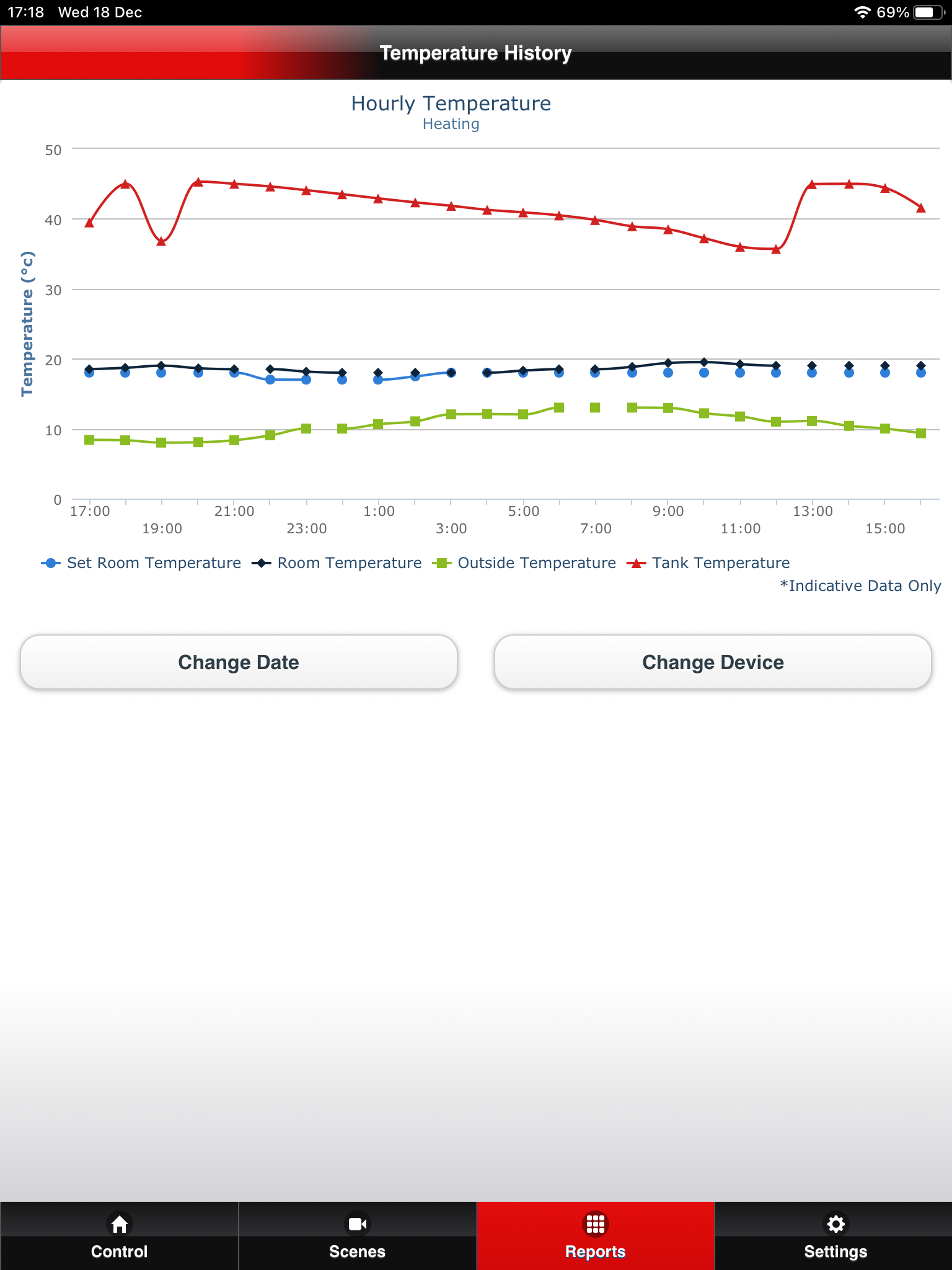
Just to follow on with Geoffreycoan’s comments, our heatpump is on 24/7, thermostat is set to 18C with a fall back of 17C from 2130 to 0230. Weather compensation is set on (38C @-4C, this is unique to our set up)

We have a 170l tank that’s set to heat to 45C for a 10C fall, it’s set to Auto.

We have EV, solar & battery and use Octopus IOG. Charge battery every night

It pretty much runs itself, but I do occasionally boost the DHW when the car is scheduled to charge outside of the normal off peak time (yesterday being an example)

I’ve included a screenshot of yesterdays usage, it may shed some more light rather than my clumsy explanation (You can see at 1900 where I manually boosted DHW)

R
#6 Rbor

Gruff I have a very similar configuration to yours. I have emboldened differences in the settings.

Heatpump is on 24/7, thermostat is set to 20C with a fall back of 17C from 2100 to 0600. Weather compensation is set on 40C @-3C.
It current temperatures, the flow temp is typically 30-32C
I have a 200l tank that’s set to heat to 43C for a 5C fall.

I have a low mileage EV, solar & battery and use Agile import with Fixed outgoing.
When my ASHP had been installed, I got gas removed (saving >£100 in SC) so all my energy costs come from electricity.

I run Predbat which controls all my charging and discharging.

I have run this setup since mid January. My average import rate is 10.72p/unit and my current energy cost since 1st Jan is –£212.

I think the best summer tariff could be one of the Flux tariffs but Agile has treated me very well.
There has been a lot of debate about using Cosy during winter but I have stuck with Agile. It has its ups and downs but, when the wind blows and rates drop, it saves me a lot of £££

Rob

G
#7 Gruff

Rbor Not too different, we’ve been gas free since Aug 2023. This months bill comes in at £148, which, for all our energy is amazing. I’d never get away with DHW set at 43C, 45C is the minimum a certain significant other would countenance 😂

We’re at 10.19p/unit. I’m travelling 1000miles/month at the moment, so IOG seems to be a good fit for us

B
#8 bRhFDKtjRMK9

SimonClarke I’m on IOG but that needs an EV.

Does Octopus verify that you own an EV car?
I am on Tomato Energy and they don't require an EV car to give me 4.7p for six hours at night. But they don't accept any exporting, so there's that.

D
#9 DD

bRhFDKtjRMK9 IOG needs to be able to control car or chargepoint. I guess you could get through the qualification by just getting a compatible chargepoint, without an EV, but T&C (presumably) specify an EV
EON is another option with prices similar to IOG, does do export, and no need for an EV.
I think tomato have said they will do export. But not all companies allow export from batteries.

G
#10 Gruff

DD To activate the IOG an EV is needed so that it check that EV can be charged. After that, fill your boots however T&Cs state that EV must be smart charged once a month or you’ll be taken off tariff.

For export T&Cs also state “We are not obligated to make Export Tariff payments to you:
(i) for any ‘Brown Export’ – i.e. exported electricity not generated by an eligible generation asset, including standby generators, batteries and technologies not supported by the Smart Export Guarantee”

D
#11 DD

Gruff To activate the IOG an EV is needed so that it check that EV can be charged

No... A zappi can be verified without triggering a test charge. Just connecting to it is sufficient.

G
#12 Gruff

DD Not the experience I had with my installation 10 months ago with my Zappi v2

S
#13 SimonClarke

Recently got a Hypervolt 3 which connects with Octopus instead of using my Tesla. Much better but it still did a test charge

A
#14 Ange

I too have Solar PV, 9.5 Battery and ASHP. I am currently on Octopus Cosy. I've been charging the battery up at the three cheap times to run the heat pump. Our is set to 19 degrees during the day. With periods of 20 degrees in the cheaper times, and 16 degrees overnight. I've been really pleased with the constant temperature.

However my average unit price for the last couple of months has been 16p per kWh. Not as good value as others on here. although I've been fairly pleased with this. 75% of my import is at the lower rate (was 11p per unit but is going up)

G
#15 geoffreycoan

Ange However my average unit price for the last couple of months has been 16p per kWh

That seems quite good to me. I’m Agile with an ASHP, and from 1st November to today my average import rate has been 18.2p.

If I were on Cosy I wouldn’t bother adjusting the cutoff temperature between the cheap and day rates, your house thermal mass doesn’t respond that quickly and it will actually use more energy trying to gain that extra 1 degree - there’s a heat geek video on this.

I have mine set to 19 degrees in the day and 17 overnight. The weather compensation curve is such that the hallway where the thermostat is situated never gets to 19 degrees so it’s basically on all the time during the day and off overnight unless it gets cold. I used to have the setback at a lower temperature but increased it as the heat pump uses a lot more energy in the morning trying to recover the temperature back up

A
#16 Ange

geoffreycoan Thanks Geoffrey, really useful advice as always.

S
#17 SimonClarke

Ours is set for 18c 2200 to 0500 and 0900 to 1730 and 19c the rest. Generally the whole house is 21c. At some stage I will try setting it to be 19 all the time but our current cop since August is 4.3 so not really bothered trying too hard.

R
#18 Roy124

I am on Cosy tariff. We have the heating set at 22-23 and HW at 50. We set the dishwasher and washing machine for the 0400-0700 Cosy slot and charge the battery to 100% at 0400-0700, 1300-1600 and 2200-2400. The battery at 0400 is usually around 45% at 0400 and lasts till about 0845. In other words we use around 5kW between 0700 and 0845. Again the battery lasts until about 1730 during the high charge period.

We are getting solar but by 1600 we are on battery whether it was charged by solar or low cost grid. Clearly we needed a battery with 10kw capacity.

Our average demand is around 28kW/day (early days yet for a firm figure) with an average unit cost of 17.5p/kW we are very happy as this is 7p below the standard rate. A very rough gas/ASHP heating with gas consumption at 3.5 times is exactly cost neutral with the gas standing charge as a positive.

I might add, we are using a fan convector heater in our Sun Room as, in accordance with predictions, the heat loss is high. The convector heater also has the advantage of quickly circulating the hot air evenly around the room

K
#19 KamenMacKay

I'm probably getting a Vaillant Aerotherm Plus 5 kw with the integrated hot water cylinder. Has anyone had any success/failure with Predheat if they have monitoring installed to set it up properly? I suppose even without Predheat that Predbat (after a small adjustment period) adapts your plan to minimize your energy costs given the extra draw from the heat pump and cylinder?

G
#20 geoffreycoan

KamenMacKay I personally don’t use predheat to predict my ASHP consumption, I have looked at it but concluded it required quite a bit of configuration and as it was all based on assumed heat loss it would only ever be as good as the input data.

If you look on the predbat discussion topics there is some clever code that predicts heat demand based upon historic consumption and average outside air temperature. This seems quite accurate; I’ve played with it, but not configured it for real with my data.

Because as you say, Predbat predicts your daily home consumption including the heat pump and hot water based on your daily home load, so pretty quickly it understands what that demand looks like. Yes it doesn’t respond to big swings in demand such as a cold snap or an unusually mild day, but I find its good enough

R
#21 Roy124

I posted my winter strategy before Christmas when my ASHP was a bit flaky. Now, a month later, I am happy with my strategy using MyEnergy Optimiser.. there are just the two of and obviously there are many variables but her goes:

Battery: At 2200 we start the first Cosy low rate. I have set the battery charge to run 2230-0000. This charges the battery to about 90% which is sufficient to carry me through to the 0400-0700 but I don't start battery charge until 0500. The charge then is sufficient to last until 0830. The next charge period is 1300-1600 but I don't charge the battery until 1400. This generally gives me battery power until about 1845.

ASHP: 2300-0400 we have the heat setting to 20°C. From 0400-2400 we now leave it at 23°C. Individual room stats are generally 20°C upstairs falling back to 18°C 1000-2000. Downstairs most stats are at 22°C with one at 23°C.

Hot Water: 0530-1000 its is set to ECO 46°C. Still playing with this but this is sufficient to give a reasonably hot shower at 2120-2200.

A larger battery would carry us through the expensive 1600-1900 period. Avoiding cooking demands would help too as would trimming back the room heat.

An associated issue it the occasional Octopus low use offer during the high tariff period. As we are generally on battery when the savings offer kicks in we have no scope for further reducing grid demand.

R
#22 Rbor

Roy124 Thanks. Interesting breakdown of what you have tried.
The crunch with ASHPs is whether you can get enough juice into your battery to get you from one Cosy period to the next. I started last winter with the old 2 slot Cosy. That didn't carry me from 4 pm to 4 am the following day. 3 slot Cosy should help. My old AC3 can only get 2.8 kWh into a battery. 5 kWh inverters would help.

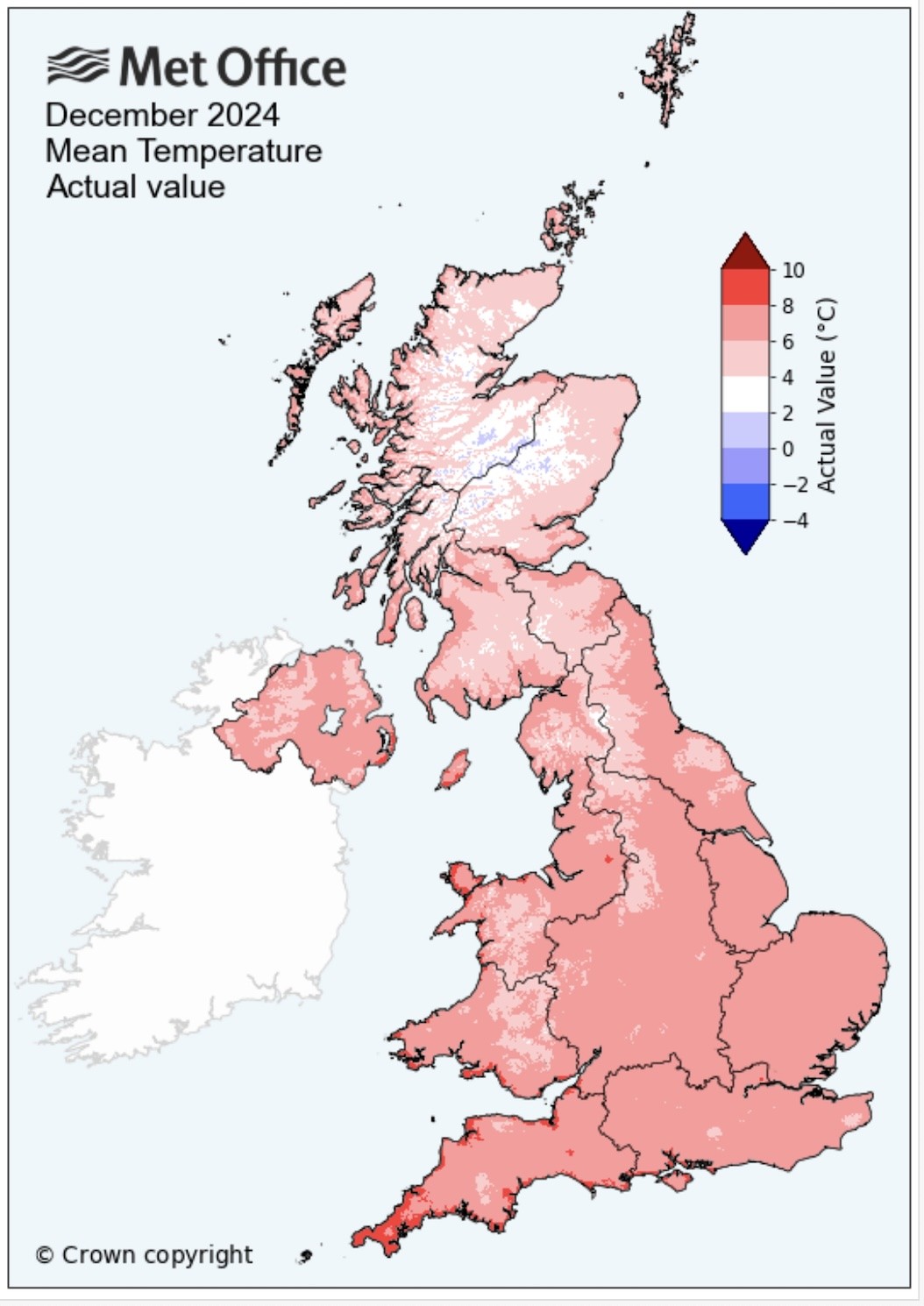
This January has been cold! There's some useful met office info here:
https://www.metoffice.gov.uk/research/climate/maps-and-data/uk-actual-and-anomaly-maps
The January 2025 info isn't here yet but you can see how temperatures have varied for each month back to 2001. You can then compare a month year by year. I have attached the mean temperature map for December 2024 which was surprisingly warmer than I thought across most of the country.The anomaly maps allow you to compare any month against the average.

You can also get info on rainfall, air frost and more ....

Rob

J
#23 Josephiah

KamenMacKay

I had a look at Predheat also, but thought there was sooo much guesswork involved that I was suspicious of its susceptibility to GIGO. After I'd gathered a few months-worth of data on stable settings, I plotted HP consumption against outdoor temperature, and got a pretty consistent relationship, which I then used to make a template sensor to predict HP consumption based on forecast temperature.

This appears to work really quite nicely (though for a long time I had the input to Predbat's load_forecast input not quite set up properly, so I was double counting to some extent; now, I've set up another helper to account for this). I like it a lot better than Predheat as it uses my real measured data instead of modelling based on a lot of assumptions.

If you're interested in this method, you could take a look at the following and see if it makes any sense, and feel free to ask any questions:
https://github.com/springfall2008/batpred/discussions/837
https://github.com/BuhJuhWuh/home-assistant-gubbins

R
#24 Rbor

Josephiah Thanks.
I wil investigate.

I did look at predheat when it first appeared but I have never run it.

Rob

G
#25 geoffreycoan

Josephiah thanks, that was the article I was referring to

Although I’m not using it in anger I think this is a much more preferable way to predict heat pump consumption as its based on your own actual data. Even without your routine I can see a clear correlation between daily average outside air temperature and heat pump consumption
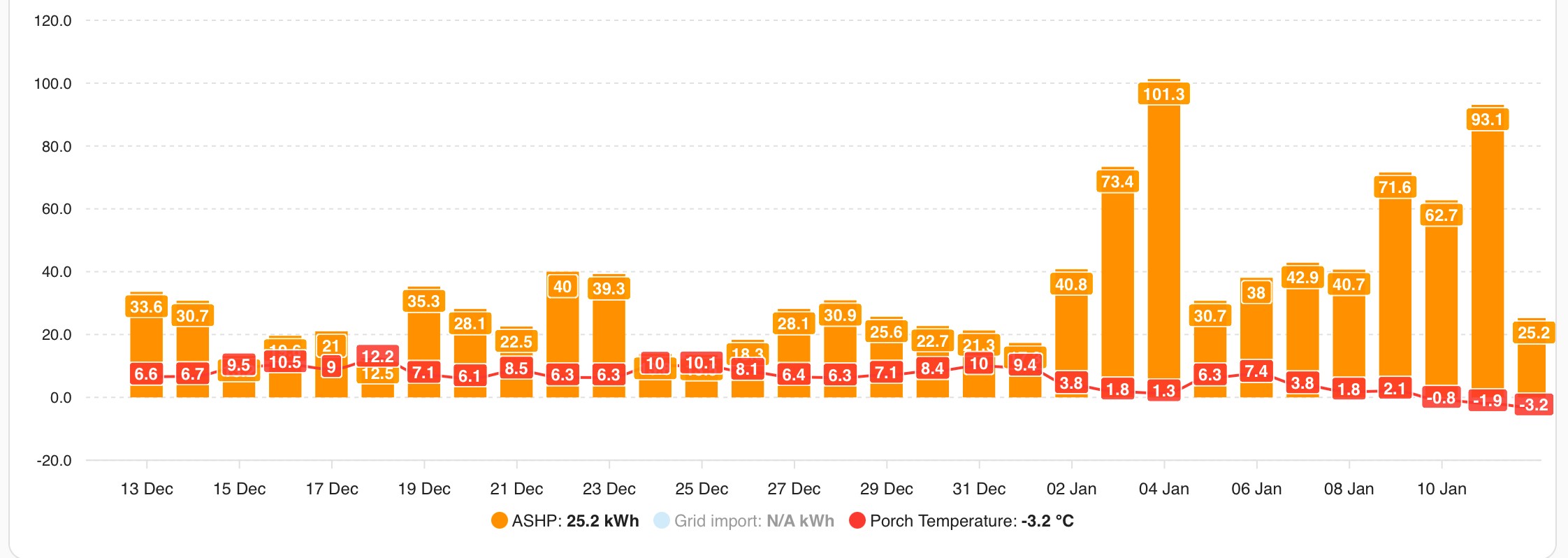
Daily average temperature is a bit of a crude measure, maybe model in 3 slots such as daytime, evening to heat pump off, and then heat pump overnight to on would give an even more accurate figure. But in the grand scheme of things the extra hassle and template sensors wouldn’t necessarily give much more meaningful answers because for me the heat pump consumption in winter exceeds my battery capacity so it becomes a moot calculation anyway.

Looking at your strategy above Roy124 a couple of observations on optimising things:

Roy124 ASHP: 2300-0400 we have the heat setting to 20°C. From 0400-2400 we now leave it at 23°C. Individual room stats are generally 20°C upstairs falling back to 18°C 1000-2000. Downstairs most stats are at 22°C with one at 23°C.

Hot Water: 0530-1000 its is set to ECO 46°C. Still playing with this but this is sufficient to give a reasonably hot shower at 2120-2200.

In general for best heat pump efficiency you want the master thermostat set to a level where it doesn’t ever turn the heating off and you control the temperature by flow rate and water temperature through the radiators being sufficient to match heat loss.
So 23 degrees for the master thermostat is fine if this is above your target temperature so it basically acts as a heating on/off switc.
But for the radiators you should open the thermostatic valve to maximum and turn the opposite side lockshield valve down to reduce the radiator flow rate to your desired temperature. That way the radiator is only getting the water it requires to meet your room temperature and the TRV’s are not artificially reducing the flow rate around your system.

You do need to have weather compensation turned on for this to work so the water temperature is as low as it can be to replace lost heat. The higher the flow temperature the more kWh your heat pump will consume so lower and slower the better. My heat pump was designed and commissioned with a 55kWh flow temperature, the house was lovely and warm but boy did it eat electricity. We have it turned down a lot more now and I’ve reduced running costs considerably (my year 3 anniversary of the heat pump was last week):

2022-23 5,311kWh £1,426
2023-24 5,936kWh £1,500
2024-25 4,330kWh £657

On the hot water, depends on your daily consumption, but I would suggest heating it only from 0400-0700 because your current timing has the hot water heating during the day-rate so if you have a shower or bath in the morning the hot water will have to heat back up again.
If a single hot water run is not enough to take you through a day then do a second burst in the afternoon Cosy period.

I heat my hot water just once a day to 48 degrees at around 3:30am. A day-time heat would give the advantage of slightly warmer air temperature but I choose to do it overnight to try to catch the cheapest Agile rates (ha!)

R
#26 Roy124

[unknown] I don't have any radiators.

I effectively have 3 circuits. The ASHP Master, 23°C by day, 20°C by night. This circuit feeds two UFH manifolds, one upstairs, one downstairs. Each room has its own room stat with individual wake, leave, return and sleep settings. During the day upstairs stats are at 18 and only increased to 20°C early morning and mid-evening. The downstairs stats are set to 23°C with kitchen and study set back to 22°C 1600-1900.

If I need more heat in the living room we use a stove fan heater. This was anticipated in the original survey.

R
#28 Roy124

geoffreycoan regarding hot water, I have got that at 46°C from 0400-0700 which still gives me a temp of 44°C around 2130. Large tank and minimal none shower usage.