Looking for advice please on best settings. I’m new to this so here goes.
I’m on octopus intelligent go so cheap rate between 23.30 and 05.30. Also on fixed output at .15p. I have gen 3 battery 9.6 which I fully charge 100% overnight. Usually runs out by about 6pm. and don’t export much in the winter but summer is quit good. Planning to add a 5.2 battery which in the winter will see me through, but what is the best option for winter and summer to maximise set up.
Should I charge to 80% and let the inverter do the work or should I charge to 100% and export either during the day or just before 11.30 pm. I don’t really want to be changing settings daily. I’d like a generic set up that is plug and play. I’m sure I’ve read that if I do a timed export then I have to manually reset to do a timed charge, and I don’t really want to bother resetting all the time. All advice and example setups welcomed please, and thanks
Advice please
Richy999 I'm sure others will chime in, but I for one like a simple life. I am on a cheap overnight tariff (6.7p / kWh) and a fixed export rate of 16.5p / kWh. To me, even with round trip losses, it makes sense to fully charge the battery overnight.
- During the winter with little solar, then the battery runs the house through to the next charge period.
- During the summer in daylight hours the bulk of the generated power is sold back to the grid as the battery is full
No changes needed to the charge set-up cycle - set once then forget (I use the web portal to do this, but you can also via the app)
CW sounds a similar tariff to mine. What size storage do you have. I think with me having nearly 14.5 kw I expect to have excess in both the summer and winter, and what I’d like to do is take advantage of buying in at 7p and selling the excess back at 0.15 p. Last summer I had quite a good return with just the one battery, so with an extra one next summer I’m hoping for more.
Richy999 I have an AIO so 13.5 kWh - usually sees me all the way through the day, even with no sun, although somedays we do need to load-shift so as to save the battery.
Yea, it is a no-brainer for me, import at 7p and export at 15p. Even with round trip losses of 20% the import/discharge cost is about 9p /kWh (7p/80%) so still making 6p /kWh
Richy999 Planning to add a 5.2 battery which in the winter will see me through
I agree with all the above comments about charging strategy, but I would suggest that you stretch yourself to another 9.5 if you can do, or at least an 8.2
The larger the battery, the cheaper the price per kWh, but there are a couple of other things to consider:
- The 5.2 is only 80% usable, so 4.2 in reality. You could get the new 5.12 which is 100% usable
- When you daisy chain batteries together on the same inverter, once one battery fills up and stops charging, or empties and stops discharging then the entire chain stop. So if you add a 5.2 (4.2 usable) to your 9.5 you will hamstring your 9.5. The batteries will charge and discharge at different rates so its not that you’ll only get 4.2 now out of your 9.5, but you won’t be able to use the whole 9.5 as you currently can do.
CW not sure what you mean by round trip losses? Also load shift? Do you have to do it on a day by day basis or do you set a timed discharge. Would it be best to set a discharge during the day when the suns out or evening when battery is fairly full before charging. Winter I envisage having some over capacity but summer probably loads
geoffreycoan I’ve gone for the gen 3 5.2 so 100% discharge. 4.2 out of 9.5? That’s a lot to lose.
geoffreycoan does that mean that adding a 5.2 to a 9.5 means I only get about 10?
Richy999 I think you‘ve got what is actually the Gen 3 5.12 battery which is 100% DOD
https://cdn.shopify.com/s/files/1/0257/3103/9284/files/Giv-Bat_5.12_Datasheet_-_July_2024.pdf?v=1723023493
The 5.2 is a Gen 1 device with 80% DOD
https://cdn.shopify.com/s/files/1/0257/3103/9284/files/Giv-Bat-5.2-01-23.pdf?v=1674387349
The 9.5 is about £1000 more but I think you will have less issues with the charging and discharging stopping prematurely when the smaller battery reaches full or empty.
Anyway, let us know how you get on
Richy999
Energy is stored in a battery in Direct Current (DC). Any battery which is charged from the mains (such as charging overnight for example) will need to convert the Alternating Current (AC) into Direct Current to store in the battery (this is what the inverter is for).
Again, in order to take some of the energy out from the battery and use it in the house, or export, it will need to be converted from DC to AC (again the inverter is the clever piece of technology that does this).
Each conversion will result in some loss (thats at least partly why your inverter gets hot!). Figures I have seen approximate to 10% per conversion, so AC to DC (10 loss) DC to AC (10% loss) totalling a round trip of 20% loss.
Or to think of it another way, if you imported 10kWh from the grid and stored it in the battery, you would only store 9kWh.
When you exported it again you would only get out 8.1kWh (roughly 80% of the 10kWh you started with) - that is your round trip loss.
Load shifting is moving some load to cheaper times of the day (e.g. time the washing machine to come on when you are on cheap rate).
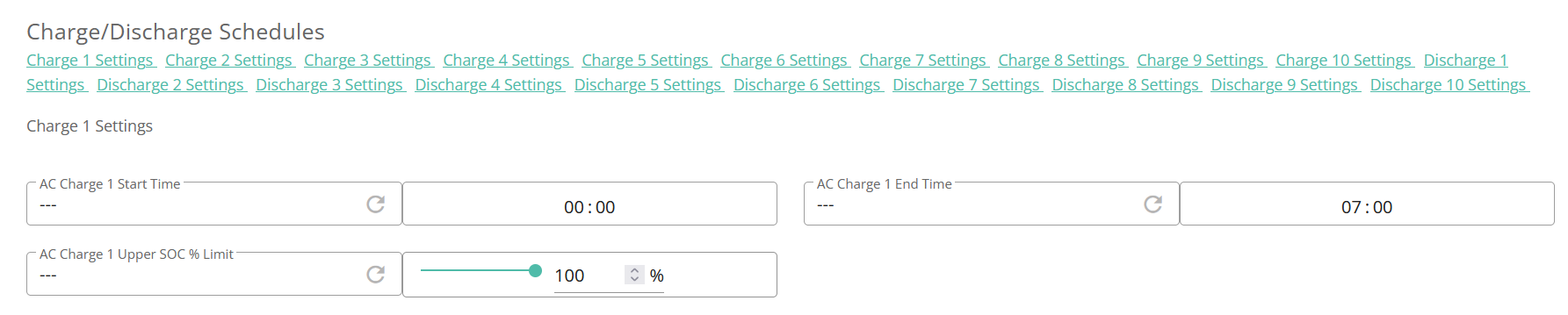
You don't need to do this on a daily basis - below is what my timed charge setting is for my hours (12.00 - 07:00)


Richy999 geoffreycoan does that mean that adding a 5.2 to a 9.5 means I only get about 10?
I honestly don’t know what you will practically get but others on here and on YouTube have complained about this issue of the whole chain stopping charging/discharging when one battery reaches full/empty capacity.
I tried to find a video on YouTube with comments about this, but I couldn’t, maybe the comments have been deleted.
geoffreycoan thanks. Yes it’s the 5.12 gen 3. I have just spoken with the installer who assures me there will be no restrictions with the gen 3 and I should get the full 14 kw no problem. 😌 I have it in writing now do time will tell. Thanks for your advice
I second all of the above.
Personally, if you can stretch, I’d probably recommend getting a second 9.5, so that things are more balanced, you don’t want to hobble your system (if that’s what happens with mix and match batteries?). But I’ve personally got no experience there, so couldn’t honestly say how they’ll work together). Not sure how much more the total cost would be by increasing to a second 9.5 after installation over a 5.2. But I’d do that if it was me.
Regarding a simple strategy;
Richy999 I’m sure I’ve read that if I do a timed export then I have to manually reset to do a timed charge
- This may possibly depend on your model of inverter. What one do you have?
I can tell you for mine (Gen3 Hybrid 5.0) that NO, you don’t have to change the settings after a “timed export” before a “timed charge”. They remain the same and will just repeat what you’ve got set up daily.
There is no real 100% fool proof “set and forget” if you want to maximise your system. Unless you automate things with 3rd party software.
The charging is simple: charge to 100% every night. All year. 23:30–>05:30. (And set the car to charge during those times, ie car “ready by” time set to 05:30”!)
The exporting; “timed export” out of summertime is what throws a spanner in the works. Because your daily generation (and to a lesser extent your usage) is different every single day.
You could go for a monthly or twice monthly change in export settings to try minimise fiddling and maximise the export but without automation you will have to change settings; particularly in the winter / shoulder months. Depending on how much you’ve got left at the end of each day.
For example;
Assuming you have some battery capacity left at the end of the day: You could just set it to export for the last 30 mins before 23:30 in the depths of winter for example, last one hour in Feb, an hour and a half in March, two and a half hours in April, 4 hours in May—> August, etc. and just accept that you’ll be missing out on export most days outside of summer. But better that than exporting too much and having to buy back at 26p because you’ve run out during your timed export. Basically if you have to import 1kW at peak you’ve totally wasted the 4kW you bought for 7p during off peak! Not totally wasted but you get the idea.
This can be solved with some clever automation, which will be your best bet for maximising savings but then there will be some cost to getting that up and running and maybe an ongoing cost depending on what automation route you choose. And some fiddling time when it cocks up. 😂
I’m exporting “semi-manually” (for now, because I have no other choice). Basically I just push back the start time of my “timed export”, as the solar genration decreases and pull it forward as the days get longer. In summer it requires pretty much no input, I just leave it set to export from 7pm—>23:29 every day.
Automation is the sensible way to go really.

I don’t wish to doubt your installers conviction however…
This may (or may not) be the case but on a side note, I can tell you from first hand experience that if one battery of a pair malfunctions or has a lower actual capacity than the other one, then it will definitely affect the usable capacity of BOTH batteries because when one indicates it’s empty (or full) then both stop whatever they are doing however full they are. And that is with a supposedly “matching” pair of same size batteries!
I have no experience of two different size batteries on one inverter but for them to operate “in sync”. ie both to go from 0% and 100% and back equally then the discharge rate of the smaller one will have to be about half the rate of the larger one. I’m not exactly sure how this is achieved. Maybe they do do that…? Sounds like they should at least.
It might be a good idea to start a new thread and at least pose the question to other owners who have two different size batteries on one inverter and see what their experience is. They are advertised to work that way. So maybe it’s all good.
Good luck.
Pete UK gen3 hybrid 5. Sounds like what you’re doing is the way forward for me. Might try for maybe 2 hrs winter and four hours summer or similar. Just so I don’t spend too much time. Thankyou.
Pete UK you are probably right with the installer. But at least if it’s in writing I’ve got a foolproof comeback if it gets too troublesome. New thread coming.