
Why does Solar go off when in island mode

21 comments started 2024-12-19 last 2024-12-20
GivEnergy ProductsAC Coupled
C
#1 CW

I have been testing the island mode capability on my AIO since the GE engineer came out and (I think fixed by) tightened a screw on the AIO breaker on the gateway.

However I have noticed that the solar generation is stopped when the system kicks over. I thought the AIO would continue to support solar in the event of a grid outage.

The AIO is at 97% and there is solar - 550 W currently, so there is somewhere for the power to go (battery and house).

Why am I seeing this behaviour - is this as designed?

My set-up is 5kW GE hybrid inverter, with 6kW AIO. 210445W panels each with Tigo optimiser on them.

G
#2 geoffreycoan

CW As far as I know it’s only the hybrid inverters that will continue to generate solar energy and charge the battery when there’s a power cut. Think its as-designed

#3 hoggy

If you watch the AIO frequency in Island mode it should be at 54Hz which will knock out your solar.
It only drops the frequency back to 50Hz below either 90% or 80% SOC (I can't remember) which allows ample space for the solar to go in.
If you flatten the AIO down to say 70% and try again it should work.

I'm unsure if frequency stepping is still on the roadmap, it's currently a hard jump to 54Hz so your solar is either on or off. Your solar inverter should be able to taper output between 50Hz (100% power) & 54Hz (0% Power) like say a Victron or Powerwall does but it don't think the AIO does this - so I imagine it see saws quite a bit maintaining SOC.

I'm guessing there is a typo in your panel info but the AIO won't like being fed more than about 5.5kW of PV when in island mode - sometimes that can cause a trip as it swamps the AIO.

C
#4 CW

hoggy I'm guessing there is a typo in your panel info

Ah yes, that should have read 2 * 10 * 445W panels !

I did wonder, so basically the solar will only kick back in when the AIO reaches a certain level - that makes sense. Just checked the logs and the Inverter frequeny jumps to 54 during that period.

B
#5 bRhFDKtjRMK9

CW However I have noticed that the solar generation is stopped when the system kicks over. I thought the AIO would continue to support solar in the event of a grid outage.

AIO + Gateway does this. I don't know about your setup (5kW GE hybrid inverter, with 6kW AIO, as you said).

In AIO + Gateway system, when grid goes off, EPS changeover trips solar inverter and it stops generating. My inverter does this, some people say their TV or router trips off too. But eventually every device will reboot and continue working. My solar inverter (Danfoss) takes about 5 minutes to restart and start generating with grid completely turned off. Generation goes nicely to household and to the battery, if there's excess.

C
#6 CW

bRhFDKtjRMK9 Yep - AIO plus Gateway - I think @hoggy got it right with it being dependant on battery SoC - I definately went to 54 Hz when I took the grid off line

Edit: I need to try an experiment when the AIO has 80% SoC or other value. I can't find anything from GE that says what the SoC needs to be before the solar inverter will kick back in

B
#8 bRhFDKtjRMK9

CW Okay, so if you have AIO + Gateway like me, then you have 6KW inverter inside the AIO. Gateway does not have any inverter. You said you have 5KW Hybrid Inverter + 6KW AIO, hence my question what exactly do you have.

54Hz when grid is turned off is not normal I think, I did not experienced this. It should be exactly 50Hz 230V, I've checked this on mine. I turned grid off for several hours, simulating blackout. Even operated heavy electric saw from the battery. All good. Solar inverter worked and produced juice from solar panels.
Lastly, I believe that AIO should produce stable output regardless of state of charge, from 100% to cutoff (default is 4%). Correct me if I am wrong with any assumption please.

C
#9 CW

bRhFDKtjRMK9 TBH I don't know, I'm going on the responses to my query above.

My set-up is 20 solar panels (8.9 kWpeak) all with TIGO optimisers, feeding into a GE hybrid 5kw inverter, with an 6kW AIO battery along with the gateway.

From what @hoggy has said, the AIO will shift the frequency up to 54Hz (as I have seen) when the grid goes down and the AIO is above a certain SoC (not clear yet what that limit might be)

I'm interested in your experiance with a different inveter. Did your system continue to run off-grid and what was the SoC of your AIO in that circumstance (would love to know where the cut-off point is, if there is one, for the solar to kick in again based on the AIO SoC)

G
#10 geoffreycoan

CW My set-up is 20 solar panels (8.9 kWpeak) all with TIGO optimisers, feeding into a GE hybrid 5kw inverter, with an 6kW AIO battery along with the gateway.

Thanks for explaining your setup, it is a little unusual as the Hybrid inverter is a bit of an over-sold, its converting the DC from your panels to AC and then the AIO is converting the AC back into DC to store in the batteries.
The Hybrid inverter could have had its own batteries because at the moment you are not using the hybrid features in the inverter. Until very recently GivEnergy didn’t have a string (PV-only) inverter so you’d have had to have a non GivEnergy inverter or under-use the hybrid inverter as you have.
One advantage of course of the AIO is the better charge and discharge rate of 6kW rather than the 3.6kW limit you would have had from using the hybrid inverter with its own batteries.

B
#11 bRhFDKtjRMK9

CW I see. So you have 5KW Hybrid inverter, 6KW AIO, and the Gateway? Two GivEnergy inverters, I am very unfamiliar with such setup.

CW I'm interested in your experiance with a different inveter.

I don't recall noticing anything other than 50Hz when I turned off the grid, but maybe I missed something. When I turned off grid, the battery level was high, around 60% or 80%. I ran off-grid for several hours, used a portion of the stored energy, and didn't notice any problems.

I am not aware of any intelligent logic for off-grid mode, such as preventing the solar inverter from working because the grid is off or the state of charge (SoC) is too low. My installer assured me that the Gateway will guarantee (as long as usage stays within the 6kW inverter range and the battery holds enough charge) that all home devices will continue to operate during a blackout. This includes the solar inverter, which will receive a "grid" signal from the Gateway, making it think everything is operating normally.

T
#12 TX200

bRhFDKtjRMK9 it was mentioned above!

If the battery is nearly full and the grid is down, the AIO shifts the frequency up to 54KHz to stop the string inverter (or in this case the hybrid) from working. Because if the battery is full and the grid is down there's no where for that energy to go.

Once the AIO battery SoC has lowered, the frequency will be returned to normal and hopefully the PV inverter will start working again (some string inverters might need to be powered off and on again, but hopefully most will just work!).

B
#13 bRhFDKtjRMK9

TX200 If the battery is nearly full and the grid is down, the AIO shifts the frequency up to 54KHz to stop the string inverter (or in this case the hybrid) from working. Because if the battery is full and the grid is down there's no where for that energy to go.

Thanks for explaining! So that's the way to shut down the solar inverter. Very clever.
Never happened to me though, I'm always on deficit of power, not excess.

C
#14 CW

geoffreycoan your setup, it is a little unusual

That's exactly what my installer said! I deliberately went for the AIO because a) I wanted whole house backup, b) I wanted as high as possible power output, which as you say the AIO can deliver 6kW continously and far better than the hybrid and c) wanted everything in the same eco system

When I went down this route, I had the thought that what I would do, would be to put another battery DC coupled onto the inverter to pick up any potential clipping, but have since found out from Giv that this is not a supported confguration and I think (certainly from seeing other posts here) potentially problematic.

In hindsight, I should have just purchased a string inverter which would have still delivered all my requirements (other than not all kit being in the same eco system)

C
#15 CW

bRhFDKtjRMK9 I'm always on deficit of power, not excess.

I'm the other way round, as I always fully charge the AIO nightly (7 hour cheap slot with Eon Next Drive) and when there is solar, it generally produces enough to power the house, so the battery is either being charged or just sitting there

G
#16 geoffreycoan

CW When I went down this route, I had the thought that what I would do, would be to put another battery DC coupled onto the inverter to pick up any potential clipping, but have since found out from Giv that this is not a supported confguration and I think (certainly from seeing other posts here) potentially problematic.

There are people with that configuration, an AIO and a hybrid or AC-coupled inverter with batteries, the problem is that the two inverters don’t know about each other and so when one is discharging to meet house load the other can see any slight excess as being grid export and will start charging, so the first will discharge more and the two sets of batteries can cross-charge. On the newer (and faster) inverters this can be quite aggressive cross-charging up to full-rate.

There are ways around this; automations using Home Assistant or setting one to do a gentle discharge during the day and the other to not charge in the day, but it’s not ideal. The EMS should in theory enable both inverters to act together but it seems the first release of the EMS will be for multi-AC configurations, then later on a multi-hybrid product, and whether mix and match with AIO, who knows.

In hindsight a string inverter would probably have been a bit cheaper. But it is what it is.

I have two hybrid inverters each with their own battery but they are Gen 1 inverters so the cross charging isn’t as fast or severe

#17 hoggy

At one point they were just giving Gen 1 Hybrids away - if it was one of those then it'll probably have been cheaper than an actual string only inverter - at least for your installer :-P
With no battery attached you gain nothing Gen1 to 3 in respect to output - 5kW max is all they'll do.

IF you do find clipping in Summer then i'm sure with Home Assistant & an battery added to it you can manage everything to your benefit.
There is a 3rd way and I don't expect anyone to actually do this as it's yet another box & they are really hard to find these days - a true DC coupled inverter/battery. These sit between the PV panels and the existing string inverter and basically syphon off energy into a battery. This same box then mimics additional panels if it sees grid import and boost PV outputs, via battery, back into the PV strings again later.
It was pretty odd but I ran one for 2 years on a Gen 1 inverter which basically gave me something that surpasses Gen 3 to this day for battery only power availability (provided you can get your head around the fact that it shows up as 2.5kW of PV output at 11pm!)

C
#18 CW

hoggy they were just giving Gen 1 Hybrids away

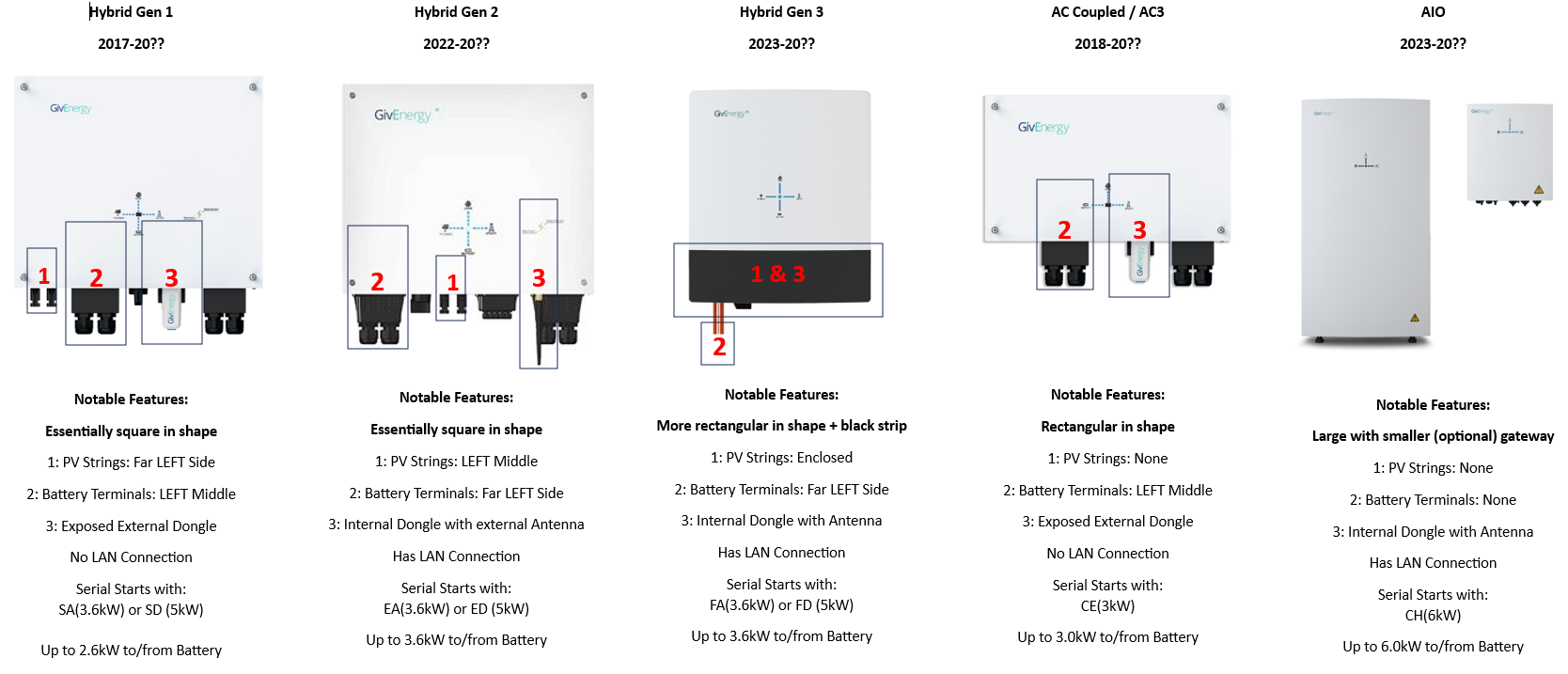
How can I tell what Gen it is (I thought it was a 3 but would be nice to know how to check)

#19 hoggy

What 2 letters do the serial number start with

T
#20 TX200

Easiest way around it is set the hybrid battery to discharge at the same wattage as the house baseload.

Charge it up overnight in the off peak, then eco mode slow discharge for the rest of the time.

Saves having to do any balancing etc. Might get some cross charging, but minimal hopefully.

C
#21 CW

hoggy Looking at the app I think it is FDnn?

#22 hoggy

CW So a Gen 3 5kW Hybrid.
Forgot I did this image a while back, that would have perhaps helped.