A question about Wind !

23 comments started 2025-01-01 last 2025-01-03
Home AutomationHome Assistant
D
#1 Daft Vader

I have been adjusting my heat pump gradually since I moved into a new house a few weeks back and I think I have everything working pretty well and am happy with my COP but I noticed that on very windy days the house cools down because the air temp is rising slightly but the windchill is cooling increasing the heat loss. I can't see any way apart from constantly tweaking the weather compensation curve offset to change this.
Has anyone solved this problem?
Thanks

Mike

D
#2 DD

Daft Vader it probably depends on the model of HP.
Daikin has a modulation feature which means it can adjust water temperature as room temp drifts from target, though it's rather crude.
Also allows you to add a fixed offset to the water temp without having to adjust weather curve.

K
#3 kram

This combined with lots of solar gain on one side of the house was why we are trying load compensation.

Is the house modern and if so have you checked that air isn’t venting up being the blasterboard?

Most WC boilers can take internal influence, so with seeing if your HP can do that and getting the correct internal stat and setting it up if it can.

S
#4 SimonClarke

To a limited extent I have the same issue but it isn’t the wind particularly but the outside temperature. It is cooler indoors when it is warmer outside. We are talking 1 degree maximum but I am unsure how to adjust the settings to compensate for this situation. I’ve made minor changes but it hasn’t really made much difference. Any suggestions gratefully received

G
#5 geoffreycoan

SimonClarke To a limited extent I have the same issue but it isn’t the wind particularly but the outside temperature. It is cooler indoors when it is warmer outside.

I have two LG Therma V heat pumps. The weather compensation (they call it ‘AI’) mode is pretty simple and its all based on outside air temperature (OAT) at the heat pumps and leaving water temperature (LWT) from the heat pumps.

Mine is set:

  • LWT 30 with OAT 14
  • LWT 52 with OAT -2

Between the two OAT’s it adjusts the LWT proportionately.

So if your house is too cool with a warmer OAT, you either increase the upper OAT (so stretching the curve over a longer temperature range) or increase the LWT at that upper OAT (so the radiator water is hotter).

Bear in mind that these are maximums and minimums of LWT that the heat pump will go to, so if its less than -2 degrees the LWT won’t be any higher than 52, and if its warmer then 14 degrees the LWT won’t be any lower than 30 degrees.

My installers didn’t set any heat curve they just set it to a fixed 55 degrees I think so presumably they didn’t have to come back with me complaining the house was cold. Electricity consumption clearly not their problem.

I’ve got to my settings through trial and error tweaking the LWT’s up and down if the house was too cold in deep winter or too hot in milder spring. I’m sure I could do it more scientifically but I just checked and I haven’t changed it since April last year so it must be about right.

The other thing of note is to make sure that the room thermostat is set high enough so that it rarely turns heat pump off during the heating period. On mine the thermostat acts as a master for the whole system so if it turns off then there’s no heating until the temperature falls in that room (the hallway in my case).

S
#6 SimonClarke

We have no thermostat at all! The temperature is by and large perfect except the odd occasions like this morning when the OAT was over 12c and inside 20.1c compared to yesterday morning when it was 5c and inside 21c ( I’ve always been sensitive to heat changes much more than my wife and much to her annoyance almost always right. We have a house full of thermometers to stop arguments!)
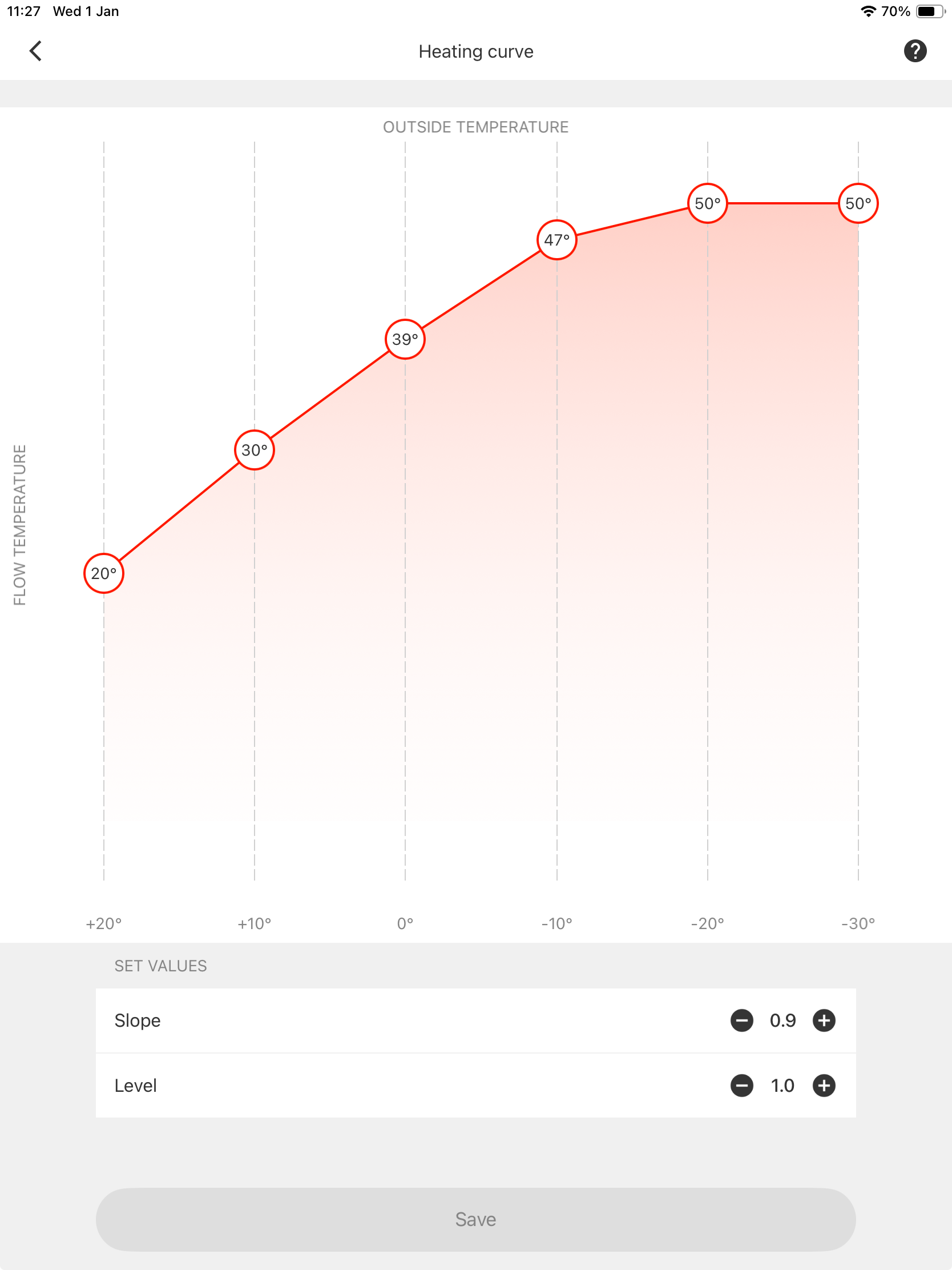
This is the curve at the moment. I am unsure what to adjust for what seems relatively minor changes.

G
#7 geoffreycoan

SimonClarke The +10, can you tweak that up from 30 degrees to 31 or 32 ?

Bit weird that it has temperatures down to -30 degrees and I wish I could get my house to temperature with a 39 degree flow temperature at zero, it’d cut my electricity costs even further. Despite having most of the radiators replaced in the heat pump install mine was designed for a flow temperature of 55 degrees and a SCOP of 2.85 (this is before I understood any of this, I’d have challenged much more if I had!) so I unfortunately need higher flow temps = more consumption.

S
#8 SimonClarke

If I change the settings to get 31c at +10 it also changes the other temperatures so I suspect it would be too warm when it is colder outside. Think I will talk to my installer as I think I will need to delve deeper than the app (Viessmann) will allow and the main unit is in the loft. The cop has just gone up to 4.35 so I’m pretty happy apart from this very minor issue. We changed all bar one radiators and replaced one towel rail like for like. This is the only thing that is a bit borderline on the output side of things but it was on a completely tiled wall so difficult to enlarge without making holes.

K
#9 kram

SimonClarke

Yes, Viessmann boilers can work with no stat, but you can add one and set how much it influences the WC .

It has to be manufacturer approved and few are, but you can add one to most WC systems.

As I said, it’s why I chose load compensation to try first as there is a large delta between inside and outside temperatures.

Better WC allows you to set the slope and change the curve so you can get away without internal influence.

S
#10 SimonClarke

Not sure if it would be worth the expense if it is only to cure a half a degree discrepancy! I suspect it can be more finely adjusted on the main unit (not the heat pump) in the loft but to be honest I have been too lazy to clamber into the loft over Christmas!

G
#11 geoffreycoan

SimonClarke Think I will talk to my installer as I think I will need to delve deeper than the app (Viessmann) will allow and the main unit is in the loft

At least you have an app! My ASHP’s didn’t have the wifi module fitted, it’s an optional £250 device and I’d need two of them so that’s not going to happen.
And my ASHP control units are also in the loft.
Have bought some 4 core cable so will be relocating them at some point soon….

S
#12 SimonClarke

geoffreycoan we had the option of putting the controller in the old airing cupboard but that seemed unnecessary and counter productive. It isn’t just electronics but lots of plumbing including the pump so quite large - think gas boiler size, and doesn’t do much for the end user that the app doesn’t do. Made no difference to the cost despite the extra pipe work.

D
#13 Daft Vader

DD
I don't have any room stats at all ! so my heatpump doesn' know the inside temp. I can buy one for my Fujitsu but I have been following the HeatGeek channel and I am only using weather compensation. We have been very comfortable in our Brand New house as it's very well insulated and the flow temperature hovers around 28C which is amazing! I am getting 4.9 cop at the moment which I am also amazed at how easy it was to set up and get to this state. It's on 24/7 and the only problem we have is the wind chill . My rads upstairs are never hot but so far it's never been below 19c so very happy there too! I do love a HOT bathroom when I shower though so have rigged up a fan heater to run for about 5 minutes beforehand. 🙂

S
#14 SimonClarke

New houses definitely have an insulation advantage

G
#15 geoffreycoan

Daft Vader I don't have any room stats at all ! so my heatpump doesn' know the inside temp.

Mine knows the temperature at the control box but since the control box is in the loft, this is pretty useless information. We have a separate room thermostat which is used to turn the heating on and off, basically 19 degrees during the day and 17 degrees at night but the ASHP doesn’t receive the inside temperature reading or the target temperature, it just knows that it’s on or off. So we set the temperature and put the stat in the hall where its slightly cooler to ensure the heating is on all daytime.

Great result on your COP BTW

SimonClarke we had the option of putting the controller in the old airing cupboard but that seemed unnecessary and counter productive. It isn’t just electronics but lots of plumbing including the pump so quite large - think gas boiler size, and doesn’t do much for the end user that the app doesn’t do

We have a buffer tank in the loft that the two ASHP’s feed into (pipework trunked up the outside wall). The buffer tank has to be no more than a certain distance from the ASHP so this was the only practical place to put it. The valve for hot water/CH, the pumps and all the ASHP fusebox and meters are up there as well.
However the control boxes are only connected to the ASHP’s by 3 or 4 core signal cable so I think I can relocate those to the bedroom below without much issue and at least I’ll be able to change the flow temperature etc without having to climb in the loft each time. My longer term plan is to get the ASHP’s connected to Home Assistant and then maybe I’ll be able to find out what my COP value is because as far as I can see its just not shown anywhere in the control menus.

Anyway, it works well enough. Since moving to the weather comp my consumption for the last full year is 33% down on prior years and running costs (on Agile) around 1/3. Knowing the COP would be nice and I could optimise to improve it but doing OK without

R
#16 Rbor

SimonClarke I have Viessmann ASHP with a separate control unit in the house. WE managed to squeeze this and a 200 l HW cylinder into an understairs cupboard!

I run solely using weather compensation.
My system was designed for a flow temperature of 40C at –3C and my installer's heat loss survey suggested a slope of 0.6 and level of 2 with 20C daytime and 17C standby at night.
My flow temperature this winter is typically 31/32C only
It looks like your system has been designed for a flow temperature of 50C at your area's minimum temperature.
I have had the ASHP for over a year now and have experimented with the heating curve setting, lowering the slope and even the level. But for me 0.6 slope and 2 level.
The level just moves the slope up by 1C for each setting.

I do have one temperature sensor in the house but this just monitors the temperature and does not control the ASHP in any way.

Rob

S
#17 SimonClarke

Rbor I think you are right about what it is set to but it is cold this morning and the flow temperature is 37c which is about as high as it gets. Its set for 19c and 18c which seems to keep the house at between 20 and 22c but usually 21. The heat curve is 0.9 and 1 but it only reaches 50c at -20c which we have never had in this area that I know of. Once saw -16.5 in a previous house nearby but that was extreme

R
#18 Rbor

SimonClarke My external temperature is dropped to –3.5C just before dawn at 08:20. Temp now risen to –0.8C but it's a glorious winter's day, great for my solar. Internally, house dropped to 19.7C and now at 20.5C.
My heat pump is using a lot of electricity and flow rate is 35C.

On my heating curve 0C is set to 35C flow rate. It doesn't reach 40C flow rate till –10C.
In the Viessmann app, There is some advice on the heating curve page, top right under ?.

Rob

S
#19 SimonClarke

Rbor yes I have seen the “help” but I think it is mainly referring to whole seasons rather than particular situations. It’s only been running from August so I am still a little nervous to change anything too drastically as it has been showing the cop as 4.4 ( changed yesterday with the month). Weather has also been very variable which slightly puts me off altering anything as one day it is 0c and the next 12! So difficult to make a comparison. If we get some stable weather I’ll have a play, possibly set the temperature to be the same all the time. This is how we used to run our oil heating.
And yes lots of nice sun!

R
#20 Rbor

SimonClarke My system is 16 months old so it has gone through all the seasons.
Temperature makes a huge difference.

  • Today (2nd Jan) my mean temp has been –2C and electrical consumption has been 26 kWh (so far)
  • On 31st Dec my mean temp was 8C (10C warmer than today!) and consumption was 12 kWh.

That's about 1.4 kWh for each 1C.

But do experiment but tweak one thing at a time. And best to get a run of steadier temperatures. Forecast for next few days is 'interesting' and still some uncertainty with weather patterns that could do anything.

Your COP is good, especially with these temperatures.
If you are interesting, my system is 2nd one down on from my wizard installer.
https://heatpumpmonitor.org
If you select the bar chart to the right, you can drill down on performance on any day.
The spikes today show defrosting taking place.
I am obviously very please with a SCOP of 5.1 since my openenergymonitor kit was installed.

Lots to investigate as you can compare different brands and installers.

Rob.

S
#21 SimonClarke

Interesting numbers! I don’t have the open energy kit (and don’t think my other half would be keen on more investment! I have put her through a Tesla, solar panels, house battery and now ashp in the last 4 years so tolerance may be running out…). Is your house relatively new or have you really gone for insulation? Notice the heating cop is 5.6 but dhw is 2.9 so I might have room for improvement on that although if there was a shortage of water for a substantial bath I would not be popular!
I will definitely have a play with the settings soon.

R
#22 Rbor

SimonClarke I live in a 1928 detached house which has been extended over the last 15 years.
The original house has 'cavity wall insulation' of sorts with a cavity <1 inch that was filled decades ago. So virtually non-existent. I have a load of mineral wool insulation in the roof space but a gale can blows through it. I reckon I lose a fair amount of heat through the roof. The only real way to improve matters is a new roof but it is covered in panels! The roof is the original, nearly 100 years old. Why didn't I have the roof sorted before panels? 🙄
No underfloor heating but there is a cellar space I did have mineral wool added beneath the floorboards.

My extension has modern insulation.
So overall, my house isn't well insulated.

My installer was excellent and very knowledgeable. A sole trader and a Heat Geek Elite.
I had half of my radiators ugraded to K3 or K2 but luckily using the same 15 mm pipework.

My DHW efficiency is the only blot on the performance of my system.
The Oso cylinder is brand new with vacuum insulation so heat loss should be small.
Something to be investigated. Winter isn't good for DHW though as the cold water feed is so much colder than in summer.

The Openenrgy kit is expensive but I was blessed with an attractive deal for its installation.
You could spend hours analysing different systems, especially comparing HP brands and installers.
I would like to see some Cosy HPs on there. They are unlikely to get high COP values because they are designed to run at higher temperatures.
There are loads of Vaillants and they perform well, together with Nibe and Viessmann.
The smaller Daikins seem fine but there has been some concern with larger 10–16 kW systems, mainly because they are the same heat pump!

Rob

S
#23 SimonClarke

Ours is a late 90’s Persimmon 3 bed bungalow. The only extra insulation is what I put in the loft which saved over a third when we were still on oil so well worth clambering about in the loft. Suspect the 10mm microbore in the walls doesn’t help. Rads all k2 now with only one in the lounge slightly bigger so no real disruption fitting.
Cold but sunny today so the battery that was full at 0530 was empty by 1030! Sun kept up with the ASHP until about 2. Just plugged the car in and got cheap juice from 1800 till 0530 - result!