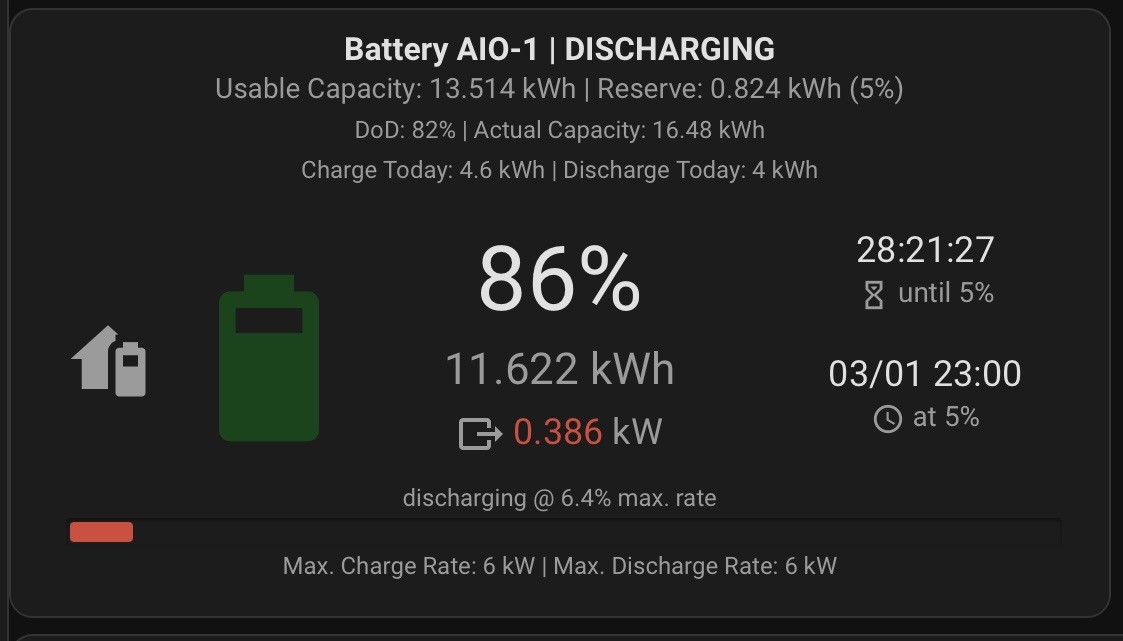
I'd appreciate the views of you clever lot.
My AiO has never managed 13.5kWh output in over a year now.
My last communication with GE support claims that the 13.5kWh capacity is stating how much you can put in it rather than what you can get out of it! With around 93% round trip efficiency, that is only around 12.5 for output.
That was never my understanding. Ordinarily I would assume this has come from someone who just doesn't understand, but it is from a 3rd line service desk engineer.
Have I been wrong all this time? Is GE datasheet, website and advertising misleading?
Total Capacity - 16.48 kWh
Total Usable Capacity 13.5 kWh
Lowest usable % - 4%
#4hoggy
If its anything like the GEN 1 it measures battery in/out on the DC side before inversion to AC. (There's a hall effect sensor at the HV bus stage)
T
#5treborUK
My 2024 annual report shows:
Charge: 3403
Discharge:3033
Suggests 89% efficiency for me.
Regularly seeing 13kWh discharge which with 10% reserve I’m happy with
C
#6Coys68
treborUK That's interesting.
I didn't realise there was such a thing as annual reports.
Mine shows 3775 of charge and 3573 of discharge which looks like around 94.6% efficiency.
I might not be overly happy with the capacity but the efficiency is rather more pleasing 🙂
The 93% I mentioned previously just came from a Google search. That is the AI summary figure which must come from somewhere I guess.
D
#7DreadorUK
Advertising says usable if they changed that now then I can see a lot of upset customers, seems more like they are trying to fob you off.
And I prior to making the mistake of updating the inverter firmware would regularly see over 13 kWh in a day
Battery is 16.5 kWh at 85% efficiency then less 4% is 13.5 kWh so ball park right. Even 82% would be giving 13 kWh.
#8nophead
Efficiency and capacity are not related in my understanding. I think the capacity is how much energy you can take out of the battery when it is fully charged but the inverter losses about 10% so you can only use 90% of that to power your home. To put the energy into the battery again the inverter wastes about 10%. I imagine the efficiency of the battery is how much energy you can take out versus how much you put in. The difference is lost in the heat generated in the battery itself.
As Daveb01 says, the AIO is 16.48kWh total capacity, but of that there’s 13.5kWh usable and a 4% reserve at the bottom so really 12.96kWh of usable capacity
And then there are AC/DC and DC/AC conversion losses each time you charge and discharge the battery. Round trip estimates vary but around 15% seems to be common. This is the inverter efficiency.
So if you put in the maximum 12.96kWh DC into the battery, it actually require 12.96/0.935=13.86kWh of grid import or Solar Generation that’s already been converted to AC by your Solar inverter, and when you discharge that 12.96kWh of DC you’ll get back 12.96x0.935=12.12kWh out of the AIO battery into your home (or grid export).
I agree, so in a nutshell you get 13 in and 12 out. I wonder if it would have been better if the AIO was one 16 kWh battery instead of 4 x 4?
It’s a shame really because when they first brought out batteries for home I thought of two things. DC batteries were best for Solar systems (DC to DC). Then only a loss when going to home (AC). The opposite for AC batteries charging from grid (AC) to an AC battery and AC battery to the home (AC) good efficiency, but a loss when charging from Solar. Then you read the docs and the batteries are DC, so AC to DC in and DC to AC out. It’s a shame really.
End of waffle and an insite in the way my brain is working 😛
B
#11bRhFDKtjRMK9
Daveb01 GivEnergy batteries are very inefficient compared to solar DC-DC, of course. But that's what we have. I considered Victron systems, but nothing would fit in a space I designated for AIO + Gateway, so GivEnergy it is. If I had more space or an extra outbuilding, I would go with something else, for sure.
Daveb01 I wonder if it would have been better if the AIO was one 16 kWh battery instead of 4 x 4?
More efficient maybe, but there are other factors. Four batteries in a box can be easily serviced, I helped my installer to handle them, it was easy. Can't imagine it being the same with a massive block of metal containing all four.
T
#12treborUK
So was back down to my 10% reserve early yesterday evening after some extended cooking.
Overnight Charge 13.7 kWh - bang on I’d say.
Garage install, charging at 3600W 0300-0700, battery generally remains 15-20 degrees throughout the cold weather with this usage pattern. Usually no more than 3-4 hrs idle before charge, often very little if solar helps during daylight.
@Daveb01 i get your point about AC-DC then DC-AC again but for those of us that already had solar on FIT then AC coupled was the only way to add battery and not lose FIT. The AIO is ideal for me and “fingers crossed” it’s working pretty well for my situation.
The other good thing about 4 x 4 is one could be replaced if there was a fault and easy to do that by installer.
#14PianSom
geoffreycoan And then there are AC/DC and DC/AC conversion losses each time you charge and discharge the battery. Round trip estimates vary but around 15% seems to be common. This is the inverter efficiency.
(Slightly) interesting stats from yesterday by my inverter&Gateway&AIO:
PV generated (according to solar inverter, presumably after conversion to AC) - 16.3 kWh
PV received at Gateway (according to clamp used by myenergi harvi ) - 16.24 kWh (loss of <0.5%)
PV generation reported by GivTCP (presumably after conversion to DC) - 15.5 kWh (loss of 4.5%)
So my finger in the air 5% loss assumption looks ok.
C
#15Coys68
treborUK that's very similar to my set-up but I've never managed 13 kWh at10%. I'd be well chuffed with that. What BMS and inverter firmware are you on?
T
#16treborUK
Coys68
613 & BMS10.
I’m a serial upgrader, I just can’t help myself click ‘update’ when offered.
13.85 in overnight- have expanded my charge window from 4 to 5 hrs during my overnight cheap rate but charging at 2800 rather then 3600W, just to reduce idle time a bit and manage temps better. Will see how it goes.
#17Tenkaykev
treborUK
Your post reminded me to dig in to the Battery settings in the portal. I had set my charge rate to 3250W in the App and it said it had been successful, but the charge rate had stayed at the previously set 4000W. When I checked in the portal it was indeed showing at 4000W.
T
#18treborUK
Tenkaykev
Yes I frequently check the portal settings if I have made changes via the app, mostly they match but every now and then I have to set via portal as well.
D
#19Daveb01
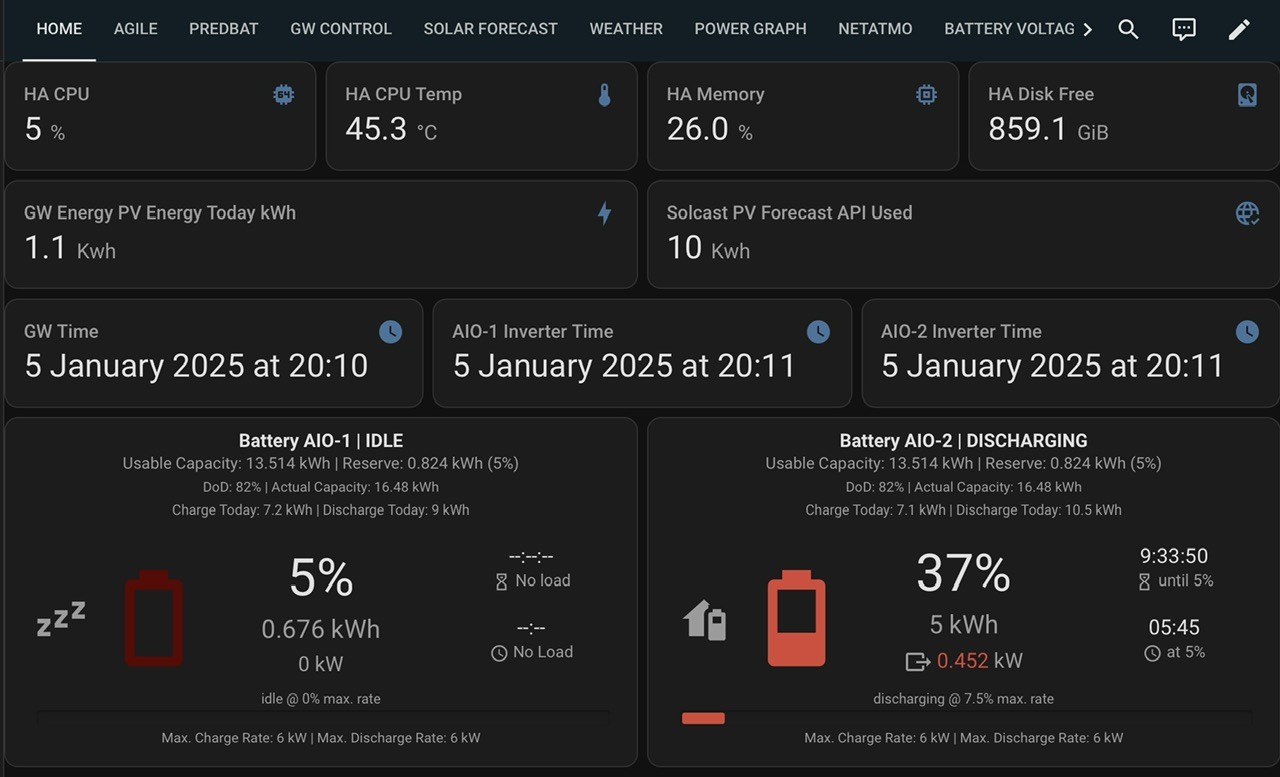
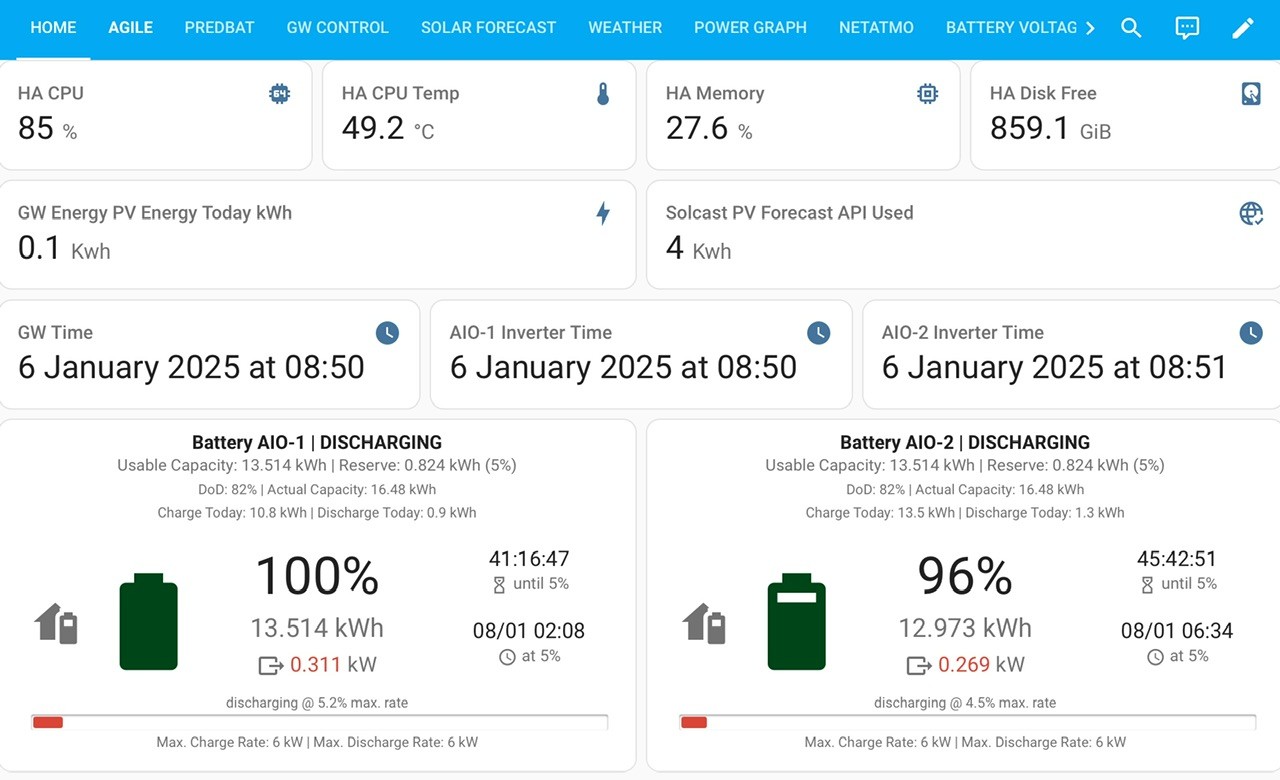
Something for you guys to look at on my battery states. Predbat is discharging them down to my set 5%, to top up my Jan account. Then charging at the cheaper prices later.
My batteries have not been charged from 5% to100% for ages, Predbat just tops them up.
However today the oldest SIO has got Idle early.
The charge and discharge is also interesting
Interesting today after a full charge, oldest AIO only put in 10.8 kWH