D
#1 Digger
The above reg amendment concerns bidirectional current flow such as used by solar systems. Does Givenergy have plans to ensure existing installations meet this?
Thank you

The above reg amendment concerns bidirectional current flow such as used by solar systems. Does Givenergy have plans to ensure existing installations meet this?
Thank you
Digger If you are looking for a reply from GivEnergy I’m afraid its unlikely you will get a response here as this tends to be a customer forum
You’d probably best to contact them directly for an answer
Digger I believe that RCBO's and RCD's should be bi-directional on the solar circuit (and any other generator circuits)

Aren't new electrical regulations only for new installations? Our house wiring done in 1990 doesn't meet current specs but they aren't retrospective.
Yes that is correct.
Note by the Health and Safety Executive
The Health and Safety Executive (HSE) welcomes the publication of BS 7671:2018, Requirements
for Electrical Installations, IET Wiring Regulations 18th Edition and its updating with the third
amendment, published in 2024. BS 7671 and the IET/IEE Wiring Regulations have been extensively
referred to in HSE guidance over the years. Installations which conform to the standards laid down in
BS 7671:2018 including Amendment 2:2022 and Amendment 3:2024 are regarded by HSE as likely to
achieve conformity with the relevant parts of the Electricity at Work Regulations 1989. Installations to which
BS 7671 is relevant may have been designed and installed in accordance with an earlier edition, now
superseded but then current. That, in itself, would not mean that the installation would fail to comply with the
Electricity at Work Regulations, 1989
I was just wondering what the Givenergy support would be in this. I will contact them just to see. They may have records as to what was fitted 18 months ago. I will also have a look myself for any markings. You never know. Though I think contacting the company who installed it may be easier.
Thanks.

Regs are forward (in time) facing. Your existing install will be grandfathered to the regs in place at the time, this is not a retrospective thing so, provided your install was done correctly in the first place and signed off it's a none issue.
Sure if you want to take account of the latest regs and have your install updated that is your choice/cost but you are not forced to do anything (beyond periodic inspections that often get ignored)
Hi I do have a periodic insp (5 year) due Feb so will ask at the time.
Not GE here, but most solar installers use single pole rcbo. I showed the amendment (2 or 3) to the installer and the solar inverter and battery got put on to dual pole rcbo.
It’s pretty essential as single pole only breaks one pole, but when it can flow in either direction either can be live depending on if it’s charging or discharging.
Erm... Neutral is always neutral, Live is always live. I can't see that any other way. Consider -- Neutral is tied to Earth in most domestic premises.
kram
It's to do with disconnecting the protection circuitry.
This is usually powered from the load side of MCB/RCBO's etc, but if a battery of solar is providing on the load side, and a fault occurs, the protection circuitry is still powered and may provide a path for current to flow, overloading it.
The NICIEC have published a useful newsletter regarding this which explains why a bi-directional RCBO is required.
https://niceic.com/newsletter/protective-devices/
It looks like under a fault condition the stored energy in the solar/battery inverter can damage the detection circuitry within a uni-directional RCBO which is not apparent to an operator.
Interesting stuff! Thanks.
Splitting hairs, but the early AIO gateways with no Nuetral Earth bond did give you 2 lives and no neutrals when in island mode. Fun times!
Simon_C The resistor in the test circuit has a very low power handling (W) capability as it is physically very small. This is not normally an issue in a unidirectional circuit as pressing the test button causes the RCBO to trip, and so interrupts any further power from flowing in the test circuit, even if pressed and held for several seconds. If the same unidirectional RCBO is supplied with power the "wrong" way around, then pressing the test button again causes the RCBO to trip, but this time it does not interrupt the power flow in the test circuit. If the button is held pressed in such circumstances, even for a second or so, the resistor will likely burn out and possibly cause other damage to the RCBO such that it may not operate correctly that one time when it may be required to save your life! The burnt out resistor also means the test button will no longer operate, which I think would also be an electrical inspection test failure.
Bi-directional circuits require bi-directional RCBOs
How can you tell what devices you have in your kit (AIO) in this case - and is this only relevant on the AIO breaker,
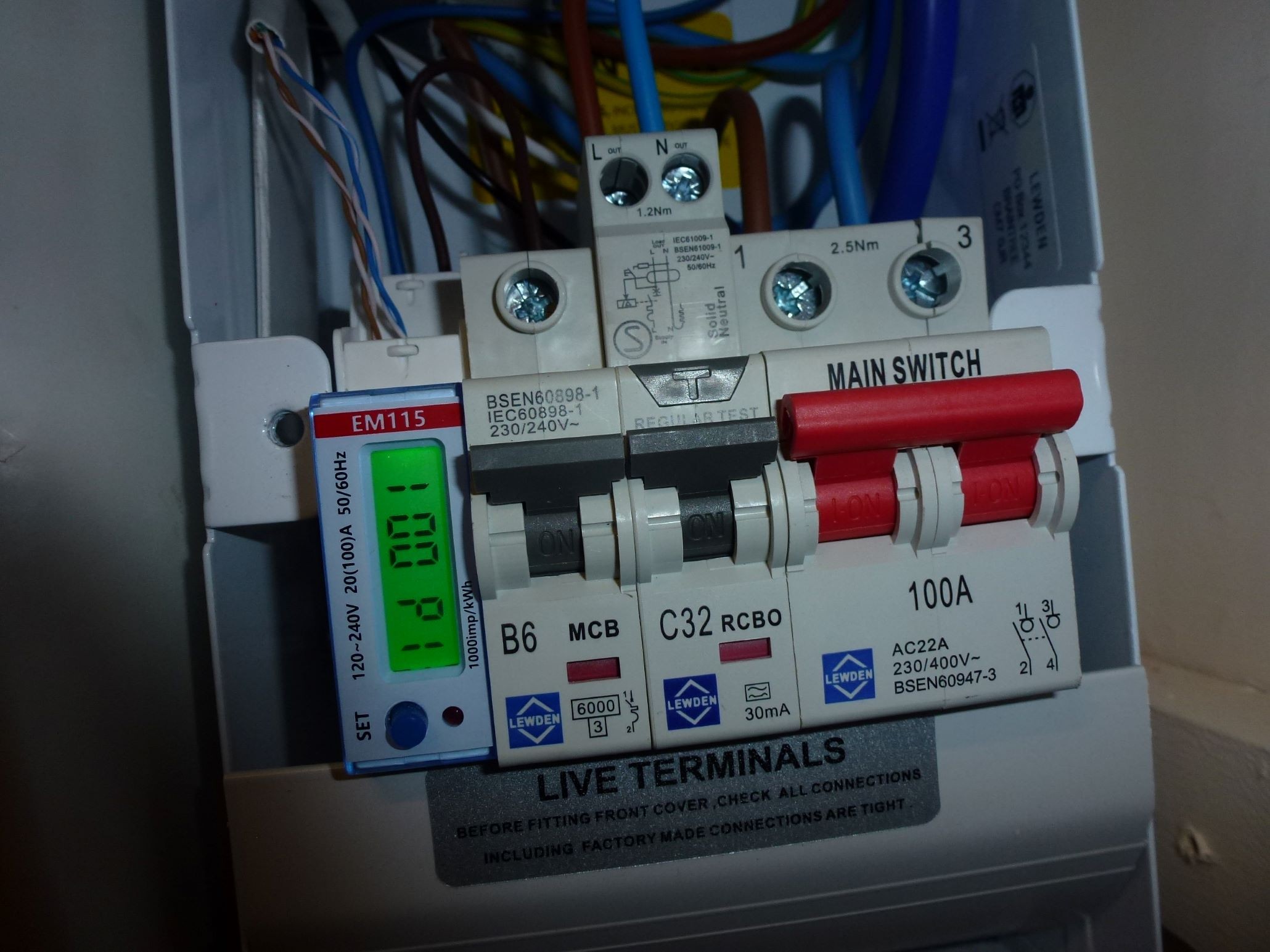
Hello, This is photo of the RCBO I have installed in my Solar system. I have looked at the markings on the C32 RCBO but I'm still not sure what I have fitted. Perhaps there is someone on here who could confirm?
Digger The diagram on the C32 RCBO says Supply In and Load Out, so taken together with the actual diagram indicates it is NOT a bi-directional RCBO, if that is the question you were asking. Caveat - I am not an electrician or installer.
Thank you T-M that was the question I was asking. I will see about getting it replaced with the correct bidirectional one. Once confirmed.
Digger One more wrinkle to mention. It is generally frowned upon to mix kit from different manufacturers in the same enclosure, so it really needs to be a Lewden Bi-Directional 32A RCBO. The reason I saw given for this is that the busbar terminations are different between manufacturers and can result in poor connections when mixed, raising the liklihood of overheating/fire.