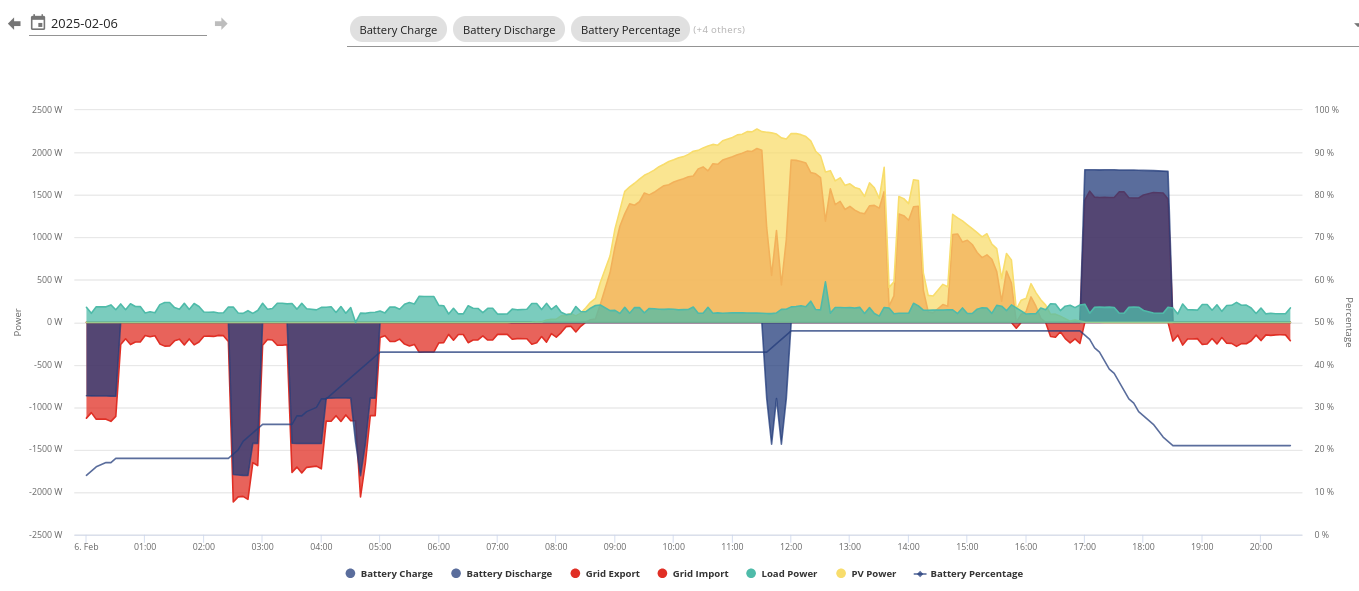
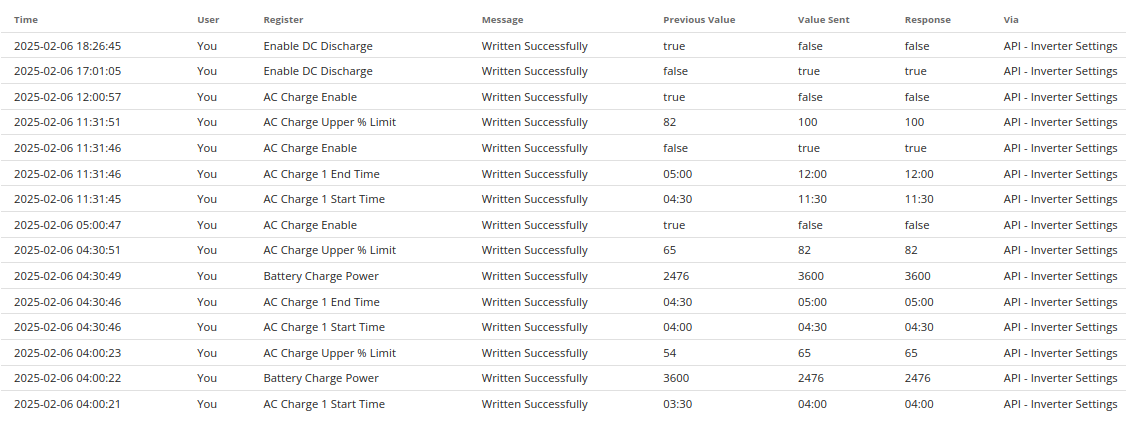
I changed from Flux a couple of months ago or so and have experienced a few occasions when the battery is not charged to 100% overnight. Octopus are aware but unable to offer a reason why. Worst event was a charge of 61% which stayed constant for the whole of the day and din't release any as export at due time. So no control by Octopus of Import or export.
Any ideas folks?
Also doe anyone know why when exporting there is a balance of up to 20% left. Normaly around 19 or 20%. Octopus claim it's to protect the battery but Giv Energy default is 4%. It effectively means only 4kw of a 5.2 kw battery would ever be useful. Any one else know of a reason for the difference?
So far Octopus has only suggested that I return to Flux tariff. I don't necessarily need the control so I would have preferred to stao on IOF.
Intelligent Flux
wjbucJohn Its disappointing that there are so many people that sign up to Intelligent Octopus Flux and do not understand how the tariff and battery works. You are the 3rd I think this week who has asked similar questions.
At the risk of repeating previous advice given (and please do search the forum for similar questions), in brief:
When you sign up to Intelligent Octopus you hand over control of your inverter and battery to Octopus to manage as they see fit. It does not operate the same as other tariffs and you need to be eyes open to this and understand what it means.
I have experienced a few occasions when the battery is not charged to 100% overnight. Octopus are aware but unable to offer a reason why.
Since you get paid the same rate to import as you do export, there is no benefit from charging your battery overnight. Other than perhaps using up spare grid electricity. In fact charging the battery is counter productive because there will be energy lost in the charging process.
Worst event was a charge of 61% which stayed constant for the whole of the day and din't release any as export at due time. So no control by Octopus of Import or export.
As above, there is no real benefit in charging your battery during the day and you will lose money compared to exporting any solar generation. Octopus want to ensure there is enough in the battery for the peak rate export, but adding more is wasteful.
Also doe anyone know why when exporting there is a balance of up to 20% left. Normaly around 19 or 20%. Octopus claim it's to protect the battery but Giv Energy default is 4%.
Read the IOF FAQ’s, the 20% is what Octopus always leaves in your battery so that if you have extra grid draw in the peak it will come out of the battery rather than be at the expensive grid import rate
It effectively means only 4kw of a 5.2 kw battery would ever be useful.
If you have one of the original 5.2kW batteries it is 80% depth of discharge so you only have an effective 4.2kW capacity anyway. Then take 20% off.
And finally, Intelligent Octopus Flux is not a particularly good tariff for the winter. In the summer when you are generating and exporting plenty, the better export rate is worthwhile, but in the winter with little generation you are paying 23p for all your import energy. Other tariffs such as Flux or even Economy 7 are better but all depend on how big your batteries are and what your daily consumption is.

I think if you are on IOF then you have given control of your battery to Octo and their systems will decide when to discharge and when to charge and the balance will be what it will be.
Octo have taken over and GivEnergy wont have anything to do with it.
Just my thoughts. May well be wrong
I don't use IOF myself, but from my perspective, it is a "set and forget" tariff. Octo runs everything for you and as @geoffreycoan has said in other posts, you are now treating the grid as an infinite battery - same cost in and same cost out, so why care?
If you do want to try and "game" the system, then you need a tariff that lets you keep control of the battery and you decide when best to charge and discharge it (there are plenty of tools available to do this).
I did know that control is in the hands of Octopus. No problem with that, but for example today battery has been discharged to 4%. This is not what Octopus tell me is their default. Their answers have been a little vague as has their reasons for not feeding the battery fully at cheap rate.
So yes, I did know what I was joining but I am puzzled by the variations of supply. It should be a fit and forget tariff, but I have had days where no input or output. I was curious to know whether anyone else had had the same quirks.
I have an interest in knowing how these thing work in practice due to having worked in the HVAC industry most of my working life, which included a lot on renewables, controls and tariffs. I do not claim that make me an expert, but I do understand what was supposed to happen, and that sometimes it did not. I do not have issues with charging battery during the day, because it should be full from overnight cheap rate. That then should be exported at slight dearer rate after 5.00pm.
I am in contact with them because they recognise there is an issue but do not yet know what is is. I am not looking for an argument but an explanation for the days where it does not function correctly.

Is the battery cold? I guess the not charging to full thing may be because Intelligent Flux isn't taking into account the lowered charge rates when cold?
Is it then getting itself stuck because the battery isn't at the % it thinks it should be and therefore not discharging it later?
I guess equally on the discharge side did it think it had longer to discharge than it did (because it wasn't fully charged?) OR is it an SOC drop that's pulled the battery down to 4%?
wjbucJohn Their answers have been a little vague as has their reasons for not feeding the battery fully at cheap rate.
wjbucJohn I do not have issues with charging battery during the day, because it should be full from overnight cheap rate. That then should be exported at slight dearer rate after 5.00pm.
I am in contact with them because they recognise there is an issue but do not yet know what is is. I am not looking for an argument but an explanation for the days where it does not function correctly.
There’s a couple of assumptions you are making here that aren’t quite right.
There is no overnight cheap rate. The rate you pay for import and the rate you get paid for export is the same all the time except for the 4-7pm evening peak. As I said above there is no financial benefit to charging your battery overnight and in fact when conversion losses are taken into account, you actually lose money charging the battery.
To explain further:
day rate in my region for IOF is 23.05p/kWh. So it costs 23.05p for each kWh you pull in from the grid. However you lose about 5-10% (let’s say 7.5%) in conversion losses when you charge the battery. So if you want 1kWh in the battery then you have to put 1/0.93=1.075kWh into the battery which will cost you 1.075*23.05=24.78p.
If you now use that kWh of stored energy in your house (or export it to the grid). When you discharge the battery there are similar conversion losses of 7.5% so to get 1kWh out of the battery to your home or grid export you will actually use 1.075kWh of stored battery power which cost 1.075*24.78=26.64p.
So you charge the battery at an import rate of 23.05p but after losses going into and out of the battery it will actually have cost you 26.64p to store and then discharge that kWh of electricity. So its actually better and cheaper for you to use the grid directly and not use the battery at all which is what Octopus are doing most of the time.
Octopus may choose to charge the battery overnight if there is a surplus of grid energy, or they may not. Its up to them. If you look at the Octopus Agile rates then you’ll see what wholesale electricity costs actually are, and for the last few weeks the rates have been pretty flat overnight so most likely why Octopus have not used your battery much
in my region,
Import rates 19:00 - 16:00 22.48p/kWh
Export rates 16:00 - 19:00 29.97p/kWh
Export commences about 17.00 to 17.30 and is normally depleted by 19.00
We try to use grid during cheaper rate times obviously.
The whole point of the tariff from Octopus point of view would be to supply local batteries when demand is low, so they can use the stored eneryg during peak period. We were working on such systems with smart storage some 12 to 15 years ago. Sadly didn't get off the ground then, but Octopus were not around as I am sure they would have been keen. The system is fine, just not always working quite as it should. They have been grateful for the feedback, and its interesting to note mine might be a bit of a one off. We may have a solution.
wjbucJohn As already mentioned by others, that may well have been cold weather limiting the charge. The lack of discharge might have been due to a threshold in their automation. I find the simplest way to test if they are still operating the battery is to turn on charge/discharge as appropriate for the tariff. If they are controlling your battery and they dont like your choice it will soon get turned off again.
For me, IOF seems to be completely haywire currently (well, for quite some time). GE system (3.6kW Gen.3 Hybrid Inverter; Gen.2 9.5kWh battery + 12x 400W Jinko PV). Absolutely no attempts to tinker, from me - pointless with IOF, of course. Absolutely no response from Octopus Support.
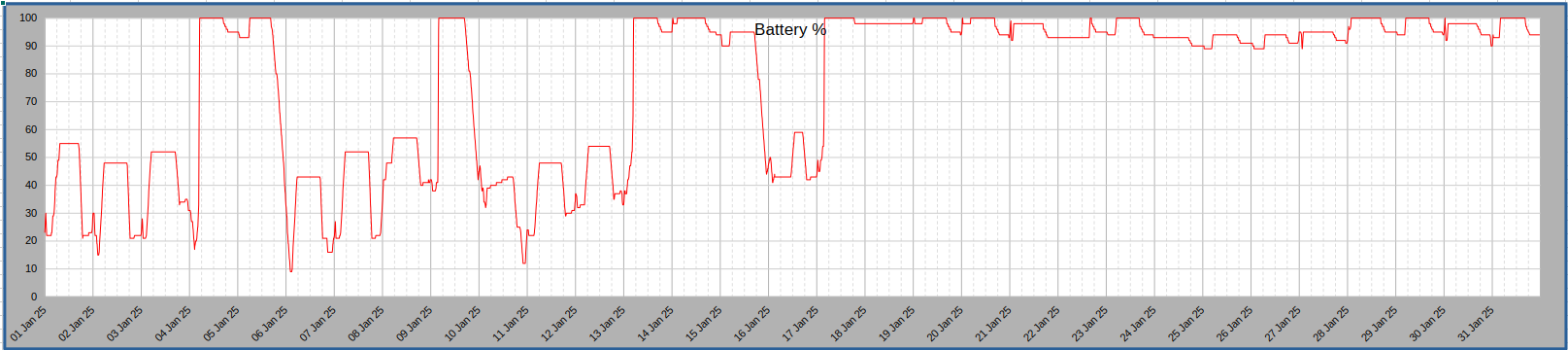
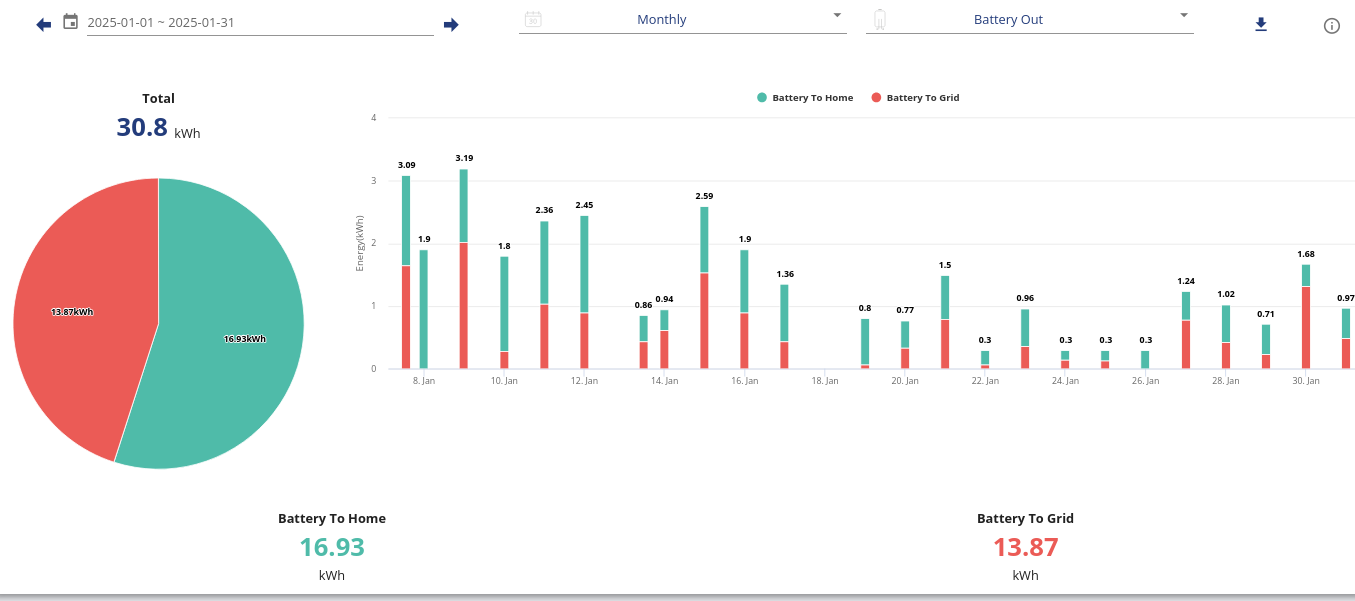
Here's what Octopus did with my battry this January...

[unknown] Hmm - if they're running your house from grid during peak periods, while the battery is full, that does sound like a bit of a problem :-(
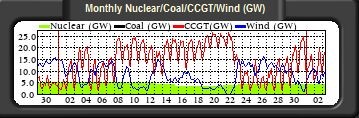
jonhd Looks like they charge when its windy and discharge when they REALLY need to - but not during DFS sessions by the looks of things.
https://gridwatch.templar.co.uk/ for some context.

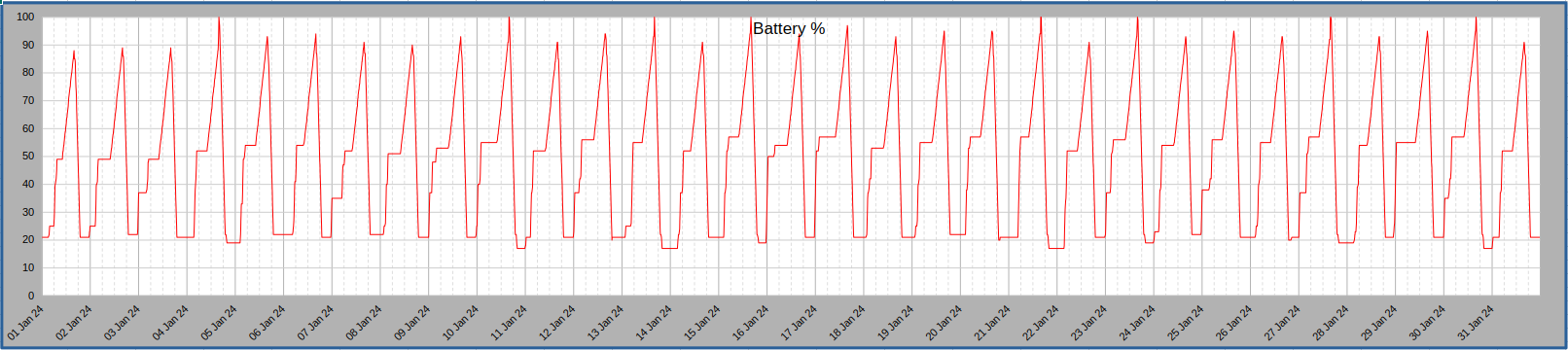
Wildly different to IOF a year previously (charge battery in the early hours, top-up from PV and Grid leading-up to 4pm, then significant export 4pm-7pm)...

Really, I guess, I'm just making the point that IOF (a beta product!) really is a leap of faith for end users. And, bearing in mind the mute Technical Support from both GE and Octopus, a leap of faith that's looking a bit foolish on my part :-)
Jon
Looks like something has got a bit FUBAR'd. Worth checking your firmware levels and doing a reset to defaults and send the time to the invertor. Did you check if Octo can still change settings by say, putting it into Eco mode. If they can control it they will switch it back. Mines an AIO but they are still doing their thing with mine ok
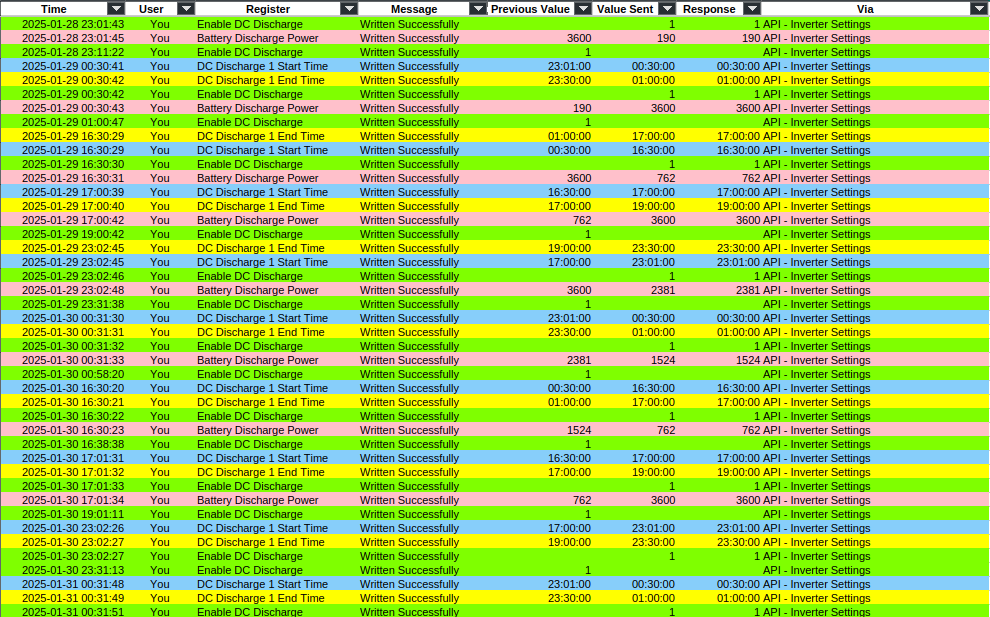
Hopeful Firmware all up to date. Octopus (according to the Giv portal, Remote Control log) doing their thing. Here's an extract from the Remote Control log (which was a tedious thing to do on account of the download timeouts that others have reported) - my colourisation / spreadsheet format / 'battery management' stuff only:

Anything glaringly obvious?
jonhd Anything glaringly obvious?
The pattern appears to be to discharge the battery from 00:30-01:00, 16:30-17:00 and then 17:00-19:00
There’s a couple of things I find strange:
- why is Octopus not letting the battery discharge from 16:00 to 16:30 which is the peak rate
- why is Octopus setting the peak rate discharge as two activities, 16:30-17:00 and then at about 17:01, a second discharge from 17:00-19:00. This adds unnecessary inverter writes and means that at 17:00 for a minute you are again incurring peak rates. Why not set a single discharge rather than two?
I don’t see any battery charging, are you getting sufficient solar charging for the peak period? If not then Octopus really should be charging your battery from the grid at some point in the day so that you don’t run out and incur grid import during the peak period
These are all questions for Octopus. I find a better response by messaging on twitter
geoffreycoan Also why are they messing about with battery discharge power?
From the graph it looks like its failing to discharge even though they are trying to initiate it. I think thats why you get the late night discharge as its trying to empty the battery to its target 20%. The stepped power change might be some winter warming oddity for the LV batteries.
Also because its not discharging it doesnt try and charge by the look of your log
.
Its worth checking vie the portal remote control if there is something odd set like a pause battery window, a SOC discharge limit on any active slots (usually 4%), or an invertor discharge power percentage (usually 100%). Be sure to refresh read each setting first.
The other thing might be winter battery conditioning (usually off).
A full reset to defaults might help if you havent done that too.
Other than that I am lost!
Vestas Also why are they messing about with battery discharge power?
I hadn’t spotted that, the 17:00-19:00 discharge is at 762watts, so anything you use above that will be at peak grid import rate !
geoffreycoan I think Hopeful has nailed it.
The battery isn't discharging at full rate. I wonder what the cell voltages look like.
geoffreycoan The thing with IOF that you have to really get your head round, and it goes against every primal reaction, is that its aim is to dump 80%ish of the battery in the peak window. It doesnt really plan to cover you on battery for the peak window. If its before the dump starts it will run on grid, if its after it hits its % level it will run on grid.
The logic, I guess, is that it doesnt matter if you draw back at peak if you have just emptied your battery at peak or will be able to in time. Powering the house or dumping to grid incurs the same losses so I think their idea is that if you help it in the battery to use, and then didnt use it, you are worse off than dumping it and drawing back only what you need, which may be less.
That being said this clearly isnt happening in this case so something somewhere is broke.
Hopeful Thanks to ALL for your comments. I'll try a 'Reset All to Defaults' - any pointers on how to do that, please (can't find a 'One Stop Shop' option to do that on the Remote Control page)?
Handing-over total control to Octopus is just fine by me - but only so long as there's at least SOME (useful) response from their Support team. I have tried and had no joy (contacted them around October when I noticed there had been a major change in IOF control at the end of last May - as far as I'm concerned I was fobbed-off by people who weren't sufficiently competent - sad to say).
Hopeful that makes sense, hadn’t entirely thought of it that way that if the battery is dumped out to the grid and you have to subsequently import in the peak rate then you’re no worse off (well you are with conversion losses)
jonhd you need to try to get through to the smart energy team, they have more idea what’s going on than the normal call handlers
geoffreycoan Wish me luck - is there a specific support email / phone no. for the smart energy team?
Found the "Reset to Defaults" on the app. So, that's done!
geoffreycoan Yea it goes against everything your brain is telling you when you have made the switch from Flux to IOF. I still have nervous "Chief Inspector Dreyfus" twitches when it hits peak window 🙂
Hopeful Now you've made me remember the lake scene at the lunatic asylum 😃
jonhd No I am afraid you have to battle through the 7 layers of defence I am afraid although I am not sure its Octopus thats the problem. Are you able to manually set a discharge window for the current time and actually see the export happening? Octo will probably turn it off but any sign of some full power export would be a good crowd pleaser at this point!
jonhd I'll try a 'Reset All to Defaults' - any pointers on how to do that, please (can't find a 'One Stop Shop' option to do that on the Remote Control page)?
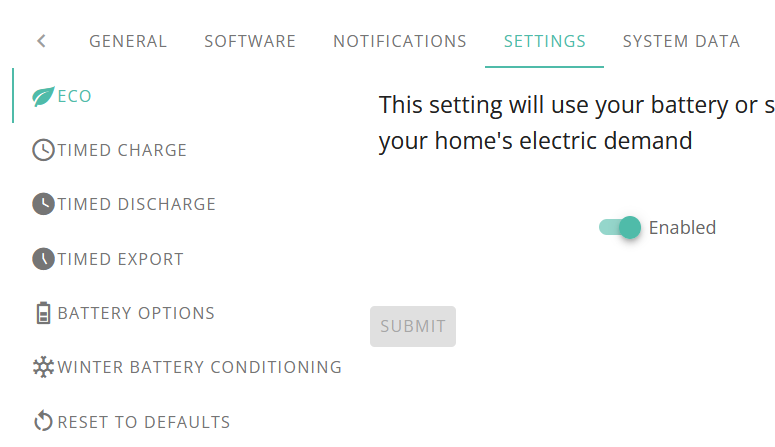
If you goto My Inverter on the web portal then chooose Settings, you should see a Reset to Defaults there
I'd post an image but this web thing keeps failing!

Aha, just save and then quickly edit!!!
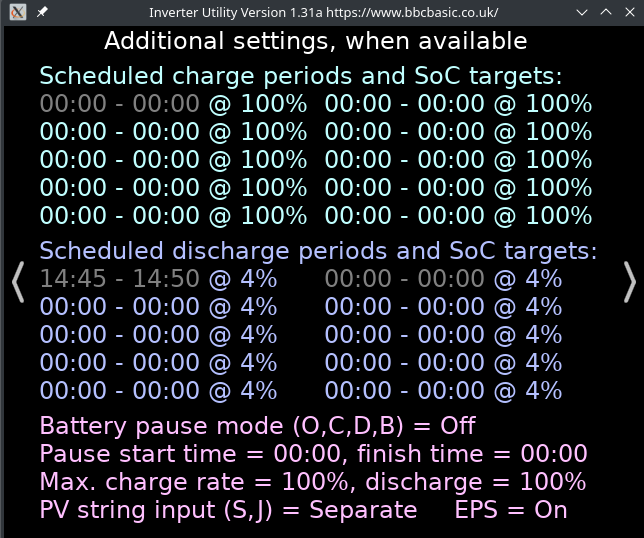
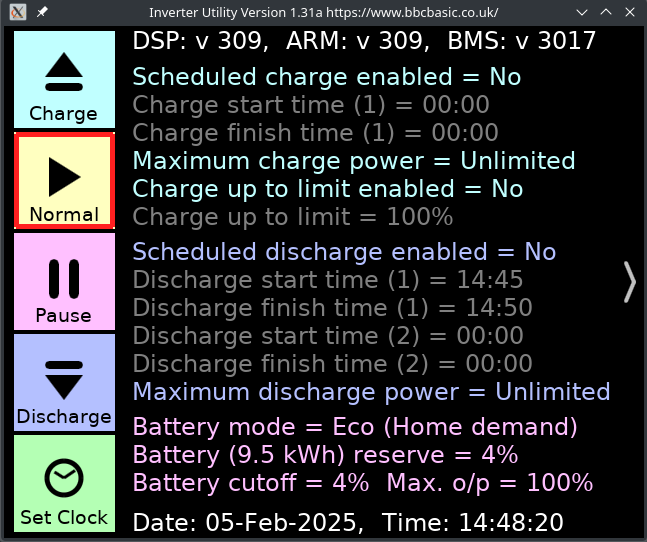
Hopeful Tried as you suggested (re test export):


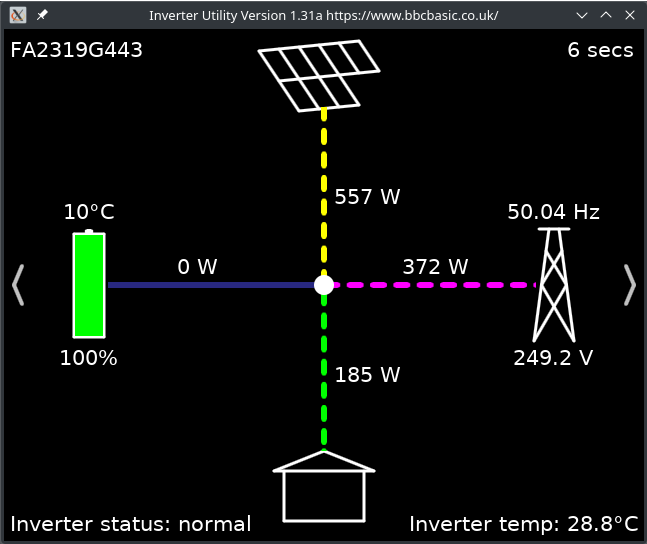
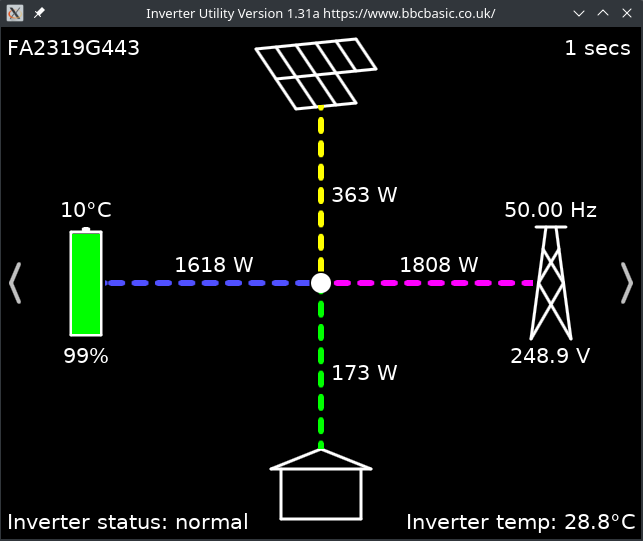
The screenshot of the BBC Inverter 'map' was taken in the middle of the 14:45 - 14:50 period. So looks like a GE battery issue? Baffled, as there has been export - here's January (so I can show a full month, but February looks to be shaping-up to be similar...
Oops - the January Battery Export graph...

Exporting now - after setting "Enable DC Discharge"...

jonhd Great so it does export, although maybe not at the rate you set unless it got changed from 3000 before you enabled DC discharge? Have to say I dream of only drawing 173w for house load 🙂
So I think the next thing is to monitor what changes Octo make and see if it responds accordingly. Based on previous logs I would expect something at 4:30pm and then Full tilt at 5pm.
Hopefully you are back in action!
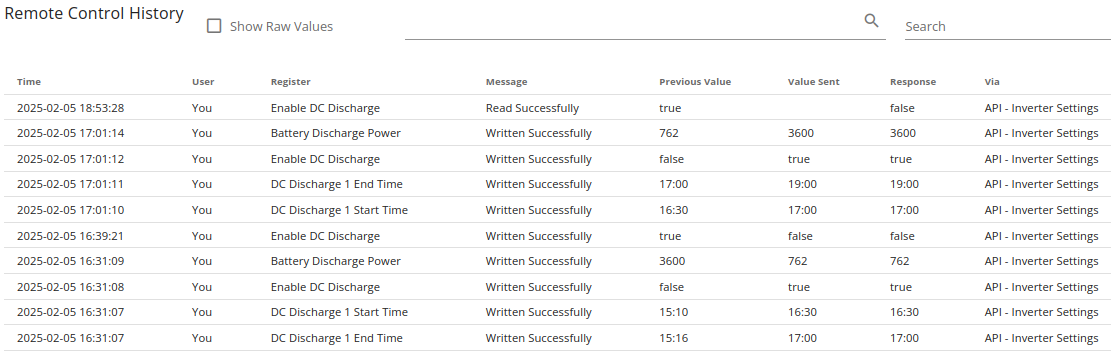
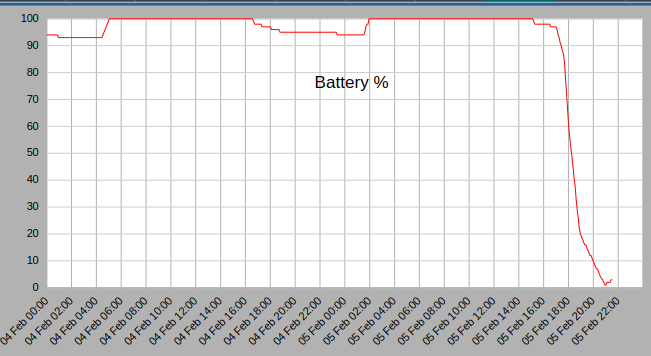
[unknown] Well, that was 'interesting'! IOF remote control kicked-in at 16:31 (well after I had done the test). Battery went all the way down to 1% (way after 19:00 hours, by the way). Very slowly climbing back up now (charge rate is 340W). Sadly, I'm traveling all day tomorrow, but will try & take a peek when possible.
Here's the remote control schedule (which does indicate a 7pm Discharge End Time (so why continue for another hour? - am confident the Inverter clock is synced & correct):

And, here's 4th Feb. & 5th Feb. Battery % graph:

May have to consider revoking the API Key, to block Octopus, if I get more 100% > 1% occurrences...
As a postscript - the battery stopped charging at 22:00. Sat at 4%. Hopefully will charge overnight...
Could it be a comms issue?
The instructions have to get from the web portal (where it seems they have arrived according to the logs) and down to the inverter.
I'm not sure how often the commands from the portal get re-tried. Maybe it a a fire and hope, rather than re-try until you know it arrived.
That could be the reason it discharges for longer than expected or doesn't change mode when expected.
Is your inverter on an ethernet connection or WiFi?
Could there be a signal issue and/or interference from other WiFi networks near by?
As for it starting exporting at 1630, I've seen that myself many times. It will export when it wants to. Or more to the point when Octopus needs the power. It'll start discharging slowly and then ramp up after 5 or 5.30pm. it's just how Octopus have designed it. Not much that can be done about that, it's their call.
jonhd Looks like it switched to Eco to discharge the rest of the battery as the discharge rate tailed off in the graph and the log shoes DC discharge was turned off, presumably at 20%. The GE portal graph would show more. Normally IOF doesnt switch to ECO and actively turns it off. Does your log show any commands from 18:53 to midnight?
TX200 and Hopeful - there certainly are comms errors. Bit baffled as to why, as the WiFi received signal strength is circa 70%. I may have to resort to ethernet....
A few screengrabs:
Energy graph showing battery never reached the target % that Octopus set (followed by the most recent logs, firstly filtered "Don't show errors"; secondly "Show errors"...


The % target they set is only a maximum before it stops, the other stop point is the time. It looks like they tried to step up the charge rate but the batteries didnt react as the graph doesnt show anything like the levels. The time slots then ended the charge.
This could be temp throttling in the new firmware but the 4:30-5 dived, which I dont believe is how the throttle works.
I dont know if the system did a calibration when the firmware was upgraded but its probably worth doing one.
After that, if its still the same I think its GE time, via your installer to try and get a timely response, unless anyone else has experience of this issue.
Hopeful Many thanks!
Will do a battery calibration when I return home (last calibration was 20/09/2024). Monitor for another week or two, and if still looking 'not right', will try my installer.
If anything significant does transpire, will report back.
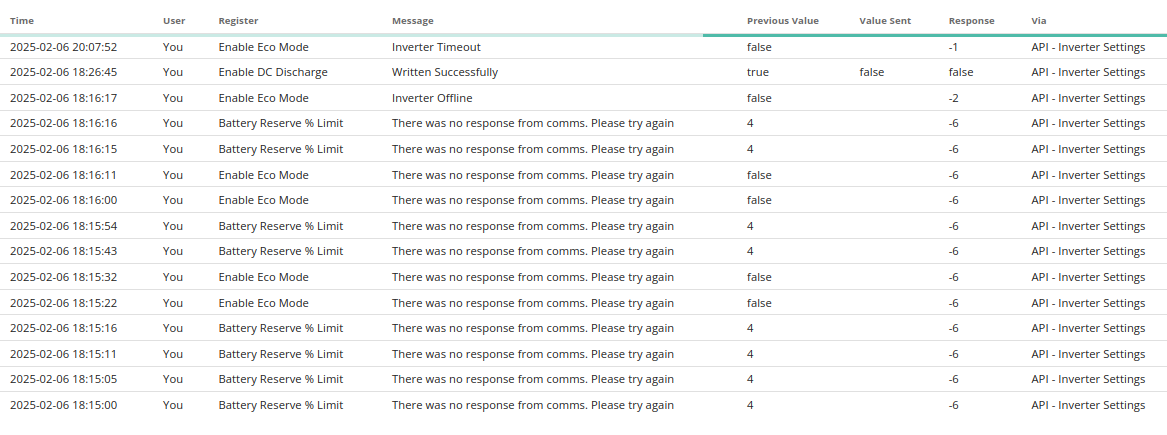
[unknown] Just an update on IOF <> GivEnergy comms issue. GE portal log ('Filter errors' OFF, obviously!), for the period 16th Feb. to 24th Feb. mid-morning:
- No. of Octopus messages: 1,145
- No. of Octopus messages that didn't fail: 162
A 'fail' is any message that resulted in a "Inverter timeout", "Inverter offline", "Request failed. Please try again", or "There was no response from comms. Please try again" response.
ALL fail responses were triggered, in the first instance, by either "Enable ECO Mode", or "Battery Reserve % Limit" messages from Octopus.
I have informed hello@octopus.energy and received a response saying they would pass it on to the relevant team. That was about a week ago. I'm not holding my breath.
jonhd If the commands are arriving in the givenergy portal and then not getting through to your inverter, the problem is nothing to do with Octopus.
It is much more likely that the problem is with comms from the portal to your inverter. Quite probably a poor wifi connection on your inverter.
Have you tried repeating the commands that Octopus sends on the portal yourself, do they reliably work or not work? I’d look at improving your inverter network connection first.
geoffreycoan I've successfully tested an Enable Ecomode TRUE command, from the portal. Shortly afterwards, Octopus sent an Enable Ecomode FALSE command, and it was successful. Here's a little snippet, showing that transaction (along with the 'normal' Octopus Enable Ecomode messages):

I'm guessing that sending this class of message with no 'payload' ('TRUE' or 'FALSE') is how they read the current value/setting... All that I know for sure is that, as long as the Inverter hasn't been blatted by a prior Enable Ecomode (or Battery Reserve %Limit) message, then it's EXTREMELY rare to see any of the other messages failing.