Adding second battery

49 comments started 2025-01-25 last 2025-11-19
GivEnergy ProductsBattery
G
#1 garycatt

I'm thinking of adding a second battery to my 8.2kWh one when I get a heat pump installed so I can make more use of off-peak rates (Octopus IO tariff).

  1. Where is the best place to source a battery? Is there a 2nd hand market?
  2. What would be approx cost to get a professional to install & commission it?
G
#2 geoffreycoan

garycatt GivEnergy did say that they were going to be launching a used equipment scheme about 6 months ago, but not seen anything of it.

There are second hand batteries appear on eBay, at prices much reduced from new, but whether you could get any warranty from GivEnergy if anything went wrong ….

You will need a professional to install and commission it. Even though electrically its very simple to add a battery, it has to be commissioned in the GivEnergy portal and only a qualified installer can do that (although any electrician can do the training course).
The way it works though is that there is that your customer account is only ever associated with one installer account so the installer has to take over responsibility for your existing installation when they add the new battery. Whether they would see that as worthwhile?

Your best bet therefore would be to get your existing installer to add the new battery. I had something similar done on my install except it was a brand new battery I bought (long story, not relevant to this). My installer charged me £400+VAT to remove the old battery, install the new one, wire up the EPS connections on my inverter which I also wanted doing, and commission the system.

I think most installers would be wary of taking on responsibility for a second hand battery they know nothing about. If GivEnergy ever do get the used equipment scheme going then this might be different - could be worth enquiring what is happening about this.

Which brings you back to buying and having installed a new battery. The economics of it will be rubbish, probably 10-20 year payback of the difference of IOG overnight vs day rates x battery capacity - 20% conversion losses x half a year that you’ll need the battery for your heat pump.

Buy more solar panels is my advice and generate and export more in the summer to build up a credit to run the heating in the winter.


G
#3 garycatt

Thanks for the reply, plenty to think about there.

Original installer was Ecobubl so I'll see if they can suggest anything.

H
#4 Henry3rd

geoffreycoan Buy more solar panels is my advice and generate and export more in the summer to build up a credit to run the heating in the winter

Is there any thought on worthiness for additional panels on the East elevation? I am assuming that these could be added in series to one of my two banks of panels.

G
#5 geoffreycoan

Henry3rd yes definitely worthwhile. I personally am in favour of East and West aligned panels because that way you get the longest solar day. You’ll get more peak performance from South facing panels, but longer generation (something like 4am-10pm at the longest day).

My roof ridgeline is almost perfectly North South aligned. My first panels (4kW FIT array) were fitted on the rear West side and then my GivEnergy panels are in two arrays, one on the front East (6.3kW) and one split East and West (4.6kW).
Today I generated 8.9kW on the East facing panels and 4.5kW on the West facing panels.

Its best if your different panel orientations are on different strings into the inverter.

If you have panels on different orientations on the same string then you can lower output than if they were on different strings because the different orientations will light up at different times but you’ll only get output when all the panels are generating their minimum voltage. Similarly shading that you might get on say the East array but not another orientation can drag the whole lot down.
This is the scenario where optimisers can make a difference.

Gary does solar has videos covering these things in a lot more detail than I can remember!

H
#6 Henry3rd

geoffreycoan I asked Octopus about the possibility of adding extra panels.
They did highlight that this would mean a fresh application to the DNO, and that there was a real possibility of a limit being placed on my export.
I got a sense, perhaps incorrectly, that they were not overly keen on retrospective alterations, which I can understand.
I could seek a third party view but I do not want to do anything that may affect my warranty.

G
#7 geoffreycoan

Henry3rd Your warranty is unaffected by adding extra batteries or inverters, but it has to be installed by a givenergy qualified installer. The other gotcha is that givenergy’s systems have the concept of 1 installer “owns” your installation so if you go to another company to have a second battery fitted, they have to take ownership of your current installation.
This makes sense from one perspective that they were the last ones to touch the equipment so they should take responsibility, but they are taking over stuff they didn’t install so some installers may not be keen to do that.

DNO approval is weird in my view. I had a 4kW FIT array installed in 2016 but when the installers of my givenergy system did the DNO approval they only put in approval for the equipment they were fitting. I queried this and they said that the DNO would already know about the existing equipment and they only needed approval for the delta.
And then about 6 months later I had a second battery fitted, another DNO approval required, and again only for that battery.

H
#8 Henry3rd

geoffreycoan Thanks, I have now heard from my original Octopus designer who has said that it is not possible to expand upon my system further because of the nature of the string-inverter. There is a maximum of one string per rooftop but only two MPPT inputs, allowing for two strings of panels.
He is going to look into the possibility of expanding my battery capacity, which brings us back to the subject of this thread.

G
#9 geoffreycoan

Henry3rd I have now heard from my original Octopus designer who has said that it is not possible to expand upon my system further because of the nature of the string-inverter. There is a maximum of one string per rooftop but only two MPPT inputs, allowing for two strings of panels

Its not quite as simple as that.

You can have multiple strings of panels on your rooftop, but he’s right, there is only two MPPT inputs to the GivEnergy hybrid inverter. So if you have a new string of panels then you would need a new inverter. That could be an AC coupled inverter (and your hybrid would charge the batteries from excess AC that would otherwise be exported) or it could be another hybrid inverter with its own battery - which at the moment isn’t a recommended GivEnergy solution (I have this setup but it does risk cross charging).

However, rather than adding a new string of panels it may be possible to add more panels to your existing strings. Whilst the inverter has a 5kW limit the panels will only generate this in peak sunshine so you can overload the inverter a bit. How many panels/kWh of solar do you currently have?

In short, 3 options are still possible:

  • more panels on your existing inverter
  • a second AC coupled inverter
  • more battery storage
D
#10 DD

geoffreycoan Whilst the inverter has a 5kW limit the panels will only generate this in peak sunshine so you can overload the inverter a bit.

Sorry, haven't been following the details, but a 5kW hybrid inverter has an AC limit of 5kW, but that's in addition to any battery charging. Mine has a 7.5kW limit, and that can be split between up to 5 to AC and up to 3.6 to battery. So my 6.4kWp array rarely has to clip (unless I carelessly allow the battery to fill).

V
#11 Vestas

geoffreycoan Remember there is a per-string limit as well as the overall published limit so its entirely possible to hit that before the inverter gets close to maxing out. That might be why Octopus are saying "no can do" in this case. I have two strings oriented exactly the same for that very reason - needed 2 strings for the G1 inverter I ended up with (would have been fine with G2/G3 on one string).

H
#12 Henry3rd

geoffreycoan One option I'm pondering is to decouple the garage from the mains and run it as a standalone. It feeds our koi pond, which has a standing power requirement of 200kwh 24x7. I do have a spare invertor.
I would need to ensure there is sufficient battery to keep the pond pump running, that said, I think its less important when the fish are dormant in the winter.

G
#13 geoffreycoan

Henry3rd our koi pond, which has a standing power requirement of 200kwh 24x7

I hope that is a typo, otherwise your I dread to think about your electricity bill !

Vestas Remember there is a per-string limit

Yes agreed, need more detail on how many current panels per string to work this out. Just saying adding more panels to a string is an option, doesn’t need to be new strings as the Octopus person seemed to imply

H
#14 Henry3rd

geoffreycoan I hope that is a typo, otherwise your I dread to think about your electricity bill !

🙂 It's an expensive hobby.

V
#15 Vestas

Henry3rd 200kWh per day? ie 200 units of electricity a day?

H
#16 Henry3rd

Vestas Ok, I admit it, I overstated by a factor of 1,000. What's a few hundred thousand watts between friends? 🙂

V
#17 Vestas

Henry3rd I was going to say, you don't need another battery/more PV - you need a wind turbine 😃

H
#18 Henry3rd

geoffreycoan Yes agreed, need more detail on how many current panels per string to work this out. Just saying adding more panels to a string is an option, doesn’t need to be new strings as the Octopus person seemed to imply

I spoke with Octopus today, and they will only entertain one string per roof. This is because of the possibility of a panel being in the shade, generating zero voltage and shutting down the whole string.
I suspect that this is a rare occurrence, but then again, why would they entertain the risk?

G
#19 geoffreycoan

Henry3rd I spoke with Octopus today, and they will only entertain one string per roof. This is because of the possibility of a panel being in the shade, generating zero voltage and shutting down the whole string.

It obviously depends on the roof you have panels on and the roof orientations you are proposing to add extra panels to as to how likely you think this is the case. There are various sun tracker apps, e.g. on iOS https://apps.apple.com/app/id1502500167 that you can use to help see where the sun will be at different times of the year and day.

However, Octopus are being disingenuous in what they are telling you. Yes if one panel is totally obscured and generating no voltage then it will stop the entire string from generating (as the panels are wired in series), or if the panel is partially obscured such as by your neighbours house or a large tree such that the power from that panel is below the startup voltage then the same thing can happen.

HOWEVER, unless your panels are really very shaded then you are going to get some generation regardless. Have a look at your generation on a day with any amount of clouds and you’ll find your panels are generating anyway even though they are not in direct sunlight. A lot of the generation comes from diffused light levels and so some shading doesn’t materially affect things. There are plenty of youtube videos that go through this in a lot more detail, have a look at the Gary does Solar channel where he explains the real-world effects of shading, and there’s videos on YT of people doing shading tests, e.g. with a branch, covering 50% of the panel up, etc.

And if you are still really concerned about potential shading then the solution is to fit optimisers on the shaded panels. These enable voltage to bypass the shaded panel so the string continues to work regardless. Again videos on YT of how these work. Really surprised Octopus are not suggesting this as this is the classic solution to having panels on diverse roof orientations where there is a risk of shading.

I suspect that this is a rare occurrence, but then again, why would they entertain the risk?

What risk? The worse that will happen is that in some circumstances the panels potentially won’t generate any current. Once the shading stops (or even partially stops) the panels will light up and generation will commence. Its no different when a cloud goes over the sky or at the start of the day, the sun has to be bright enough to reach the string start up voltage.
Or fit optimisers.

But sounds like Octopus just don’t want to do this anyway so even if you have the facts they don’t seem keen on it.

H
#20 Henry3rd

geoffreycoan But sounds like Octopus just don’t want to do this anyway so even if you have the facts they don’t seem keen on it.

Yep. They were keen on supplying a second battery and I asked for a quote which was £4.9k for an additional 9.5kwh.
It's unlikely I'll take this up.

G
#21 geoffreycoan

Henry3rd Yep. They were keen on supplying a second battery and I asked for a quote which was £4.9k for an additional 9.5kwh.
It's unlikely I'll take this up.

Not a great price. Battery prices have dropped an a Gen 3 9.5 battery is around £2,800 https://www.itstechnologies.shop/collections/givenergy-battery-storage/products/givenergy-9-5-kwh-li-ion-battery-gen-3 (the gen 2 is slightly less)

I had one fitted for £400+VAT but I already had the DNO approval, that could add another £300 depending on your region

A
#22 AndyL123

I think i already know the answer to this question but wondering if adding a second battery is the best route for me, I have the 5kw hybrid inverter and 9.5kwh battery, i have 7.5kw of panels on a ground array, the panels regularly make 6kw or more but since its cold at the minute only 2.8kw or so ever goes to the battery, maybe 2kw into the house and the remainder is being exported at a really poor rate(10.5p/kwh?), the question is would a second battery help reduce the export by increasing the output capability from the inverter to batteries or would the inverter to battery power remain at 2.8kw ?

G
#23 geoffreycoan

AndyL123 When adding a second battery the inverter to battery charge rate doesn’t change.

However in your case since the cold weather limit is being applied at the battery an additional battery will mean that the inverter output (2.6kW or 3.6kW depending on which model you have) will be spread across the two batteries so you won’t see the temperature slowdown.

You don’t mention who you are with for your electricity supply, but Octopus its 15p export and Eon its 16.5p so you could increase your income by changing supplier.

Adding a second battery doesn’t usually make a lot of financial sense though.

V
#24 Vestas

AndyL123 If you have a 9.5kWh battery then there's no way of adding another battery without probably losing money, not the way GE connect them up (as @geoffreycoan described). 5.2 and 2.6kWh batteries would make sense to add a second battery to go to 10.4/5.2kWh storage respectively but not 9.5kWh batteries.

A
#25 AndyL123

geoffreycoan Im in NI and unfortunately we dont have very many tariffs to choose from, PowerNI is my supplier/PPA and the current rate is 10.32 p/kWh so when im exporting 2kw and my battery isnt fully charged yet i feel like im being robbed

A
#26 AndyL123

Vestas I think what your telling me is that while its possible to add another 9.5kwh battery it doesnt make financial sense and that the 5.2kwh or 2.6kwh would be a more sensible purchase ?

V
#27 Vestas

AndyL123 No.

What I'm saying is if your starting point is owning a 9.5kWh battery then it doesn't make sense to buy another battery and connect it to the same inverter. You won't get payback because the inverter maximum charge rate is split between the batteries making it difficult to charge 19kWh during cheap rate time etc (assuming 2 x 9.5 on one inverter). Different sized batteries on the same inverter are problematic - there's plenty of posts if you search.

If your starting point was a 5.2kWh battery and you added another 5.2 then that'd make sense because you could charge both in a cheap rate time and the payback required is smaller. Ditto 2.6kWh.

Basically if you have a single 9.5kWh battery then financially its extremely hard to justify adding another GE battery because they're so expensive (commissioning costs on top of purchase). Payback period probably exceeds the battery lifespan in the overwhelming majority of cases.

G
#28 garycatt

Henry3rd

Bumping the thread as I now have the heat pump installed.

That does seem expensive. I had a quote from Ecobubl for £2795 total for the 8.2kWh battery, including £75 for materials and £250 labour. That was zero VAT rated.

This 5.2kWh one seems better value now, but VAT is charged here (?) I guess it needs to be supplied and fitted to be zero-VAT.
https://www.itstechnologies.shop/collections/givenergy-battery-storage/products/givenergy-5-2kwh-battery-ip65-charge-from-economy-7-octopus-go

G
#29 geoffreycoan

garycatt yes it needs to be supplied and fitted to be zero rated, and you can’t self-install the battery either, you have to get an installer to do so and to recommission the system.

I bought a 9.5 battery from ITS technologies as my installer wanted stupid money for battery storage, and then on finding I couldn’t install it myself (despite it being just a matter of plugging it in and setting the dip switch), I had to get my installer to fit it. They did the additional DNO approval as well; not convinced I needed that as the inverters were not changing, but anyway, they insisted on getting DNO approval, so that and waiting for the connection cable which was out of stock delayed my second battery install.
At the time there was VAT on batteries regardless so it didn’t make any difference.

If you are thinking of a 8.2, I’d look at a 9.5 instead. More storage for pretty much the same money.

#30 hoggy

garycatt Geoffrey will sell you his spare 9.5 - comes with a handy drain hole in it...

Sorry, couldn't resist...

G
#31 geoffreycoan

hoggy yep, a part-worn 9.5 is still in the garage, open to offers ….

C
#32 CGoode

My 2 pence worth.
I added an extra 9.5 battery to my existing 9.5kWh battery & 3.6kW Hy inverter in Jan '24 together. Also added 5 extra NW facing 425watt panels to the existing 10 x 415Watt SE panels.
Reason, my original 9.5kWh battery couldn't last the day during the winter months. I was also considering adding a HP at some point (no longer the case) so the extra storage would be needed to run that as well.

We are at home during the day most of the time & the household appliances never seem to stop so the original 9.5kWh batt was running out around 2-3pm most days during the winter - with no solar top up.
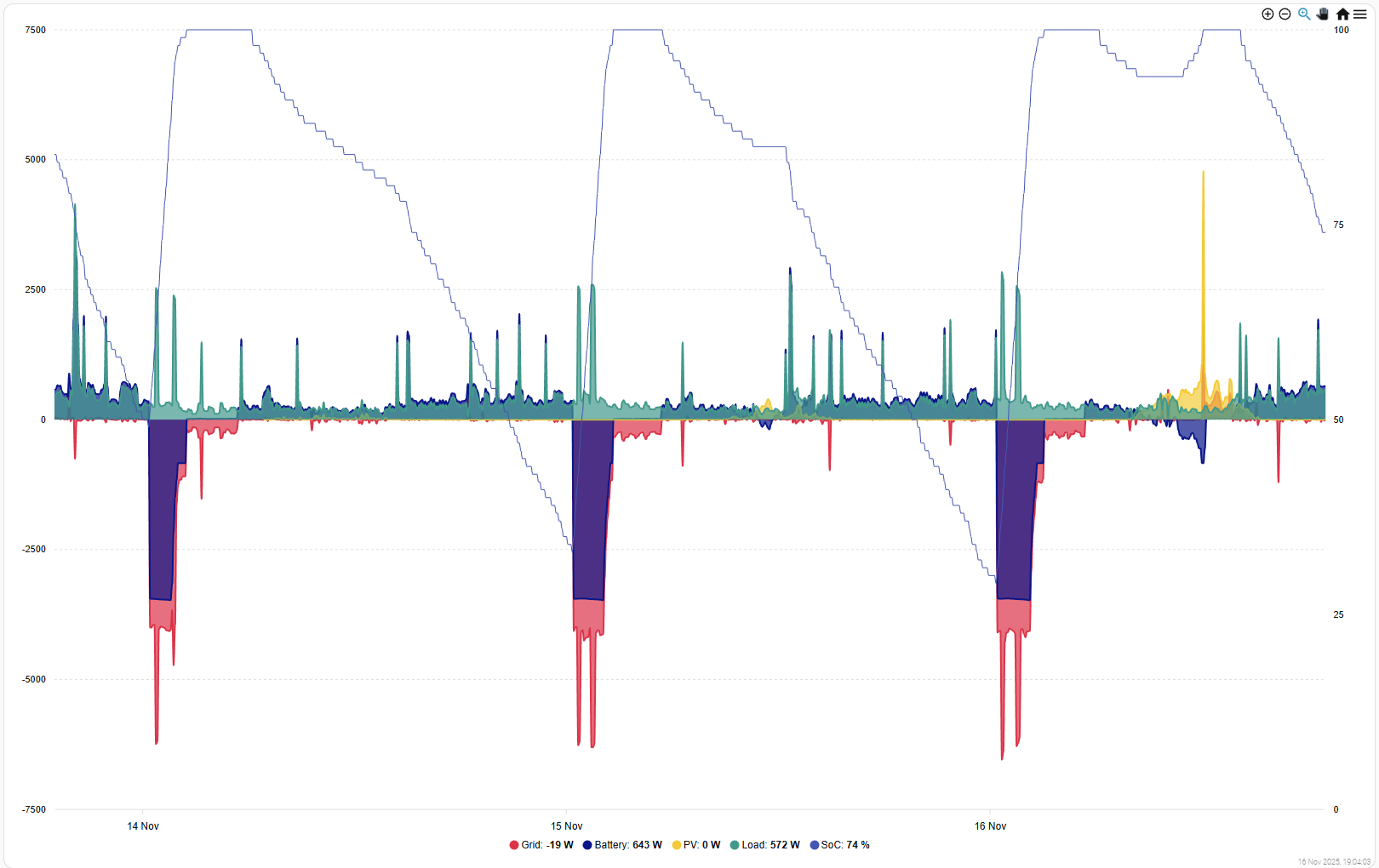
Now with 19kWh of storage we can run the house all day on battery power only during the winter without any solar or grid top up. On the IOGo tariff we can charge the 19kWh of batteries during the 6hr cheap rate window with the 3.6kW Gen 2 Inverter - just.

The 2nd battery & panels with scaffolding, pigeon protection et all cost £8k in Jan 2024 & probably won't make financial sense to many but for me it was being able to avoid using any grid power during the day in winter.

The extra storage capacity had another benefit during the summer, in that we could earn extra income from force discharging our fully charged batteries towards the end of the day. That extra income helps offset the cost of the existing & extra kit, reduces our Octopus bills generally & has allowed us to claim back overpayments from Octopus as well. We are still in credit with Octopus which means our winter gas usage is paid for.

Sometimes it's not all about ROI but some degree of self sufficiency & knowing that you're not lining some Utility companies fat cat's pocket.

R
#33 Rogerbu

I added a second 9.5 to my AC3.0 inverter 2 years ago. Great.
I have never run out of power during the day since.
I have always fully charged during the 23:30-05:30 Igo 7p/kWh window
I don't have to think about usage.
I don't have to monitor the family's use to avoid Igo high charges after the single 9.5 ran out.
Charge and discarge inverter limits are spread accross both batteries, so niether is being Charge/discahrge stressed

The only issue is that the inverter's charge/discharge limit of 3kW is sometime a pain, but can be easily managed

So I am happy with my decision. The use and family results overcome a poor financial case.

S
#34 SimonClarke

We have thought about another battery but can’t justify the cost. We have a 9.5 battery, 5kw gen 1 inverter, EV, and heat pump. All on IOG. Yesterday was a bad day and the battery ran out at 17.30 as there was almost no solar. This is with the heat pump keeping the entire house at over 21c, normal appliance use, and using the oven to cook dinner. If it is sunny at all we can get to 2200 or later so it is difficult to justify an extra battery but if the price goes down we might reconsider as we too could export more in the summer - assuming that too is still viable

G
#35 geoffreycoan

SimonClarke I think the economics of adding extra battery storage are only going to get worse.

Its highly likely that the fixed export rates will get replaced with tiered/banded export rates, encouraging us to export in the peak when the grid needs it, but paying much less in the daytime when there is an excess of power.

I had forgotten that it was only September 2022 when Octopus raised their export rate from 8 to 15p https://energy-stats.uk/octopus-agile-outgoing-export-eastern-england/ and it was a period of time after that before export with Octopus Go was aligned to the same 15p rate.

As already posted here, Eon have cut their export rate from 16.5 to 6p, and whilst Octopus will pickup some customers as a result of this, I wouldn’t be surprised to see them follow suit.
I’d love an extra battery (although quite how I would fit it in the garage without losing some storage space for all the useful ‘stuff’ that’s in there), but I just can’t justify it financially. Yes not importing at peak rates is good, but the rate differential of 26-6p or whatever takes an awful lot of kWh to recoup the investment.

I’ve done different spreadsheet models and depending on scenarios (extra peak rate export, avoiding winter grid import, etc) I get a payback of between 5 and 22 years. With import and export rates as they are I will payback my current equipment in a further 4 years time, and will see what happens then

S
#36 SimonClarke

geoffreycoan we have been doing forced export/discharge or whatever it’s called during the sunny times for about two hours 16-1800 so that might still work if there was encouragement to help with peak times. We have a Solar iBoost that we don’t use now because of the heat pump so that would come back into use.
There is so much speculation on what is coming in the budget all of which appears to be just guessing and then acting as if it is fact. I’ll worry about it when it becomes real and the same applies to octopus etc as well.

S
#37 SimonClarke

Another issue with adding a battery is where does it go? Ours is in a cupboard next to the front door. Ideal location. Doesn’t get too hot or cold. Not getting rained on. But I think the current “rules” wouldn’t allow this location. I think we would have to move everything to the detached garage which would be hardwork and expensive

M
#38 mikes01666

I have an AIO system (Battery in garage, Gateway in house).
With little solar this time of year the Battery lasts the whole day (just) until the cheap rate (IOG) kicks in.
What are the possibilities of adding a second Battery (not another AIO as too expensive).
Maybe an old 2.6 kWh Givenergy or 9.6 kWh newer model.
Can it just be daisy chained onto the AIO (plenty of space in the garage) or will it need separate connection to the Gateway?
I'd just like the battery capacity to be increased to 15 -20 kWh which will guarantee day-long power.
Any DNO considerations?
Obviously a Givenergy accredited installer will need to do the work.
Thanks.

G
#39 geoffreycoan

mikes01666 You unfortunately can’t just add a secondary battery to an AIO, have to add a whole new AIO unit and connect both AIO’s through the gateway. I believe the AIO2 you can connect the same stackable batteries as are used on the 3 phase and high voltage hybrid inverters, but since none of us have these, it’s a moot point.

You can add a second inverter, e.g. a hybrid and its own batteries, and that will work, but you are going to get issues of cross charging so are going to have to deal with that in how you program the AIO and inverter throughout the day. Basically don’t leave them both in Eco mode at the same time.

SimonClarke But I think the current “rules” wouldn’t allow this location.

I’ve heard conflicting things about how enforced/enforceable these “rules” are, whether they are best practice, guidance or what. So sort of thing best to talk to your installer about and not take advice from internet forums over !
It may be possible to fit a second battery remotely from the first, there are distance limits though, or maybe fit the second battery outside?

As you said about the budget, much speculation and column inches getting filled with discussing it. I have tuned out of such things and totally stopped watching the news about a month ago; not missing it much TBH. When it happens it happens and I’ll deal with it then

W
#40 wrighar

Likewise, I could really use one, but I'm having a hard time justifying it.

We average 12.3 kWh per day and have a 9.5 battery.

We use IOF during march to October, so could export an additional 4 kWh at 31p if Kraken choose too as opposed to currently those 4 kWh at 23p, currently it exports 5pm to 7p as that takes the battery from full to 20%.

Nov to Feb we are on GO this year (COSY last year). With COSY the 9.5 battery was topped up 3 times a day at 13p kWh, so we never ran out
This year we're trying GO at 8.5p kWh but only a 0030-0530 cheap slot. even with Friday 0.2kWh solar gen we didn't quite run out as we've moved the dishwasher to overnight, but haven't used the oven yet.
Any daily solar just extends out range, so the 2.5kWh we got today was brilliant.

It's a bit like having range anxiety, except will will not get stranded, just charged 29p kWh for any shortfalls.

Maybe I should have gone for an AIO, but would have needed an inverter too and that was all too expensive and I didn't need a gateway which was 'needed' back then, likewise a 2nd battery at day one was too.

If there had been a single 13.5kWh LV gen 2 battery I'd would have jumped in.

O
#41 Ortwin

We added a second 9.5Kw battery to our 5Kw inverter and panels. It's been good as we are now on Intelligent Octopus Go with our BEV and can import cheap electricity overnight and export during the day at double the rate.

J
#42 Josephiah

I modelled this in depth for several scenarios for our home (fairly heavy usage - heat pump, household of 7), and couldn't get the economics to make sense. On Agile or Cosy, once you have enough storage to bridge the 4-7pm peak, and the bulk of the standard rate time, you're really into diminishing returns. For my situation, the next big step change would be when proper bidirectional EV charging becomes a thing, at which point the economics of the whole house + vehicle system changes significantly.

I do occasionally toy with the idea of putting another PV array on our NE-facing roof, which would double the capacity on overcast days, and do well in our northern summer sunshine, but that's probably never going to happen.

G
#43 geoffreycoan

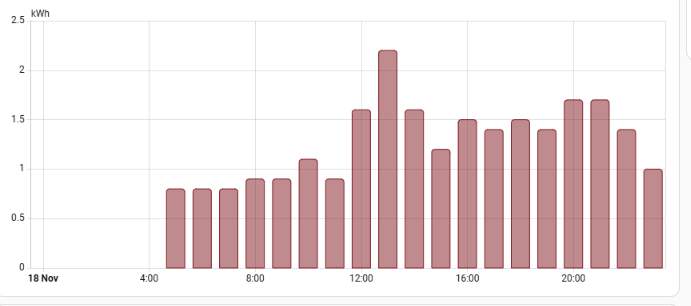
Josephiah real world example from today, I'm on Cosy, its been cold today and the heat pump has been consuming between 1.4 and 1.7kWh:

I fully charged the batteries in the 4-7am and 1-4pm Cosy slots, but with cooking, etc they ran out at 9:30pm so I was grid importing at the Cosy day rate until 10pm.
According to the Octopus app I imported 40p of electricity in that time period. If it was on electricity stored from charging in the Cosy cheap rate (and ignoring that my inverter throughput would have been a limiting factor to fill extra batteries), it would have cost 20p,

I'm sure the import will increase as the weather gets colder, but there are relatively few really cold days and I built up a £900 Octopus account credit from summer export.

#44 Windy Miller

geoffreycoan So using that metric of costing an extra 20p on one cold day. If another battery costs £2000 then you need 10000 similar days to recover that cost. That's 27 years minimum payback (actually a lot longer as perhaps only 60 days a year are this cold). It's easy to see why adding an extra battery doesn't make economic sense. Really, as Josephiah said, you need just enough capacity to get through the peak sessions. In my house (without a heat pump) a single 5.2kWh would do but I bought 2 at initial install. That second one will take me longer to get the value back but I do have some redundancy as a result.

Where an extra battery does help is where I can charge cheaply and export at a high price - the opportunities to do this on Agile are rapidly diminishing, yet if I could choose the export time for maximum gain (better than the fixed 16.5p EON export SEG) it would certainly help.

C
#45 CW

Windy Miller better than the fixed 16.5p EON export SEG

That rate no longer exits. I do wonder though, with the inexcerable march towards smaller and smaller export tariffs (even going negative) how that would then change the calculations, because once the battery is full and you are exporting, then if you are being charged for that (which could be for a good 6-8 months) that might change the dynamics

V
#46 Vestas

CW It probably does for Windy Miller as EON installed his PV.

C
#47 CW

Vestas Ah yes, that tariff is still looking very good 😃

#48 Windy Miller

CW It does until May when my annual anniversary comes round.

**Your new SEG tariff
Next Export Exclusive
Your new SEG Prices
16.5p/kW
Tariff end date
01/05/2026

Your SEG will automatically renew unless you tell us differently or switch to another supplier.**

C
#49 CW

Windy Miller For me at renewal it would be the new rate 6p/kWh. Octopus energy is looking a much better option going forward!