Inverter not using power from the battery

32 comments started 2025-02-03 last 2025-08-11
GivEnergy ProductsHybrid
P
#1 Pht

Hello, I have a GIV-HY5.0 inverter with a 9.52kWh battery. It has been installed for nearly two years. I have seen quite a few times where the battery has plenty of charge as far as the logs show but the inverter decides not to use it and instead we use power from the grid. Originally this was suggested it could be related to over voltage from the grid and as it took so long for UK Power Networks to sort this out by installing a new transformer on their network that supplies out property we were told to turn our installation off to avoid invalidating the warranty. Once the work had been completed by UK Power Networks last April we turned it all back on. I have been monitoring this from the various logs on the portal and have yet again noticed the issue where power is drawn from the grid and not from the battery though this is normally overnight and for 1 or 2 hours where we don't use a lot of energy at present. I have got ECO enabled in the settings. However, last night it was the worst I have seen where it spent from about 22:00 though to 3:30 not using the battery (3:30 it the time I have set to charge the battery from the grid as I am on Economy 7 and wish to make use of battery during the higher cost period). Obviously this is not what I wish to happen and I was wondering if anyone else has had this issue or any advice?

S
#2 SteveCook

What tariff are you on. Are you using an externally controlled tariff?
Eco 7 starts at 00:30 so why wait until 03:30
What do inverter logs say?

D
#3 danhaywood

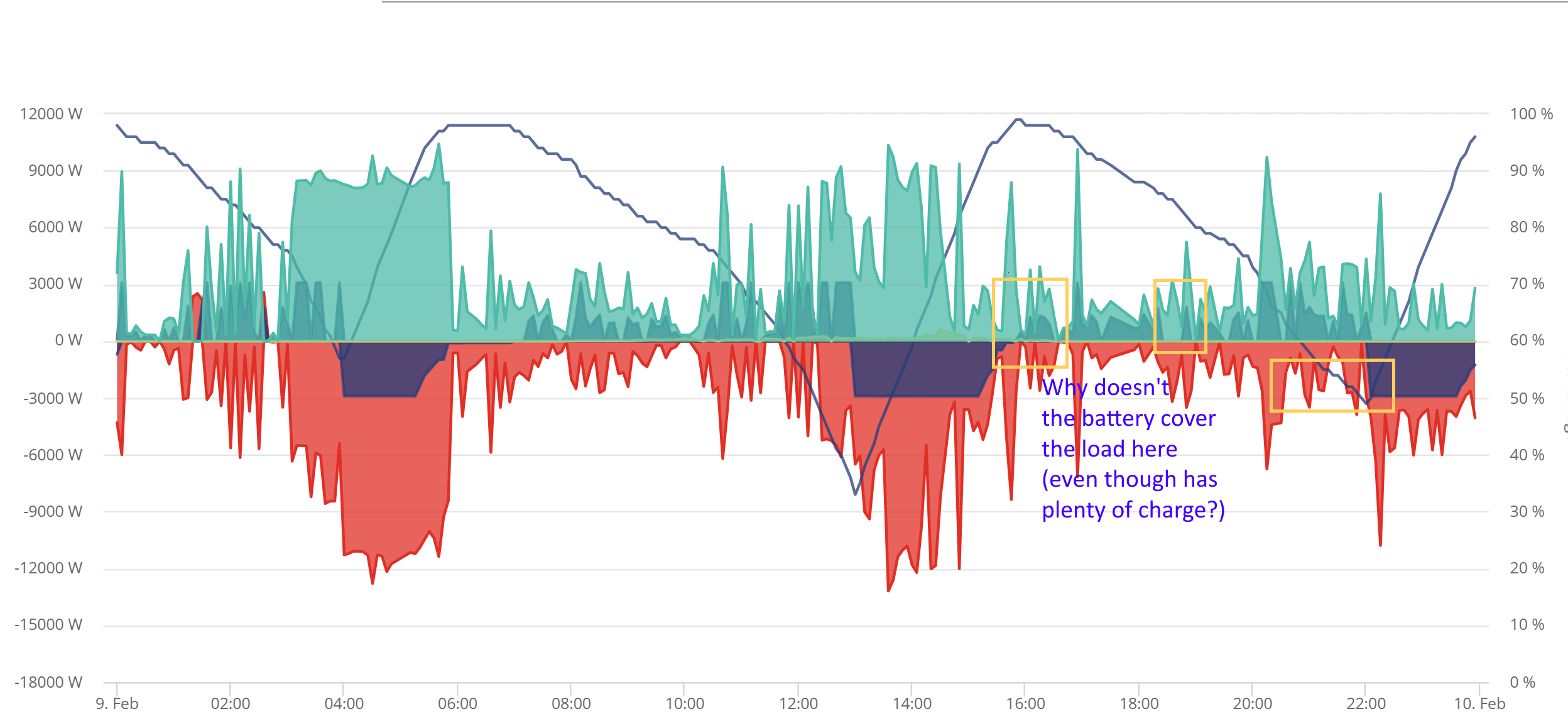
Pht We notice something similar with our newly installed system, eg:

Still debating the issue with our installer, but interested if anyone here has an insight.

Inverter Model
GIV-AC3.0
Software Version
D0.205-A0.205

G
#4 geoffreycoan

danhaywood what settings have you got your inverter set to, is Eco mode turned on, is there a timed discharge or timed charge or anything setup for the highlighted periods.

In the graph above have you got battery discharged turned on? There doesn’t appear to be any blue above the vertical line which would indicate battery discharged turned but yet the SoC is dropping in the boxes you marked, indicating that the battery is discharging.
I do notice you have some very large house load spikes at around 9kW. The AC coupled inverter which I think is what you have from the software version is limited to 3kW charge and discharge rate so it wouldn’t be able to meet all that demand and you will have some grid import

D
#5 danhaywood

Hi geoffreycoan - I'm on Octopus Cosy, and am using Wonderwatt to do a force charge during the cheap periods, 4-7am, 1-4pm, 10pm-12am. Outside of those times, Wonderwatt switches the inverter to Eco mode.

Yes, I do understand that our inverter/battery has a max throughput of 3kW, so any time our house load exceeds that we are going to be using the grid. And indeed when it does spike, I do indeed see the battery at 3kW. But at other times the discharge is less than 3kW, typically 40-60% of the actual house load.

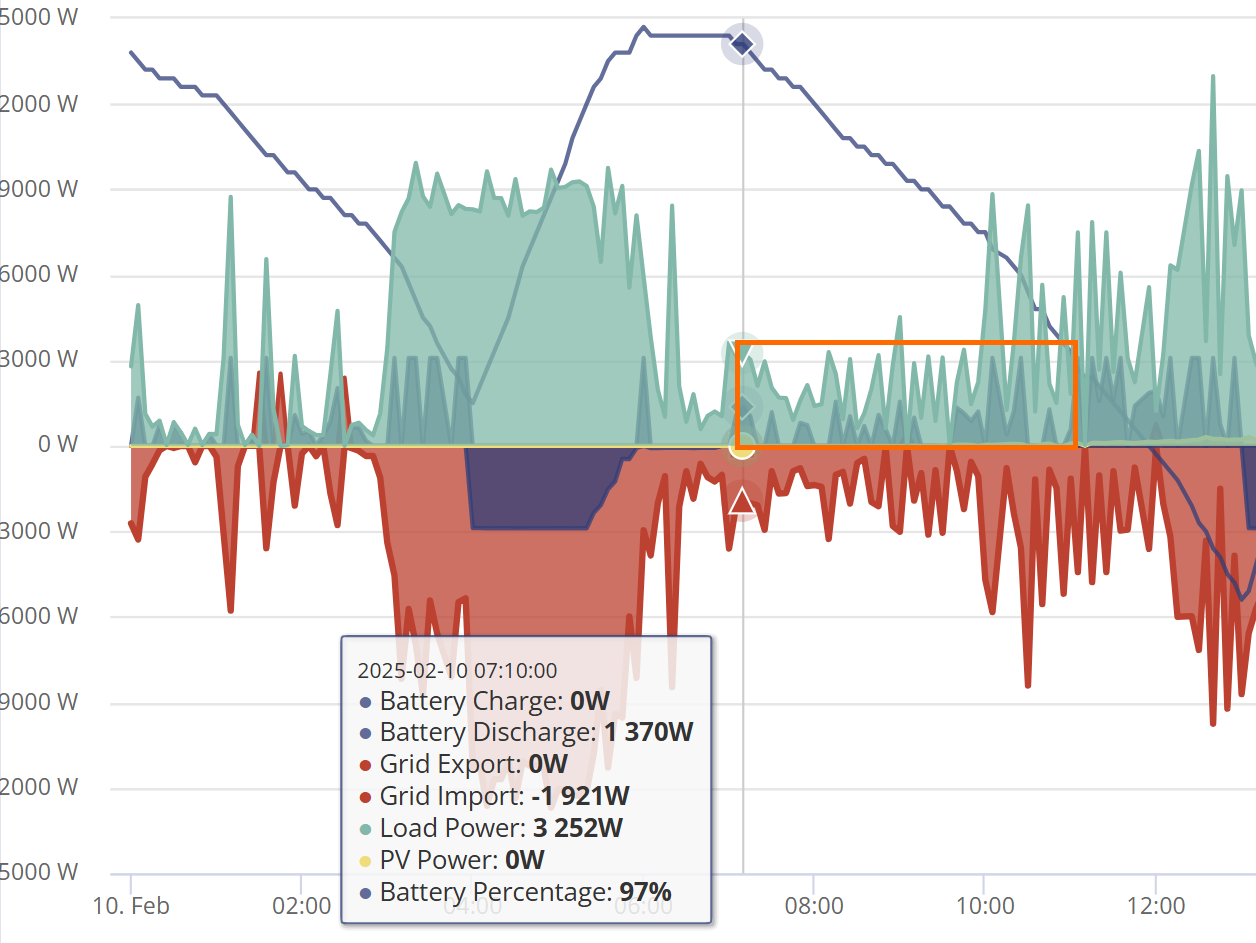
Here's another picture from today:

From a layperson perspective, it looks like some sort of calibration issue? But that's a random guess. If you/anyone has an insight on this, it'd be much appreciated to keep my leccy bills down a bit.

Thanks

G
#6 geoffreycoan

danhaywood thanks, that’s clearer, can see the spikes of your inverter discharging now, its dark green on top of the light green load.

Looks like your inverter discharge is following the load and even up to 3kW, but not discharging sufficient to meet the load

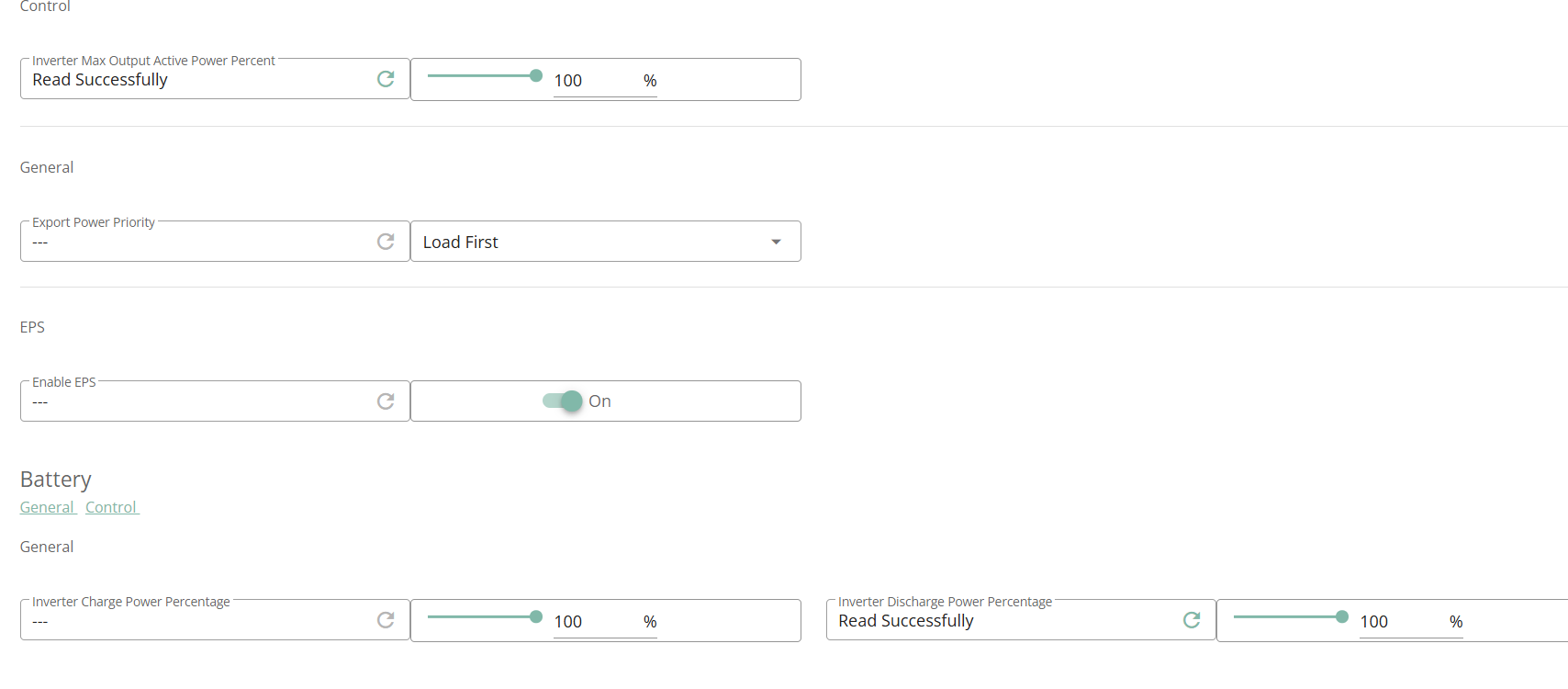
Have a look at the remote control settings in the portal, in particular Inverter Max Output Power Percentage, Inverter Discharge Power Percentage - these should both be 100%. Click the little circle next to the control to retrieve from the inverter, and even if it says 100%, try changing it to something else then change it back to 100%.

I suspect one of those is misconfigured to 50%,

D
#7 DD

danhaywood From a layperson perspective, it looks like some sort of calibration issue?

The demand is extremely spiky, whereas the readings are snapshots rather than integrated totals. Because you are on Cosy, I assume you have a heat pump - does the power consumption really fluctuate that much ?

However, between about 3am and 4am, the consumption was consistently high, yet the battery discharge still seemed to pulse. So that's pretty odd. Again around midnight - consumption is noisy, but consistently above 3kW, so it's odd that the battery didn't just discharge at a flat rate. I wonder if the large swings are confusing the inverter in some way (power factors, those sorts of things).

D
#8 danhaywood

geoffreycoan

Thanks for the suggestion, which makes sense to me, but it would seem both are set to 100%:

D
#9 danhaywood

DD We don't have a heat pump, but we do have an electric boiler for our new annexe/office, which has underfloor heating and a 9kW electric boiler. The advice for underfloor heating is to keep it pretty consistent, still experimenting but my current regime for my office has the thermometer set to 22 at 4:30am, back to 20 at 7am, up to 22 at 1pm, and down to 20 at 4pm. That way the room is cooling down when leccy is more expensive, warming up when it's cheaper. I probably also need to experiment with keeping it consistently at 21, say, but even if that uses less leccy overall, my guess is that I'll end up buying more during expensive periods.

For the 3am/4am, perhaps my thermometer is out by an hour, I'll double check. For 10pm/12am, that's when I have Wonderwatt switch on battery charging, which accounts for the load there.

Thanks for the theory re: large swings maybe confusing the inverter; if that is the case, then not sure if its actionable, other than hoping for more sophisticated firmware...

D
#10 DD

danhaywood The advice for underfloor heating is to keep it pretty consistent, still experimenting but my current regime for my office has the thermometer set to 22 at 4:30am, back to 20 at 7am, up to 22 at 1pm, and down to 20 at 4pm. That way the room is cooling down when leccy is more expensive, warming up when it's cheaper. I probably also need to experiment with keeping it consistently at 21, say,

But the consumption is very spiky on a much shorter timescale - seems to be outputing short bursts of high power rather than modulating down to produce lower power continuously.

D
#11 danhaywood

DD Yeah, I don't really know. The boiler in question is in a cupboard within my office, so I can hear it click on and off every now and again; in case this is relevant it's a Potterton Gold, product code: 94022005.

The other gas guzzler we have is an Everhot oven, like an all-electric Aga. But I know that maxes out a 3kW because I am monitoring its usage through a GE plug. Still when it and the Potterton pull at the same time, we spike up at 12kW.

I'm too much of a layperson to know if spikes are unreasonable, though ... should the Potterton somehow smooth out its usage? Is my programming of those small changes in the temperature to blame?

V
#12 Vestas

danhaywood The other gas guzzler we have is an Everhot oven, like an all-electric Aga. But I know that maxes out a 3kW because I am monitoring its usage through a GE plug.

Ummm you may want to have a search through the forum regarding "GE plugs" and what load they're really rated for.

Spoiler - fire/melting/burning may appear in those posts 😉

D
#13 danhaywood

Vestas IIRC the GE plugs are rated to 16A, and the oven runs from a standard 13A plug. But thanks for the heads-up.

G
#14 geoffreycoan

danhaywood IIRC the GE plugs are rated to 16A, and the oven runs from a standard 13A plug.

The GivEnergy plugs are NOT rated to 16A. The product literature is wrong and GivEnergy have been told that.
Someone did a teardown of one and some of the components inside are only rated to 10A IIRC. As @Vestas says have a search on the forum, there’s been a lot of discussion of this before including a melted one.

If you want to run a high load appliance on it I recommend the MyLocalBytes ones which are rated to 16A

D
#15 DD

danhaywood Is my programming of those small changes in the temperature to blame?

No. It just seems to be the design that it's either on full-power, or it's off. So the clicks you hear may well be it doing that.

The web page does say "Soft start and zero volt switching to avoid power surges", which should help a bit.

C
#16 CW

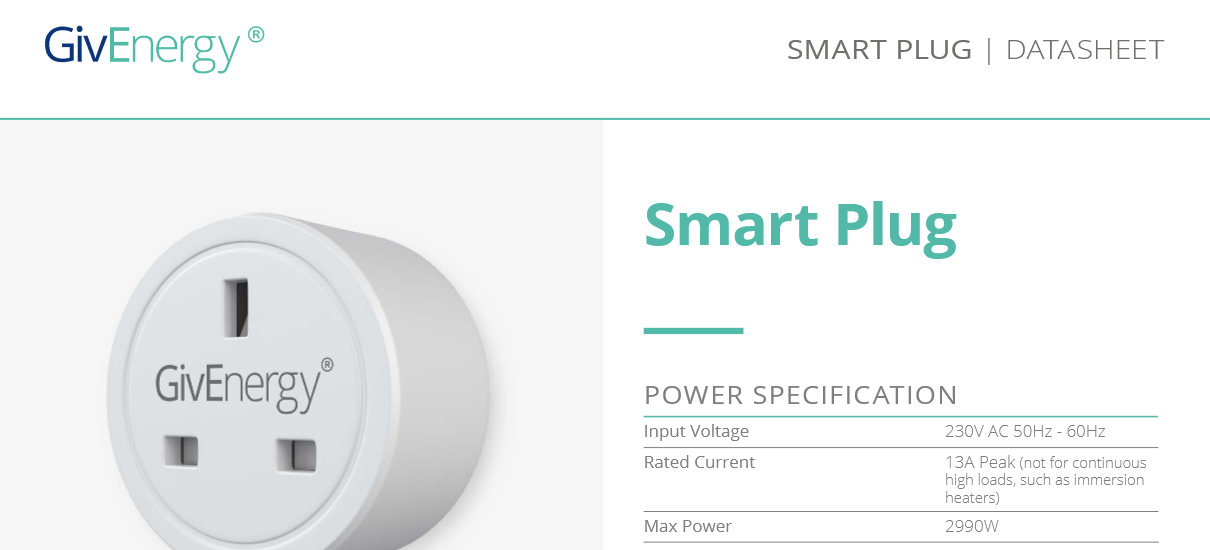
danhaywood Here is a link to the plug spec. It would suggest that 13A is the maximum current, but not continuously

D
#17 DD

CW It would suggest that 13A is the maximum current, but not continuously

I've heard that this is the case for 13A sockets anyway - 13A peak, but 10A for a continuous load.

V
#18 Vestas

CW It was my understanding that GE no longer make these & that they were only ever sold by third-parties on fleabay.

Also 13A rating is nonsense when there's a relay inside rated at either 6A max or 10A max depending on which specsheet you look at.

If ever there was a case of caveat emptor its this junk!

#19 Tenkaykev

Vestas
There was a video by EVM in his role as a GivEnergy employee demonstrating how to set up said devices ( the two I have have never been sucessfully commissioned despite numerous attempts )

D
#20 danhaywood

[unknown] Thanks for the recommendation, will follow-up on that.

D
#21 danhaywood

Thanks for all the feedback on the GE plugs, all good to know. Doesn't progress my original issue with the battery not kicking in to cover the full load.

What I'm hearing is that my spiky usage of the Potterton boiler (and perhaps the Everhot oven) could be the problem, that the inverter isn't able to react fast enough. Can anyone else provide evidence to either back this up or refute? eg when you turn on a kettle, is your inverter able to get the battery to cover it? My (perhaps naive) feeling is that it should be able to, but what do others see?

G
#22 geoffreycoan

danhaywood there is a noticeable delay when load increases before the inverter notices it and starts discharging the battery to meet that load. The newer inverters and updated firmware are better but there is still a short delay and you can hear the inverter relays clicking over as the inverter swaps mode eg charging to discharging

It may be that the way your appliances work don’t play well with the inverter, it’s hard to tell from the energy graphs what’s happening at a detailed level as the graphs are only at 5 minutes granularity

I believe that induction rings can have similar problems with the way they rapidly turn on and off.

D
#23 danhaywood

geoffreycoan OK, thanks for that. One suggestion that I got from a different forum was to arrange for a 3kW sustained load, eg a heater or turn the oven up high, and then see if the battery discharge "catches up" over 20 mins or so. Didn't yet do that, but Would you concur that's a worthwhile test?

G
#24 geoffreycoan

danhaywood yes sounds worthwhile

But look at the energy flows in the GivEnergy app, if you switch it to home mode the data is updated every 10 seconds

D
#25 danhaywood

geoffreycoan Gotcha, thanks.

And do you have a similar setup, where you could try out the "kettle test" and see if the load is picked up immediately via discharge ?

#26 ChrisLav

danhaywood FWIW, my experience is there is a short (6 - 7 secs) lag between turning the kettle on and the inverter taking on the full load. Prior to that the HID is reporting a grid import of c. 240 W, which would imply that the inverter supplies c 85% of the initial load (kettle is 2200 W), and then 6 -7 seconds later supplies 100%. When the kettle turns off the HID shows an equivalent export figure, again for about 6 - 7 seconds, as the inverter presumably ramps down again...
[GE 5kW hybrid + GE 5.2 battery, both Gen 3]

D
#27 danhaywood

[unknown] Thanks, Chris ... that's great to have some concrete figures ; appreciate it.

D
#28 danhaywood

ChrisLav Thanks, Chris ... that's great to have some concrete figures ; appreciate it.

#29 hoggy

There is a noticeable delay on Gen1 old fw if going from a "cold start" (I.e battery not providing for any of the load) vs it moving from say providing your baseload at 300W to 2600W for the kettle. The latter case mine will notice and boost output within the 10 sec data refresh period I have set. The former however it can take upto 30 seconds for it to engage battery from "cold*"

*I'm guessing the fast firmware keeps the battery bus active, hence why you can't set battery power to true 0W (only pause can do that) vs old fw which goes into some sort of powersave / deep sleep. Tradeoff being higher inverter power consumption over the day?

W
#30 wrefordj

danhaywood It sounds like you don't have Andrew Miller's "Monitor for GivEnergy inverter" app. That will show you what is going on.

V
#31 Vestas

hoggy I'm guessing the fast firmware keeps the battery bus active, hence why you can't set battery power to true 0W (only pause can do that)

Only if you pause BOTH charge and discharge.

Pause discharge and it still pulls some power - claims its 29W but its more than that. SoC drops 1% every 75 minutes or so on a 9.5kWh battery so more like about 75W.

D
#32 danhaywood

Just to close off this thread ... in the end I got there, and the battery now properly covers the house load. It's unclear exactly what was required; in the end the fixes (that I'm aware of) were:

  • wifi access point (the dongle seems to get confused by mesh networks, we ended up using a simple repeater)
  • a possibly damaged cable
  • a battery firmware upgrade and
  • a half-stuck inverter firmware upgrade.

of these, either the battery firmware upgrade and/or the cable seem most likely as the issue.