I am looking for some advice regarding the installation/integration of a 3rd Party EV Charger with GivEnergy Solar and Battery. For reference I have the Hybrid Inverter 5.
I am with Octopus and want to stay with them and make use of the IOG tariff. I am looking at the Hypervolt Home Pro 3 which I can buy for a decent price of £690 however I am after advice on the installation of it. I can buy a Charger and Installation package for around £1100, which suggests £400 for the installation?! I guess what I am asking, is the installation something that can be done by a qualified electrician who doesn't necessarily have experience of Solar and Battery systems? Or does it require more complex skills?
I appreciate any advice :-)
Thanks,
Paul
G
#2geoffreycoan
PaulTacchi I would ask an electrician for a quote. There’s nothing special with wiring in an EV charger if you have batteries and solar, the only important thing to get right is to ensure the placement of the CT clamp for the EV charger and the inverter are correct so that the inverter can’t “see” the EV charging.
If the EV charger connection is placed after the inverter CT clamp then when the EV starts charging your inverter will see this as house load and discharge the battery into the EV which is probably not what you want.
S
#3SteveClubley
Hi. Have you discounted the GivEnergy charger for some reason?
S
#4SimonClarke
Giv one doesn’t work with IOG does it? Also have a vague memory of something in the Hypervolt warranty about non approved fitting?
P
#5PaulTacchi
SteveClubley I have looked at the GivEnergy EV Charger sure, and it makes sense to align with the rest of my hardware, however as @SimonClarke states it is not compatible with IOG. I have no desire to move away from Octopus, so the next logical option would be the normal Go Tarif, however I have read several testimonials in this forum and from across other online forums/review sites that the GivEnergy EV Charger is fraught with issues with scheduling.
@SimonClarke what do you mean by a non-approved fitting?
Thanks,
Paul
S
#6SimonClarke
PaulTacchi I may be imagining it but I thought you had to use an approved installer. I had a Hypervolt 2 just over 3 years ago so maybe things have changed. It was recently replaced with a Pro 3 as it broke. This was a much improved response from them than previous contacts and they swear blind this one won’t go yellow within 2 years but only time will tell. I would also get it connected by wire rather than WiFi. Again they are supposed to be much improved but why bother to find out!
D
#7DD
PaulTacchi FWIW, a while back, Go paid only half the export rate of IOG (8p vs 15p), so I took the plunge and bought a Zappi to be compatible with IOG, to get the better export rate. But since then, the rates have aligned, and Go also pays 15p export. Obviously everyone's circumstances are different, but the benefit of being on IOG vs Go now seems relatively small, so payback time from buying a more expensive chargepoint might be worth considering. (As you say, GE chargepoint does sound a little ropey, but of course on forums you only tend to hear from people who are having problems.)
S
#8SteveClubley
I don’t think Octopus have approved their integration with the GivEnergy charger but that doesn’t matter if your EV is approved. I have the GivEnergy charger and followed the process in the Octopus iPhone app to ‘link’ Octopus to my car. I then switched from the Flux tariff to Intelligent Octopus Go (IOG) for import (7p per kW between 23:30 and 05:30) and Octopus Outgoing for export (15p). Octopus recognise when the car is plugged in and create a charging schedule in the app. Sometimes there are slots before 23:30 and some after 05:30. However I use the scheduler in the EV section of the GivEnergy app to control charging within the IOG hours. I also charge my GivEnergy ‘solar’ battery at the same time so it’s full by 05:30.
I got my EV in October so haven’t tried using solar to charge the EV but my intention is to let any excess solar be exported anyway at the 15p rate and charge the EV at 7p. Over the last few sunny days that’s what’s happened and will only get better later in the year.
The GivEnergy charger seemed to be sensitive to high grid voltage and went offline at times. This was fixed by a GivEnergy voltage optimiser. (See other post on this earlier).
C
#9CW
SteveClubley I don't have an EV, but both IOG and OG both support the 15p/kWh export rate. The only difference is in the import rate, but it is not very much (7.0p vs 8p?) so I wouldn't be fixated on a particular charger that Octopus supports - get the charger that works best for you
I have taken onboard your comments and I am actually leaning more towards the GivEnergy EV Charger now. The benefit of having it all in one eco system is too good an opportunity to miss, especially considering the cost to buy and install is half that of the others I was looking at!
I do have a question for anyone that has the GivEnergy EV Charger - the installation manual recommends installing a GEM120 Meter and CT clamp for optimising the solar, but also mentions a direct connection back to the Meter on the Gen 3 Inverter is 'coming soon'. Is this now an option does anyone know as I already have all the relevant meters and it seems odd to have to duplicate.
For reference I have the GivEnergy Hybrid Inverter 5.0 Gen 3.
Thanks,
Paul
D
#11DD
PaulTacchi I do have a question for anyone that has the GivEnergy EV Charger - the installation manual recommends installing a GEM120 Meter and CT clamp for optimising the solar
As mentioned, there currently isn't really much financial incentive to charge an EV from solar: simpler to just charge from the grid off-peak, and then export any excess solar directly for 15p/kWh. Since the grid accepts whatever you throw at it, there's no need to try to micro-manage the car's current draw. (In EV charging, the chargepoint indicates the maximum power available, but it's the car that actually decides how much to take.)
(IOG also gives a slightly longer off-peak period, which might matter for a very large battery needing to be filled daily.)
C
#12CW
PaulTacchi especially considering the cost to buy and install is half that of the others I was looking at!
Just out of interest, if you don't mind me asking, how much are you being quoted for to supply and install the GE charger - I was quoted £950
C
#13CW
DD (IOG also gives a slightly longer off-peak period, which might matter for a very large battery needing to be filled daily.)
Fair point, although if you take a look at EON Next Drive they have a 7 hour slot @ 6.7p /kWh with an export rate of 16.5p / kWh and don't mind what car or charger you have
P
#14PaulTacchi
@DD For my personal circumstances there might be an argument for utilising solar charging. I have a pretty high export system - 8.4kWp with around 7000+ kWh generation vs approx 2200kWh consumption - so it is possible that with my low mileage (6k to 7k per year) my current Intelligent Octopus Flux tariff might be the most cost effective. This factors in the off peak import of 21.77ppkWh which I would charge at as the export is also 21.77ppkWh, and 29.03ppkWh between 4pm and 7pm when my battery force exports. So the higher charging costs would be hugely offset by the very high export costs. So the ability to use some of my solar generation to charge my EV the little I use it is important to me.
Thanks,
Paul
P
#15PaulTacchi
@CW I have been quoted between £1050+ VAT and £1100+ VAT by local electricians for supply and installation of Ohme, Hypervolt, Zappi and GivEnergy EV Chargers. I am fortunate that my dad is an electrician and has installed many 'dumb' EV Chargers, but has never worked with smart or integrated ones. Having spoken to Alexander from GivEnergy earlier today he confirmed that any qualified electrician can install the GivEnergy EV Charger as it is the same as any other basic EV Charger, and commissioning is done entirely through the App which anyone can do and he or any other Support Technician are always happy to help over the phone. The GivEnergy training and accreditation applies only to Inverter and Battery warranties and does not prevent the EV Charger installations from being carried out by anyone who is competent to do so, as verified by Alexander.
I have seen the GivEnergy EV Charger for around £425inc VAT, so with the additional cabling, consumer unit and bits (and a few pints for my dad haha!) it shouldn't cost me more than £500ish
Sorry I can’t comment on installation side of things as my charger, inverter etc were all installed by the same firm at the same time.
I would reiterate that the GivEnergy charger did get upset by high grid voltages so if your DNO won’t do anything about that if it happens to you then you should factor in another £250 for a voltage optimiser.
One useful thing my installer did was to replace the standard 5m charger tethered cable with a 15m tethered cable so the charger could be fitted where I wanted it but still reach a car connection on near or offside of a car on my drive.
G
#17geoffreycoan
SteveClubley I would reiterate that the GivEnergy charger did get upset by high grid voltages so if your DNO won’t do anything about that if it happens to you then you should factor in another £250 for a voltage optimiser.
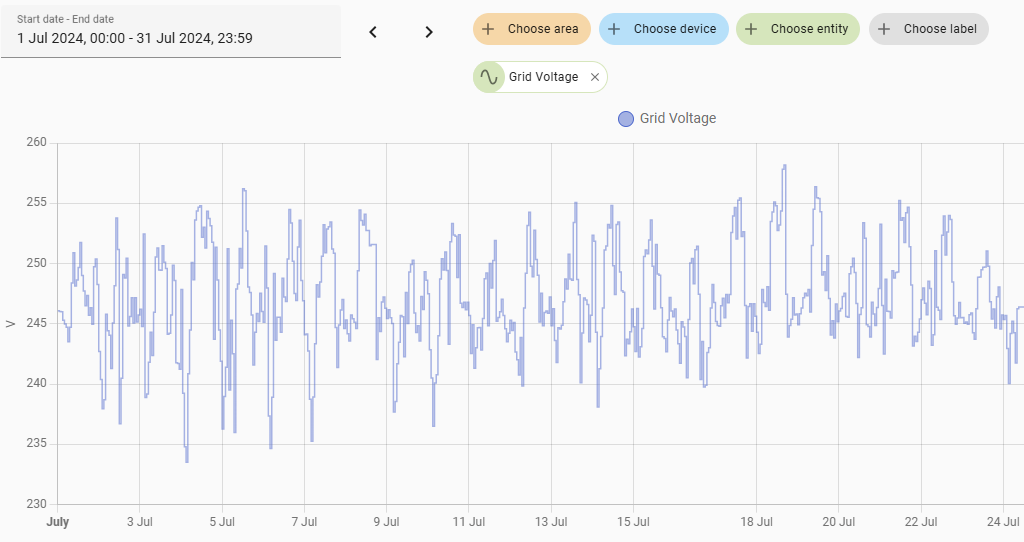
And another potential thing to highlight is that if you are exporting plenty then this can also drive the grid voltage up. On a sunny day I can be exporting so much that the grid voltage gets driven up to 260+V and this shuts down one or sometimes two of my inverters. I would assume that the GivEnergy inverter would shutdown as well so you wouldn't be able to charge the car from solar (although as others have pointed out its usually cheaper to export everything and charge the car overnight on an EV tariff)
P
#18PaulTacchi
SteveClubleygeoffreycoan I’ve never heard of grid voltage being an issue before. According to my inverter mine sits at around 247v. Is that good or bad?
Thanks,
Paul
K
#19kram
Zappi and ohme can directly integrate with IOG.
That alone is worth a lot as you don’t need to mess around with car support. I have a zappi and it’s been a good choice to date.
Look at Doncaster cables with the power plus a cat5 in a single cable. You can use the cat5 in with the power to connect the CT clamps to the zappi which saves a load of faff.
You can the use WiFi for internet .
If your dad runs the cables, MCB/rcbo etc and leaves spare you’ll likely get a better price as that’s the hard bit. Also the zappi has pen protection so you don’t need a separate earth or a stand alone garo.
Paul. Check what it is when you’re exporting at max rate. Mine was getting up to 256V last summer.
G
#21geoffreycoan
SteveClubley the data in Home Assistant loses granularity as its summarised to hourly, but as you can see it peaks at least at 258V. And this was after the DNO turned the voltage down on my transformer, it was even worse before they did that !
D
#22DD
PaulTacchi So the ability to use some of my solar generation to charge my EV the little I use it is important to me.
I think I'd argue it the other way: IOF balances import and output price, so it's exactly the same cost whether you charge from grid and export solar, or charge from solar.
Several people have reported IOF behaving rather oddly recently, and not really utilising the battery as you might hope (charge off-peak and export during peak).