What tariff should I use, I need help maximising my setup

45 comments started 2025-02-18 last 2025-03-27
Mobile AppGivEnergy ProductsBatteryEV Charger
D
#1 Danomite

Hello All,

This goes without saying, I am very grateful for this forum and I'm hopeful some of you may be able to steer me in the right direction.

Here's my setup:

11 * 430w Eurener Panels
5kw Hybrid Gen 3 - GE Inverter
9.5kw GE Battery
8kw Samsung ASHP Gen 7
Tesla Model Y w/ Tesla Wall Connector
Tariff = Intellingent Octopus Go
- £0.25.5 kwh / 530a-1130pm
- £0.07 kwh / 1130pm-530am

The solar panels, battery, Octopus Tariff are connected to the GivEnergy App. I cannot connect the Tesla Wall Connector(Charger) to the GivEnergy App.

I'm experiencing days when the battery discharges minor energy back to the grid(100w day). I'd like to stop this.

I have my system setup:

Battery Charge - 00:00-5:00am
Battery Discharge - Throughout the day
EV Charge - 00:00-5:00am

My questions to everyone:

  • What's the most efficient Octopus tariff with my setup?
    • Currently, I'm charging my Tesla and Battery at a cheap 7p night time, which is beneficial for winter months.
    • Come spring/summer, I may be generating around 20-40kwh per day from Solar - With excess energy automatically going back to the grid from Battery, should I just setup the Export Tariff(Intelligent Octopus Flux) around April time?
    • Has anyone tried both Tariffs?

-How to stop by battery from exporting to grid, if i'm not on export tariff and OR - if im exporting to the grid unintentionally, does that export automatically come off the top of my import?

-How can I connect my Tesla charger to Givenergy App, so that my solar is charging the Tesla in Summertime? If I can't connect to Givenergy what's the best way forward?

What's the best way to make my setup the most effective and efficient?

I'm slightly confused on how this all works - any and all information, suggestions welcomed. Please and thank you. 🙂

G
#2 geoffreycoan

Danomite My questions to everyone:
What's the most efficient Octopus tariff with my setup?

There probably isn’t a single best tariff, as you have said, a different tariff in winter from summer may be beneficial. It you haven’t, get your export tariff setup straight away as it can take a couple of months to come through and you’ll need it for the summer.

Currently, I'm charging my Tesla and Battery at a cheap 7p night time, which is beneficial for winter months.

You haven’t said what your daily consumption is in summer and winter, with an ASHP I would expect your 9.5kWh battery won’t be sufficient so you’re importing in the afternoon/evening.
You might find Cosy is better for you, a slightly higher 13p import rate for 8 hours a day, but you can keep your battery topped up so reducing your grid import.

Come spring/summer, I may be generating around 20-40kwh per day from Solar - With excess energy automatically going back to the grid from Battery, should I just setup the Export Tariff(Intelligent Octopus Flux) around April time?

Intelligent Octopus Flux is a good tariff for exporting, but you handover control of your battery to Octopus to do what they want with it. Bear in mind that you will now be paid the same rate for export as you are for import, so this means any EV charging will be at about 27p/kWh so depends how much EV charging you do as to whether this is a problem or not.

IOG paired with 15p fixed export could be a better alternative. Fill the battery overnight at 7p and export all your solar during the day.

Has anyone tried both Tariffs?

-How to stop by battery from exporting to grid, if i'm not on export tariff and OR - if im exporting to the grid unintentionally, does that export automatically come off the top of my import?

You can’t, this is because the inverter takes a small finite amount of time to respond to changing house load, and as a result you get small bits of import and export when the inverter changes over.

-How can I connect my Tesla charger to Givenergy App, so that my solar is charging the Tesla in Summertime? If I can't connect to Givenergy what's the best way forward?

You can’t. The GivEnergy app is only for the GivEnergy products. If you want to see your EV information alongside your home information you’ll probably need to go down the route of Home Assistant or similar.

What's the best way to make my setup the most effective and efficient?

D
#3 Danomite

Hi,

Thanks for the clarity.

1) I can still export to grid using the Intelligent Go EV tarrif?

2) what is home assist, is there an app that lets you bring all your renewals into one central spot?

3) if I can’t pair my Tesla wall charger to GivEnergy product - how does my solar know to charge my Tesla on the sunny days?

S
#4 SteveCook

Home Assistant is an operating system running on something small like a Raspberry Pi.
https://www.home-assistant.io/

It can pretty much 'talk' to anything in your home with a chip and allow you to setup all sorts of instructions like "if i put the TV in movie mode, then dim the lights and close the blinds (if you have stuff like that - I dont).
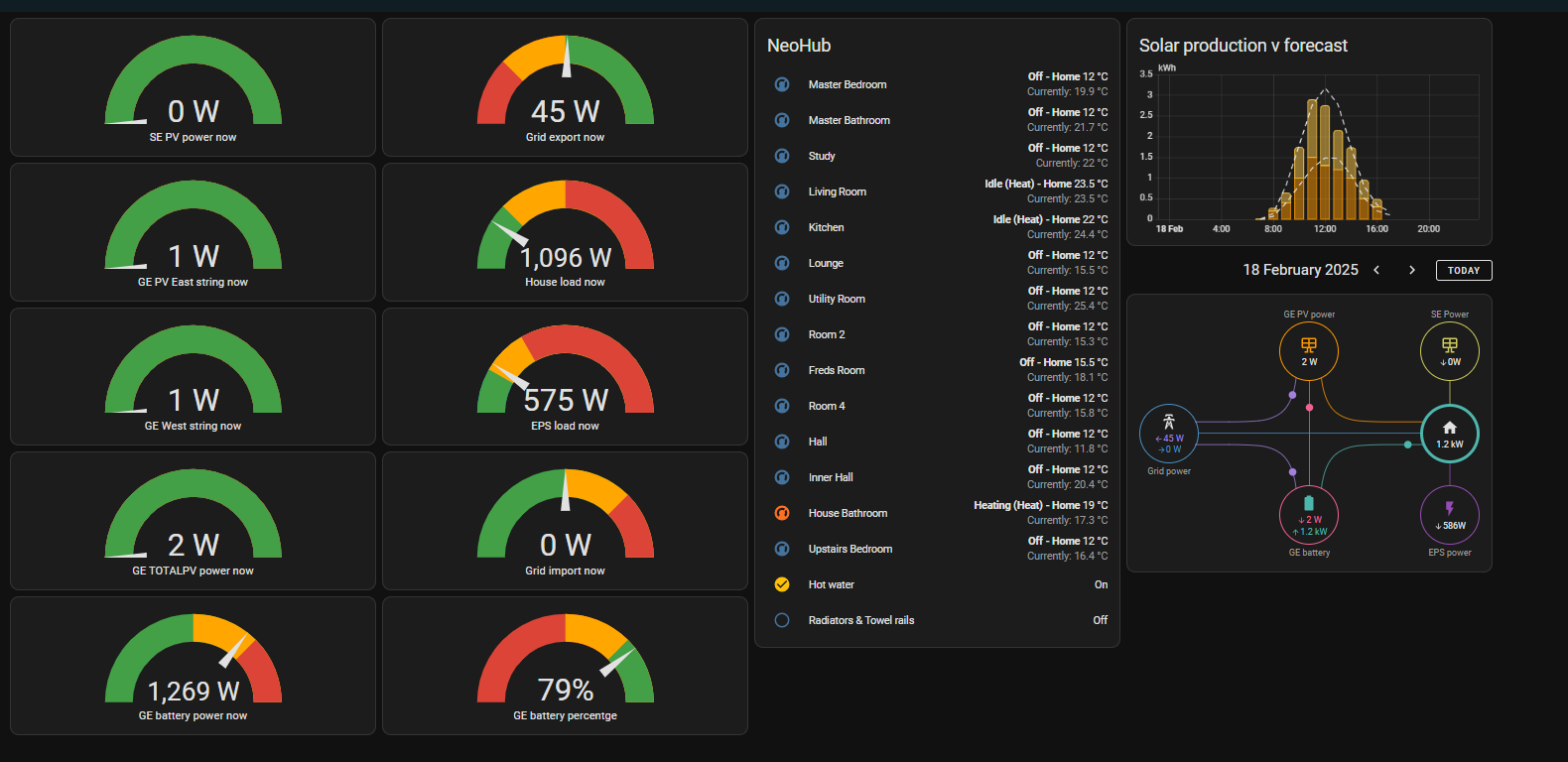
But I use it to monitor my PVs, battery and heating system and let Predbat look at solar predictions and my tariff and select the best times to import and export to minimize costs.
It allows you to build simple dashboards. This is one of mine

D
#5 DD

geoffreycoan You might find Cosy is better for you, a slightly higher 13p import rate for 8 hours a day, but you can keep your battery topped up so reducing your grid import.

I'm still undecided on this... I'm also on IOG with 9.5kWh battery and ASHP. My average unit price for January is hovering at just over 12.5p, the Cosy cheap rate, despite quite a lot of daytime import. So Cosy might be cheaper as long as I can run entirely on cheap rate, but that seems unlikely. So it will come down to how much car charging you do - I don't do that much, but if you have a higher mileage, that might swing it.

D
#6 DD

Danomite if I can’t pair my Tesla wall charger to GivEnergy product - how does my solar know to charge my Tesla on the sunny days?

Perhaps you don't actually want to do that... on IOG, you can charge the car overnight for 7p and export the solar during the day for 15p. (Assuming you have your export tariff sorted out by then.)

The complication with IOG (that you haven't mentioned) is that Octopus can schedule car charging at any time. You ideally want to avoid discharging the GE battery into the car. One approach is to wire things such that the chargepoint is invisible to the GE system - that's how I have it. The alternative is to have some software (could use home assistant) to spot when the car is charging, and pause (or actively charge) the GE battery.

G
#7 geoffreycoan

DD My average unit price for January is hovering at just over 12.5p, the Cosy cheap rate, despite quite a lot of daytime import. So Cosy might be cheaper as long as I can run entirely on cheap rate, but that seems unlikely

Cosy gives you three charging periods of 8 hours in total at ~ 13p (13.23p in my East Anglia region). So on the face of it if your average is 12.5 then Cosy won’t be beneficial for you.

I was on Agile and Cosy is definitely cheaper than Agile at the moment. I don’t have an EV so definitely couldn’t get IOG, but comparing Octopus Go, its a couple of pounds a day more expensive.

All depends on individual usage pattern. One benefit I have found with Cosy is the three cheaper rate periods, it gives us so much more flexibility for putting the washing, dishwasher, etc on than hunting the cheaper slots on Agile, or indeed only a single overnight cheap charging period.
I’m keeping an eye on it, but will probably go back to Agile for the cheaper overnight charging once the winter demand subsides.

Danomite 1) I can still export to grid using the Intelligent Go EV tarrif?

Yes, you can sign up for either the Octopus Fixed Outgoing (15p) tariff or Octopus Agile Outgoing which is variable, pays more during the evening peak but generally less during the day.
Most people are on the 15p fixed outgoing tariff.

3) if I can’t pair my Tesla wall charger to GivEnergy product - how does my solar know to charge my Tesla on the sunny days?

You don’t need to pair the wall charger to GivEnergy, I don’t know about Tesla wall chargers but on Zappi for instance they have a CT clamp on the grid supply and when the Zappi detects outgoing export it can use that to charge the EV (if you set it to solar charging).
Would expect the Tesla charger has similar functionality.

However whether you want to do this depends on the tariff you are on. If you are on Go or IOG then you can charge the battery and your car overnight at 7 or 8p, then let all the solar export during the day and be paid 15p for each kWh. Financially more beneficial than charging the EV off solar.
But if you are on a tariff that doesn’t have such a good overnight rate then it may not be worth doing this.

D
#8 Danomite

geoffreycoan

IOG doesn’t say anything about allowing exporting. The only way I can setup exporting is by choosing an export tariff through the Solar Battery tariff plans. And it looks like those rates are a lot higher.

D
#9 Danomite

SteveCook This is interesting thanks for sharing. I searched integration, and Givenergy wasn’t available. How did you get givenergy to integrate with Home Assist?

D
#10 Danomite

DD

Octopus doesn’t appear to offer exporting on IOG tariff.

I have my EV connected to Tesla App, Tesla controls when it charges. Maybe in summer I’ll remove the charging restrictions on Tesla app to allow Octopus to maximise my energy usage.

G
#11 geoffreycoan

Danomite IOG doesn’t say anything about allowing exporting. The only way I can setup exporting is by choosing an export tariff through the Solar Battery tariff plans. And it looks like those rates are a lot higher.

I'm sorry, you're wrong. See https://octopus.energy/help-and-faqs/articles/which-export-tariff-can-i-combine-with-my-import-tariff/

Danomite This is interesting thanks for sharing. I searched integration, and Givenergy wasn’t available. How did you get givenergy to integrate with Home Assist?

There are two options popularly used, GivLocal and GivTCP. Different fans of each. GivLocal is simpler to use, I think GivTCP is more comprehensive and more up to date with the newer inverters.
Personally I use GivTCP

D
#12 Danomite

geoffreycoan

Ok thanks for this.

So here’s where I’m at. I applied for export import tariff last night. This morning octopus has sent me the terms to approve a new tariff “flux tariff”.
In order for me to turn on an export import tariff I had to switch tariff.

Am i right in thinking. I accept the terms above switch to the flux tariff temporarily and then I can switch back to IOG tariff and the exporting will automatically be applied?

Sorry for all question.

D
#13 DD

Danomite I accept the terms above switch to the flux tariff temporarily and then I can switch back to IOG tariff and the exporting will automatically be applied?

There should be no need to switch to flux temporarily. Import and export are administratively separate - switching to a tariff that combines them may make it harder to switch away again, since both have to be changed and the automated systems may not be up to that. There might be delays of 30 days for switching export tariff, and that therefore constrains import switching too. (Seems to be a delay of 30 days for agile/fixed export switch. Not sure if it's generally applicable.)

G
#14 geoffreycoan

Danomite DD is right, there is no need to switch to Flux temporarily

What you are seeing is that the Octopus website is not really geared up to people applying to join the Export tariff, so the website only shows Import tariffs, of which Flux and Intelligent Octopus Flux have export components as well.

I would cancel your switch to Flux because what will happen is your Flux import will happen straight away and then you could be waiting for a month or more (depending on your DNO) to get the export setup.

Instead contact Octopus customer service directly by email or message on Twitter/X and tell them that you want to go onto Export fixed alongside your IOG. I use the latter, they usually respond quite quickly

R
#15 Roy124

geoffreycoan Instead contact Octopus customer service directly by email or message on Twitter/X and tell them that you want to go onto Export fixed alongside your IOG. I use the latter, they usually respond quite quickly

Same as I did, takes maybe a day or two.

T
#16 TX200

It seems that export switching is fairly quick (1-2 days) if it doesn't require a change of billing/accounting on the meter

Or slower if it does (4+ days, perhaps several weeks sometimes).

IOF export, Flux export and agile outgoing are billed in 48 half hour segments each day.

Outgoing variable (15p) and SEG are presumably based on daily index readings.

So if you swap the export within the same type of accounting, it's quick. If you swap to a different type of accounting it's slower.

In some circumstances people used to have to switch via SEG but I think that's gone now, so it should be possible to quickly go from one export tariff to another as long as it uses the same form of accounting on the meter.

T
#17 TX200

Oh and the 30 day thing I think doesn't apply if moving between two different smart tariffs. Usually it's an import change restriction, but not sure if it could also apply to change of export tariff?

I'm not sure what they'd count as smart though. SEG doesn't sound smart (same price all day), but isn't that what the S stands for?

IOF and Flux deffo smart export tariffs. Agile outgoing too. Would outgoing variable (15p) count as smart?!

P
#18 Pete UK

Danomite

I have a similar set up to you (same car, same EV charger, same inverter, same batteries - no HP though and a larger plant and battery system) and I’m on IOG with 15p fixed export tariff.

The best tariff for YOU is going to depend entirely on how technical you want to make it and what your daily import is in kWh and how much/ often you charge the car; And specifically how much you import from the grid between 05:30 and 23:30 on your current IOG tariff (ie how much you are importing at peak rate). What your average import rate is.

What time does your battery run out in winter?

Firstly, with your current tariff/ set up (as is without using any automation) I’d recommend operating your car between 20-80% state of charge (if feasible - which should be possible most of the time unless you do a lot of mileage. Even if you do there are other work arounds);

The aim on the IOG tariff is to maximise the 7p import rate and reduce to the minimum all peak rate import (same as most tariffs I guess 🤣)

Minimise your average import rate and maximise your export at 15p is the goal. In summer this is much easier!

To do this on IOG;

1) Set your Tesla (in the Octopus app) and batteries (in the GE app or web portal) to charge from 23:30 till 05:29 (That will reduce your battery depletion start time by an extra half an hour in the mornings for a start and eliminate any chance of the car depleting your home battery from 23:30 to 00:00 when IOG commands a charge. If indeed your home battery is not already empty).
2) Set the off-peak end time in the Tesla app to 05:30. (That will stop it charging at peak rate and/or depleting the battery for anywhere up to 20 mins when you first plug it in.)
3) Set the Smart charging settings (in the Octopus APP) to ‘Ready By Time’ = 05:30 and ‘Charge Target’ = 80%.
4) Apply for an export MPAN, if you don’t already have one. Join the Octopus 15p fixed export tariff (you can apply for this on the Octopus website from within your Octopus account with your export MPAN).
5) As we are starting to come into spring/ summer you will start to find that you have excess left in your battery towards the end of the peak rate time. You want to export all this to the grid at 15p. To do this (without automation) you will need to work out when to set the start time of a “Timed Export” in the GE app and set that (this will need to be adjusted daily/ weekly depending on how hands on you want to be or you can just move the start time in a conservative manner weekly so you don’t export too much and deplete the battery. You want to always have the ‘end time’ of the timed export to be 23:29
And you’ll need to adjust the start time so your battery arrives as close to 4% as you can (at 23:29).
6) Tell us your daily kW use. (This will determine the best tariff you should get on). Also if possible how many kW you think you’ll use between 05:30 and 23:30. (This will make it easy to assess if IOG is the best tariff for you or not). With a heat pump a different tariff may possibly be cheaper.

On IOG, all year round you can leave the battery and car charging settings the same. As long as you plug the car in with at least 23% (IIRC). It’ll arrive at 80% in the morning. Without any automation, the “Timed Export” start time is the only thing you’ll need to regularly change during the shoulder months and possibly (or not because it’s already empty) winter.

  • Ah, I’ve just read your post above and realised that it is possible for you to set multiple timed export slots to achieve this in a “set and forget” manner because you have a Gen3 inverter which allows this.

Having said all that. I did see Tomato Energy offer a tariff which looks amazing for heat pumps owners
Off peak of 5p 00:00-0600 and two cheap dips in the day (each of 2 hours I think) down to 15p.
But I don’t know what their export rate is - which might change things.

And this would forgo the 15p Octopus export rate which is quite good for you as you would be exporting a lot in the summer (all solar and battery).

Tweak your setting for now and let us know your daily PEAK import kWh usage and if you know it YOUR average import rate. Between us all we can analyse more from there. 👍🏻

G
#19 geoffreycoan

TX200 So if you swap the export within the same type of accounting, it's quick. If you swap to a different type of accounting it's slower.

TX200 IOF and Flux deffo smart export tariffs. Agile outgoing too. Would outgoing variable (15p) count as smart?!

My own swap from Fixed Outgoing to Agile Outgoing happened within an hour or so of me requesting it via Twitter. I could see on my bills that the fixed outgoing was billed based on the meter total reading whereas agile is based on the half hourly. So that swap of accounting approach was quick for me.

I'm wondering if this does count as a non-smart to smart swap and I won't be able to swap back for a month. Its almost been a month on Agile Outgoing now and I'm pretty much ready to swap back, just waiting to be sure there is no cold weather DFS sessions where the Agile outgoing will be worth it.

The last three sessions were 7p net profit from forced exporting to importing at Cosy day rate afterwards so after the first one I didn't bother. Once I get onto fixed 15p it won't be worth it at all.

For @Danomite it sounds like they haven't got an export MPAN setup yet so the process will be slower

P
#20 Pete UK

Pete UK On IOG, all year round you can leave the battery and car charging settings the same. As long as you plug the car in with at least 23% (IIRC)

This is specifically for the MODEL Y

(The 23% figure)

D
#21 DD

Pete UK Having said all that. I did see Tomato Energy offer a tariff which looks amazing for heat pumps owners
Off peak of 5p 00:00-0600 and two cheap dips in the day (each of 2 hours I think) down to 15p.
But I don’t know what their export rate is - which might change things.

Last I heard, they don't currently offer any export tariff - need to use a separate provider for that, which probably means minimal SEG (4p) rates. Though it was in their plans.

I'm not entirely sure that

Set the Smart charging settings (in the Octopus APP) to ‘Ready By Time’ = 05:30

is entirely consistent with

The aim on the IOG tariff is to maximise the 7p import rate

since you're forgoing any bonus charging slots, which are very useful if you're running a heat pump.

P
#22 Pete UK

DD

Yes there is always some kind of a catch 🤦🏻‍♂️

The Tomato plan does look amazingly good if you have an EV and/or heat pump but don’t have Solar and batteries where the export isn’t applicable to the end user.

If they had a decent export rate or if you could get a good stand alone one elsewhere (doubtful) they’d beat Octopus hands down. Well in my case they would.

T
#23 TX200

geoffreycoan I wonder if it depends on the make of the smart meter. Maybe some just work better than others when it comes to reliable Comms and updates!

P
#24 Pete UK

Is the Tomato plan not an outright winner for anyone with a heat pump/ panels/ batteries. Even without a decent export rate….? Or is the loss of the decent export rate the killer?
🤔
@geoffreycoan ?

  • anyone?
P
#25 Pete UK

DD since you're forgoing any bonus charging slots, which are very useful if you're running a heat pump.

Yes - your right, I agree. (I assume you meant “isn’t entirely consistent with” - ‘maximising the 7p import slots’?)

All the above I posted was basically the starting point for the OP with his current set up, without an export MPAN set up yet(?) and without automation.

There is also of course Lesson 2 to follow - “Advanced tweaking and maximising extra IOG slots for heat pump users”. But my reply was too long already and I don’t have a heat pump…

I’ll leave that to someone else with a heat pump and HA expertise to explain to the OP.

G
#26 geoffreycoan

Pete UK Having said all that. I did see Tomato Energy offer a tariff which looks amazing for heat pumps owners
Off peak of 5p 00:00-0600 and two cheap dips in the day (each of 2 hours I think) down to 15p.
But I don’t know what their export rate is - which might change things.

Pete UK Is the Tomato plan not an outright winner for anyone with a heat pump/ panels/ batteries. Even without a decent export rate….? Or is the loss of the decent export rate the killer?

As ever it depends on your individual circumstances, and in particular with a heat pump how well your battery can cover your house load in winter.
Mine doesn't, by a country mile, (13kWh battery capacity, 20-40kWh a day in winter on the heat pump + house load) so I have to look at the day rate and when the charging periods are.

Tomato sounds good but during the day the 2x cheap rate periods are not going to give a lot of time to recharge the batteries. I have 2x Gen 1 inverters so I'd get about 4.8kWh into the batteries in each slot, which would last me 1-2 hours of running the heat pump :-(
Octopus Cosy has a 3 hour period 1-4pm which makes a big difference, I can charge up overnight, run the heat pump through the morning and the afternoon period is long enough to fill the batteries up before the evening peak, which the batteries then cover.

I think someone else said that Tomato are now offering an export rate, but IIRC it was something like 8p, so quite a hit on the Octopus rate. I do rely on the Octopus 15p to build up enough summer credit to last me through the winter consumption.

Am also quite fond of the Octopus Power up events (had one yesterday, another today), over the year I get about 12% of my entire import free in these events

#27 Tenkaykev

geoffreycoan Intersting reading about the " Power Ups '. We're in Dorset and we haven't had any. ( we do however have oil wells 😮 ). If we have a heat pump installed , hopefully this year then Cosy does at the moment look to be the best fit.

G
#28 geoffreycoan

[unknown] unfortunately the power ups are not UK wide.

They started in East Anglia with a linkup between Octopus and UK Power Networks, that was about 18 months ago, they were initially just for a year but its carried on although they do seem to be much more localised than they used to be. I get a number of power up events that @[deleted] doesn't get and he's about 10-15 miles away from me.

After East Anglia the Power Ups were launched in Scotland, and then there is a much more limited trial I think in Northern England for 3 months only but the terms are different for that one.

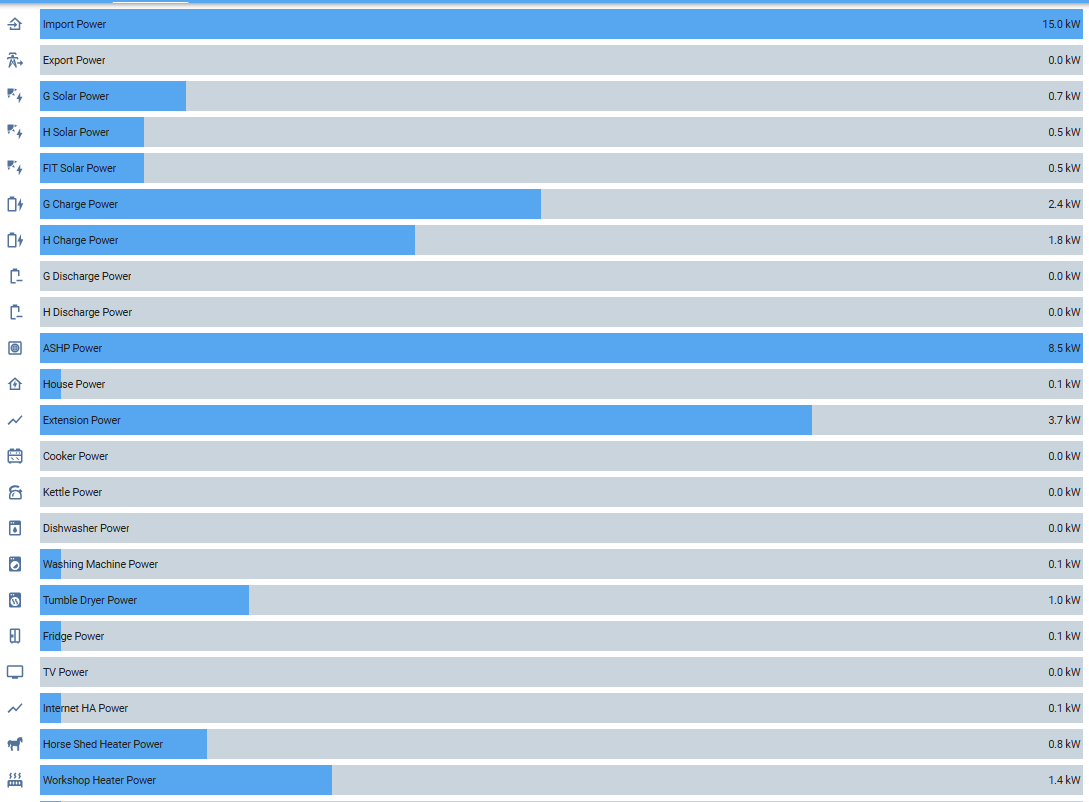
I love them! We're currently pulling in 15kW with both batteries filling up, tumble dryer and washing machine on and the heat pump cranked up to the maximum:

But it does require the DNO in your area to want to play ball with Octopus over them

#29 PianSom

I am assuming that I am @[deleted] - it sounds about right 🙂

I had Power-ups on 1 and 2 January this year - and NOTHING since. A big and bad departure from my experience last year, when they were plentiful. No idea why that should be, but I would guess it is because I am closer to the huge and growing conurbation that is Cambridge than @geoffreycoan

S
#30 SimonClarke

Seems to be some missing of the point of IOG. Octopus are supposed to be in control of when they charge your car with you telling them when you want it by. Setting timers in anything might mess it up. Avoiding discharging the battery to the car is easy by sorting the position of the ct clamps or some other battery settings (which I don’t know or use). When we used the Tesla with IOG it was mostly good with very few extra 7p times but now we are using a Hypervolt pro 3 we get far more 7p times - which has helped with the heat pump.

R
#31 Rbor

PianSom geoffreycoan
Power ups? Oh yes, I can remember you and Geoffrey discussing these.

From just up the road from me on the edge of the Peak District, I can peer out over the flatlands to the east. I used to be able to see the Trent Valley power stations to the South East: West Burton, Cottam and High Marnham. But these are being demolished one by one. On a really clear day, I can pick out Lincoln Cathedral, midway between what's left of Cottom and High Marnham.

To the North East, I can see Drax, providing 7% of our energy by burning 'renewable' wood chips from Canada and the US.
........ all this generation and not a Power up to be seen ......

Rob

#32 Tenkaykev

Rbor
There used to be a foot race from Grantham to Lincoln and back, the turning point being the courtyard of the Cathedral and following the B roads. That's where I learned that Lincolnshire is flat-ish, not flat. 😁

R
#33 Rbor

Tenkaykev Yes, Lincoln Cathedral is on its own hill which is why it can be seen from a distance. Years ago, I ran the Lincoln half-marathon, which starts near the Cathedral and finishes at the racecourse. 'Downhill' all the way.
I am told that, if you travel due east from my house, the first higher ground that you reach is the Urals in Russia.

Rob

P
#34 Pete UK

SimonClarke Seems to be some missing of the point of IOG. Octopus are supposed to be in control of when they charge your car with
you telling them when you want it by

Some might seem to be missing the point but in reality they actually do get the point.

The first “ready by” time option offered by Octopus is 05:30. Which is a valid and legitimate option to select. Some might select 11:00. Which is also a valid and legitimate option. Usually the cheapest slots fall between 23:30 - 05:30 anyway.

If I want to add 5-15% charge to my car every night to top it back up to 80% (which is the norm for me) then Octopus will still be in control of when they charge the car, picking the very cheapest two slots (for Octopus) within the parameters they offer every day over the whole week. Some people only plug in once a week and get extra slots to meet their car charge requirement which are undoubtedly more costly for Octopus and use more expensive slots. And you could argue they are “missing the point”, along with the people who only turn on the smart charging toggle once a month and use IOG as a GO tariff !

Note that setting the “off peak end time” to 05:30 in the Tesla APP only stops the car from charging at peak rate when you first plug it in (until Octopus pick up that the car is charging and shouldn’t be yet).
It isn’t a timer and doesn’t stop the car charging after that time. It merely notes to itself that this is when the off peak period ends. And a quirk of setting that “off peak end time” to 05:30 is that it prevents what loads of people were moaning about in the Tesla forum; which was that the car was charging at peak rate for up to 20 mins every day until recognised by the Octopus IOG software.

To be honest, most of the time I’m only adding 10-15%. But if I need more, In my experience, whatever “ready by” time I select (all the way up to 11:00) 99%+ of the time ALL of the slots given are between 23:30 and 05:30. Where I live anyway!
Only seen about 3 power ups ever as well where I am. I’d love more of those.

People are trying to game the IOG system in many ways, some more dubious than others (like only using a granny charger while the heat pump, batteries and house load is maxing out etc).

Some people want the option to be able to discharge the battery into the car (to avoid solar clipping or when you don’t have an export MPAN set up or when the export rate is lower than the import rate to name a few scenarios for example) but also they want to prevent unnecessarily doing this at the wrong time. So moving the CT clamps might solve one problem but cause another. In other set ups it is helpful though.

There is a very long and interesting discussion about using IOG on the TeslaMotorsClub forum. Along with many differing opinions on what’s fair game and what isn’t!

I don’t believe selecting your desired “ready by time” to one of the options offered could in any way be considered “missing the point” though. I mean that’s literally what they ask you to do!

S
#35 SimonClarke

Pete UK having recently gone from using the Tesla with IOG to using the Hypervolt I’m pretty sure that the issue of over running when first plugged in is purely a Tesla one. When I plug in now it immediately switches the charger on and immediately off again followed by a schedule within 2 minutes. It also often starts the low rate immediately ( obviously depending on the time I plug in).
As for all the gaming going on let’s hope octopus don’t take a dim view of it and change the tariff.

D
#36 DD

Pete UK In my experience, whatever “ready by” time I select (all the way up to 11:00) 99%+ of the time ALL of the slots given are between 23:30 and 05:30.

I regularly get charging 5.30 to 6 - indeed I did this morning. (And I was only asking for 15%.) On a Saturday morning I often get slots as late as 8 or even 10.

P
#37 Pete UK

SimonClarke

Yes, it’s definitely to do with the time it takes Octopus to poll the Tesla to realise it’s charging, then stop it.

As I mentioned there was a lot of discussion about this in the TMC forum. Long and the short of it was, when Octopus were regularly polling the car to see if it had just been plugged in and had started charging too early, people were moaning that the car was being woken up too often and wasting battery (especially when not plugged in !). When the polling time was reduced people were complaining that the car immediately charged at peak rate for up to 20 mins (not the desired event) when plugged in.

I think Octopus have found a balance but the better solution was to set an off peak ‘end’ time in the car. Which doesn’t affect Octopus controlling the car past that time but stopped the unwanted charging when plugging in (similar to the behaviour you now get when using your Hypervolt). You can still set ANY “ready by time” in the Octopus app and it will play by those rules !

Interesting that using your Hypervolt it seems to give you more slots outside of the core times than before when the car was the integration instead of the charger. I suppose it’s all to do with Krakens optimisation.

In the OP’s situation (similar to mine) I’m merely suggesting a good starting point to optimise his set up as he was asking.

D
#38 Danomite

Hi, Thanks to everyone that's responded to my post. Very helpful.

If I decided to go on the Intelligent Flux options - It's ready to go now - Octopus has registered my MPAN, all is good.

What's the downside on having the intelligent flux, and Octopus talking to my Battery/Inverter every 30 mins to make sure i'm getting the best value. Is it the fact that the energy cost is 24p import/export - and charging my EV will be way more expensive at night time?

I don't understand why Octopus would offer a Flux import/export smart tariff that would cost me more, than their EV IOG.

The idea with having smart connectivity is to save money. Or so I thought.

G
#39 geoffreycoan

Danomite What's the downside on having the intelligent flux, and Octopus talking to my Battery/Inverter every 30 mins to make sure i'm getting the best value. Is it the fact that the energy cost is 24p import/export - and charging my EV will be way more expensive at night time?

I don't understand why Octopus would offer a Flux import/export smart tariff that would cost me more, than their EV IOG.

The different tariffs are aimed at different people with different equipment, there can’t really be a single tariff for everyone, you have to choose what’s best for you.

Intelligent Octopus Flux is great for people that don’t want to micro-manage their inverter & battery, and want a good rate for export. The export rate is the best on the market and you really have to consider the grid as being a virtual limitless battery because what you export you can them import later on at the same rate.

Some things to be aware of with IOF, it doesn’t ’talk to your inverter to make sure you are getting the best value’, Octopus take over control of your inverter/battery and any setting changes you make will quickly be reverted by Octopus. You have no control over the charging and discharging of your battery, but since its the same rate (except in peak), why would you care?
Octopus tend to charge the battery overnight, export all the solar during the day and then discharge the battery during the peak time; but this varies day to day depending on grid demand etc.

Side effect is there is no cheap overnight charging period as you would get with an EV tariff. How much this matters to you depends on how much you consume (including the car) vs how much you export. Tim & Kat’s Green Walk channel on YouTube suggested a ratio of 1.4 was the sweet spot, above that (you export 1.4x your consumption ) then IOF is the best value tariff.

So at the moment whilst solar generation is limited I wouldn’t necessarily recommend IOF. Come May when you’re generating lots, then go for it, but now you’d be better probably on an EV tariff and charging your car and batteries overnight

D
#40 Danomite

geoffreycoan

Crystal clear. Thanks

So no ones found a hack to get the Tesla wall connector to talk to the GivEnergy Cloud?

P
#41 Pete UK

Danomite So no ones found a hack to get the Tesla wall connector to talk to the GivEnergy Cloud?

I don’t know about your Wall Connector but mine won’t even stay online !

I’ve managed to connect it several times but it just keeps going off-line, so now I’m ignoring it. Doesn’t really make much odds to me to be honest.

D
#42 Danomite

Pete UK what wall charger are you using?

I have the Tesla wall charger.

As some have stated here we use Home Assist through raspberry pie.

P
#43 Pete UK

Danomite what wall charger are you using?

I have the Tesla wall charger.

I have the same. Gen3

P
#44 Pete UK

Danomite As some have stated here we use Home Assist through raspberry pie.

I don’t know much about how you’d do that TBH.

I’m using the integration with the car. Works great. (As long as it’s set up as needed). Pretty much “set and forget” on IOG.

D
#45 Danomite

Pete UK I’m using Tesla wall charger.