Apologies if this is the wrong place to post.
As time goes on I am increasingly reluctant to resort to complex Home Assistant automations but willing to try ones that are not so taxing. I have a solar array feeding into a 3.6 Givenergy Hybrid Inverter with two 9.5 kWh batteries. I am on Intelligent Octopus go and fully charge both batteries on off-peak and discharge during the day in Eco mode exporting any excess down to 4% in the evening. (All done via the Givenergy mobileapp) I would like to prevent any solar going into the battery with it going to grid instead. Do you know how this can be achieved easily using HA or otherwise. Thanks
Send solar to grid during the day.
Chrisg2003 I'm in a similar boat - I use my own python scripts to control things over modbus, without going down the full HA route.
Simplest way to prevent solar charging is to use the pause timer to pause (solar) charging during the day. The only downside of this naive approach is clipping: if solar exceeds the AC capacity of the hybrid inverter, then it has to clip the generation. So under high solar, I instead turn off eco mode : that has the effect of prioritising grid export, but excess is sent to the battery.
Then I have additional settings to manage the charge level throughout the day, so it can export excess battery to the grid.
monitor.py at https://github.com/divenal/givenergy-scripts is quite an old version - it has moved on quite a way since then.
The other scripts just use the API - that might be responsive enough for your needs. (Previoulsy I dynamically adjusted the charging rate to avoid clipping, which required very frequent updates. Since then, I learned that turning off eco was sufficient, and that doesn't really need the same sort of responsiveness.)
Using your preferred method of automation, reducing the battery charge power (to zero) during the daytime should achieve what you want.
Chrisg2003 think my anti-clipping measures sprang to life for the first time this year. Fortunately I had only just reduced daytime target battery level from 100% to 90%, which left a little space to accept the few hundred watts of excess power.
DD your panels must be quite a bit bigger than your inverter if you’re getting clipping already?
My East and then West arrays peaked at 2.5kW today, nowhere near clipping for me. But in the peak of summer I have to do the same, keep some space in the battery for mid-day to let solar charging soak up the excess power.
I don’t often go over the inverter limit but its more that the exported power pushes the grid supply voltage up too much and the inverters then shutdown.
First world problems
geoffreycoan We got 2.8kW for about 10 minutes today on a 3kW array through hazy cloud.
Remember if its cold the array will be pushing a fair bit more out than at 20C....
geoffreycoan your panels must be quite a bit bigger than your inverter if you’re getting clipping already?
6.4kWp panels, SSW-facing, reached about 5.9kW (briefly) at around 2pm.

4.8KW at 2pm. More than my battery could absorb so actually exported a bit. Ended with 97% having started at 6% so almost a perfect day.

Today, 25 Feb, we would have had clipping if we hadn't been running the washing machine and tumble dryer so much. Our peak generation today was a shade under 6kWh, and we have a 5kWh inverter. Today was the highest generation day of 2025 so far at over 20kW.
miffy amazing the different results we get across the country. It was a reasonably clear day today and I achieved 21.2kWh but as I said before, only peaked at 2.5kW power output.
Its not my best this month either. The 17th and 18th both generated 25kWh, and February last year we peaked at 30kWh in a day. We get up to 80 or so in June.
@miffy You're going to end up with a lot of summer clipping if you're already over your inverter limit in February.
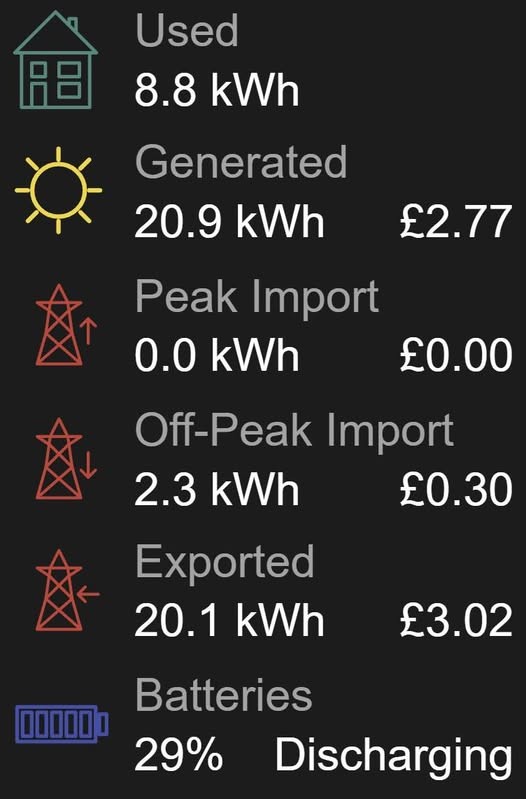
We had a peaky day but with fairly good overall numbers:
21kW generated.
Chrisg2003 Chris, I can recommend MyEnergyOptimiser. Fairly easy to use, free for 10 days, then £5/month if you wish to use the charting functions. The real plus is the Developer is very hands on and can even help set up your options.
You can set 48 half hour segments and many options such as max and min discharge and maximum charge level for import.

[unknown] We get high peaks of power when it is sunny in winter. I assume it's due to the cold temperatures making generation more efficient. What part of the country are you in, and how many panels do you have? We are in Gloucestershire, and have 9kW of panels on the roof, 5.2kW facing SE, and 3.825 facing NW. Obviously, the NW-facing panels don't do much Nov-Jan, but the rest of the time they add between 1/5-1/3 extra generation to the total.
On 17 Feb, we generated 17.4kWh, and on 18 Feb it was 17.1kWh. The highest during Feb 2024 was 19.3kWh, although last Feb had more consistent generation, unlike this year. So far this year, we've only generated 391kWh, compared to last year's 470kWh by now. We had the panels installed April 2023, so coming up to two years.
If I look at the generation for 2 June 2024, which was our highest generation day of 2024, of 54kWh, the highest peak was 6.3kW, and looking at the graph, there's no obvious clipping/flattening. I do my utmost to ensure there is space in the batteries to avoid clipping.

geoffreycoan We get high peaks of power when it is sunny in winter. I assume it's due to the cold temperatures making generation more efficient. What part of the country are you in, and how many panels do you have? We are in Gloucestershire, and have 9kW of panels on the roof, 5.2kW facing SE, and 3.825 facing NW. Obviously, the NW-facing panels don't do much Nov-Jan, but the rest of the time they add between 1/5-1/3 extra generation to the total.
On 17 Feb, we generated 17.4kWh, and on 18 Feb it was 17.1kWh. The highest during Feb 2024 was 19.3kWh, although last Feb had more consistent generation, unlike this year. So far this year, we've only generated 391kWh, compared to last year's 470kWh by now. We had the panels installed April 2023, so coming up to two years.
If I look at the generation for 2 June 2024, which was our highest generation day of 2024, of 54kWh, the highest peak was 6.3kW, and looking at the graph, there's no obvious clipping/flattening. I do my utmost to ensure there is space in the batteries to avoid clipping.

Not sure why my reply posted twice, sorry about that!
miffy I’m in Bedfordshire and have a lot of panels - 44 in total.
Its a fair sized house that has been extended to the side so we have a long East/West roof, plus the garage is integral and has its own sloping roof on the front (East).
We had a 4kW FIT array of 16 panels installed on the rear (West) roof in 2016. We didn’t get the peak of FIT rates but its still been OK, about £600 a year so by the end of this year the FIT payments will have recouped the installation cost.
Then in January 2023 we had a further 28 panels installed, 16 on the front (East) in two strings on a GivEnergy 5kW hybrid inverter, then 6 on the garage front East roof and the remaining 6 filling in the gaps on the rear West roof, these 12 being on a second GivEnergy 5kW hybrid inverter.
My logic was that panels are relatively cheap and I might as well maximise the opportunity whilst the scaffolding was up. In hindsight we could have got 2 more on the garage roof and if the installers had been willing to shuffle the FIT panels along could have got a couple more up there as well, but 44 is quite a lot…
The East/West alignment is great for giving long solar days particularly in summer, but does need active battery management as they can fill up by 10am on a sunny day and then I start getting clipping, particularly when the grid voltage gets pushed up so much by all the export! Predbat does most of my battery management but its handling of multiple inverters and clipping isn’t perfect so ends up having to be automated in Home Assistant alongside Predbat
geoffreycoan I'm constantly astonished that the DNO hasn't curtailed your export given what happens to the local "grid" when you export full rate 😃
Vestas Shh. No export limit !
Whether they took account of the existing 4kW FIT array, I have no idea, but I had a DNO approval for the original solar+5.2kW battery and then a subsequent approval for the 9.5 battery, both with no limits imposed.
I’m not just powering my neighbours electricity in summer I am powering most of the street !
geoffreycoan Do you have any sort of plan if it all goes tits up? ie someone nearby has a problem, reports it to DNO & its traced to your install. Its an awful lot of PV going into a very small amount of batteries (currently).
Vestas No, I don’t know, never thought about it as I have an approved G100 application with no export limit from the DNO. Given that they have approved everything that was installed by FIT / MCS approved installers, there’s no self-installed shenanigans, I would think they’d find it difficult to subsequently un-approve it?
I did have a problem early on with the grid voltage being too high that was prematurely impacting the inverters, but this was definitely not down to me, it did mainly happen during the day but I would also see spikes at random hours of the night, so couldn’t be solar. Raised it with the DNO who fitted a monitoring device and agreed that the supply was outside limit so they turned it down at the transformer.
The engineers that came never even asked about my approvals, and I was showing them the GivEnergy portal data at the time to share the high grid voltage (this was before I got Home Assistant).
Adding more batteries wouldn’t be financially practical, just too much money with awful payback periods.
The strategy I used last year was to:
- let both batteries drain down overnight
- stop all battery charging at 7am and let everything export
- allow the 9.5 to start charging at 9:30, but at 1200W
- allow the 5.2 to start charging at 13:30, also at 1200W
- at sunset set both inverters to PauseCharge which stops them cross charging
- at 1:30 stop the 9.5 from discharging to allow the 5.2 to discharge
This seemed to work quite well, both batteries got cycled once a day and by trickle charging them is both better for them but also reduced the grid clipping I had around the peak of the day

geoffreycoan They can revoke a G99/100 if the local grid can't handle it.

Vestas They can revoke a G99/100 if the local grid can't handle it.
But would that be working back in time with the most recent additions revoked first until the local grid can cope, or dividing up the newly found capacity limit between all the connected generators?
Simon_C I'd imagine they'd downgrade all the G99/100 installs export to G98. How they'd do it - I doubt anyone knows but they do have the statutory powers to do so. Other countries with more experience of PV mandate supplier/DNO control over the inverter so export can be limited dynamically & that's where we'll all ultimately end up.