
Recalibration frequency

12 comments started 2025-02-24 last 2025-02-25
GivEnergy ProductsAC Coupled
C
#1 CW

How often should a recalibration be needed?

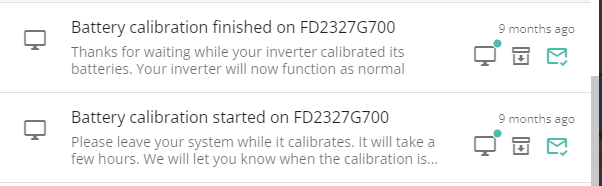
I have recently done a recal on my AIO (a couple of weeks ago) and have now noticed that the battery is going from 4% to full with around 9kwh of charge (according to the energy graph) so I am surprised that is seems to be holding less charge in such a short time.

I usually run the battery down to "empty" on a daily basis which I thought would stop the SOC problem, but it looks like that might not be the case.

Any thoughts?
W
#2 wrighar

I have not done a Recalibrate (to my knowledge) since May 2024...
I just use it down to around 40-50%, then charge it back up, where it then sits for an hour or two in the cheap morning slot before being used again.

W
#3 wrighar

I have not done a Recalibrate (to my knowledge) since May 2024...
I just use it down to around 40-50%, then charge it back up, where it then sits for an hour or two in the cheap morning slot before being used again.

I'm not getting any SoC issues or capacity loses.

K
#4 KevinB

CW What BMS version are you on? If I have a SOC jump from 80% -> 100% a few days in a row, then I usually trigger a calibration. I think I've done it 2 or 3 times in the last 4 months? It's frustrating to have to do it, but at least the option is there now (it's only recently been made available for us mere consumers).

G
#5 geoffreycoan

I haven’t to my knowledge ever seen a SoC drop on my gen 1 inverters, that get used from full to empty at least once a day.

Last recalibration was March 2024 but I can see the operating range on my 9.5 has reduced and some of the cell voltages are out of alignment so I do plan to do a recalibration but will wait until either cheaper rates or I’m less dependent on the battery to run the house - i.e. a bit more into summer.

Once a year or every 9 months I’d suggest?

C
#6 CW

[unknown] I'm currently on BMS 10 - I don't see any option to upgrade that yet

V
#7 Vestas

KevinB I wouldn't go using calibration for the reason you stated. That's why they removed the ability of users to trigger a calibration in the first place - it ages the battery fairly dramatically when run repeatedly.

I certainly wouldn't run a calibration more than once every 6 months unless its triggered by a firmware update (which I'm not sure it is anymore?)....

D
#8 DreadorUK

If the battery starts to just offer 7-8 kWh a day then you can see why people do it - if your losing 5 kWh a day thats equivalent of degrading the life by 5 years as such.

My advice @cw is to just let it bed down and see over a few weeks - Raise issue also with GiVEnergy - good luck with that - and your installer

I had major issues with .5 kWh loss a day after moving onto new inverter firmware (already on BMS 10 with no issues prior to that) and I ended up doing 3 recalibrations over 2 weeks there abouts, and its just about settled now so you can improve it using it - I still get the odd day where I get 8 kWh from a full battery but it corrects itself for the next day now where before it didnt.

C
#9 CW

Vestas it ages the battery fairly dramatically when run repeatedly

Could you elaborate - how does this happen - is this to do with battery cycles or something else?

V
#10 Vestas

CW Simplistically - a calibration takes the battery from 0% to 100% true charge (not quite but very close).

Lithium-ion batteries react very badly to this (especially being fully discharged) which is why this sort of charge range is not exposed to the user on any lithium-ion charging system. Not your mobile, laptop, tablet, none of it. They all give you a "fake" 0-100% range which prevents over/under-charging.

A normal full range charge on a GE battery would be from 4% to 97%.

There's lots more reading online as to the effects of 0-100% cycling on lithium-ion cells.

C
#11 CW

Vestas OK so if I understand you, a recalibration goes across the whole range of the battery capacity (not the bit that we get to access normally) - that would make sense and not something I was aware of. so what is the answer if you lose SOC tracking over time - what is the best/safest way to resolve it?

V
#12 Vestas

CW On a LV battery system the way to do it is to let the battery discharge to 4%/cutoff, leave it to idle for 2-4 hours to rebalance cells (it may discharge for 30 minutes if it finds more charge) then charge to 100%.

On an AIO - no idea I'm afraid.