I've been encouraged to start a thread for those of specifically on 3 Phase so we can group the potential issues and discuss workarounds etc.
I'm Ian, and I have a 3ph 20kw inverter with 13.6kwh battery (4 batteries).
When first commissioned last November it was stand-alone so pretty easy to discern it's performance.
Issues:
Low Charge/Discharge: I noticed pretty quickly that it was only charging/discharging c. 10kwh - almost as if 1 of the 4 batteries wasn't working. Support was pretty poor and I was just about to return the system when Paul Landregan Head of UK Hardware Lifecycle got involved - eventually they tried replacing the BMS with no joy then wrote a new firmware (for the BMS I think) which seemed to do the job. How are others getting on?
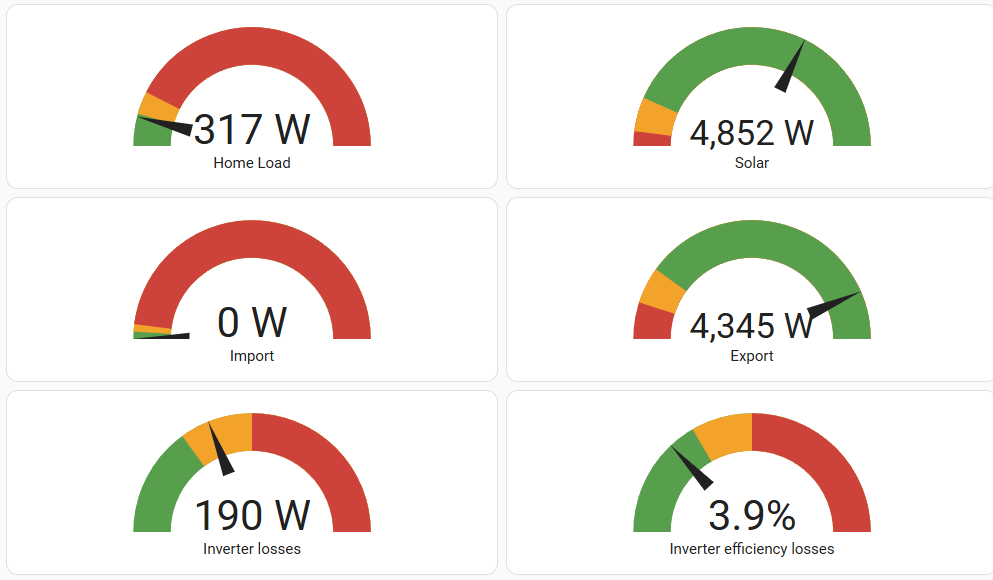
System Overhead: I noticed early on that there was a c. 200W overhead (c 5kwh per day!)
This seemed massive to me and in no way represented the claimed overhead/round trip loss. No one wanted to answer this one until one day a support chap pointed out that Inverters don't like low levels of work - until they reach 10% of capacity their performance curve tends to be rubbish (all inverters not just GE apparently). After a little research I was happy to accept this with a 20kw inverter generally only handling 300W of draw I could see the issue. Now I have a heat pump and the first phase of my solar ... the overhead seems to have increased to c. 6kwh per day ... so I'm becoming more sceptial! I'll wait until I add more load (solar in summer/heat pump in winter) but it's not obvious that this overhead is going to go! Anyone else noticed similar?
'Home' on App not working: I've tried everything and had various explanations - the latest being that my mesh system isn't playing nicely - but I've tried being on the same node etc and no joy! I'd be interested to hear if anyone on 3phase has this 'Home' part working?
Solar Forecast on Cloud: I've got this bit working, but the Actual data doesn't show ... ie the bit that GE has! Anyone got this working?
I look forward to others thoughts and hearing about other experiences/issues!
All the best
Ian
R
#2Rubikcube
I only have single phase, but I will comment on point 2. All electrical/electronic equipment consumes power. 200W when standing idle sounds about right for the configuration you have. Of course, when you charge or discharge the batteries, the power consumption will increase. Ask yourself, is it warm? Does it feel like a 200W heater would feel?
N
#3Nil Desperandum
Rubikcube yes it is warm. But the specs say 97% efficiency and <18w self consumption... so I find 200W way over the top. An overhead of 5-6kwh per day on a house with a 12kwh per day load strikes me as way OTTP. So I did comment on the EVMan video saying just get a battery and inverter and working the figures on 90% round-trip efficiency! Now, I accept I may have erred on such a big inverter at least initially, but I will have > 20kwp solar soon.
I'd be interested to hear the overhead on other systems out there, including yours?
Thanks
Ian
R
#4Rubikcube
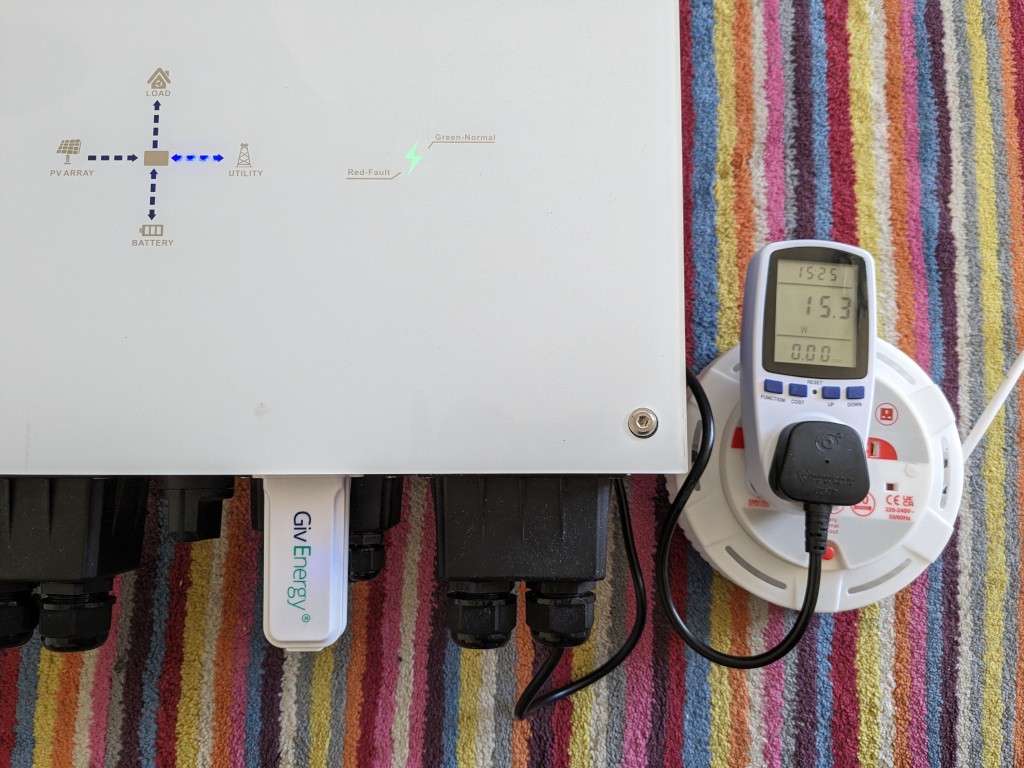
My single phase inverter uses 15.3W with no panels, no battery and no network connection. To measure that I just put a plug on one.
By my understanding, 3 phase requires 3 inverters, so might consume 3 times the power? Then there is the batteries, where the power consumption is more difficult to measure because the internal computer (known as BMS) is powered by the battery itself. I have only 1 16-cell battery, and I believe it consumes around 15W when idle. You have 4 24-cell batteries so I would expect 20W-25W consumption each.
The idle consumption of my basic configuration is about 30W, which equates to about 262kWh per year. I charge the battery each night on the Octopus GO tariff, and the total power consumption of the battery and inverter is about 600kWh per year. Having the battery has increased my annual electricity consumption from 5200kWh to 5800kWh, but using more energy saves money as most of my import is off peak at 8.5p. Rough calculation:
Before 5200kWh @ 25p = £1300
After 5800kWh @ 10p = £580
#5TheDragon (GivEnergy)
Note, that inverter efficiency falls with low loads. So a hugly over sized inverter, will not operate as efficient as one running at its optimal power.
N
#6Nil Desperandum
Rubikcube That's really interesting thanks. My 3ph inverter is rated at self consumption < 18W which is excellent if true. I hadn't seen the numbers on the batteries so that's really interesting. I'm not clear why the batteries should have an overhead (power 'leakage' I guess?) but I can certainly see the BMS having that overhead. It all adds up I guess. I still find 200W a lot. Indeed it's more than that, the average is 6.4kwh/day (av 267W) (gone up a little as I've loaded it)
You say that your overhead is about 30W ... I'd be very happy with that. Or even 100W for a big 3 phase system. 267W strikes me as a lot and skews the calculations somewhat. For me, it's not about the money it's about the energy usage and helping balance. To be clear, I'm ploughing forward, it's just I have to find another 6kwh/day ... 2.2 MWh per year to get to net zero! That's about another 3kwp of solar... it all adds up.
Thanks for the feedback and very happy to discuss further.
Cheers
Ian
N
#7Nil Desperandum
TheDragon (GivEnergy) yes, thanks, I had noted that above. I would guess that most inverters would run below 10% max load quite a bit of the time and hence be relatively inefficient. I hadn't found that in any of my research - getting practical experience is valuable!
Given only 2 MPPTs on the 20kw inverter, I'll likely have only 15kwp attached to it ... the rest I'll need another solution, which is a shame. But the 11kw inverter would have been a bit too small.
Indeed. 2.2MWh is approximately the equivalent of your annual standing charge for electricity and gas - single-phase electricity standing charges, I'm assuming yours are higher for 3-phase.
This was my 1Ph hybrid yesterday: I just use a rough gen+import-use and battery to get a 'lost' Watt figure, so not perfect, but gives me a rough idea.
Runs idle around the 50W mark,
about 250W when doing heavy battery charge from grid
Varies when solar, but 100-200W mostly
and around 300W when doing forced export
Ignore the big spikes, I've not got fully clean data or worked out calc
W
#12wrighar
Charged between 03:00 and 05:00
Discharged between 17:00 and 19:00
Solar from 07:00 and 18:00
{{
(states('sensor.givtcp_fd2327g700_pv_power') | int +
states('sensor.givtcp_fd2327g700_battery_power') | int -
states('sensor.givtcp_fd2327g700_grid_power') | int -
states('sensor.givtcp_fd2327g700_load_power') |int ) | abs
}}
I suppose I could clean it up a bit using sensor.givtcp_fd2327g700_import_power and sensor.givtcp_fd2327g700_export_power
N
#13Nil Desperandum
wrighar thanks. So what's your average daily loss do you think?
Yes I realise that numbers are imprecise. In fact it amuses me that the Grid Import is always 0.5-0.6kwh less than Octopus charges me ... hmmmm (My numbers work off the Octopus as the actual)
Cheers
Ian
W
#14wrighar
looking at the 12th April,
there were about 12 hrs idle (40-50W, 00:00-03:00, 05:00-09:00 and 19:00-00:00) worst cast 0.6Kwh
4 hrs forced charge and discharge at max rate at 250W and 300W, so 1.1kWh
and 8 hrs solar generation where inverter losses were from 0W to 100W, but these I've not counted as it's all covered by solar...
So about 1.7kWh, 2/3rd of which came from force battery charge/discharge.
W
#16wrighar
If I go back to 14th March when I was on COSY and charging at 04:00 and 22:00 mostly, it's a lower use picture:
1hr at 125W and 1hr at 215W, idle still around 50W
Oddly low solar gen pushes the use power down to around 15W when high solar gen puts it up nearer 100W, but that's when solar is over the inverter limit and then charging the battery with excess.
Right this instance, I'm assuming I have this correct...
W
#17wrighar
Had a bit of a think this afternoon and updated my losses calc to :
{{(states('sensor.givtcp_fd2327g700_pv_power') | int +
states('sensor.givtcp_fd2327g700_battery_power') | int -
states('sensor.givtcp_fd2327g700_grid_power') | int -
states('sensor.givtcp_fd2327g700_load_power') |int ) | abs }}
battery_power and grid_power are both +ve and -ve ranging so that gives me my 3 sources and 3 sinks.
Following up on point 3 - the use of a Mesh network.
First of all, I am new to using GivEnergy Inverters, since my 10kW (with 6.16Kw Solar and 13.6Kw Battery) was only commissioned yesterday.
During the commissioning process, my inverter struggled with the Mesh network. Tech support from GivEnergy tried to tis the connection down to a physical MAC address , but this was also problematic.
Luckily I had installed a physical network cable to the location to the Mesh router, so there was a physical connectio available. Tech support advised on changing the dip switches on the inverter and we were running on a physical connection.
This greatly improved the commissioning and everything seemed to work reliably.
My view is that you should use physical network connectivity if possible and this is far better than a Mesh and probably better than a connection to a single wifi router as well.
N
#19Nil Desperandum
AllanD Interesting, thanks. We'd need to use a powerline adapter to do that. And since the inverter is running fine on the mesh (except for the Home bit of the App) I think I'll leave it. I actually didn't realise there was a physical connection option else I might have gone for that.
N
#20Nil Desperandum
Any other 3phase system users on this forum?
V
#21Vestas
Nil Desperandum Only one I've seen is someone in the Netherlands.