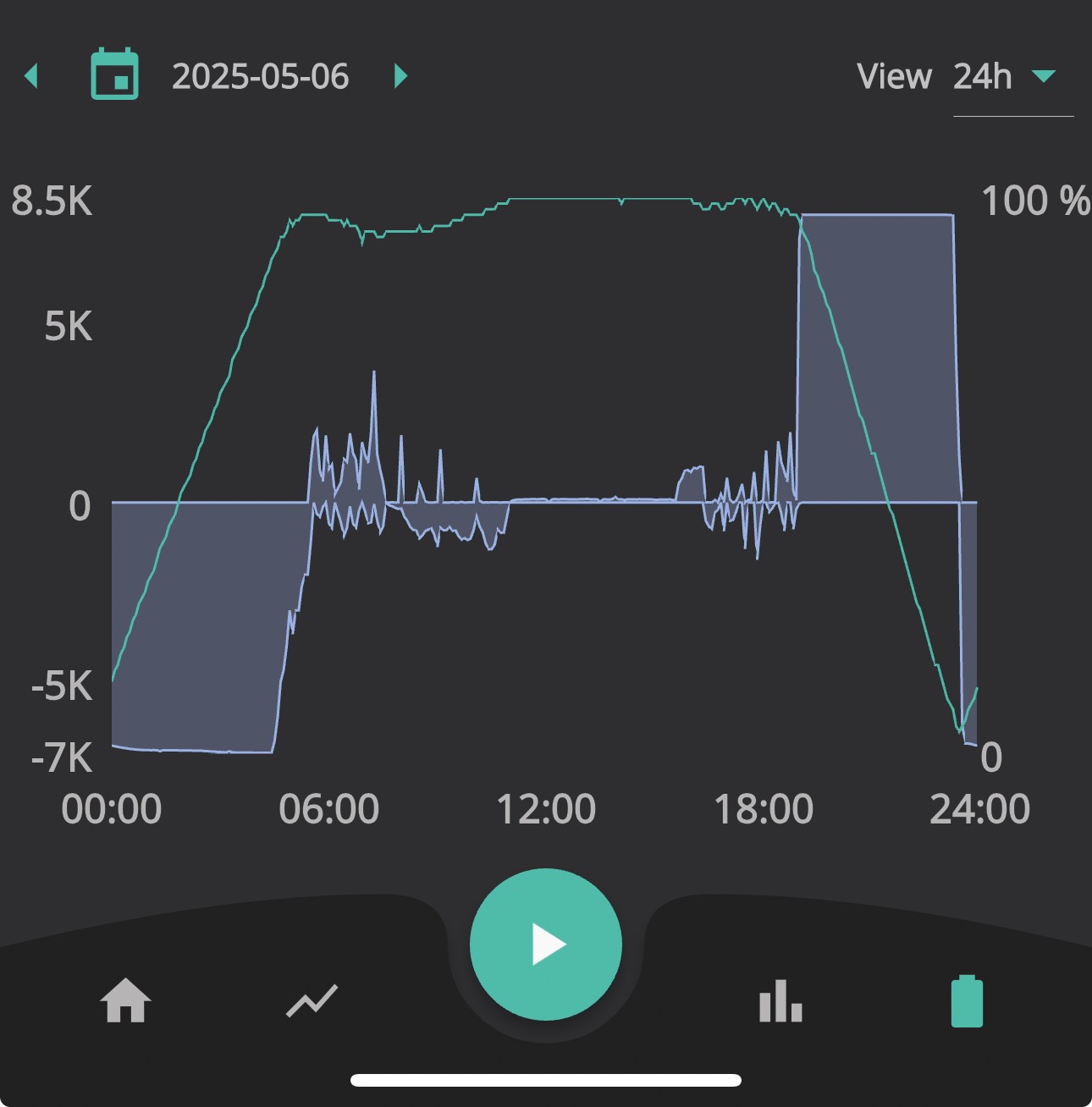
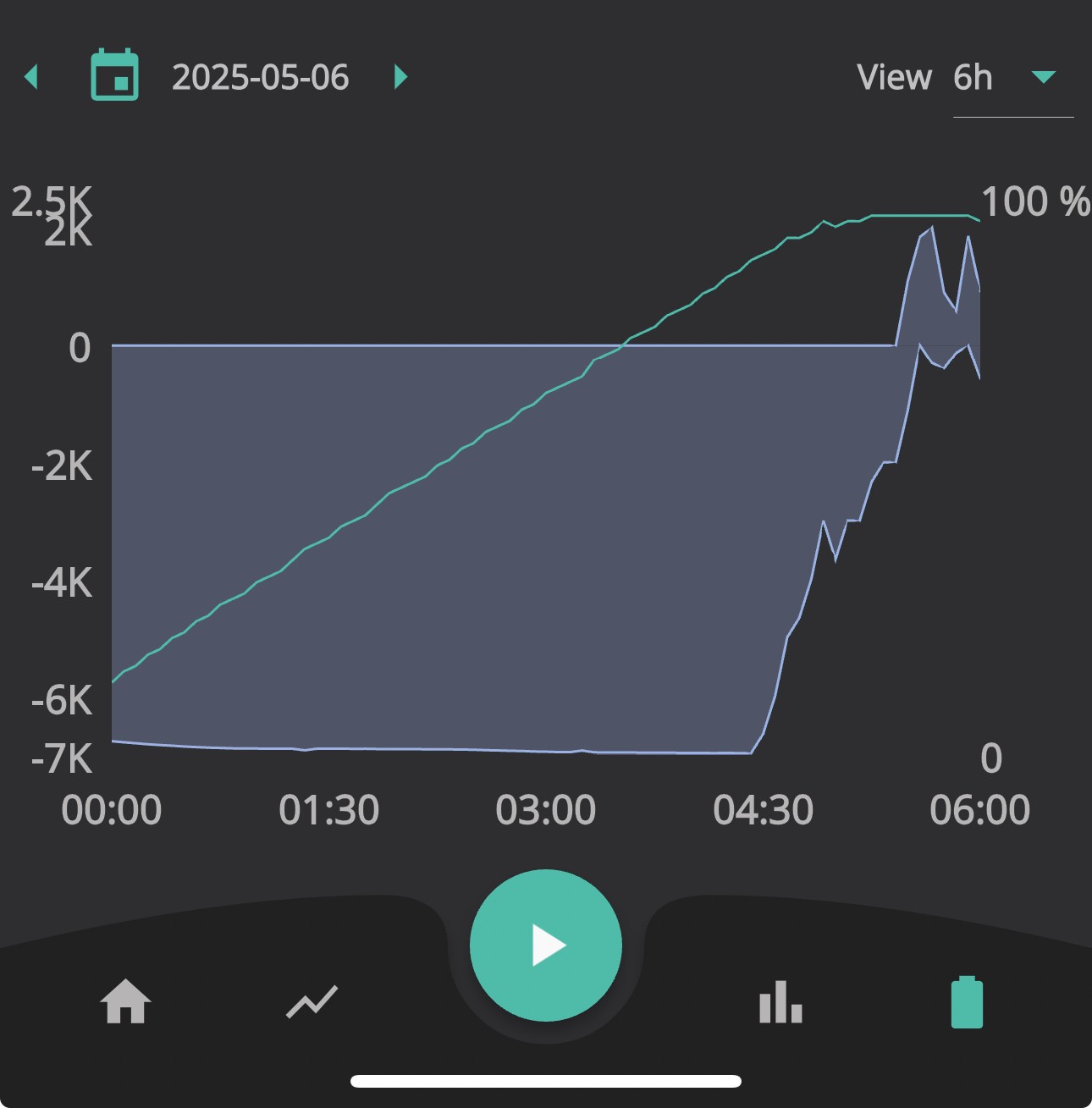
Adding more batteries to my system?

46 comments started 2025-05-05 last 2025-05-16
GivEnergy ProductsBattery
A
#1 Andrewz61

I've only had my system (5kw inverter & 9.5kw battery) since December but it is already looking like more storage capacity would pay for itself in the long run especially if I pick up a cheap battery......

Now to the questions, there are quite a few used batteries starting to pop up on various selling sites.
Do they need to be de registered from the previous owner?
I'll be looking for a newer Gen battery With 100% DOD so will be plug to plug, do I need an installer to set it up or does the system instantly see it when plugged in?

V
#2 Vestas

Andrewz61 You need the installer to commission it. Most won't want to know if the battery is used, those that do will likely charge you a fair whack as they'd have to support it. A third-party installer could do it but then they'd be responsible for the entire system, not just the second-hand battery.

That's why second-hand GE kit is worthless.

G
#3 geoffreycoan

Andrewz61 In addition to the comments that Vestas makes, I’d carefully evaluate what the payback on having additional battery storage really is.

There are different scenarios:

  • charging from solar and exporting in the peak period (e.g. Octopus Flux)
  • charging overnight on an EV tariff and exporting during the day (e.g. Octopus Go, Eon drive)
  • charging overnight on a cheap rate because you need the extra battery storage for home load (usually in the winter)

All of these have different paybacks, but batteries are expensive, circa £4k fitted for another 9.5kW battery. I’ve run the numbers for myself and had paybacks up to 22 years!
And adding an extra battery won’t change your inverter throughput, you will still be limited to a 3.6kW battery charge/discharge rate.

#4 Judith

I considered adding more storage to our 9.5kWh system, but encouraged by the good users here I did a more thorough cost saving analysis. The conclusion was that we would save £200 per year but as stated above the costs were£4000. The original battery was well worth it however together with a further 2kW of panels the payback was 8 years. It very much depends on what tariff you can get (such as a 7p EV one) which changes the calculation. Without an EV nor bravery to use agile the savings are more limited.

W
#5 wrighar

We've just had ours 1 yr now, 5kWh hybrid gen 3 and a 9.5kWh battery.

Have looked at a 2nd 9.5kWh battery but the extra annual benefit of about £350 (£1 a day) would take 10 yrs to repay by itself.

But the system has saved me £1975 this year (so a 4yr9m payback), so following that, adding a 2nd battery would extend payback by about another 1yr9m - the currently 4yr's of £350PA extra payback taking me out to to 5yr9m if bought now.

So adding the battery today would extend my current 4yr9m payback by 1yr extra.

And that is assuming my current cosy + export winter and IOF summer tariff's
More battery would allow a more aggressive single slot import tariff at 7-9p kWh vs the COSY 3 slot 8hrs 14pkWh, giving even more benefits.

V
#7 Vestas

I'm not sure I'd be inclined to buy another LV battery. There's limits to the efficiency given that 50Vdc from the battery has to be boosted up to 300+Vdc, then converted to 230Vac and at low power levels (10-20%) the efficiency on round-trip is awful.

Having said that, the LV batteries/hybrid inverters were designed to dump excess PV into batteries so efficiency wasn't high on the list of priorities - affordability was pretty much king, and 50Vdc battery packs were ubiquitous.

I haven't looked closely but I think 400Vdc is what the automotive industry seems to be using so that's likely where we're headed on HV batteries.

R
#8 Roy124

I think bottom line is buy more battery at initial installation and avoid a second commissioning charge. How much battery is the question. I was lucky my supplier, just before they folded, offered a 5.2kW battery over the initial 3.2kW quote. Had I known better (and been able to bear the cost) I would have opted to the 2 additional panels for which I have space, and a larger battery.

P
#9 Pete.J

I have a 5kW hybrid inverter and two 9.5kWh batteries. The capacity is very nice, but something to bear in mind is that the pair will take twice as long to fully charge as a single battery because the inverter still only supplies 3.6kW to the pair when charging from grid.

D
#10 DD

Pete.J But presumably charging doesn't slow down when it's cold, since even when throttled, it's the inverter that's doing the limiting ?

P
#11 Pete UK

DD But presumably charging doesn't slow down when it's cold, since even when throttled, it's the inverter that's doing the limiting ?

I can’t exactly answer that (because mine are usually always about +20c). But what I see with 4x 9.5’s on two Gen3 HY5 inverters (in a warmer location) is this…. My max charge rate is 7kW (starting at 6.9kW from ‘empty’ and increasing slowly. Then above 90%, (in the last hour), the charge rate trails off. But more slowly now on firmware 316 and battery 3020 than before. So at about 05:30, I’m still seeing a charge of anywhere between 838W and 1.6kW (99-98% full on the global SOC). ie a pair of batteries on each inverter ‘just’ fully charge within the IOG 6 hour window. Sometimes they make it to 100%. Just depends exactly what % they got down to at 23:30 after the evening grid export. If it’s 4%: 98-99% if it’s 5-6%: 100%.

For a pair of batteries on a single inverter, the charge/ discharge numbers you see below will obviously be half of what I’m getting. I don’t see 3.6kW charge rate (max3.5kW). Max discharge to house load with all 4 batteries is 7.2kW (3.6kW for a single pair) and forced export is 8kW (4kW for a single pair).


P
#12 Pete UK

Judith It very much depends on what tariff you can get (such as a 7p EV one) which changes the calculation. Without an EV nor bravery to use agile the savings are more limited.

Exactly this 👆🏻

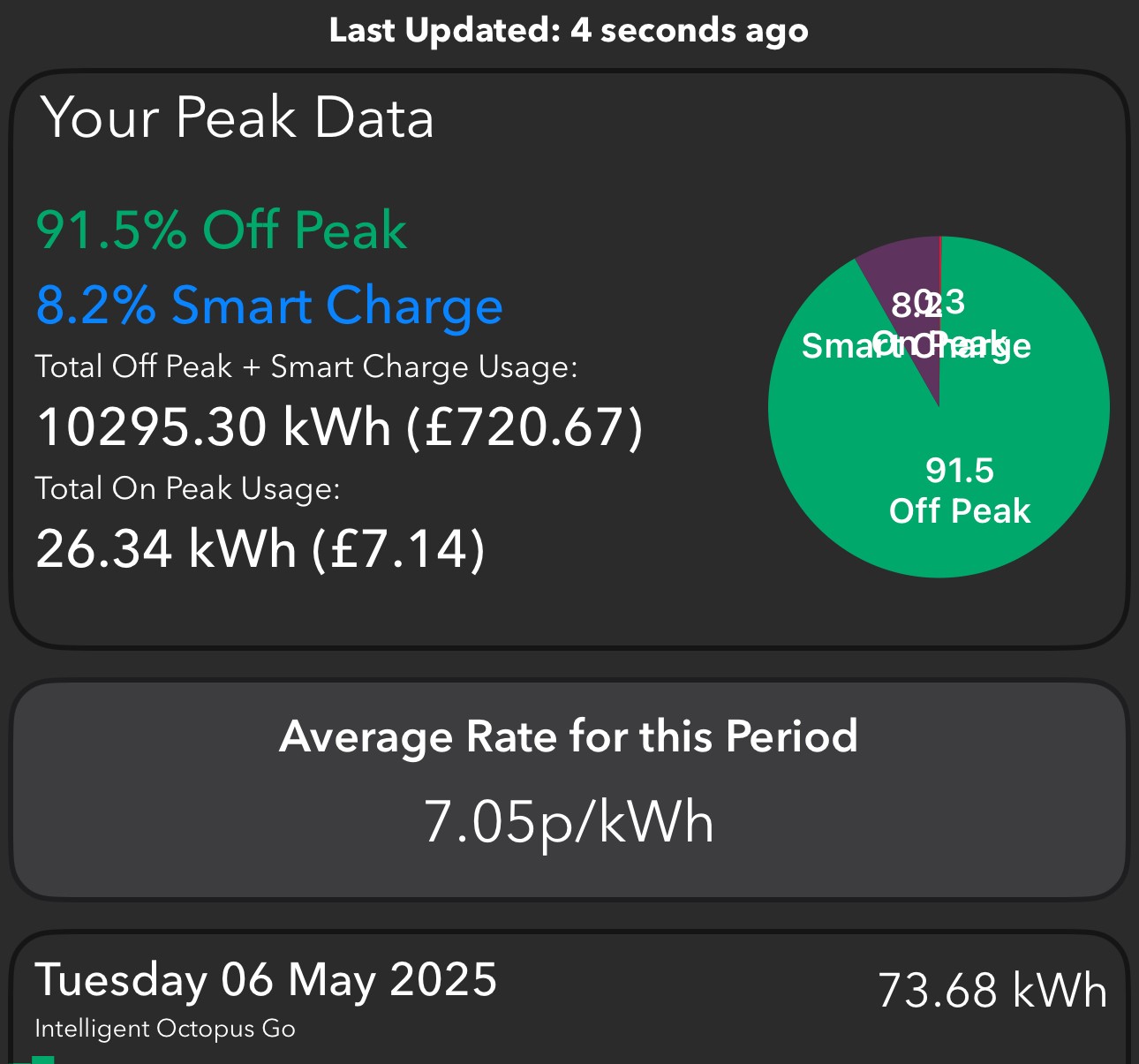
If an extra battery allows you to swap onto IOG and significantly reduce your import cost per kW down towards 7p that changes everything. Payback time will be reduced dramatically, compared to an average import price of say 12 or 14p.

I realise that it won’t always be financially practical in every case to just add some battery storage that allows the swap onto IOG. However, if it does, in this scenario, you need to use a figure closer to 7p/kW and multiply this by your annual number of imported kW’s over the last 12 months. Then subtract that from what you actually paid for import in total over the last 12 months. Thats one very large part of the ‘adding another battery’ saving that gets overlooked. The other part is the ability to discharge more to the grid at 15p/kW (which is the part most just focus on when looking at payback for adding another battery). Then there is the ‘avoiding peak rate import’ part as well due to having more capacity to last you longer, helping to get the number down to as close to 7p/kW as possible.

There are lots of moving parts to this due to different scenarios and usage, as can be seen from the varying array of peoples ’payback time’ calculations.

Looking at just the possibility of perhaps cutting your annual import cost in half (alone) could easily be a massive contributor to the payback time of adding another battery and shouldn’t be overlooked. It’s worth a second look and a bit of serious thought.

…my average import price per kW over the last 6 months was 7.05p. (Last 12 months it was 7.15p due to some teething problems).

#13 PianSom

Pete UK
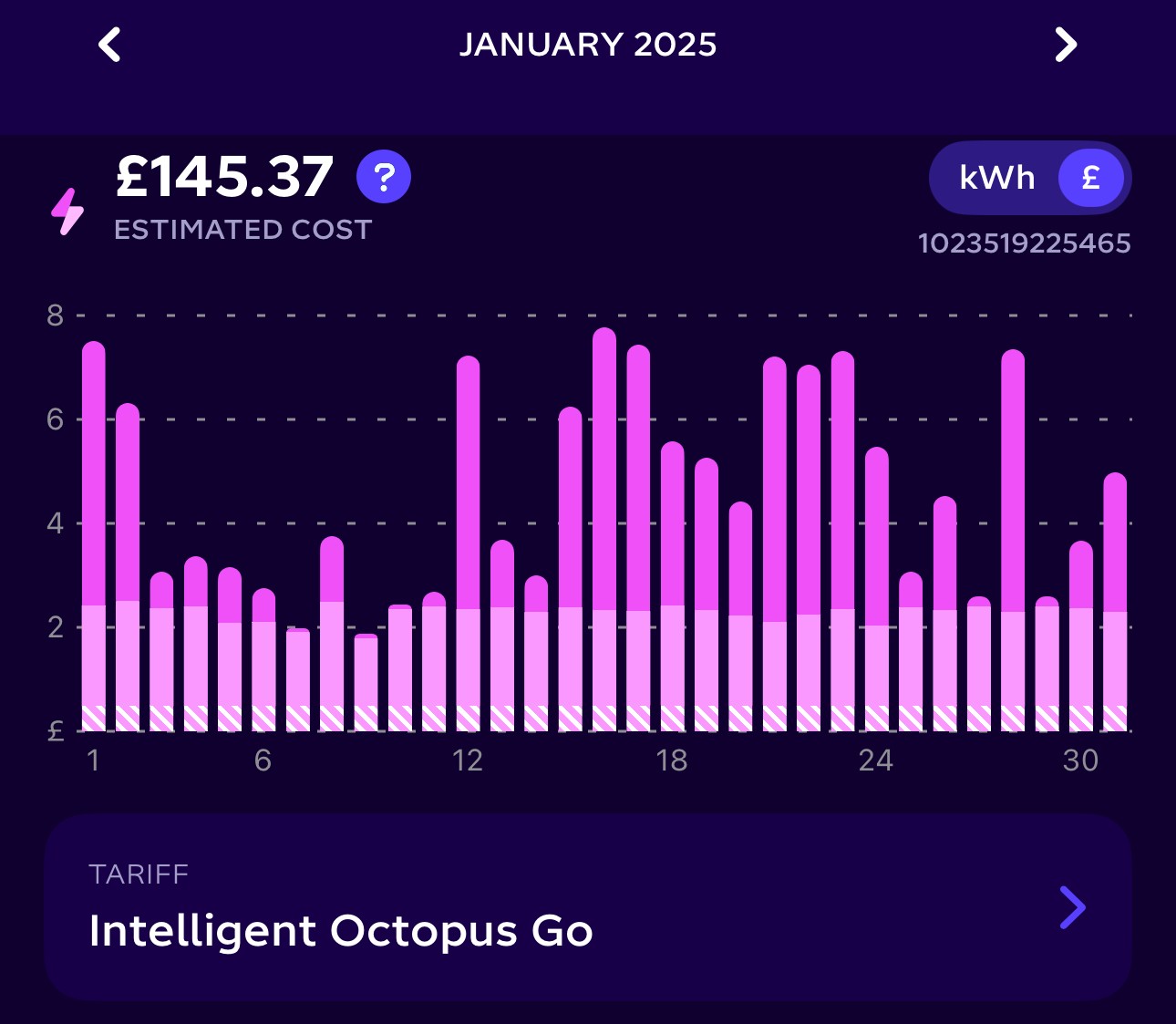
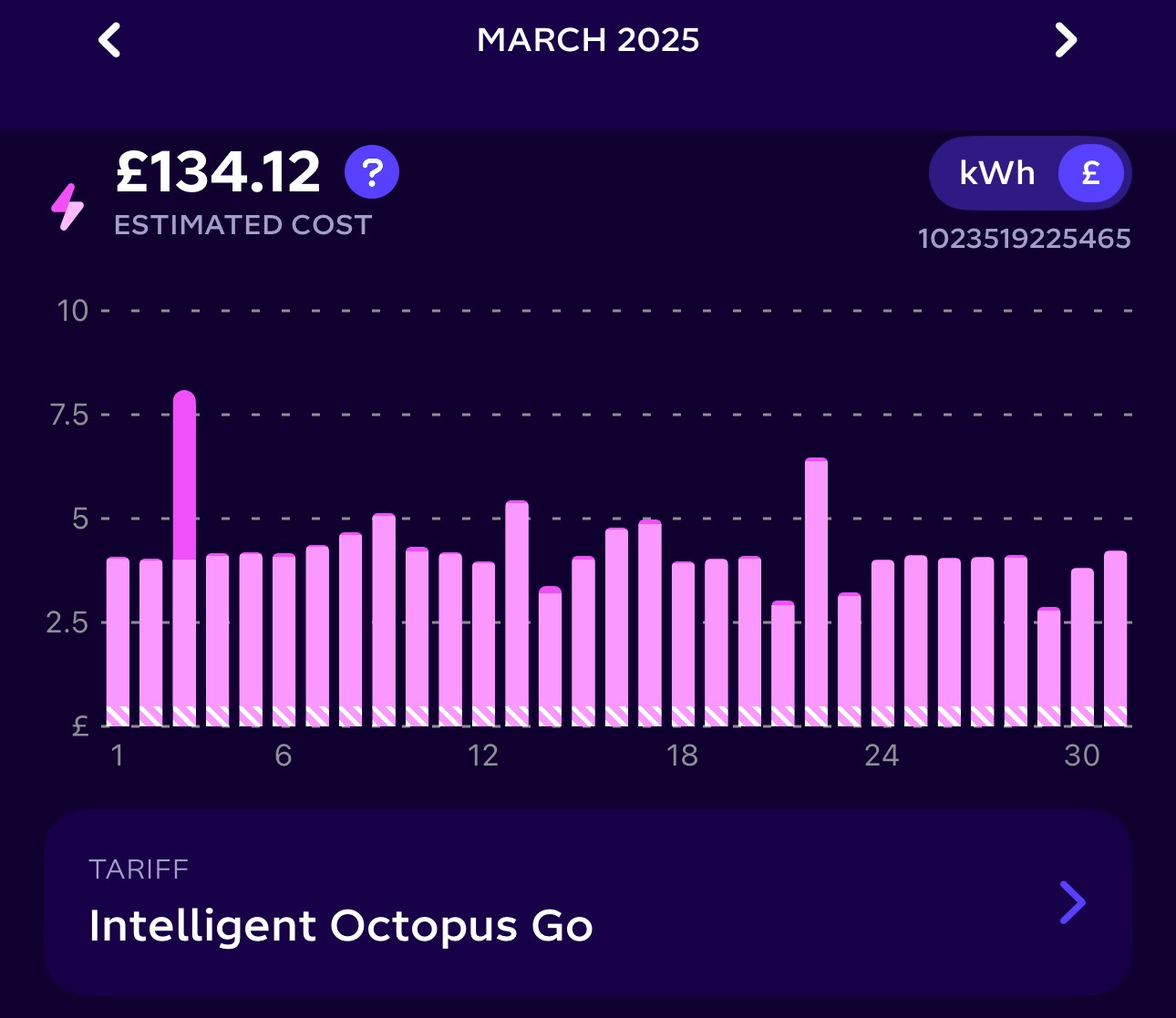
Just to illustrate your point graphically, I had my second AIO installed in Feb this year. Here are my import cost graphs for Jan + Mar from the Octopus app (NB 3 Mar I had a Power-up, so the peak import showing was actually charged at 0p)


(Of course, my export quantum went up considerable between January and and March also)

BTW adding more battery does not give access to IOG - that requires an EV.

W
#14 wrighar

I'm on COSY + Export in the winter, and Intelligent Flux in the summer and averaged over the last year:
Import unit price £0.1724
Export unit price £0.2156

And was £573.28 in prifit at the end of 12 months.

P
#16 Pete UK

Nice.

PianSom BTW adding more battery does not give access to IOG - that requires an EV.

Yes. Correct. What I meant is that it may give you the ability to swap to the IOG tariff because you can last on battery power between peak prices, assuming you have an EV.

P
#17 Pete UK

wrighar

Nice. That’s very impressive results. What size system/ batteries do you have? I’m assuming quite a large array and generally low ish usage? Which is maximising your gains from solar export. But that’s just a guess.

W
#18 wrighar

[unknown]

5kW inverter, 1* 9.5kWh battery and a 6.02kWp array.

Home usage is 4400 a year, generation was 6500.

D
#20 DD

wrighar Home usage is 4400 a year, generation was 6500.

I read somewhere that if you generate more than around 120% of usage, income might be taxable ..?
(But comes within £1000 trading allowance)

C
#21 CW

DD I read somewhere that if you generate more than around 120% of usage, income might be taxable .

I believe that to be true. This is from the government site...

S782A Income Tax (Trading and Other Income) Act 2005

With effect from tax year 2007-08 there is an exemption from Income Tax for an individual’s income from the sale of electricity generated by a microgeneration system where:

the system is installed at or near domestic premises occupied by the individual, and
the individual intends that the amount of electricity generated by the microgeneration system will not significantly exceed the amount of electricity consumed in those premises.

For the purpose of this exemption ‘domestic premises’ means premises used wholly or mainly as a separate private dwelling.

A ‘microgeneration system’ is defined in S263AZA of the Taxation of Chargeable Gains Act.

This exemption is aimed at domestic microgeneration which is primarily intended to match the generator’s own home consumption needs. The term ‘significantly exceed’ in (b) above is not defined in Section 782A and should be considered by reference to the particular circumstances. However, in general, a householder who does not intend to generate an amount of electricity more than 20% in excess of their own domestic needs is unlikely to be regarded as intending to significantly exceed the amount of electricity consumed in their own premises.

No income tax will therefore arise on feed-in tariffs received by an individual from domestic microgeneration where the above conditions are met.

P
#22 Pete UK

‘Intend’ - “I thought I’d be using more when I get an EV….. and/ or I’m producing 20% more than the installer estimated”…. valid?

‘significantly’ - how do you define that? 10%, 50%, 100%, 200%….?

Seems a bit subjective to me. Probably largely irrelevant.

V
#24 Vestas

CW Interesting. I wouldn't be surprised if revenue & customs take a closer interest in G99 systems in future given how much generation some people have.

Their argument will be that you cannot offset your "summer earnings" against your "winter costs".

Obviously if it goes to an upper tribunal they'll win (they do in over 90% of cases & win most of the rest on appeal*) but it will be interesting to see if they go for it before the DNOs/suppliers pull the plug on export (as has happened elsewhere).

*you need deep pockets to win an upper tribunal case, maybe the PV suppliers would fund it?

C
#25 CW

Pete UK Indeed - in fact when I was looking at this I did wonder what the 20% was measured against.

Is it the compared to original grid consumption prior to solar or after? This makes a big difference, because grid consumption will automatically reduce once solar is in as a fair chunk of eneergy will be provided by the panels.

I suspect they will not really go too far with this currently as the amounts would be small, but Vestas makes a good point as more and more solar is installed, then maybe......

V
#26 Vestas

CW If they do it then they'll simply set a limit to export - say 5MWh/year - and anything over that will be taxable. It'd require secondary legislation but that's easy enough as the relevant minister just signs it off, no vote required.

Personally I'd put my money on the DNOs and suppliers eliminating domestic export before that happens. Have no doubt about it, that's definitely going to happen - especially with all new-builds getting solar from 2027. No electricity distributor (anywhere) wants domestic exports as all they do is increase infrastructure costs for little to no benefit. I reckon we have 5 years MAX before the exports get pulled....

C
#27 CW

Vestas I remember Gary Does Solar talking about how things are changing in the USA where there is now too much eneregy being produced and homeowners are being billed for their export. I think that will come here as more solar/battery is installed nationally. Maybe that will be the trigger so individuals will automatically reduce export to avoid the charges.

V
#28 Vestas

CW The DNO will have a kill switch to turn off/reduce export on each inverter. That's what is happening now in various countries, older inverters don't support it so will have to be grandfathered out.

At least new builds will be evenly spread between phases, unlike the largely unsustainable install regime we have now. That's a fairly expensive problem for DNOs - one phase potentially being locally saturated with export and going out of limits (sometimes from only one premises) while the other two are normal. The "benefits" are minimal at best as usually nobody wants the export because its at the wrong time. Edit - and of course those additional costs are paid for by people without PV.

#29 Windy Miller

#Threadhijack

When I look at the generation mix in the UK on the EnergyDashboard and the OpenEnergyMonitor sites the difference between the nighttime and daytime usage is around 12GW; nighttime being around 20GW and daytime around 32GW.

Does this not imply that Solar benefits the country when it is below 12GW peak in the day? Currently the sites say it is around 10GW peak so we are nearly there. If we pass the 12GW point then we have to think about curtailing the country imports (probably not a bad thing as some of them are high gCO₂/kWh).

It is difficult to completely turn off gas/biomass/nuclear when you'll need it later in the day. The grid needs more localised batteries. They should be paying us to store our excess energy for release to our neighbours later in the day. Or we could use the excess to heat the water in the pumped storage and recover it later with massive heat pumps? :-)

#30 hoggy

We currently add 70-80MW of solar capacity every two weeks. Most of which just acts as demand suppression during the day as its embedded.
I forget which site it is - it might be the energydashboard one if that is the blue one? (mine doesn't yet do this) but if you add the forecast embedded generation to the current demand you get an approximation of what the tue demand really is (rather than the huge U shape trend from conventional generation) which does flatten things out a bit demand wise.

I have a feeling that the DRM port (or the API equivalent) will re emerge as a solution to strangle inverters.
I'm also building out the embedded type stuff over on Terravolt over the coming weeks to see what can be gleaned from that. A few of the DNOs have started reporting their transformer data so reverse flows can be spotted easily (of which most will be domestic PV, particularly if it vanishes overnight)

V
#31 Vestas

Windy Miller You're talking about commercial PV generation which has properly designed infrastructure, including large batteries these days.

Domestic export is a different ball-game entirely - its cobbled together through local infrastructure which was never designed for it. Arguably much of that infrastructure is going to have to be upgraded if everyone is going to have a heatpump/EV but nobody seems to be paying that much attention as far as I can see.

C
#32 CW

Vestas The DNO will have a kill switch to turn off/reduce export on each inverter

That is not a bad idea, at least then we wouldn't get punished to sending power back to the grid - hopefully I will have paid back my investment before then 😄

#33 Windy Miller

Vestas Am I? EnergyDashboard is currently showing (11.15am) 10GW Solar which includes both Commercial and Domestic.

P
#34 Pete UK

CW I remember Gary Does Solar talking about how things are changing in the USA where there is now too much eneregy being produced and homeowners are being billed for their export.

I think that’s mostly in some parts of California isn’t it?

If that were to ever happen here I suppose we’ll have to go back to charging home batteries and EV’s (if they are home) from solar in the daytime and not charging too much overnight or dumping batteries into EV’s at night to minimise daytime export. And become a bit more “self-sufficient”, as it were. Hitting us all in the pocket in the process.

That would be a massive kick in the teeth to the industry. Government encourage people to become more green and burn less fossil fuels, watch us spend loads of cash on our systems. Then later on charge us for all we import but then also tax us on our exports and also the supplier charges us for exporting “too much”. What a crazy situation that would be !

I don’t know too many people that have solar where I live but I do have a lot of friends that don’t have solar and some are are pretty skeptical as it is (upfront cost, payback, blah, blah). If you can’t make an install payback at all in the future, then what would be the point? No one would bother installing a new system. Kind of a massive own goal for the government. A bit like removing the VED on EV’s way too early.

Hopefully that’s a long, long way off, if it ever happens. I hope not. I’m sure we don’t get sun here like California does.

V
#35 Vestas

Pete UK I doubt the govt would view it that way - all new homes will have PV/heatpumps so that's the "green" box ticked.

The current govt isn't that bothered about "green" anyway - if they were they wouldn't be pissing away £25bn on carbon capture and storage (a technology which has had more than $200bn poured into it and still doesn't work) to appease the "city"/fossil fuel companies.

There would be zero political "hit" in taxing PV export income - as in the average person would say "they can afford it anyway" so that wouldn't stop them.

Worth bearing in mind that apart from SEG (I'm ignoring FIT as its old rules) there is no obligation at all for energy suppliers to pay for export. Even then the suppliers could choose to pay 0.01p/unit - as long as its positive they're not breaking any rules.

In years to come I suspect we'll view domestic export and home batteries as a temporary anomaly.

P
#36 Pete UK

That’s a gloomy picture. One step forward and two back.

Vestas In years to come I suspect we'll view domestic export and home batteries as a temporary anomaly.

If the UK goes 100% cheap green energy, maybe but that remains to be seen. I’m sure at these prices people will want to generate and store their own and use it, even if the export payment goes away, (which I don’t think will happen for a long time). So there will still be a need for panels and batteries, unless electricity becomes almost free. I don’t think that’ll ever happen, I can only ever see it going up in price.

V
#37 Vestas

Pete UK In terms of batteries - assuming everything goes to plan we'll all have EVs with huge batteries sitting outside the house.

Frankly if we're talking about carbon cost then the cost of an inverter (hybrid) takes maybe 3-5 years to payoff (there was a pdf posted here on CO2 cost for a GE inverter from mining to factory gate). Batteries? I haven't seen any docs but if the inverter is the best part of 2000kg of CO2 than the GE battery isn't going to be pretty. I suspect many/all batteries won't come close to ever recovering the carbon cost.

The only upgrade anyone should be considering on "green" grounds are PV panel upgrades. They pay for themselves both financially and environmentally and have a lifespan which far exceeds batteries or inverters.

So lets stop pretending that what we're doing is because its "green". Its because it saves us money and we can afford it 🙂

The fact it may be "green" is a side-benefit.

P
#38 Pete UK

Vestas

Well, not everyone has a drive, or a car. I do but…
I’m not too Convinced about V2H TBH. Good in some situations but hardly ideal; How will it power your heat pump and home during the day, when you and your car are at work? Esp. In winter. You’d have to buy grid power in at peak diring the day. And when you get home from work and your car battery is empty…? same. And on the flip side; how would you store all the solar power during the day if you and your car aren’t there and you have no home batteries? It’d all be exported to grid (potentially for nothing much if your prediction comes to light). Rendering any sort of PV financial payback very minimal indeed.
The only way to make full use of V2H in that case would be to have and old banger EV sitting connected to your house all day (if you have space which many won’t and it’d have to be new enough to support V2H). Or be retired or wfh. Also I’m not sure manufacturers would be too keen on battery warranty claims if using V2H on your daily driver. Maybe they’d be ok, maybe not, maybe excluded for warranty purposes?
And you’d have to have an ugly old banger parked outside your house 24/7. To be honest that’s just the same as having a home battery permanently connected, only it’s potentially much cheaper? Much like the people who have removed an old EV battery and connected it up as home storage.

Carbon costs - I wasn’t talking about that. But what you said is interesting. Isn’t a large part of the carbon ‘savings’ from using more green grid times as well? Also they can be re-cycled. How does that add in? IDK 🤷🏼‍♂️

On green grounds - PV upgrades. Yep but if you install/upgrade PV you’ll need a new inverter. And if you install new PV and a new inverter, you’ll need a home battery to make it financially viable especially if export becomes negligible. So you can’t really just do a PV upgrade on its own to be “max green”. So what’s the real alternative here?

Vestas So lets stop pretending that what we're doing is because its "green". Its because it saves us money and we can afford it 🙂

The fact it may be "green" is a side-benefit.

Mostly agree with that. I do think there is some green benefit. Exactly how much is debatable on a case by case basis I guess.

V
#39 Vestas

Pete UK Mostly agree with that. I do think there is some green benefit.

Most of us go into it with a vague "its green as well as saving money" view.

The actual carbon cost of what we're buying isn't really understood and nor is the payback other than in financial terms. For example I'm not convinced that the carbon cost of home batteries can actually be recovered in the UK given their likely lifespan and our lack of solar power for 4+ months a year.

M
#40 mrand31

Vestas
Yes, but when batteries aren't being used to store solar generation to avoid imports at expensive times, they are being used to shift load from cheap periods to expensive ones. Thereby flattening the demand curve and making the grid more efficient.

V
#41 Vestas

mrand31 Still won't cover the cost of making them. Average sized (3-3.6kW) system will take at least 5 years to payback the CO2 cost of manufacturing inverter and PV panels so by the time you get to that stage your battery is halfway through its lifespan.

The situation is arguably worse for heatpumps - none of them are likely to cover the CO2 cost before they need replacing (assuming 15 year lifespan).

As an aside I'd be amazed if home batteries have any measurable effect on "making the grid more efficient".

#42 Judith

Fortunately people have calculated the carbon pay back period see for one example https://cat.org.uk/store-and-save/ and it is more like 1-2 years.
The financial payback is longer depending on personal circumstances and input assumptions.
PV panels also pay back in carbon terms in 1 year

V
#43 Vestas

Judith Unfortunately the figures in that article only work if you have a magical lithium tree - or you assume that all lithium on the planet comes from brine extraction, which is total nonsense especially for China as over 90% of the lithium used there comes from spodumene. Spodumene has to be roasted at 800C to extract lithium and that results in a minimum 15 tonnes (15,000kg) of CO2 per tonne of spodumene processed.

They have purposefully ignored those CO2 emissions and they will add at least another 120-150kg of CO2 per kWh.

Edit - so assuming their figure of 100kg/kWh in the factory is correct then you're looking at 250kg/kWh. That in turn suggests that the 9.5kWh battery has created at least 2,375kg of CO2 from mine to factory gate. That's a conservative figure as a G1 inverter is near enough 2000kg of CO2 from mine to gate.

The giveaway here is them going on about "factories which use renewables/fossil fuels" when they know full well that the majority of carbon costs come from mining/processing & transporting lithium - and there's currently no way to use renewables for that.

Also their figures assume no gas generation will be used to charge the batteries. Again magical/wishful thinking here as that's not how the UK grid works.

In short the figures in that article are deliberately misleading nonsense 🙂

V
#44 Vestas

I wondered more about the CO2 recovery costs on the battery and it seemed to me to be simplest to use some Octopus data...

Today's CO2/kWh peak on https://agile.octopushome.net/dashboard is 239g between 0900-0930. Edit - or was anyway, revised downwards now which makes the following about as favourable a scenario as possible.

So lets assume you have a 9.5kWh battery. Lets further assume that the battery charging/discharging circuit/chemistry is 100% efficient. We know its nowhere near that at low loading but lets go with that.

Its a lovely day here and there's no need to use any grid power to charge the battery from empty to full. All done via PV.

The average (non-predbat user) will only do this once a day so the calculation is simple.

9.5 x 0.239 = 2.27kg CO2 saved

So that's the maximum an average user is going to save in CO2 by load shifting with a 100% charge/discharge from PV.

Looks like around 1000 days - ideal sunny summer days with zero wind - to recover the CO2 from manufacturing.

However we're in the UK so that's probably nearer 2000 days... or 6 years if you prefer.

P
#45 Pete UK

If you charge from solar only that saves 2.27kg. Then if you discharge that 2.27kg in the evening it saves someone else using 2.27kg, so that’s 4.5kg, plus the fact you export all your solar in the day, which in summer could be an additional 30kW, saving maybe another 4kg (because it’s less carbon intensive averaged over the day). I know that’s only in summer so maybe 4 months you are saving 8.5kg. Less in winter obviously. Maybe they factored that into their calculations? If you said an average of 7kg for 365 days, that’s 2,555kg of CO2 saved. 🤷🏼‍♂️

Then of course the batteries should hopefully last 10-15 years+ Then they can be refurbished or re-cycled.

Depends on how you calculate it all.

V
#46 Vestas

Pete UK You're double counting but this is just for the battery, not all of it.

I rather suspect that most of the battery figures pushed out by "Information Officers" relate more to EV usage where the CO2 recovery rate on manufacture is much quicker - not burning excessive hydrocarbons while speeding, umm driving at an appropriate speed for road conditions 😉

Basically PV panels are pure gold because they last for decades. Transformerless inverters extended their lifespans to decades. Batteries... not so much, and second batteries 🙁

The thread looks at whether its worth getting another battery and that's obviously primarily a financial decision. I think its worth considering the carbon cost as well has the financial aspect.

Re : end of life disposal, well we'll have to see but I suspect we'll be paying for it.....

P
#47 Pete UK

@DD

I found this on the EON website…..

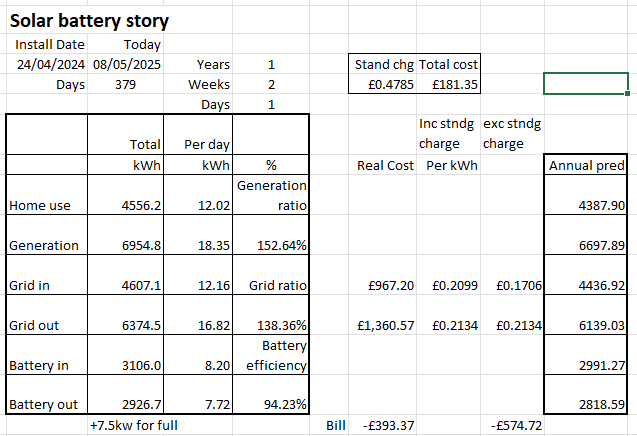
No idea how they get to their wishy-washy “around £1,000” figure. Is that the “Trading allowance”? And what is that exactly?

I’m importing 18,600kWh and exporting 11,100kWh, so I’d interpret that to mean that I could export 22,300kWh (120% of my current use (see what I did there?) ) a year before I’d have to pay any tax on it. Which means I’d have to quadruple the number of panels on my house to get close as the batteries can’t really work any harder.

D
#49 DD

Pete UK (Odd mix of pronouns - "your solar panels on a property they own")

Yes, I think it's the trading allowance - misc income from a hobby, etc. Eg eBay trading.

What you import doesn't necessarily match what you use - you might be using an additional 10,000kWh of generation, or a large fraction of what you import could be re-exported. So we can't tell from those two numbers what you use.

P
#50 Pete UK

DD Pete UK (Odd mix of pronouns - "your solar panels on a property they own")

Maybe that’s just how they identify. Confused.

DD What you import doesn't necessarily match what you use - you might be using an additional 10,000kWh of generation, or a large fraction of what you import could be re-exported. So we can't tell from those two numbers what you use.

Hopefully they can’t either ! I’m not sure I can exactly also.

I’m sure it’s better defined somewhere else but I’d argue that I “used” the grid imported electricity to charge my batteries “at home”. But I’m sure HMRC have a 200 page document somewhere explaining every detail of what the phrase “used at home” means. 😂

As for myself. I generate about 5,600 a year. If you add that to my 18,600 import that’s 24,200. Battery import is 38kW a day - 13,870. Probably consume 13,000kW per year. I’m exporting 11,200 per year. So I’m under but I could export 13,000 x 1.2 = 15,600. Using the more restrictive definition.

#51 Hook

V2H will be a game changer, even if you're at work during the day. You'll charge your EV and home battery during cheap rate and your home battery will run your heat pump during the day, then you'll come home and your EV will do the evening peak heavy lifting. This is all presuming it's winter.

Despite more renewable energy than ever, energy prices don't seem to be going down. As much as it pains me to say, Trump may be the solution to cheaper prices bringing Russia back into the fold.

We don't seem so great at decoupling energy prices from gas prices.