Power Units

11 comments started 2025-05-26 last 2025-05-26
Cloud Portal
R
#1 Roy124

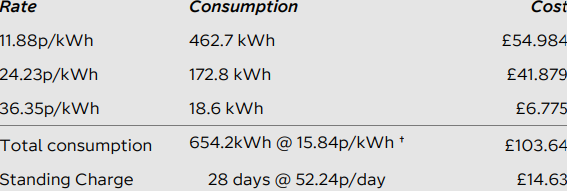
Have I just suffered a brain frt or are all the generally accepted units wrong? Here is a snip from my Octopus bill:

The cost is correctly shown as pence per kilowatt hour but the consumption should be kilowatts and not kilowatt/hour which is a rate.

And the Givenergy site shows rates rather than wattage.

My panels, 8x3.2kW can discharge 2.6kW/hr for one hour or one minute (2.6kW/60min) whereas my battery has a capacity of 5.2kW which is may discharge at a rate of 2.6kWh for 2 hours.

Is this another example of DC Current or AC Current?

#2 nophead

Power is measured in kW and is the rate of energy, which is kWh and is what you get charge for.

Batteries have an energy capacity in kWh and a maximum charge and discharge rate measure in kW.

P
#3 PaDav6

Take a lateral step; think of distance in metres, speed become distance per time or m/s and acceleration is speed per time or m/s2. A Watt is 1joule of energy used per second. A kWh is a rate of 1 kW used for an hour or 3600kJ of energy. There is no such unit as kW/h.

D
#4 DD

PaDav6 There is no such unit as kW/h.

To be pedantic, suppose my solar is producing 2kW at 10am and 6kW at noon: that's an average rate of change of 2kW/h ;-)

R
#5 Roy124

The point I am trying to make is:

Octopus charges me at a rate of x pence per kW consumed per hour and bill me for the number of kW consumed in a month.

This is p/kW x kW.

The bill actually shows p/kW x kW which, I submit, is wrong.

Givenergy also displays kWh or MWh when it really means quantity, kW, rather than rate.

W
#6 wilfleek

The bill is correct- you are charged for the number of kWh consumed. The instantaneous rate of consumption is kW, the total consumed is kWh.

So if you use one kW for an hour, the total energy used is one kWh.

A bit like car battery ratings - 100 Amps for an hour is 100 Ah.

R
#8 Roy124

wilfleek yes, I follow that.

#9 Windy Miller

One is power, the other is energy. You are billed for the energy you use but the circuit ratings are in measurements of power.

kW is the power measurement
kWh is the energy measurement

A strong man could lift 200kg. This is his power. In order to do this he has consumed a bowl of cornflakes from where he got the energy (measured in kcalories which is another measure of energy like kWh).

1 kWh is constant power of 1kW consumed in 1 hour
It is also constant power of 2kW consumed in 0.5 hours
Or 10kW consumed in 0.1 hours (6 minutes)

So energy = power x time
1kWh = 1kW for 1 hour

If your house feed is 60Amp. Multiply this by 230volt you get 13800watt or 13.8kW. This is the maximum power you can draw from the grid before (eventually) your house fuse would rupture. But you could pull this power continuously. If you did this for 24 hours Octopus would charge you for 24x13.8 units = 331.2 units of energy (kWh) for that day.

This all applies to DC systems as well as AC systems. The main difference is that we transmit power around the country using AC as it allows us to transform the voltage up and down using transformers which helps us transfer large quantities of energy with reduced losses. For DC systems you need to use an inverter to convert between DC and AC. Batteries and Solar arrays can only work as DC systems so need to be converted (inverted) to connect to our grid systems. Many small household appliances eg computers and tv's convert AC to DC to work which they can do simply using diodes (after a transformer has been used to convert the voltage to a safe extra low voltage).

HTH

S
#10 SteveClubley

At least you’re getting bills from Octopus @"Roy124". I haven’t had a bill from Octopus for imported energy since Jan 1st. It used to be that I didn’t get credited for exported energy very often but Octopus have been regularly crediting my account this year so far. It appears that the smart meter is working ok but nevertheless I did a manual meter reading recently and uploaded them via the Octopus app. The very next day a received an export credit! Still nothing for import.

D
#11 DD

SteveClubley I haven’t had a bill from Octopus for imported energy since Jan 1st.

If you're on a tou tariff, a single missing reading can confuse their billing system. There are tools that can identify missed readings. If you ask them to re-read the meter, that may sort it out.

S
#12 SteveClubley

DD
I can see in the Octopus app that there is the odd day in the few months were there are no half hourly values at all so I think you’re are right in that they don’t have the full picture. Whilst I could manually get the total peak and off peak readings from the meter there is no option within their app to submit the two values. Just an option to submit one import value. Looks like I will need to call them or just wait until they realise that they’re not getting any income.