Wonder Watt - forced discharge improvement on Agile

29 comments started 2025-07-09 last 2025-07-28
Home Automation
#1 Wonder Watt

A few months ago, we had a suggestion from an Agile Octopus user to allow easier and seamless selection of half-hour slots for forced discharging.

For interest, original post here:
https://community.wonderwatt.com/d/826-greater-functionality-of-the-agile-page

This has now been implemented in our latest release, and may be of use to GivEnergy users here who do not use Home Assistant but still want an easy level of automation.

There is an animated gif at the end of the forum post on how this works (tried to post image here but seems like there's a size or file type restriction?).

Worth to mention also that we do support Intelligent Octopus Go and allow you to take advantage of cheap ad-hoc slots and prevent battery drain into the EV.

A
#4 alan_johnston

I have been testing the enhanced Agile Octopus scheduler and it is now easy to pick ad-hoc slots to export.
Works well with my gen1 inverter.

#5 TheDragon (GivEnergy)

Are you still using users private API keys? Or have you now got oficial and use OAuth2

D
#7 duplada

[unknown] You mention that your IOG support prevents battery drain into the EV. I currently have 2 x Givenergy AIO, Gateway and Givenergy EV charger. The GE EV charger software is not compatible with Dual AIO's so ignores the Do Not Drain Batteries setting in the Givenergy EV software. Therefore the only way I know is to charge the EV from the grid, is to charge the AIO batteries at the same time, which means it is easy to overload the Gateway if you are not careful. I am currently on Octopus Agile, and I am trying to decide what to do about this problem.

My options are as follows as I understand it.

Implement a Home Assistant / predbat system (too much hassle for me)
Use the portal to enter commands to pause the battery then more commands to charge the EV (more hassle)
Use Portal to Adjust Battery Charge to 60% (7K), Start EV Charge, portal battery charge from Grid. (even more hassle)
Wait for GE to update the EV firmware to support Dual AIO's (they say they are on with this) (not sure it will happen)
Get my installer back to rewire the EV charger so its not going via the Gateway. (expensive)

I so wish I had never seen the Givenergy Battery Systems Advertised mines never worked correctly from the get go and is more trouble than its worth. It seems so difficult these days to purchase something that just works how you would expect it to. Plug it in and press charge.

I am obviously expecting too much

D
#8 duplada

Duplicate

A
#9 alan_johnston

WonderWatt has a hold charge feature for use with the Octopus Agile tariff which can set a maximum battery discharge rate for a period of time. I use it to limit battery discharge to 700W (enough to run the house base load) while the EV charger is going to be charging the car. This effectively forces the EV charger to use the grid (and any spare solar) and stops the GE battery emptying itself into the car.

Not sure if it works for 2 AIOs but you can probably have a free couple of weeks to try it.

D
#10 DD

duplada Therefore the only way I know is to charge the EV from the grid, is to charge the AIO batteries at the same time, which means it is easy to overload the Gateway if you are not careful.

You could configure a charge, but set the target SoC below the current value so that the net effect is to pause the battery. Or use the timed pause feature to pause battery discharge. Or set a timed export but with SoC limit higher than the current SoC. Or just turn off eco mode. Various options...

A bit harder during the day if you want solar to go into your battery rather than your car. (I generally don't plug in until evening anyway.)

#11 TheDragon (GivEnergy)

[unknown]
It looks like you are using the users own API key generated. Requiring the user to enter this somewhere.

OAuth2, is an authentication setup not using this user key.
What Octopus use, EoN, Accuselect and many other energy controllers
User opts in and you control the system

#12 Wonder Watt

TheDragon (GivEnergy) Yes, I know what OAuth2 is.

I'm just wondering where the details are, things like GE's Auth URL, token refresh URL etc. and the process to have a Client ID and Secret set up.

D
#14 duplada

[unknown] Thanks for the reply. Where do you actually do the settings for time period and the discharge wattage. I need something that other household users can understand and use.

I just don't understand where everyone finds out what each of the settings actually does. I tried a few things on the portal but since there is no documentation I can find it is a very slow learning curve. As sometimes you actually have to set multiple things active at the same time to get a result.

D
#15 duplada

DD You could configure a charge, but set the target SoC below the current value so that the net effect is to pause the battery. Or use the timed pause feature to pause battery discharge. Or set a timed export but with SoC limit higher than the current SoC. Or just turn off eco mode. Various options...

Thank you for your reply I will give some of these a try one day. Though remembering them will be an issue.
How on earth are you supposed to find out what all these convoluted settings actually achieve? My mind doesn't find it easy to understand or remember procedures that don't seem logical, I guess It's just to technical for me.

D
#16 DD

duplada timed pause is fairly straightforward. The charge and export are just two sides of the same coin: a charge or export will continue only until the target SoC is reached, so if you choose a target that has already been achieved, the battery goes idle. There is only one tined pause, whereas you could have multiple charge slots all configured with low target SoC.

(On my own system, I have the pause timer set for the whole day, and toggle pause-type between the various modes, as required. In effect, just pause-charge until I say otherwise, etc. All managed by a raspberry pi.)

D
#17 duplada

[unknown] Worth to mention also that we do support Intelligent Octopus Go and allow you to take advantage of cheap ad-hoc slots and prevent battery drain into the EV.

Is there a way in Wonderwatt if you are not on Agile or IOG (say on OG) you could set a schedule or a time period to pause the battery to stop the EV drain. I have two Giv AIO's and the Giv EV charger, One of the issues having dual AIO's is that the Giv EV software doesn't understand Cloud mode therefore all the advanced settings including "Do Not Drain the EV Battery" etc do not work and it takes charge from the batteries.

I contacted Give Support who confirmed that Currently, EV charging via “Cloud” mode isn’t formally supported on parallel AIO setups" and it may be supported in new firmware going forward maybe. When that may be is anyone's guess

I realise that I could go to the portal set a pause for a period, time start, time end, pause type, you then have to remember to turn all these settings off again which is a right pain. I do not want to be involved in micro managing my system on a daily basis that's why I recently ditched Agile for GO. I now charge to the max in the Go Cheap Period, export what's left at the end of the day and repeat. Charging the EV at the same time as the battery is problematic also because with two AIO's everything is doubled charging at 12kWH plus the EV charger at 7.2kWH puts you one kettle boil away from overloading the Gateway which I have already done. But wait aren't there some more settings in the portal that I could set to overcome this? I guess there are but I just cannot be bothered to waste my time finding them out. Life is too short for that right?

So my base specification for a pause utility would be to
specify days of week to run,
Start time, End Time,
House load wattage to cover,
able to run for a specific range of dates or forever,
set everything back when current pause period has finished
if it involves turning ECO off then turn it back on.

Now I would be prepared to pay the £54 per annum Wondewatt fee just for that feature because I would be able to train other family members to use it before charging the EV. At the moment no one is the slightest bit interested in trying to understand the undocumented Givenergy Portal and its convoluted settings.

So over to you Dr Wonderwatt can you do it? Or more importantly will you do it. £54 per annum coming you way if you do.

D
#18 duplada

Duplicate

D
#19 DD

duplada I realise that I could go to the portal set a pause for a period, time start, time end, pause type, you then have to remember to turn all these settings off again which is a right pain.

I assume you are on Go. Is there any reason why you don't want to just leave discharge paused for the entire off-peak period, so that you are running from grid even when you are not charging EV ?

Though you seem to be describing two different problems: one is that you don't want to discharge batteries while EV is charging; the other that you don't want to be charging AIOs at the same time as the EV.

I forget the capacity of AIO - is it about 13.5kWh ? And max charge rate is 6kW. Perhaps you could reduce the charging power of the AIOs - 4kW should still be sufficient to fully charge in the 4-hour off-peak period. Rather than charging at 6kW to do it all in a couple of hours.

D
#20 duplada

DD DD

Yes I am on Go and set my system to charge to 100% from 00:30 - 05:30 every night so I guess I am running from the grid anyway. Let me explain about the EV charging.

I have an EV and Giv EV charger. About once a month there is a need to plug in the EV and activate a charge during the off peak period. Now since we are already charging the Give batteries during this period the EV charge gets taken from the grid, however, since the dual AIO's setup defaults to charging at 12kWH and the EV charger at 7.2kWh it is very close to the 80amp limit that the Gateway can handle. As I said it only takes someone to fire up a kettle and you go over the limit, then the Gateway falls over in a heap, and the whole house power goes off. I have had this happen and it took hours to get everything back up and running again and numerous calls to support to reset things that we don't have access to.

So I decided to have a look at the Portal commands to see if I could turn down the AIO's as they don't need to be running flat out at 12kWh as you say. What I didn't realise before purchasing my Give system is that Give Energy don't seem to document anything and in particular the firmware of each inverter, and how and what each command actually does in the portal, or when executed from the app. This is an area I know something about as I owned a sizeable software company for over 40 years before I retired, and I know what it takes to write good software, and how to document it correctly. If you don't have good documentation in your business, you will not succeed. Givenergy don't seem to have any good documentation whatsoever. If you produce good quality documentation it significantly reduces support calls as customers can sort out their own issues. This may be why Give has over 4000 new support tickets a month and hasn't been answering any phone calls from joe public for last 2 weeks.

Sorry back on to the subject. I did try to test some of the commands on the portal to see what they did but I soon found out what works for single AIO installation does not always work for dual setups like mine. For instance adjusting the Battery Charge Power and Discharge Power (both are set at 12000 W default) I tried doing a charge and discharge I can change the values to anything from 0 to 12000 though it seem not to have any effect whatsoever. It could be that I am not activating some setting or other that stops these settings from working, but who knows? So if you can help me with the settings that reduce charge power that would be much appreciated.

I did have some success with the
Battery General
Inverter Charge Power Percentage Range 0 to 100%
Inverter Discharge Power Percentage Range 0 to 100%

These commands worked but if I set 50% for instance the actual rate wasn't anything like 50%

If anyone else wants to chime in

If you want to use these commands
what do they do ?
What fields need to be active to use them?
how are they useful ?

The ones I am not sure About

Percentage Limits
Battery Charge Power - Range 0 to 12000 W
Battery Discharge Power - Range 0 to 12000 W
Control
Inverter Max Output Active Power Percent Range 0 to 100%
Export Power Priority Range Load First / Battery First / Grid First
Battery General
Inverter Charge Power Percentage Range 0 to 100%
Inverter Discharge Power Percentage Range 0 to 100%


D
#21 DD

duplada (should perhaps move to a different thread since this is nothing to do with wonder watt.)

Sorry, can't help with AIO, and particularly with dual setup and gateway. I just have a hybrid.

I have two settings affecting charging power (via the remote control page). Battery charge power as W, which affects both solar and grid charging. And in the battery section, an Inverter Charge Power Percent which only seems to affect grid charging ? - I have it set to 50% since that's sufficient to charge battery over my off-peak period, and I assume slower is better.

(I used to mess about with the API to change the former one to 2kW overnight then back up to max during the day, but having discovered the latter one, that saves me the trouble.)

I fully agree that (lack of) documentation sucks.

C
#22 CW

duplada I don't have a dual AIO, just a single one, so this may not be relevent at all.

On my AIO I have set the charge power to 2226 Watts which suffices and works for me.

I wonder if it is possible to connect to each AIO individually and set their respective figures? Probably not, but maybe it might work.

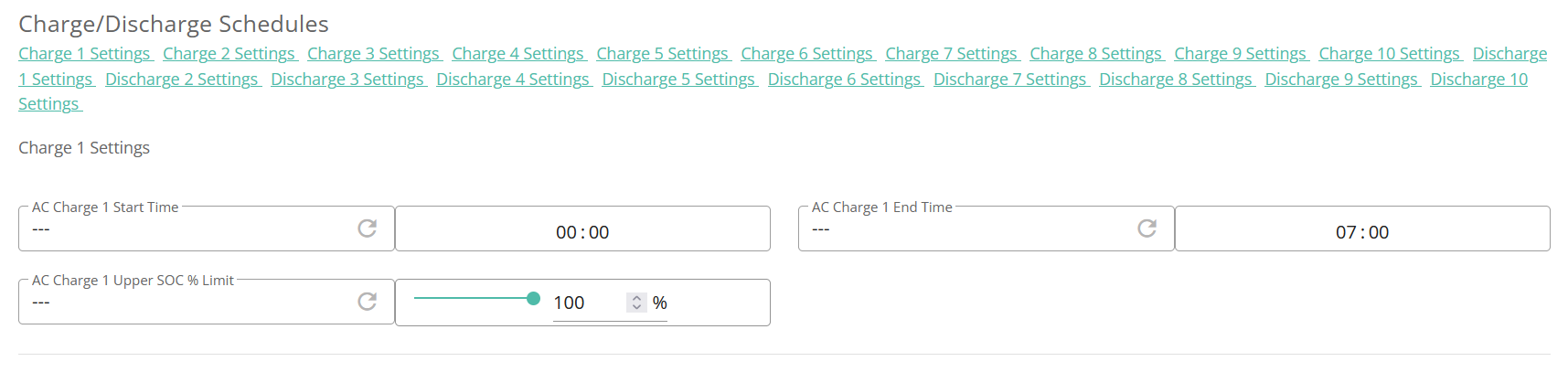
Here is a screen shot of my settings so you can see how that fits with your remote control page (of course possible not because uploading images seems to be rather problematic with this forum now!)

D
#23 duplada

CW Thanks for you reply.

So to be clear your are Altering the Battery Charge Power Setting to 2226 W
Time From to needed ?
Does AC Charge need to be set on?
Any other settings

D
#24 duplada

DD I have two settings affecting charging power (via the remote control page). Battery charge power as W, which affects both solar and grid charging. And in the battery section, an Inverter Charge Power Percent which only seems to affect grid charging ? - I have it set to 50% since that's sufficient to charge battery over my off-peak period, and I assume slower is better.

Understood on my system setting Battery charge power watts doesn't work on either charge or discharge, it just carries on at full rate either in or out. You are not setting anything else other than start / stop times and the ac charge or dc discharge on right?

The charge Power % does work for me but 50% does not set it to half 6000 rather 12000 I can't remember the exact amount but it wasn't anywhere near 50%

D
#25 DD

duplada You are not setting anything else other than start / stop times and the ac charge or dc discharge on right?

I also have a charge limit set. Normally 100%, but if I'm charging car I may limit to 90% in case there are late bonus charging slots and I want to leave space in the battery for solar (rather than having it go to the car).

D
#26 duplada

DD (should perhaps move to a different thread since this is nothing to do with wonder watt.)

I do have a Wonder watt question though. In the Advanced section of Wonder watt you a Max Inverter Rate (Charge/Discharge) and Max Battery Rate Charge/Discharge setting that you can record.

Why can't you record separate values for both Charge and Discharge for Inverter and Battery rates as they can be different. My inverters combined Dual AIO power is 12kWh in 12kWh out. However, I have a DNO limitation Outgoing of 9.5kWh. So it occurred to me that in Wonder Watt it would be better to record both Charge and Discharge Rates and not assume one size fits all.

It also occurred to me that users may want to charge / discharge more rapidly or slowly depending on a given situation. Therefore in the section where you can create schedules it would be useful if you could optionally enter charge / Discharge Rates for each schedule that you are creating.

One thing to note is that if like me you have a dual AIO setup then when Wonder watt sends the Battery Discharge Power = xxxx command to my system this command Does Not Work. However, the Discharge Power Percentage does work. So in settings section a field to record whether the system has dual AIO's would be useful to determine which command to send depending on the system type.

C
#27 CW

duplada Yes. I'm changing the charging power to 2226W (I leave the discharge at the 6kW) and I ensure that AC charge is enabled. For me I also set a charging from and to in slot 1 (although others have said slot 1 can be overridden by other settings - possibly from the app) but this could be done in another slot.

#28 PianSom

[unknown] since the dual AIO's setup defaults to charging at 12kWH and the EV charger at 7.2kWh it is very close to the 80amp limit that the Gateway can handle

I too have a AIOx2+EV system. I regularly charge both batteries and car and run a house load (including eg tumble dryer/dishwasher).

I observe the Gateway automatically limiting AIO battery charge rate at times when the current draw may be excessive.

Is your firmware up to date?

D
#29 duplada

[unknown] Yes I have V13 Gateway with V13 BMS AO.618 had support set 80amp limit. But since then have not dared to charge my EV as I didn't want a repeat performance. Waiting for GE to say when the EV firmware is coming that supports dual AIO's the current EV firmware / EV software has all the settings to stop Battery Drain, Solar and Hybrid charging etc its just that they don't work on dual AIO systems.

D
#30 duplada

CW Thank you for the information I can confirm if you have the dual AIO setup like me then altering the Charge Power Watts value doesn't work it has no effect whatsoever. However, the "Inverter Charge Power Percentage" does work.

A
#31 alan_johnston

[unknown] Is there a way in Wonderwatt if you are not on Agile or IOG (say on OG) you could set a schedule or a time period to pause the battery to stop the EV drain.

WW has a general scheduler where you set charge or export schedules based on start and end times. You should be able to set a charge schedule to coincide with your EV charging which will prevent battery drain. during the EV charge.
You can sign up to WW for a free trial period to see if it works for you.

D
#33 duplada

alan_johnston Hi Alan, thanks for the tip I will give that a try today.