Giv batteries on non Giv inverters

13 comments started 2022-06-28 last 2022-07-05
GivEnergy ProductsAC CoupledBattery
#1 dbt85

I assume somewhere here there are people that added Giv batteries to an existing setup?

Can I ask, did they have to install an AC couple as the only means to run it like that (and so leaving you with your original solar inverter and a new AC couple just for the battery) or are they able to pipe the DC from the panels direct to the battery and out of the battery to the existing inverters?

#2 hoggy

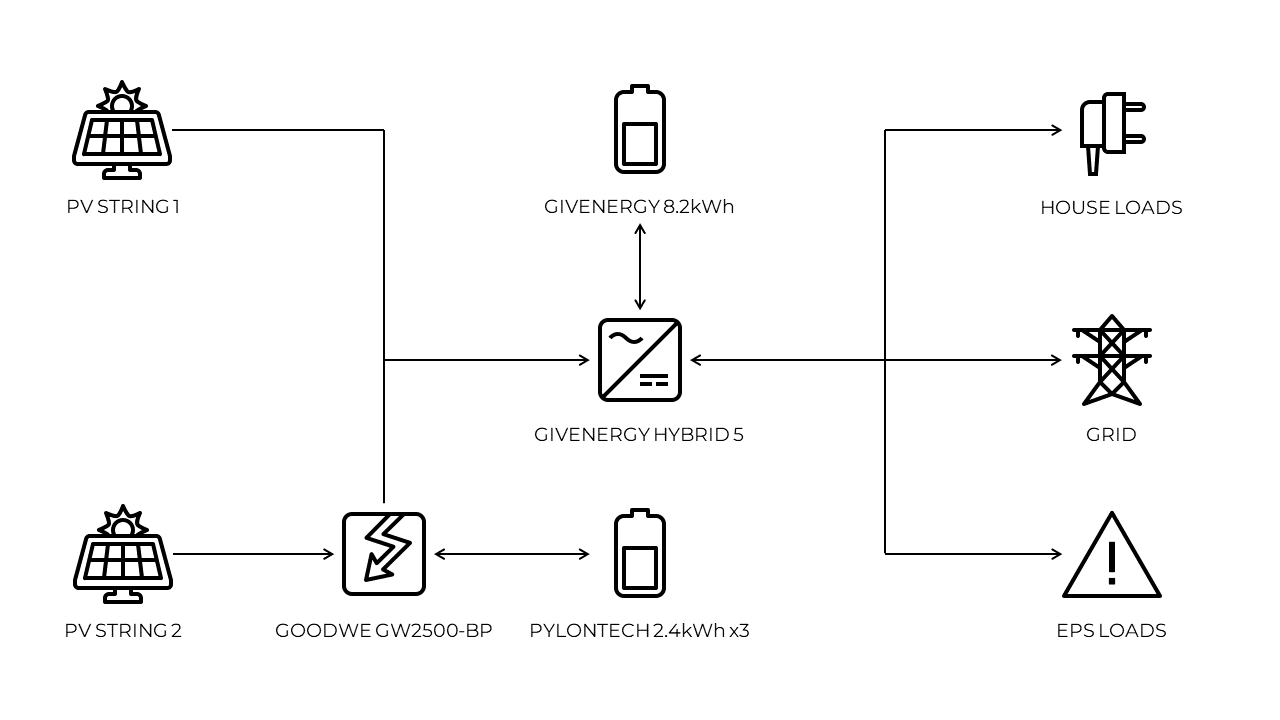
Running GE battery on another inverter:
Not that i'm aware of. The BMS in the battery likes to talk & given no one else's inverter will talk to it I suspect it'll just sit there like a lemon and refuse to do anything.
AC Coupled is the route to go if your looking to add it to an existing setup.
You can't push PV straight into the battery either (well you can, but just once & lots of smoke)

You can (sort of) go the other way and add other storage indirectly to the Givenergy PV side and feed it in through the Givenergy inverter (keeps everything nice and neat inside one app/system) but the merits of this route are a bit "meh" given you are then hamstrung by only being able to charge them from PV. Plus you need another converter in the middle anyway - the only reason I went this route personally was because I had most of the kit laying around & I was a bit bored really. Suspect my warranty is probably null & void (atleast if I blow an MPPT or something) so not recommended but "technically" possible.

S
#3 sparky77

pv string 1 cannot share at the same time,
would it not be better just to get another battery from giv energy.

#4 hoggy

sparky77 it's not sharing, its on string 2.
I'm not suggesting it's a good idea - I just already had this stuff & I now get up to 5kW on battery only as opposed to having more storage but no more discharge ability.

#5 dbt85

hoggy Running GE battery on another inverter:
Not that i'm aware of. The BMS in the battery likes to talk & given no one else's inverter will talk to it I suspect it'll just sit there like a lemon and refuse to do anything.
AC Coupled is the route to go if your looking to add it to an existing setup.

Interesting, I would have thought the battery and its BMS were capable of working with many options like most batteries, in part because it just opens up more people to sell the battery to.

My install would be wholly new, but originally was going to be a solar edge inverter and a powerwall, however I can probably get more storage for the same or less than a powerwall even if I still need 2 AC couples to feed 2x batteries.

I guess it would just make more sense to use a couple hybrid giv inverters which would also save on the S500 power optimisers.

S
#6 sparky77

dbt85 if you are starting a fresh
What's the max capacity of your roof, how many panels will fit.
how quick i require Return on investment
then choose inverter to suit
then batteries or immersion divert or both.
if you require a estimate on cost drop me an email. justin@justelectrical.co.uk

#7 dbt85

sparky77

I appreciate that Justin. Our main roof is a hodgepodge of steep dodgy angles and so isn't really suitable unless really desperate. I've a 30m2 workshop with a east west roof so could feasbly mount some on there, but the plan is to get planning to put a 10kw array in the field behind the house (since the owner of said field is my father in law). I've already paid for the pre planning advice and it's basically "yes but you have to do these things".

ROI is not a specific concern, the install is coming from my mother in laws pocket and the house will be either ours or in our possession in perpetuity and I'm not yet 40. With the cost of energy what it is the install is just better done sooner than later.

Thus far the only estimate (I still need to get formal planning approval) I have from our existing installer was circa £20k, for 24x 395w panels, power optimisers, 10kw solar edge inverter, the ground mount and the groundworks to do it (note no battery). Given that even I can buy the panels, inverter and optimisers and a 50m reel of 5 core 10mm swa for something like £8k inc VAT, and that an install would have no VAT at all, that estimate seemed steep to me. Perhaps the ground mount and its groundworks far more expensive than I thought or perhaps I've missed something. Clearly there are additional things needed to get it all running.

They are doing another with 2x 5kw Giv hybrids, 2x 9.5kw giv batteries and us doing the groundworks since I'm home every day and we are farmy types who are well used to digging holes and constructing things.

S
#8 sparky77

i know we are in summer but yesterday it was cloudy 30-40% up to about 11 then light rain 80%clouds, the back to 30-40% cloudy
the system is a 10kw 10 years old panels with about 14% efficient, today's panels are 20%, immersion control supplying first a 300l system then pumped to a buffer 1000l
the immersion diverted solar energy about 13kwh.
my recommendation would be get some history of use, for me battery's RIO is poor compared to Solar PV.
the last 24hrs of use https://pasteboard.co/Ou4GqPdj2HSR.png
location Norwich England
screen shot of the batteries and immersion divert playing nice 8am this morning https://pasteboard.co/sAgtww575qQl.png

S
#9 sparky77

yes ground mounts are more expensive, you my indeed priced the system 8k inc VAT, don't forget the installer has to place food on the table, i know I'm one of them with about 150 solar installs, and because of careful planning only had 2 inverter fails, both over voltage from the grid.

#10 dbt85

sparky77 my recommendation would be get some history of use, for me battery's RIO is poor compared to Solar PV.

I have access to the usage of 3 other properties before and after the battery installs in September last year. Grid import had more than halved compared to just having the PV (18kw in total between 3 properties also serving 2 large heat GSHP). I also know my own usage and know that at this precise moment our property cannot possibly consume what a 10kw array can put out, but since anyone with a 4kw array and no battery also rarely consumes more than a third of what it puts out, that seems rather here nor their. We are rural and rely on oil to heat our home. In 4 years time I will not be able to replace my boiler if it should break, in addition we'll likely have an EV soon and solar diversion to the cylinder will also occur.

As I mentioned before, the ROI is not of significant concern at this time as it is coming from a pot of money that has been sitting earning sod all interest for a while now. Now it will knock a significant hole out of our electricity bill for the forseeable future and should I need to add more later I have other options. Right now I have to spend £2200 on electricity a year, and come October that's going to be nearer £3000 it would appear. Eventually electricity price will fall again, but I doubt we'll ever see the kind of prices we saw before things started going nuts. The sooner it's all in the better.

sparky77 yes ground mounts are more expensive, you my indeed priced the system 8k inc VAT, don't forget the installer has to place food on the table, i know I'm one of them with about 150 solar installs, and because of careful planning only had 2 inverter fails, both over voltage from the grid.

Of course they do and I am half in that arena myself. Unlike many people if a pro quotes me £250 or £300 for a days labour I don't mind paying it because if I called them in the first place it's a job I can't do without getting into trouble or because of a gap in my knowledgebase or comfort zone.

However, when I can get the quoted inverter, panels, optimisers and cabling for £6,600 ex VAT at Joe Public prices I do have to wonder just how much the ground mount, the groundworks and the actual install and profit is going to be to come up with a £20,000 price tag.

I shall see what the new estimate comes back with and decide what to do from there.

T
#11 Tim

dbt85 We jumped on the PV bandwagon late last year when electricity prices were said to be rocketing. We were fortunate to get our installation completed in late January this year, within a few weeks of agreeing the spec which was 12kW PV, with two HY5s and 8.2kWh batteries. We also bought an EV in February and now belong to the local "Smug Club".

Our annual consumption for several years had been around 6,000kWh with very little seasonal variation. From our smart meter, our monthly import this year is:
January 438 kWh
February 150 kWh
March 31 kWh
April 28 kWh
May 33 kWh
June 28 kWh
According to the Givenergy Portal, our generation since commissioning is 5,200 kWh and total export has been 2,100 kWh. We haven't changed the way we live our lives (so annual consumption will still be about 6,000 kWh) other than charging the EV. We did go on a road trip in the EV in March and paid to charge at commercial charging stations but since then, we've done 2,162 miles and charged 604 kWh from PV (according to the Zappi). That would have cost about £400 for petrol if we had done the same mileage in our previous car.

We had the same choice as you late last year: leave the money in the bank depreciating at the rate of inflation, or put it on the roof and save £100s each month on electricity and petrol. We could have done some RoI calculations but TBH, it was a case of either we do it or we don't. It had been the case for several years and it was the promised massive price hike that tipped us to just go for it. I've got all the data I need but I'm not even going to work out when it would break even. The money is on the roof and we are happy that we are now saving on our monthly bills and maybe doing a bit for the planet.

E
#12 Edward

Any reason your looking for power optimisers on each panel dbt85?

These are only needed if some of the panels have differing levels of shade.

I see at lot of installers pushing these, often through ignorance or possibly trying to increase the profit.

In some cases the optimisers offer a real benefit, in many the cost far outweighs the benefit.

A bit more info::
https://redelectrical.co.uk/beware-the-villians-mis-selling-solaredge-upgrades/

M
#13 mrand31

Some panels, e.g. Trina Vertex claim to have diodes onboard. They don't say whether these are reverse polarity protection diodes (which would be daft for a permanent installation) or are freewheel diodes. If the latter, then an optimiser would be superfluous.