
Benefits of Givenergy EV charger?

16 comments started 2025-08-19 last 2025-11-09
GivEnergy ProductsEV Charger
D
#1 daveharding100

Question: What are the benefits of Givenergy EV charger, integrated with Givenergy battery and inverter (as opposed to other EV chargers)?

Why do I ask: I have a Gen 3 Hybrid inverter and 9.5 kW battery. All is working well. My supplier is Octopus. I am planning on buying an EV and so will need a charger.

-do I get a GivEnergy EV charger compatible with my inverter?
• It looks like this makes it easy to charge the car with Excess solar, but with intelligent Go I would be better off selling this to Octopus (15p/kWh) and waiting to charge at cheap rate (7p/kWh) - so not that useful unless I want a quick charge on a sunny summer day.
• Are there any other benefits with GivEnergy?
• My experience with the inverter and battery is that they are reliable (18months) but customer support is poor (they have(had) limited knowledge) and there is very limited documentation (eg nothing on scheduling) - you are really left to work it out yourself. Is the EV charger the same?

-do I get a an EV charger compatible with Octopus integration?
• What extra does the charger integration offer over just the EV - looking at other posts you get Octopus smart scheduling outside the 6hour cheap rate window. Does this integration offer anything else?

-Do I just get 'the best' EV changer and ignore compatibility?
• Are there EV chargers out there that stand alone, are just so much better that the (marginal?) benefits of inverter &/or Octopus integration make no odds?
Are there any with great customer support and documentation? (as well as the robustness that I have so far experienced with Givenergy)?

I realise that there are similar discussions (eg one in April), but was hoping to get more specific advice / pros /cons

many thans
S
#2 SimonClarke

Had a Hypervolt 2 to start with, not compatible with Octopus and used the car - Tesla- for IOG which was fine when it worked but often didn’t. The charger broke and Hypervolt surprised me pleasantly by replacing it with a 3 pro which is compatible so I now use that and it (touching wood) has been faultless. Plus we get way more extra 7p slots which has been handy with the ashp. I always export everything and don’t use solar for the car. I believe the Hypervolt will do this but not work with the GE stuff. The way IOG is currently I don’t know why you would.

D
#3 DD

daveharding100 What extra does the charger integration offer over just the EV - looking at other posts you get Octopus smart scheduling outside the 6hour cheap rate window. Does this integration offer anything else?

Intelligent Go gives bonus slots regardless of car- or EVSE- integration. I think some people ask for charging to be done by 5:30am just to avoid having to cope with bonus slots. (Or even just abuse the service and don't do smart charging at all.)

The impression I get is that EVSE integrations tend to be more robust and reliable: the car-based ones are of course reliant on the manufacturers' support for their API. At least one has withdrawn permission for use of the API by third parties. There was another where constant polling of the status caused the 12V battery to run down. On some, the car starts charging as soon as you plug in, and it can take a little while for Octopus to notice (be notified) and turn it off, and that is charged at day rate.

I think Tesla is one of the better ones, but that has a new risk: Tesla want to enter the UK energy retail market, and they might decide that they want exclusive access to their cars for virtual power plant implementation.

A potential disadvantage of going the GE route is that you can't hide the charger from the inverter: I have my Zappi wired up so that the solar system doesn't see it, and this removes all hassle of avoiding the battery discharging during any bonus charging slots (without having to rely on additional software support). (But the car could still charge from excess solar if I chose to do so.)

Plus if you go for a compatible charger, you remove a constraint when choosing your EV. (That said, Octopus are not the only supplier in town - EOn have a comparable, and arguably simpler, offering.

I don't place particular value on having all energy usage published through one service. But simplified reporting probably is one benefit of the integrated chargepoint.

D
#4 DD

daveharding100 What extra does the charger integration offer over just the EV -

One disadvantage of chargepoint integration is you have to set the amount of charge to add each time, whereas with car integration you can just set the target SoC and it will calc how much to add.

Now if you do the same commute every day, so always need to add, say, 40%, it's not a problem. But I generally have to tweak it each time since sometimes I need only 10% to get back up to 80%, but sometimes 40% or more. (I don't have a daily commute.)

S
#5 SimonClarke

DD I just set the car, charger and Octopus to 80% or whatever

D
#6 DD

SimonClarke I just set the car, charger and Octopus to 80% or whatever

You ought to (be able to) set it just in the Octopus app, since that's how Octopus decide how to schedule the charging. Is it possible you're basically telling Octopus to always add 80%, but then the car stops the charge early when its own limit of 80% SoC is reached ? An AC chargepoint has no way to read the car's SoC. Octopus uses the car's API for it.

Not sure if Octopus can use both chargepoint and car API - latter to read the current SoC, and chargepoint to do all the scheduling ? I wasn't aware that it could.

S
#7 SimonClarke

DD I used to get lots of messages saying the charge limit was too low but since doing what I said it works every time. I must admit to not having altered my behaviour since getting the new charger so maybe. I always thought that the 80% set in the octopus app was a limit not an amount? Just tried googling that and got both answers!

D
#8 daveharding100

Some very helpful answers:

-It sounds like:
-no one is using or see value in the Givenergy charger/inverter integration
-the Octopus charger integration has useful value - extra 7p/kWh slots
-Octopus EV integrations are perhaps not to be relied on compared with Octopus integrations with the EV charger
-the Octopus charger integration prevents at least one person from setting a charge limit (eg 80%) - this sounds like a massive ease of use issue (my usage would be very variable).

My summary:

  • don't bother with Givenergy integration - best to have a non-Givenergy charger.
  • Octopus integrations with the EV and with the charger have potential drawbacks.

Do all users with Octopus charger integration have the 'unable to set charge limit' problem?

  • yes/no and which charger model?
  • any other issues that I should be aware of?
  • If I choose an EV and an EV charger that are both compatible with Octopus integration can I choose which I integrate?

Again, many thanks for these helpful insights.

M
#9 M_J

daveharding100

I have a Hypervolt 3 with an Ioniq 5

I had been waiting for the GE charger but ultimately I am glad I never bought GE despite having GE batteries.

The Hypervolt has been excellent and I set the charge limit in the car to 80% so it never gets more than that.

I do tell Octopus to only do 80% but it has no idea on that so you will have to rely on the car.

By leaving the car plugged in, even when it is at 80% I still get 7p sessions so that is great if you need them. If you have batteries you will need to find a way to stop them discharging into the car.

Yes you choose what Octopus integrates with.

D
#10 DD

daveharding100 the Octopus charger integration has useful value - extra 7p/kWh slots

you should be able to get those with the car integration too. It's a fundamental feature of IOG that they choose when to charge, and that is not limited to the 6 hours off-peak you get for all (other) consumption.

If I choose an EV and an EV charger that are both compatible with Octopus integration can I choose which I integrate?

Yes, you should be able to. If integrating car, you don't really need to tell them what sort of charger you have. Though with the EVSE integration, you do still need to tell it car model, so that knows battery size and charging rate, so they can turn a %age into a charging time and a number of kWh which is ultimately what they're controlling. (My Leaf can only charge at 3.6kW, so Octopus have to allow extra time for that.)

A useful forum is speakev.com - notionally international, but populated almost entirely by brits.

The IOG FAQ is at https://octopus.energy/blog/intelligent-go-faqs/ with a video at https://www.youtube.com/watch?v=qrlk_pzYAOw showing a Tesla integration.
At offset 0:56 it shows a setting for 'charge limit' which is used when using the car integration. Octopus will get the current SoC using API and calculate how much it needs to send. But at 0:51 it's saying charge to add, rather than charge limit. I see the latter on my Zappi integration since I have to tell it how much charge to add - it can't get it from the car, since Leaf API is not supported, and AC chargers cannot read the current SoC from a connected car.

S
#11 SteveClubley

I think the key thing to do is whatever you need to get onto an EV tariff to not just charge your car but your house battery too at the cheapest overnight rate and export excess solar. That said I have a GivEnergy charger which has worked fine. I can get stats from the Giv app, portal or Home Assistant. I rarely charge from solar but it does work. My installer was able to provide a 12m tethered cable instead of the standard 5m one so it would reach to the extremity of my drive for EVs with charging points in different places.

D
#12 daveharding100

Many thanks for your help above.

I am getting to the point of getting quotes and ordering. My take is:

-Hypervolt 3Pro and Octopus Go (OG) or Intelligent Octopus Go (IOG) & so more questions:

• How do I stop my battery discharging during the charge time:
o Easy with OG - I just schedule a Givenergy charge during the fixed EV charge slot. The Givenergy battery is disable for discharge during timed charge.
o With IOG I can do a timed charge for the core EV charge slot, but I am concerned that the Hypervolt charger will discharge my battery - especially if this is an extra morning slot when my Givenergy battery has been filled ready for the day ahead.
o Question: How do I stop the GivEnergy battery discharging during extra IOG EV charging slots?

• A neighbour has another supplier's EV charger. This charger's response to a grid over voltage is to trip/turn off and EV charging doesn't restart until the user manually resets. The result is the car not being reliably charged overnight.
o Question: How does the Hypervolt 3pro respond to over voltage events? Does it reset automatically once normal voltage is restored?
o How good is Hypervolt support - I will ask them this question and find out!
Many thanks for all of your help so far
Dave

D
#13 DD

daveharding100 With IOG I can do a timed charge for the core EV charge slot, but I am concerned that the Hypervolt charger will discharge my battery - especially if this is an extra morning slot when my Givenergy battery has been filled ready for the day ahead.
o Question: How do I stop the GivEnergy battery discharging during extra IOG EV charging slots?

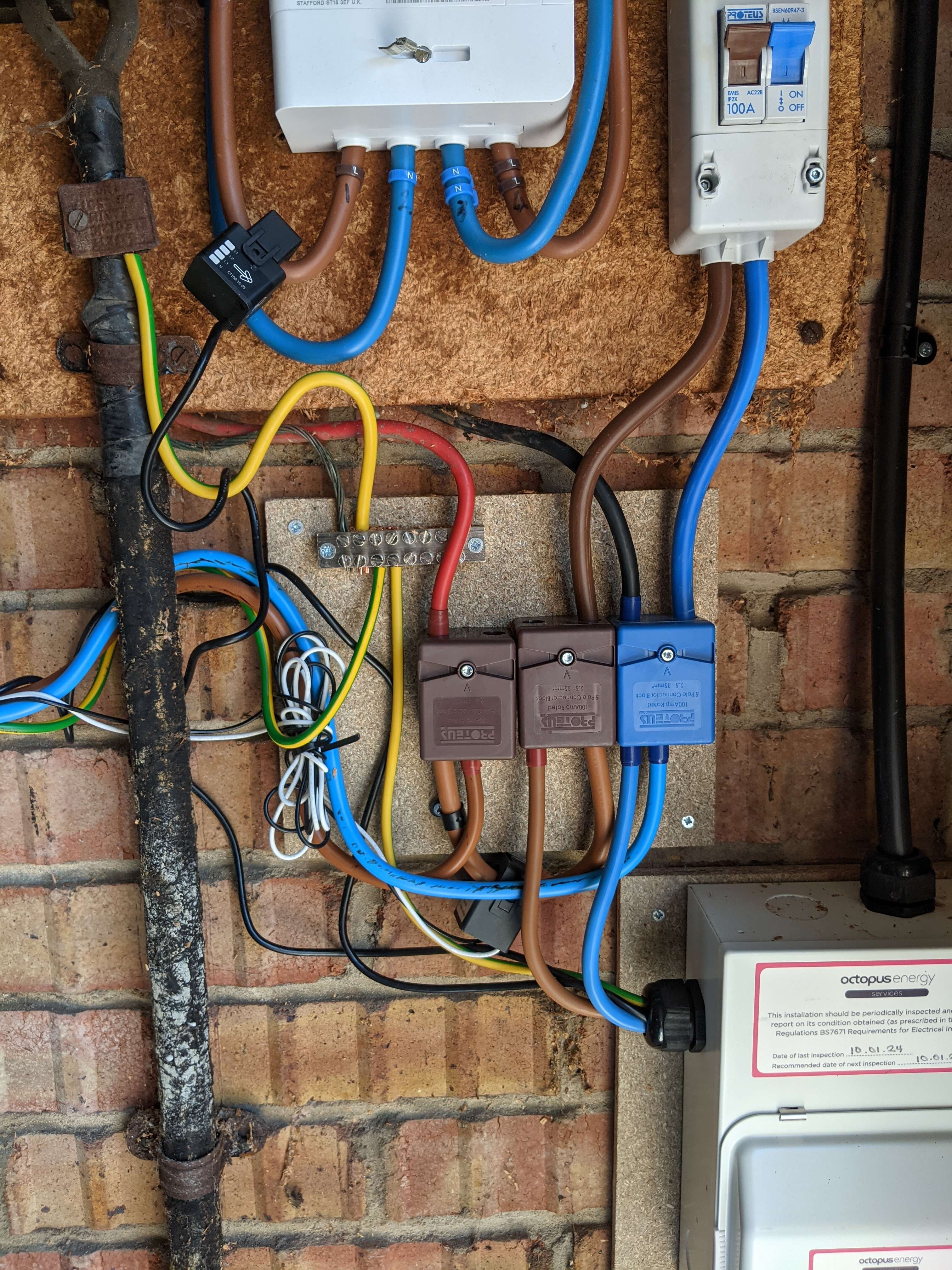
Simplest is to arrange for the supply to the chargepoint to be taken before the CT clamp for GE. Eg my wiring is as shown:

where the CT clamp for GE is the one hanging on the small brown tail linking the two henley blocks, and so it doesn't see any power going to the EV (Octopus consumer unit at bottom right).

Well... that's enough to stop GE discharging to cover EV draw. Even better to get battery to stop discharging at all, so that the whole house runs from cheap-rate grid power. That requires some additional software (eg Home Assistant).

S
#14 SimonClarke

I have the Hypervolt and it works fine with IOG. CT clamp as per DD above so no worries about flattening the battery. No idea about grid over voltage - as far as I know it never happens or nothing happens to the charger. The only problem I’ve had is the original 32a trip burnt out (came with the original fitting by EV Bug in 21 and original Hypervolt 2 which failed) and was replaced with a 40amp version.

D
#15 daveharding100

DD
Hi DD,
This is very, very helpful.
I just want to make sure that I understand your photo - please confirm if this is correct:
-Main incoming feed/smart meter and circuit breaker (brown and blue switches) are at the top.
-feed from the grid feeds the henley blocks from the top right.
-house fed from distribution/circuit breaker box on the bottom right

Questions:
-blue and brown wires exiting the left of the photo go to the EV charger?
-what are the red and black wires that go behind the chipboard panel?
-what is the 2nd CT clamp on the blue wire that feeds the smartmeter at the top?

I have also seen that Wonder Watt offers a software solution to this problem & will post a more general question on that...
...but do you have any thoughts on Wonder Watt Vs your 'hard wired' solution?

Many thanks for you help - this does look like a really neat solution

Dave

D
#16 DD

daveharding100 -Main incoming feed/smart meter and circuit breaker (brown and blue switches) are at the top.
-feed from the grid feeds the henley blocks from the top right.
-house fed from distribution/circuit breaker box on the bottom right

No, the box on bottom right is the EV charger. The red/black are the house consumer unit. Bottom left is the CU for the GE inverter. So the GE clamp sees power to itself and house, but not the EV.

I don't use WW - I have own local control system, slowly evolving.
Only concern with WW would be that Octopus have a habit of changing slots at very short notice. I detect the car actually charging, rather than relying on planned charging slots.