Heat pump with solar panels + battery

27 comments started 2025-09-09 last 2025-09-12
GivEnergy Products
N
#1 neild

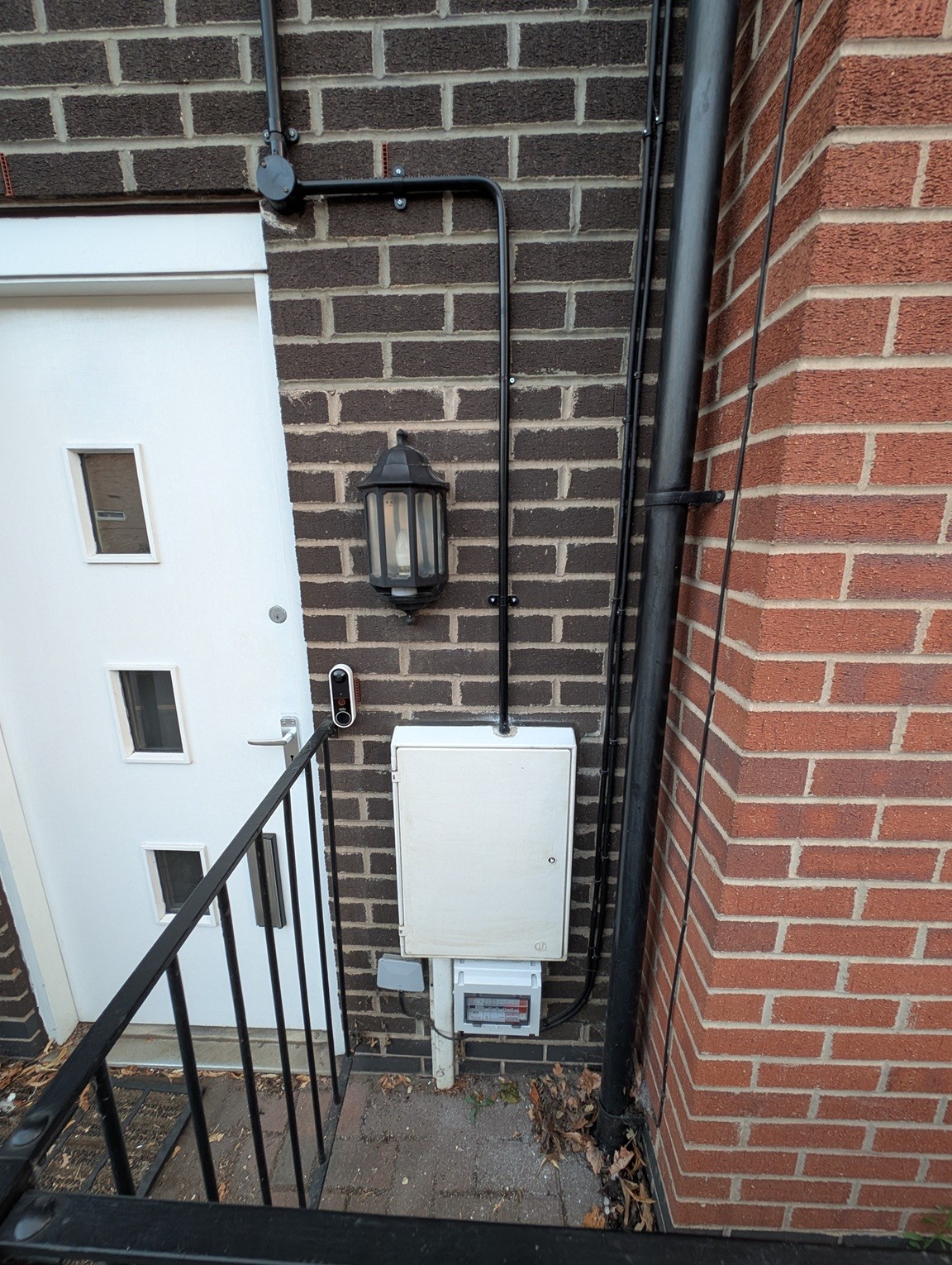
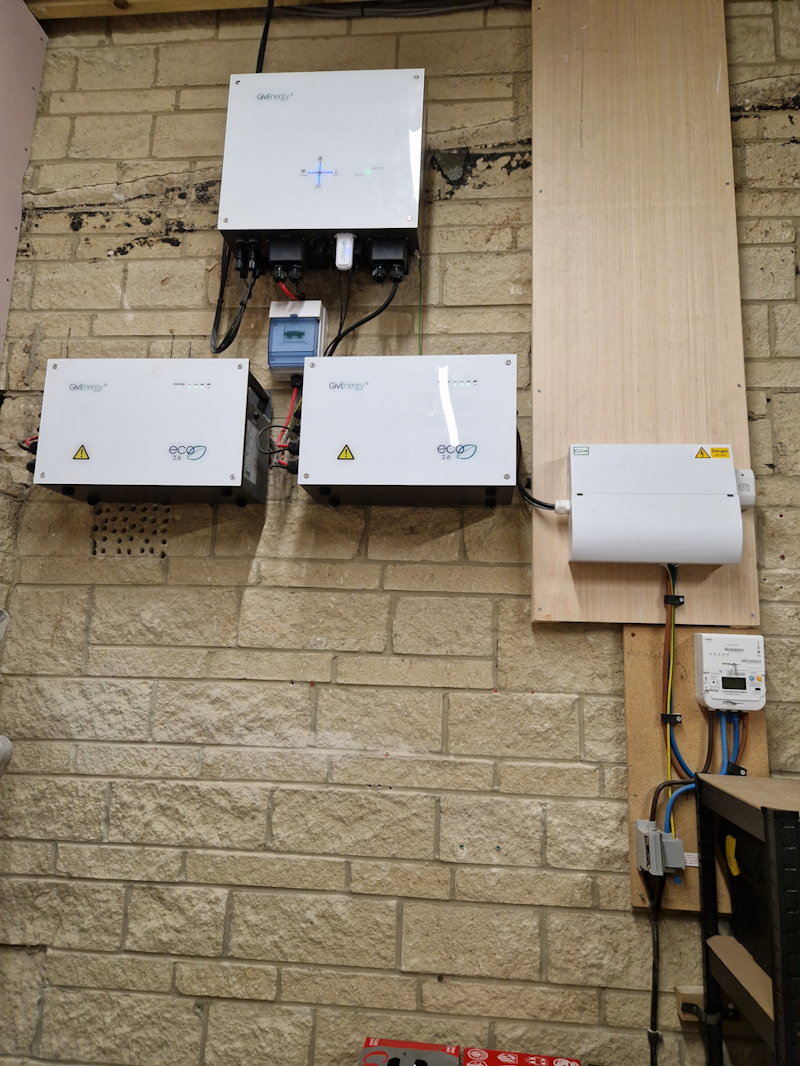
I've got 5.6kW of solar panels and a 5.2kWh battery. I'm about to get a heat pump installed as well and wanted any opinions as to where the heat pump gets connected.

I understand that one option is to connect the heat pump between the meter and the inverter, so that it doesn't benefit from the panels or battery at all, but it does still benefit from any heat pump tariff I'm on. The other option is to connect it after the inverter, so that on a sunny day it benefits from solar and it can use the battery as well.

My first thought is that connecting it after the inverter is a no brainer, you get the best of all worlds, solar, battery and tariffs. But when I mentioned it to Octopus (installer) they suggested I might want to make use of the battery for other uses in the house and so connect it between the meter and inverter - it really wasn't that clear why.

So, what do you think?
D
#2 DD

neild But when I mentioned it to Octopus (installer) they suggested I might want to make use of the battery for other uses in the house and so connect it between the meter and inverter - it really wasn't that clear why.

Electricity is electricity - don't really see the point of distinguishing heat-pump consumption from other consumption. No point importing from the grid for heat pump while there's energy still in the battery just in case you turn on the kettle.

G
#3 geoffreycoan

neild I am surprised you are getting a choice over the cabling installation.

My own heat pumps were connected (via their own fusebox) to henley blocks in the meter box. The henley blocks are connected to the meter outlet on one side and to the house existing fusebox and my inverters on the other. I would think given the high current draw of the heat pump your installer will do the same.
Also think the installer won’t want to piggy back off any existing cabling in the house.

Where the CT clamps are placed is really what affects how the inverter can “see” house load but as DD says why preserve electricity in the battery and grid import at the same time?

It’s worth pointing out that your 5.2 battery unless it’s one of the very new ones is 80% depth of discharge, so is really only 4.2kWh usable. This won’t be much to run your house and heat pumps on. Have a think about what tariff would suit your new load best, probably Octopus Cosy for the 3x cheap rate charging periods but you are going to be grid importing in non-cheap periods

D
#4 DD

neild I guess if it's physically wired before the inverter, you can choose whether the inverter sees it or not just by moving the CT clamp back and forth. Whereas connecting it after the inverter removes that choice.

Another consideration might be, if you have EPS configured, whether the heat pump is powered during a power cut or not.

N
#5 neild

I haven't really been "given the choice", it's more that I went to see someone with a heat pump on the "Visit a heat pump" scheme, and they suggested that connecting it to the inverter allowed them to run the heat pump from the battery/solar when energy is available. I did contact Octopus about the options and they were a bit vague and said it was up to me, though I'm not completely sure they understood or thought about it very deeply.

I agree that my battery is rather small and wouldn't run the heat pump very long. The reason I was considering it is that over the summer when I need hot water it would be nice to use that solar during the day to produce it.

I'm guessing that the "usual" way of installing it would be between inverter and meter then?

G
#6 geoffreycoan

neild I did contact Octopus about the options and they were a bit vague and said it was up to me, though I'm not completely sure they understood or thought about it very deeply.

I agree that my battery is rather small and wouldn't run the heat pump very long. The reason I was considering it is that over the summer when I need hot water it would be nice to use that solar during the day to produce it.

I'm guessing that the "usual" way of installing it would be between inverter and meter then?

Octopus sales team probably won’t know anything about these kind of wiring details. It’s something to discuss with the electrician when they are installing your heat pump. The usual way I believe is to connect to Henley Blocks between the meter and the rest of the house. Assuming you have a hybrid inverter then what would happen in the summer is your inverter would:

  • firstly satisfy any home demand, so if your heat pump was on it would let the heat pump use the power
  • secondly fill your battery up with any remaining energy
  • thirdly any excess would be exported

You can adjust the balance between 2 and 3 by setting the charge rate of the battery.

In my case I have the heat pump set to heat the water just once a day as we find that a full tank is sufficient to last us all day. In the summer I have the hot water heating set from 12 to 4pm so its filled off peak solar that would otherwise be exported, and in the winter I have the hot water heating set for an overnight cheap rate period when I am charging the battery in parallel.

D
#7 DD

neild I'm guessing that the "usual" way of installing it would be between inverter and meter then?

The actual order of the wiring doesn't really matter... power will flow where it's needed. My system has inverter, home and heat pump all coming out of one Henley block, so neither "before" nor "after". The only thing that matters here is how much current is flowing through the CT - that's how the CT decides whether it should discharge the battery, or charge from excess solar.

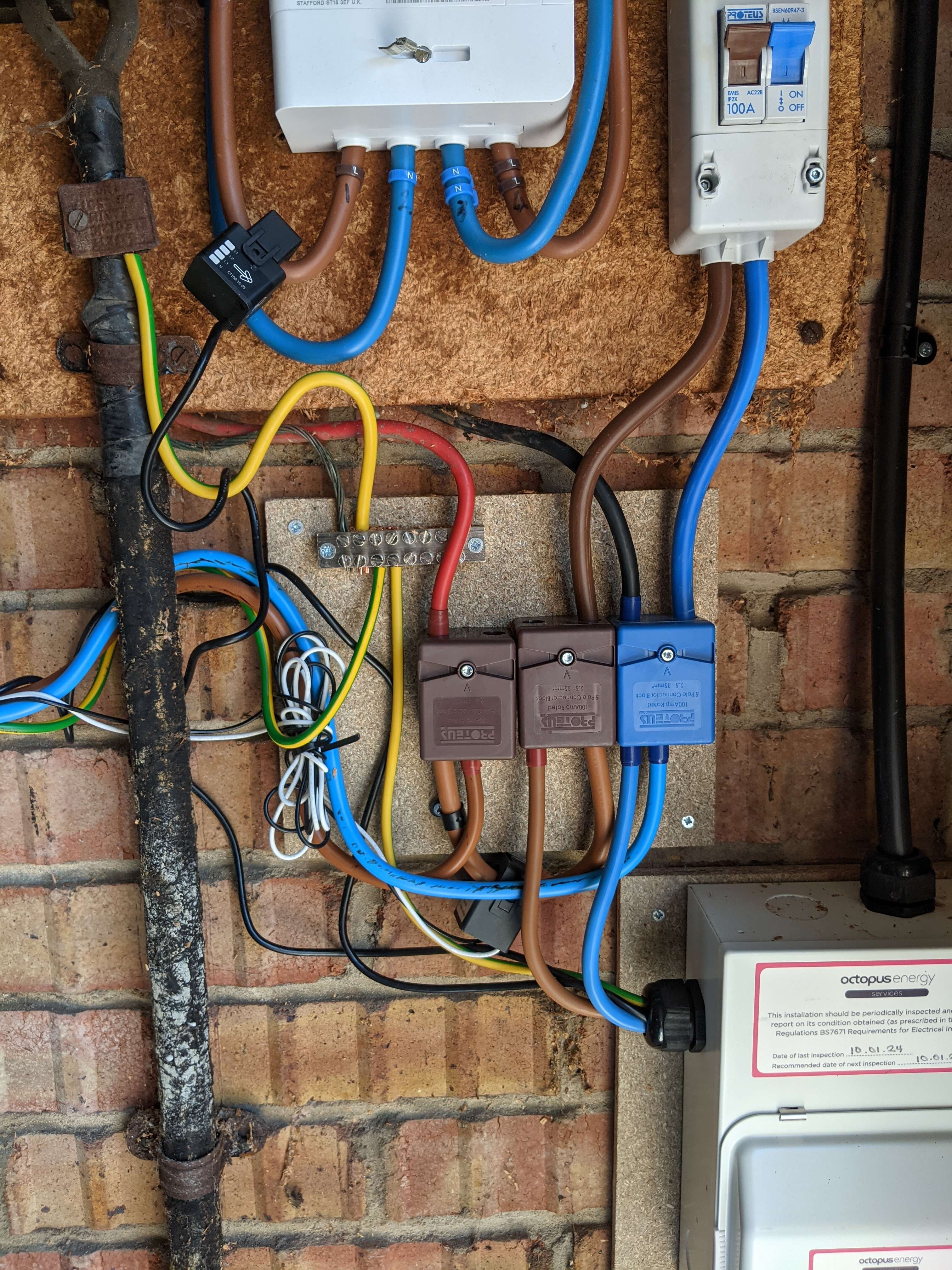
This photo predates my heat pump, but may help.

The box on the bottom right is supply for EV charger. It is wired between meter and inverter. (EV comes from right brown block ; house and inverter from the left one.) In this case, I dont want the inverter to see the EV, since I don't want solar or battery to power the EV. The small black box on the short brown cable between the two brown blocks is the CT clamp for the inverter. Because it doesn't see the current flowing to the EV, the inverter doesn't attempt to power it. But if I was to move the CT clamp earlier in the supply, it would see and power the EV chargepoint.

(The CT clamp at the top is for the EV chargepoint, since it wants to monitor grid import. It sees all the import/export.)

If I force an export from the inverter to the grid, the EV would by default grab it to charge the car - I've had to configure that separately to tell it to ignore it and allow it onto the grid.

I ought to upload a newer photo that also has the heat pump...

S
#8 SimonClarke

We have 6.2kw of panels east/west and a 9.5 battery. Last August we got a 6kw ashp. We have an EV doing about 10k a year. All on IOG. So we charge the car between 11.30 and 0530 plus any extra from octopus. We charge the house battery every night to 100% and run dishwashers etc at the same time. March to October we export excess solar. The ASHP does the dhw once a day in less than two hours also at the 7p rate. All running through the inverter except the car. During the winter with the whole house around 21/22c - 109m2 - we didn’t use that much from the grid at the full rate, which resulted in our total energy bill being about £300. This was the first year of being totally electric so I am hoping to improve on this.
With a smallish battery obviously you would use more peak grid power unless you like it cold!
If you don’t have one get an EV!

P
#9 pwdst

As I understand it Octopus Energy Solutions always install a new Consumer Unit connected directly to the meter and will not touch the existing house wiring or Consumer Unit at all. This very likely means that your CT will not see the Heat Pump load. This is often the case with EV chargers as well.
I imagine only using your own wiring means you can guarantee that all of cables are sufficient rating for the load and there will be no future liability issues around loads exceeding the rating of cables hidden in walls or under floors. It probably is also faster and less disruptive than attempting to route internally.

As it happens we just had a Vaillant ASHP installed by a different company and they did exactly this. I paid our electrician (who is also a GivEnergy installer) to move our CT clamp from the Consumer Unit to the meter box and now the batteries and solar see the Heat Pump load. This means that we are no longer having to import to handle DHW loads in the middle of the day. In the winter I am hoping it means that the batteries can at least handle the (hopefully limited) load to maintain the setback temperature during the Cosy peak period.

The Octopus electricians may or may not be willing to move or extend your CT clamp for you - if you want this I strongly recommend you get it agreed with your install coordinator in advance.

D
#10 DD

pwdst As I understand it Octopus Energy Solutions always install a new Consumer Unit connected directly to the meter and will not touch the existing house wiring or Consumer Unit at all. This very likely means that your CT will not see the Heat Pump load. This is often the case with EV chargers as well.

I agree with the first bit, but I'm not sure about the second bit : if the CT clamp is already directly on the meter tails it will pick up import no matter what is consuming it. You'd have to move it (as I did, in the photo above) to get it to not see the heat pump.

(Moving the CT clamp really isn't a big deal - it goes around the cable rather than connecting to it, so you're not exposed to any bare cables. About the only thing that can go wrong is putting it on the wrong way round, but that's trivial to diagnose and correct.)

P
#11 pwdst

Our CT clamp was connected to the existing Consumer Unit and not the meter tails, which is why I paid our electrician to move it to the meter tails. Had it been like that in the first place I would not have had to pay for this extra work.

I have read a number of posts by people who have had EV chargers and/or Heat Pumps installed and been left in the same position where the inverter does not "see" the load so by no means do I think our solar install was unique.

Edit- I can also categorically confirm that until the CT clamp was moved our inverter was completely unaware of the Heat Pump demand and as such we had to be "exporting" in order to cover it. The GivEnergy app and the Bright app/Hildebrand Glow were out of step with each other whenever the Heat Pump was running.

P
#12 pwdst

This photograph shows the wiring for our solar installation, Heat Pump and the CT clamp run from the indoor/main Consumer Unit to the Meter. The Consumer Unit below the Meter Box is for the Heat Pump and the Immersion Heater in the DHW tank. The conduit that runs vertically connects the indoor/main Consumer Unit (and EM115 meter) to the solar Inverter. The conduit that dog legs down into the Meter Box was added later by our electrician and carries the cable for the CT clamp.

I was hoping it would be straightforward to route the cable for the CT clamp along with the supply cable from the Meter to the indoor Consumer Unit but our electrician wasn't able to get it through that way.

The cables for the Heat Pump were much too large for the existing conduit and run from the wrong place anyway, so the electricians run those up near the drain pipe to tuck them out of the way.

M
#13 mrand31

A 6-8kW heat pump is only going to draw 2-3kW of power. Just run it off the circuit that used to feed your immersion heater.

G
#14 geoffreycoan

mrand31 A 6-8kW heat pump is only going to draw 2-3kW of power. Just run it off the circuit that used to feed your immersion heater.

My 9kW heat pump will peak at 4-5kW power draw. 2-3kW steady state, but the peak is higher. Today for example when heating the hot water it went up to 3.8kW.

But that’s kind of irrelevant, whoever is installing the heat pump will not want to piggy back off existing cabling that is in unknown condition and unknown specification. In order to fill in the certification paperwork it’ll b easier and safer for them to run new cables. In our case it was directly to the meter cabinet. Likewise with the solar install, all direct to the meter cabinet.
Our CT clamps were placed on the meter tails so the inverter saw all the house load, but I can understand how they could be placed on the house fusebox feed.

N
#15 neild

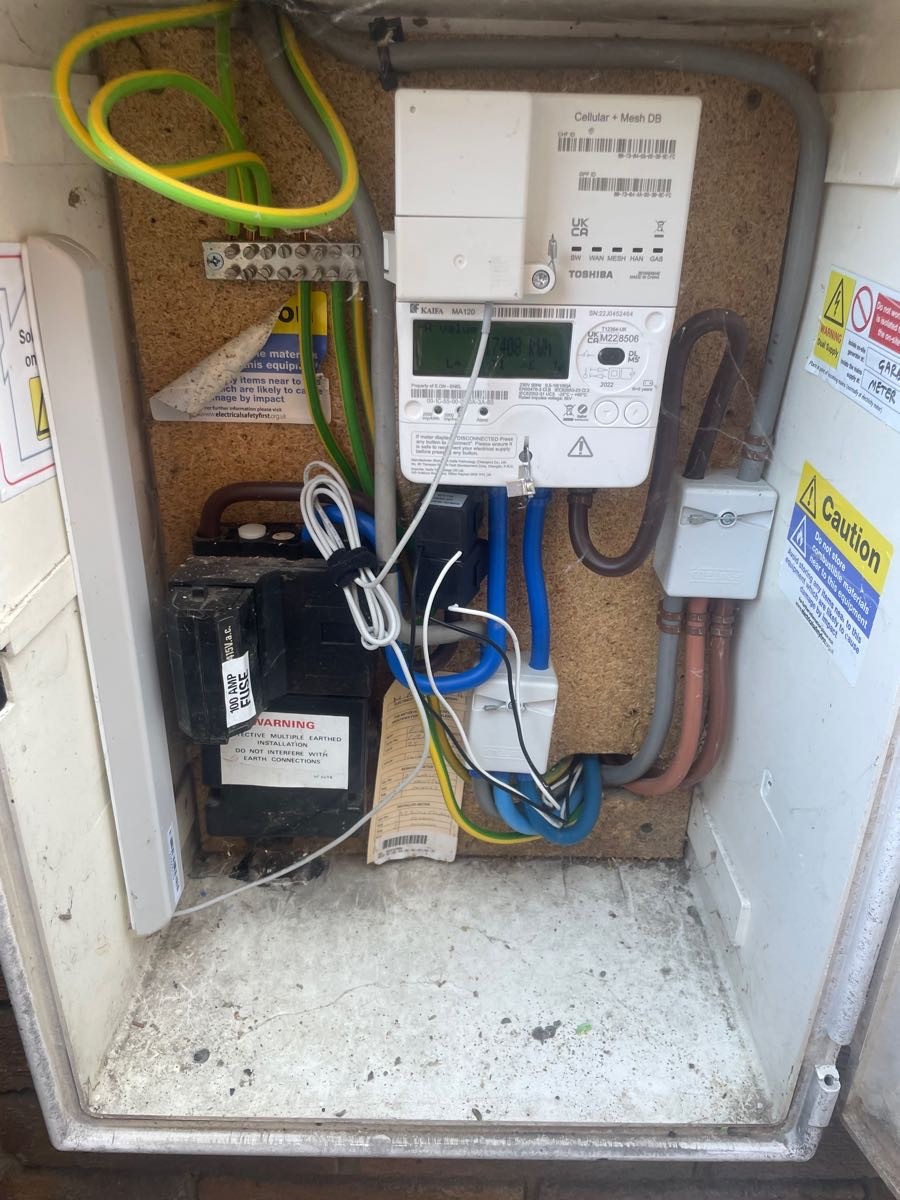
That's all very helpful. So if I understand correctly, Octopus will install it where they want to install it. But this doesn't really make a difference because if the CT clamp is in the right place the inverter will "know" what power it's drawing anyway. Is this correct?

My only question is, where's my CT clamp?

P
#16 pwdst

neild Do you have an EM115 meter inside your Consumer Unit? I would guess that the CT clamp is attached to the supply cable in there, and hidden from view. That would mean it misses your Heat Pump load.
The good news is that the proximity of your solar inverter, Consumer Unit and meter should make it straightforward to relocate the CT clamp on to the appropriate meter tail.

D
#17 DD

neild Is this correct?

Yes

My only question is, where's my CT clamp?

A related question... which is the cable that supplies the rest of your house? What's inside the consumer unit above the meter? Is that just for the solar components? I'm wondering if perhaps the supply to the rest of the house comes out of there somehow? (At the back, perhaps ?)

If you look back at the picture I posted, there's a tangle of black/white thin wires tucked under an earth cable, leading off to the left of the picture. The CU for the solar install is to the left, and those are the cables for the CT clamp. Inside the solar CU there's a little meter/display - EM115 or something like that ? - which is what interfaces the CT clamp to the inverter. Do you have anything similar? It might be inside there?

(When my Zappi EV chargepoint was installed, it comes with a CT clamp for measuring solar. For some reason, they opened up the CU for the solar and hid the CT clamp inside there, rather than just putting it around the tail supplying it. I ended up repurposing that CT clamp so that the Zappi recorded heat pump usage instead, since I didn't really need it to measure solar, and it couldn't distinguish solar from battery anyway, since it's a hybrid inverter.)

G
#18 geoffreycoan

Here’s my meter cupboard for example. The CT clamps are those white boxes with black and white whites that go through the wall to the inverters on the inside garage wall. As you can see they are directly on the meter tails so they measure all my house load.

The Henley blocks bottom right are where the live and neutral from the meter split off to different sub fuse boxes - the main house fusebox, the supply to the house extension (which has its own fusebox in the utility room), the ASHP, the inverters.

But every house wiring is different so it’ll be something to discuss with your installation engineer

N
#19 neild

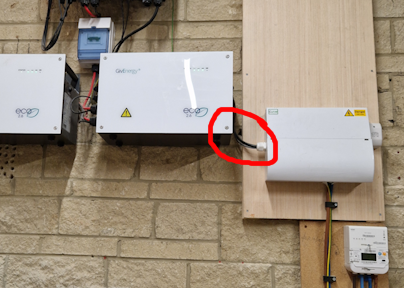
You can't see in my image too well, but the bit I've circled red is actually a thick cable and a thin one. I'm guessing the thin one would be to the CT clamp in the house consumer unit. To answer the questions above, yes there is one of those EM115 units in there.

I think we'll probably end up leaving the CT clamp as is for the time being (once the heat pump's installed in 2 weeks). Then at some point we can get someone in to reconfigure it.

P
#20 pwdst

neild The cable will be the communications between the Inverter and the EM115 meter. The CT clamp will be connected to the EM115 directly.

R
#21 Roy124

Just to say how I am using Cosy in the summer when there is ASHP need only for water. The low tariff is 12.28p/kW and the export rate is 15p/kW. While the difference is only 2.72p I can exploit this by discharging the battery before the low cost periods and recharging from the off-peak.

I know there are losses and I haven't tried to calculate it. The only thing that does prick my conscience is using electricity that I didn't have to.

I am sure someone will tell me I am wrong and next month, with an anticipated increase in import rates I will stop this discharge/charge routine.

P
#22 pwdst

[unknown] I know there are losses and I haven't tried to calculate it.

If you go to the Energy Graph tab in the GivEnergy app you should be able to see the energy difference between the Total Battery Charge and Total Battery Discharge for a given period. I think you might be surprised at the difference between these reported figures.

Even ignoring the cost of cycling the battery unnecessarily I would be very surprised if you were making a profit selling energy until you are making at least 15% or 20% more back than you bought it for.

If you pick the time of discharge to match the demand peaks the you probably are helping out the grid somewhat, but I certainly wouldn't see that it makes much economic sense to be force exporting in the middle of the night to make a fraction of a penny a unit.

B
#23 Blasteh

My heat pump was installed by Octopus, I had to pay for my own electrician to move the heat pump CU to be behind my AIO Gateway as the Octopus electrician refused to connect it to anywhere but the incoming tails. If you are expecting them to be doing any work outside of what they usually do, get it in writing to be sure.

Z
#24 Zakalwe

My heat pump was installed by Octopus. The load is just seen as another house load and is happily supplied by my GivEnergy batteries and inverter.
There were no objections raised when I specified that this is how I wanted it.
HP installed in March this year.

S
#25 SimonClarke

My ASHP installer looked puzzled when I asked him to fit it so the inverter couldn’t see it. He talked me out of it but would have done it if I insisted. He was right. The most I see is about 4kw when it is doing dhw and then only for a short while that is in the IOG cheap window with the battery charging so comes from the grid.

G
#26 geoffreycoan

SimonClarke My ASHP installer looked puzzled when I asked him to fit it so the inverter couldn’t see it. He talked me out of it but would have done it if I insisted. He was right.

I agree with your installer, you want the heat pump load to be visible to the inverter/batteries. This gives you the most flexibility.

If for example you are on Octopus Cosy with cheap charging periods and a peak rate period you don’t want your heat pump pulling from the grid during the peak rate. Of course you could turn the heat pump off, but depending on the outside temperature your house will then cool down, and it’ll require more heat (and more cost) to build it back up again. Low and slow and continual is the best way of running a heat pump. [There’s a heat geek article comparing the costs and efficiency of running on different smart tariffs].

If you don’t want the battery to discharge then set the inverter to pause mode or turn discharge rate down to just base house load.

S
#27 SimonClarke

geoffreycoan I did realise the error of my ways so it just shows as a house load. It was just that the car charger was done to be ignored and without really thinking about it seemed a good idea to do the same at the time. Live and learn!
Currently only doing dhw but will be back to running the same temperature all the time. Did have offsets for a while but I gradually lowered the difference until they were the same. Scop is 4.35 since last August with 10mm microbore so we are pretty happy. Used about £200 of extra juice last year, which is about a bit less than a third of what the oil used to be, and it is better all round.