
Very basic newbie question - where is the power going

9 comments started 2025-09-12 last 2025-10-07
GivEnergy ProductsBattery
J
#1 Jonw

We've just has an installation with panels, GivEnergy inverter & batteries and have been watching the stats & graphs in the GivEnergy cloud to try to work out how best to organise/control our energy usage. But now I have a very basic question, best illustrated by this screenshot showing activity through the night:
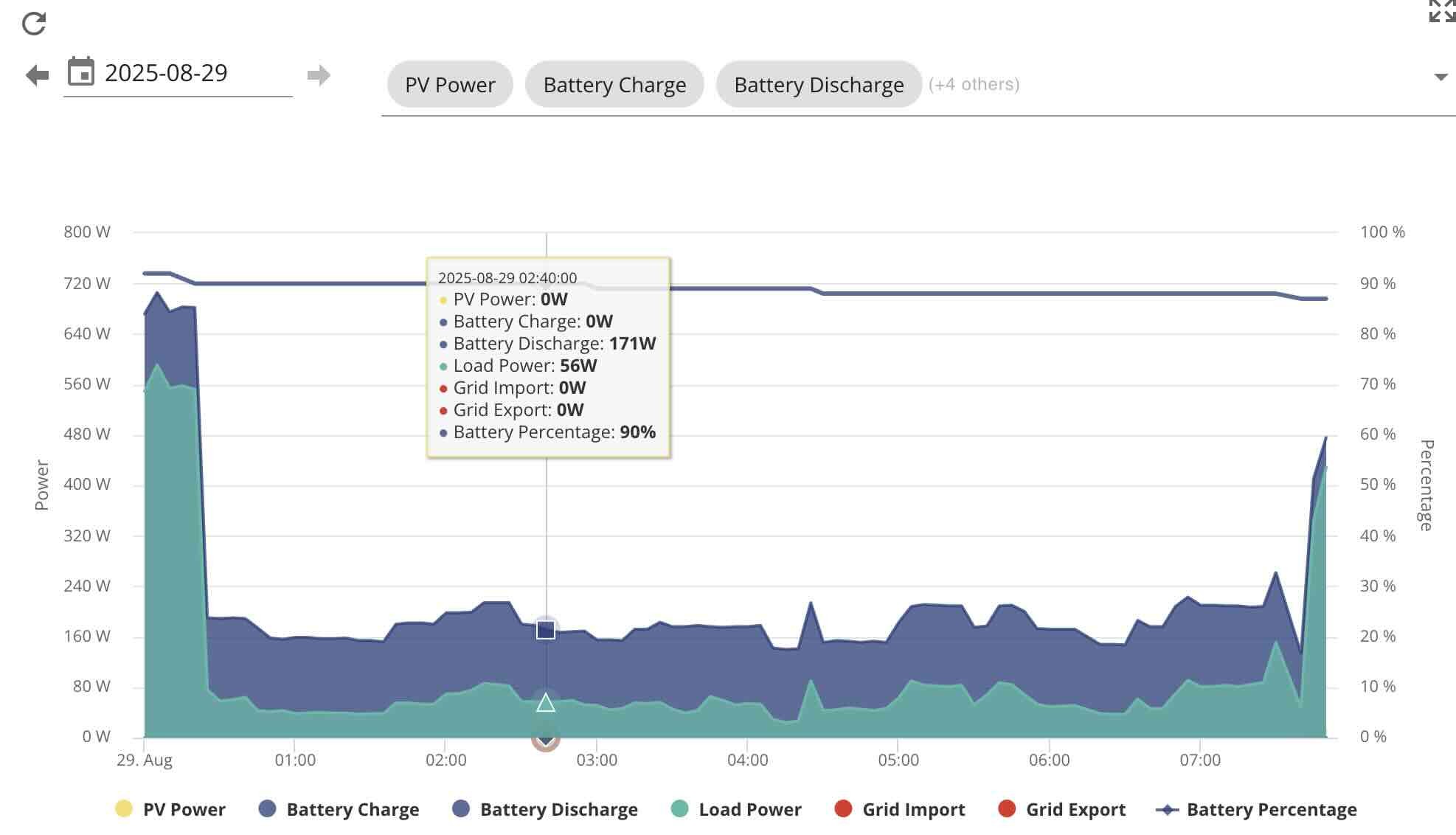
Basically, whatever the load power is, battery discharge if always about 100w higher. Where is this extra wattage going? Is it consumed somehow (resistance) in the wiring?

Thanks for insight!

S
#2 SteveCook

I dont think the inverter can exactly match the consumption load, and there will be some DC/AC conversion losses, plus internal consumption of the inverter

G
#3 geoffreycoan

SteveCook Correct, conversion losses plus running the inverter account for the load/discharge discrepancy. If you turn off all house load (e.g. fridge, oven clock, lights) then you’ll still get a constant draw of 100-200W.

I believe also the discrepancy is partly due to the way things are measured: load is measured as AC power whereas battery discharge is measured in DC from the battery pre-conversion to AC.

And worth noting that the inverter is less efficient with low power loads so the conversion losses are more visible on overnight base load.

These are just the things you have to get used to Jonw . There’s a cost to running the system and what you get out of the battery is not what you put in. Losses of 10-20% are quite common.

D
#4 DD

Jonw The app by default (I think) hides the losses by adding them to the consumption.

On the animated screen, under the 'away' button there's an icon with some dots and a pencil. Clicking that takes you to an options page, and the first is 'show calculated load'. I think that's the one that does the fudging. I have it turned off, and it shows the 'raw' values as measured.

On my system, 'off' shows consumption of around 300W, 'on' raises it to around 500W, and makes the numbers all add up. Neither could be said to be wrong, since, as has been said, the losses could be considered to be consumption somewhere along the line (running the inverter, heating up the wires, ...)

If you use android, there's a free alternative app which displays the unaccounted difference as 'inverter' (orange)
https://givenergymonitor.wixsite.com/tutorials

R
#6 Rubikcube

Jonw Put your hand on the thing that you have had installed. Is it warm? That's where the energy is going. You have, in effect, just bought an electric heater.

D
#7 duplada

Rubikcube I stupidly not knowing asked my installer to install switched spurs and trickle heater under each of my 2 AIO's inverter/batteries, located in my attached garage, having read prior to installation that the batteries need to be a certain temperature to operate efficiently in winter. My Gateway is also in there too. Its was always cold in there, the heaters have never needed to be switched on. The garage is now the warmest room in the house and we are considering moving the sofa and TV in there.

On the topic of your app. I have been using it for a while now and subscribed the other day out of interest. I know you don't directly support the newer kit and in particular the higher voltage batteries systems like mine, with a gateway and 2 Battery/Inverters. My systems are all on fixed IP addresses so since you added the second IP address for battery comparisons etc, I have been playing with the app entering the IP's of the Gateway and one of the batteries or both batteries and then looking at each of data properties to see what is missing and where, it is surprisingly very close to fully working considering there is no support for it. With a third IP address for the Gateway and bit of remapping of data to correct what's shown where, its not far away from working already. If that's something you want to do in the future then let me know, and I could send you some screen grabs with explanations so that you can see what's displayed where.

R
#8 Rubikcube

duplada I have never actually seen an AIO, but from what I know about the design I would estimate the power consumption at idle to be 110W. This is made up of 20W for each of the 4 battery packs plus 30W for the top bit. When charging at full 6kW power consumption would be around 480W. When discharging at full 6kW power power consumption would be about 280W.

My app shows this completely wrong because it is based on my low voltage system where charging is more efficient than discharging. The old 48V systems have a fairly efficient charger design, but for the inverter side, the battery voltage needs to be boosted up first which isn't terribly efficient. Because the AIO has 300V batteries, the charger system has to boost the voltage up a bit, whereas the inverter has the voltage it needs to run efficiently.

Two AIO should easily keep a garage warm!

By all means, please send some screen grabs attached to an email to inverter.monitor.app@gmail.com

I will see what I can do. I would also like to get the battery cell voltages display working for the AIO, if you would be prepared to help me with that.

D
#9 duplada

Rubikcube By all means, please send some screen grabs attached to an email to [inverter.monitor.app@gmail.com](mailto:inverter.monitor.app@gmail.com)

I will see what I can do. I would also like to get the battery cell voltages display working for the AIO, if you would be prepared to help me with that.

Yes I can help you with all of that. I will find some time this week, and as a starting point send you some screen grabs with explanations of how things are set at the time of capture etc.