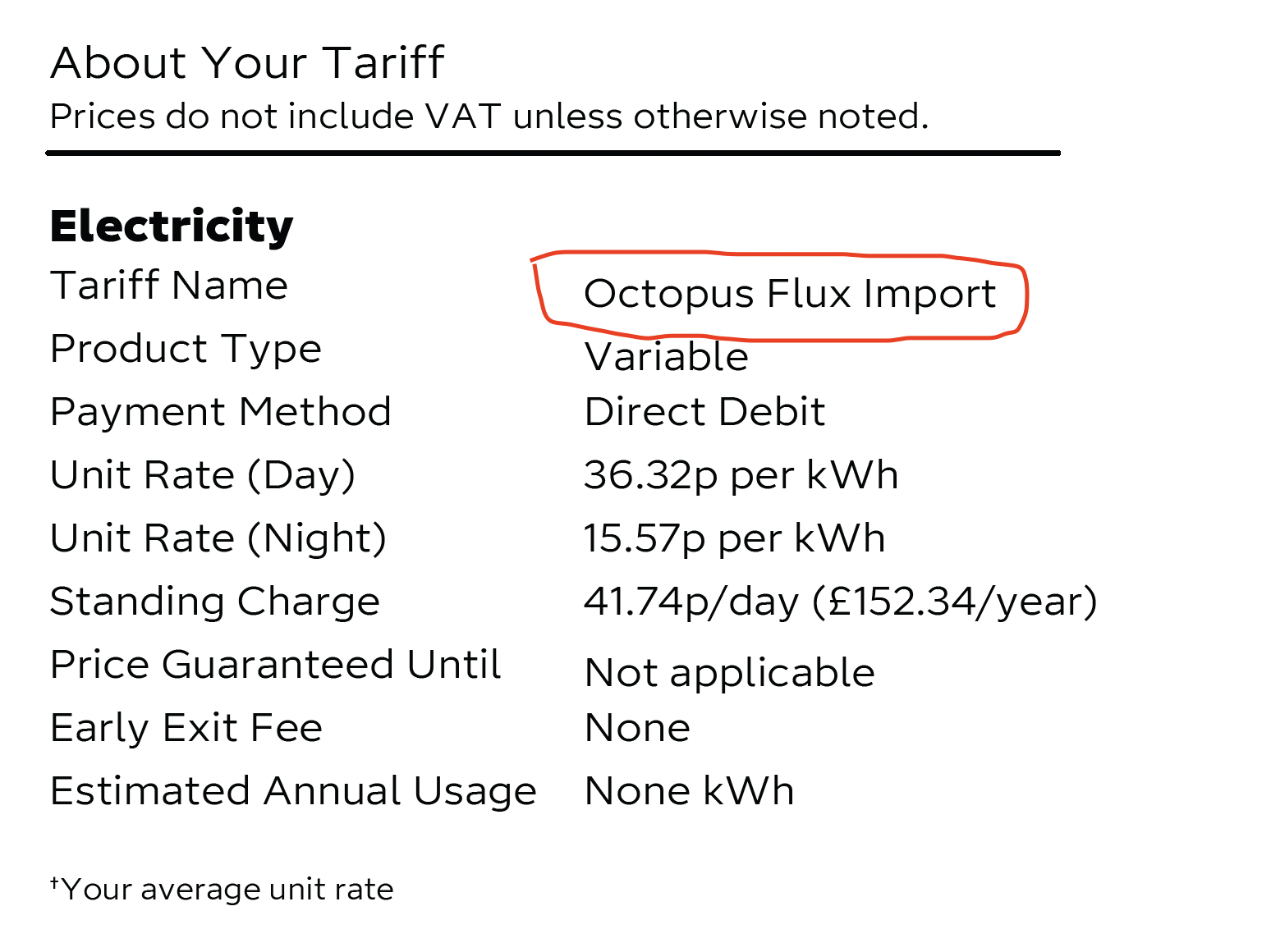
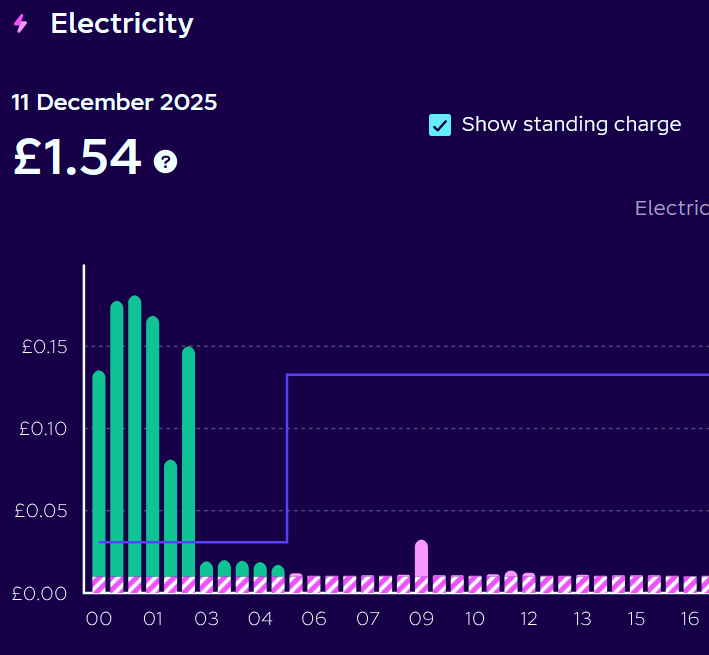
Hello. I’m slowly going nuts so any help would be great … I have a 8KwH solar array with a 13KwH battery and I’m on Octopus Flux Import. The battery is set to ‘Eco’ mode, and I have a Timed Charge set up to charge between 2.02AM – 04.59AM. During this time, the battery charges to approximately 90% (at a cost of approximately three pounds). A 90% charge would normally run the whole house for 24 hours on an average day. Looking at my Octopus portal Energy Usage, I see I am being regularly charged for usage (over four pounds) between 15:30PM and 01:00AM when the battery is still over 50%. Also, there are all these little charges between 05:00AM and 15:29PM which amount to a couple of quid, give or take. My question is, why isn’t the house using the battery as it’s supposed to? Why am I being charged for electricity usage when the battery has plenty of power? What are all these ‘little’ charges during the day? Can anyone explain this to me please? Thanks in advance.
C
#2CW
Mayford What are all these ‘little’ charges during the day? Can anyone explain this to me please
I can't answer the other points, but for this one, this is likely due to the sudden demand for power which takes the inverter a small amount of time to respond to - during this period the grid will supply the power. I think I have seen other threads around here which talk about inverter firmware changes which later ones I believe can respond quicker to demand (there are others on this forum who will be better able to point you to them).
It might also be helpful for others if you could advise on inverter type and model as well as battery and what firmware versions you have for them.
HTH
#3ChrisLav
Have a look in the GE portal - My Inverter - Remote Control (top far right on the page) and check the logs (top left 'Jump to logs'). This should tell you if Octopus or anyone else has been changing your settings. You might also want to check your consumption at certain times of the day (also accessible through the GE portal). If you have any peaks exceeding the battery's discharge limit then the excess power has to come from the grid (or solar, but unlikely at this time of year).
I have a smaller array and smaller battery, and I try not to eg, run the kettle (2200W) at the same time as the microwave (800W) as this would exceed the 2600W limit on the battery and force an import of 400W (never mind using the oven as well!)...
G
#4geoffreycoan
Mayford there are two things that will cause you to grid import when your battery still has charge:
It takes a finite amount of time for your inverter to respond to changes in electricity demand and start charging or discharging your battery, so when you turn a load on (e.g. a kettle) there will be a noticeable period of time, usually a few seconds where you’ll grid import before the battery discharge starts. At the end when the load stops, kettle boils, the battery will continue discharging and you’ll export a little until the inverter spots the dropped off load
Maximum discharge rate. Your inverter has a maximum charge and discharge rate, older kit is lower. So if you turn on load above the inverter limits, e.g. cooker, kettle, dishwasher all on at the same time, the inverter can only supply part of that power and the rest has to come from grid import
Of course there could be a misconfiguration of your inverter as well
First thing to do is look at the power graphs in the givenergy portal, what do they show during the day for load and battery activity to understand what’s happening
M
#5Mayford
Thank you all for responding. Very much appreciated, and does make sense.
I'll carry out the recommended inverter checks, but I do think that Octopus is ripping me off. Last night I was charged six quid for a two-hour slot long after we'd cooked. Thanks again!
T
#6TimHutchings
Are you on Octopus Flux or Octopus Intelligent Flux?
P
#7pwdst
Mayford Last night I was charged six quid for a two-hour slot long after we'd cooked.
In our region six pounds would equate to roughly 12.6kWh at the peak times 1600-1900hrs or roughly 20.8kWh at the daytime rate. That is a lot of energy and relatively few battery systems would be capable of covering that rate of discharge.
It's possible that your batteries were discharging but were simply not capable of keeping up with the household load at that time. You will need to look in the GivEnergy app or portal to see what the system was doing.
Do you have an electric vehicle that could have been plugged in at that time? Were the batteries themselves being charged? Perhaps via a second slot or automation.
I am struggling to think what might account for such load otherwise unless you had a lot of things running at once.
#8Watcher
Mayford regularly charged for usage (over four pounds) between 15:30PM and 01:00AM when the battery is still over 50%
Does it ever drop under 50%? Have you checked battery settings?
Mayford Have you looked at your meter serial number to compare it to the bills? It's not uncommon for meters to initially be assigned to plots when properties are being built and these aren't always mapped to the correct property number. Compare both meter readings and serial numbers if you can.
Does the GivEnergy app show a spike in load and/or import at the same time as the Octopus app. It is a lot of load for you to have been unaware of.
T
#14TimHutchings
Mayford
Sorry, but there's no such tariff!
There's either Octopus Flux which is an import and export tariff, or there is Octopus Intelligent Flux which is also an import and export tariff, but your equipment is totally controlled by Octopus, they do what they like with it, and the import and export rates are the same but high.
From the figures you are quoting it sounds very much you are on Octopus Intelligent Flux tariff, which isn't a great tariff to be on in the middle of winter, but gives you loads of money on solar export in the summer.
P
#15pwdst
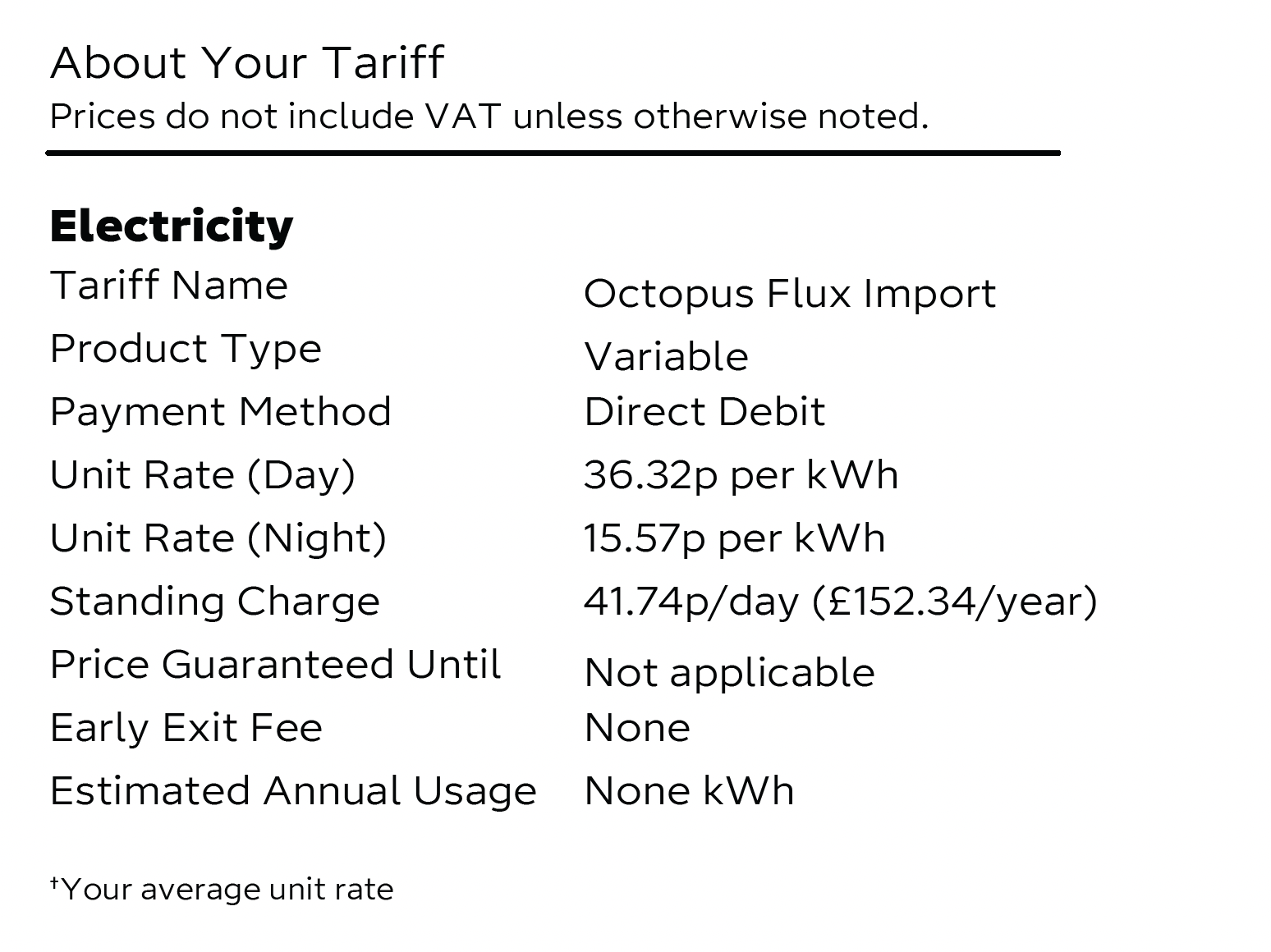
TimHutchings IIRC In the app Octopus label the tariffs as Octopus Flux Import and Octopus Flux Export on the usage page if you are on normal Flux. Their tariffs page also explicitly lists "Octopus Flux Import". Based on the OP's charging pattern I am very much assuming that they are on the non Intelligent version of Flux where they control their batteries themselves. If they were on IOF then to be charged £6 for two hours usage they would have had to consume over twenty kilowatt hours in that time - which is higher than many households consume in a day.
T
#16TimHutchings
pwdst
He has an AIO, which from memory charges at 6kWh so if Octopus decided to charge the battery over 2 hours would account for 12kWh at 23p-30p kWh and household drawing from the grid on top. It would also account for why his battery only empties to 50% and then he uses grid.
P
#17pwdst
TimHutchings Why is their overnight charge at half the cost of a daytime charge? The overnight charge cost they quote is consistent with Flux at ninety percent of their battery. The times they are changing almost exactly line up with Flux tariff times.
If the battery is only dropping to 50% during the day the two hour cost is even more unexplained, half of a 13kWh battery is much less than 12kWh. The OP state that they are on Octopus Flux Import and I believe them.
The wrong meter number doesn't make a whole lot of sense either given the overnight charge matching so well with expected cost but I doubt the OP forgot they were running the washer, dryer, the dishwasher and the immersion heater at the same time during peak rate.
#18Woodstock
Unlikely to be a problem with Octopus but worth checking that your energy supplier is applying the smart meter time of use periods correctly.
I had to point out to my electricity supplier that they were using the peak rate readings to charge other time prices and the other time readings to charge peak rate prices. Luckily they were correctly using the cheap rate periods to charge cheap rate prices so the overall effect on my bill (with 99% of my grid import being cheap rate battery charging) was negligeable. Dread to think what the effect would have been if they had transposed the cheap and peak rate readings though!
T
#19TimHutchings
pwdst
The OP just has to check if he is on Flux or Intelligent Flux and his answer didn't make that clear at all. Those are the two tariffs in question!
If he isn't on Intelligent Flux then it sounds like he has problems. But it wouldn't be the first time someone who was on Intelligent Flux thought they were on Flux and found they couldn't control anything, as Octopus moved the settings back.
Firstly - THANK YOU TO ALL WHO HAVE REPLIED - I really appreciate your time and effort.
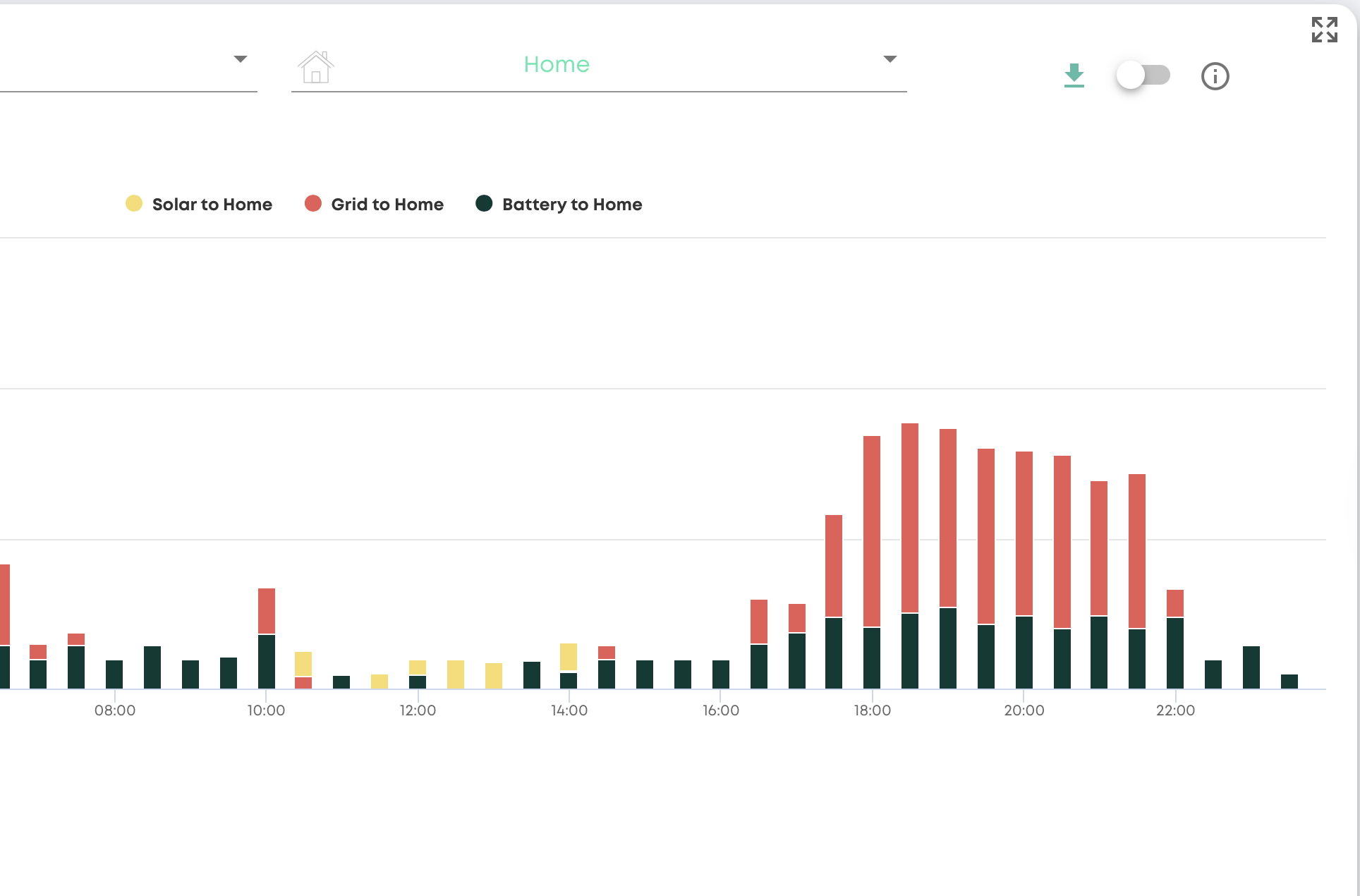
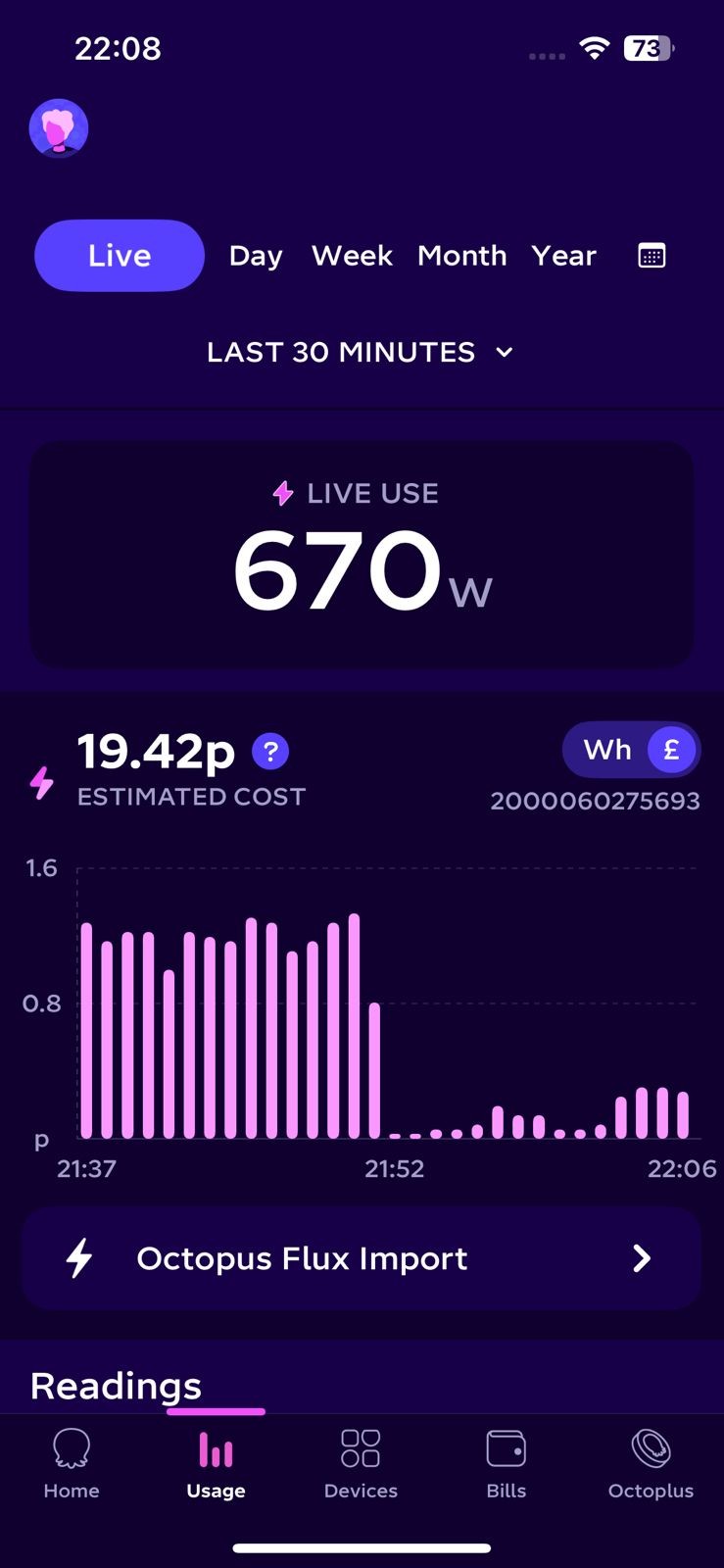
The missus and I went to the pub last night. While we were out, I was charged £19.42p for a 30 min period between 9.30 and 10pm (I was home shortly afterwards - bit of a lightweight these days). See attached screenshot. I also had over 40% battery at this time. I've also attached my Givenergy screenshot. For some reason, my battery, despite having plenty of power, is not feeding the house as it should (ECO mode is enabled in the GE portal and app). Any comments/advice gratefully received.
M
#22Mayford
Watcher Hi, and thanks for replying - No, it was set to 480W - that could be the issue, no?
It might be worth checking you haven't set (or had set) an export to 50% at some point. Even if the export timer is disabled the battery will maintain the 50% as the minimum. Any timed export should be to 4% and adjust the export rate or time to limit the export.
A reset to defaults may be best then recreate your charge timer (using the second slot) if battery winter conditioning is set to on as that overwrites the timed import.
#25Watcher
Mayford
Yes, set to max, at least the use will come from battery rather than grid!
If your battery output was limited to 480W then any usage over and above that must come from the grid. If you are finishing the day with 50% battery there is clearly headroom for more of that usage to come from the batteries.
M
#28Mayford
CW Apologies, you're absolutely right! Appreciate you putting me straight. I'm so paranoid I'm being ripped off, I missed that. Thanks again.
pwdst Thanks, and yes, that could be the problem. Set to max discharge now.
Thank god for forums like these.
M
#31Mayford
PaDav6 No timed Export settings in the app as far as I can see.
A reset will be the way to go if all else fails, but I'm hoping that changing the discharge power from 480w to 6000w will do the trick. Thanks for the info.
C
#32CW
Mayford It might be helpful for others here to see your remote control settings to see if everything is as it should be (e.g. max discharge, SoC reserve etc) - a second pair of eyes wouldn't hurt. Also is your system an AIO? If so , too have one so could compare your settings with mine