S
#1 SimonClarke
As per title. Slightly depressing but could be worse

As per title. Slightly depressing but could be worse
Sad day. I'm off to look for another supplier, assuming this will be futile.
I don’t think you’ll find better from any supplier. Eon had already slashed their export rate. The only decent rates are if you had your solar panels installed from your electricity supplier and then they give you a lock-in better rate.
Whilst we’ve enjoyed 15p export, it was only a few years ago it was 8p fixed rate, and that was at best, SEG’s were typically 3.5p.
I suspect a part of this is down to the reduction in import rates with the government taking some of the electricity costs out into general taxation/scrapping them.
Edit: Just got my email from Octopus, in it they describe the history of the export rate, as I thought, it’s only been 15p relatively recently.
I need to do the math but I suspect that this will overall make little difference financially. I export about the same as I import each year, so with a 3.5p cut in import rates (hoping/assuming they apply to all time of day bands equally), and 3p off the export rate, maybe I’ll be marginally better off. Unless you export substantially more than you import, it’ll be similar net-neutral
Well, we knew it was coming! Ever since they made the 15p export rate variable, it was inevitable that the rates would drop. It could have been worse, but checking Jan to December last year, I exported 6162 kWh, which at 3p a kW, means my Electric credit for export would be now down £184.86 for the same amount this year.
Raises a couple of questions! Do I still continue to import and fill the battery every night at 7p (8.4p with in/out losses), move to Agile export and part empty the battery between 4-7pm, or move to Intelligent Flux for the summer months with an EV to charge once a week, or take the easy life and suffer the hit.
There's some thinking to be done!
TimHutchings when we first got our system we were placed on agile export and it was horrible trying to read the weather for the next day so we didn't sell to much, if we didn't sell enough the previous night and the next day was very sunny you'd end up getting 2pkwh for the export, then if you get it wrong and it's cloudy you end up buying it at peak rates.
No good for a small system.
Octopus are saying the unit rates have come down but last month's bill was our biggest ever.
I wonder if the IOF rates will change, as soon as my inverters fixed (.....) and average generation is 12kWh per day I'll be moving back to it.
Are they coming down for everyone, regardless of whether you fixed for 12 months?
arczi19 When did you fix your 15p export rate?
TimHutchings a week ago 🙂
arczi19 Are you sure?
arczi19 Didn't know you could fix the export rate at 15p. I know you can fix the 7p import rate on IOG for 12 months but you pay a slightly higher day rate. I was moved off the fixed rate export 15p, middle of last year, and was advised only variable was available.
Now that I think of it, I might have confused this with my Octpus Go tariff - I have switched both expert and import last week to Octopus. Apologies for confusion!
TimHutchings when I first got my system installed that was what Octopus told me, there was only Agile, after about 8 months of headache trying to maximise benefits someone told me about the fixed rate tariff. I called octopus on the bounce and the switched me over.
This week my 12 month contract expired and they were only offering a fixed rate import. This would have meant more standing charge & import prices.
I gave them another call and the placed me on agile.
There is some shady practices going on at octopus.
TimHutchings Exactly the same dilemma here and with similar export rates and potential loss. We ended up about £150 net negative with overall bills last year (gas and electricity) so looking like a break even at best. I might opt for the easy life and roll with it or maybe have a play with Tim's (Tim and Kat's Green Walk) calculator to see if one of the flux tariffs stacks up better. It's only going one way unfortunately but it was good while it lasted. We've got 10.1kwp on the roof so it will be grim watching export rates drop away progressively. Maybe a long extension lead to the neighbours or rent out the car charger 🙂
Marren2016 I think you'll find there's a few Octopus tariffs that you could move to. It depends on your circumstances, the energy you use, times of day you use most, and what equipment you have. You could look at Flux or Intelligent Flux if you just have solar and battery which are both import and export tariffs, if you have a heat pump there's Cosy, or if you have an EV or hybrid car, you have a choice of Octopus Go or Intelligent Octopus Go. Also if you can shift your usage, there's always economy 7.
With export, there is only Outgoing Octopus at 12p (1st March) or Agile export which is very variable as you know, plus of course Flux or Intelligent Flux.
Worth having a look through the tariffs to see if you can find one to suit you better.
TimHutchings I suspect we will see the IOF rates drop by a similar amount, and don’t forget all the import rates are due to drop in April so this will help balance the annual bill.
Agree there are lots of Octopus rates to look at, and probably worth saying there is no one single rate for all year. I’ve been on Cosy for the winter, and will have to decide what to do for the summer, whether to remain on Cosy and just run on stored solar, whether to move to Agile as I did last summer, or go to Go ahead of an EV purchase. IOF isn’t an option for me as Octopus can’t control multiple inverters on the same account (and TBH I like the control myself).
Tim and Kat’s tool is useful but do watch the video where he explains how it was constructed and what the assumptions are that it’s based upon. They were OK but didn’t match perfectly to me, so just be aware of the assumptions made. Frankly though until the new post-April rates are out it’s not really worth making any comparison.
sponev
Good to be industrious! 🤣
My Zappi allows solar charging to the EV if I choose, so possibly a move to Intelligent Flux, and using solar for the car in the summer, then back on IOG in October - I'm not sure at the moment as I haven't done any figures. I did have a quick look at Octoprice, and specifically at 'tariff hopping' section over last 12 months, and even with the 3p reduction over the whole year, I'd still be better off on IOG and 12p export, than moving to IOF by around £100.
I'll hold fire for the moment.
TimHutchings yes, charging the EV from solar will start to feature no doubt and we've a second one arriving in March. So that will soak up some, although we don't do too many miles these days. I guess the AC might see more use too. But still early days and a bit of a moving feast at the moment. A little less in the pocket but still fascinating!
Well, I’ll be about £400 worse off a year. I’m 99% off peak usage at 7p/kW.
Unless of course they also reduce the IOG off-peak import rate by 3p. Which I can’t see happening.
I should just scrape break even point though on the new rates with a bit of luck.
Time to up the DD by £33 !
I do think they should have a think about a dual or tri-rate export tariff though. You know something that encourages export at the times they really want it, like 4-7pm with a higher rate payment for those times. I know there is flux but - meh.
geoffreycoan
It's a tricky dilemma! Don't think IOG 7p rate will be coming down in April, so if I stay still with 3p reduction, I'll just be down around £180. I did actually make a £90 profit last year, Jan to Dec, on all my energy costs including home car charging, electric, gas and standing charges. As long as the tariff with IOG stays at 7p import, and 12p for export, and of course we have as much sun overall as last year, I guess I can be pleased it will only cost us £90 all in for this year.
It's a bit of a game really to beat the system! 😂
TimHutchings My Zappi allows solar charging to the EV if I choose, so possibly a move to Intelligent Flux, and using solar for the car in the summer,
I thought that on IOF the import and export prices were in sync. So there's no point making a special effort to use solar for the car - net cost is exactly the same whether you charge the car from the solar, or if you export the solar and charge the car from the grid. (But obviously not at the same time.)
(And obviously better to export the solar during peak rate, and charge car during day rate.)
TimHutchings It's a tricky dilemma! Don't think IOG 7p rate will be coming down in April,
Seems unlikely given that they're increasing the off-peak rate for new customers. Will probably go up for existing customers before too long.
DD
You're quite right DD! Just mulling things through my mind, but I'm sure the solar charging will be worthwhile one day as the gap between import and export narrows.
I think I'll keep my Direct Debit at £1 a month, as I still have a couple of hundred credit in the account.
Octopus want to control as many devices as possible, across various cars and various home batteries. If they can carefully balance demand vs. purchased energy then it's good for them.
Hopefully that means tariffs such as IOG and IOF continue to have good rates (whether that's import off peak on IOG or export peak in IOF's case).
Will IOF rates change? Who knows. If they do, hopefully not by much.
What is interesting is what comes next... Could octopus control both* car charging and home battery charging with a tariff that's good for both? How about controlling heat pumps too?
(*) Those who use the octopus forums might already know the answer to that...
TimHutchings Don't think IOG 7p rate will be coming down in April, so if I stay still with 3p reduction, I'll just be down around £180. I did actually make a £90 profit last year, Jan to Dec, on all my energy costs including home car charging, electric, gas and standing charges.
I agree, I doubt the overnight EV rates will come down at all, if anything I think they will go up because the overnight rates are cross-subsidised by the day-rates, and the day rates will come down with the government changes.
I know Octopus pre-pay for a lot of the IOG overnight electricity, but open market you rarely see agile rates that low, unless its a very windy night. IIRC Octopus actually said it on a video I was watching, its down to the total day bill for the customer, the EV gets charged at a cheap rate but all your day electricity is more expensive. Of course for those with EV and solar and battery you're gaming the rates really, gaining from the cheap rates and avoiding the expensive.
I earnt £109 profit last year from export and import, DD £1/month. Will have to decide whether to change off Cosy to Agile for the summer. I'm on the Cosy fixed deal so will have to pay a £25 exit fee, but I calculated I'd still save more than £25 by being on the fixed rate for the winter. At worst I'll just run off stored solar for the summer which is what happened with me and Agile last year except for the windy days when I could overnight charge.
geoffreycoan
There's a lot of options to consider Geoff. There's also a lot of variables like how much sun we'll get in the year, how cold the winters will be etc. Would it be prudent to fix IOG for 12mths and pay a slightly higher day rate? Are government interventions likely to play a part in conserving energy or taxing the hell out of it in some way? Will there be any kind of change to standing charges up or down?
Don't feel I'm gaming the rates as such, just using what's available. Octopus could always change their tariffs, like stopping IOG customers using cheap rates overnight for their home. After all they control the zappi charging. They could stop people changing tariffs so easily through the year, and there must be loads of other interventions they could make if they wish. But they have to be competitive with other energy suppliers also, so maybe need loss leaders. I don't know how they work, but I'm sure they have clever people running computer algorithms to maximise profit wherever they can. It's a business after all!
Guess overall one just has to be adaptable, versatile, and move with flow.
To all, that claim IMPORT rates will be reduced: can you show some indication that this is expected? I haven't seen any signs outside of the announced standing charge reduction. Has there been an announcement on the next level of price cap?
Marren2016 Their systems are broken again!
We got 16 HOURS notice that they were going to switch us to SVR from Agile so they've had to pay us £80 compo for taking money from the account without billing correctly (£40 compulsory compo) and another £40 compulsory compo for failing to give notice of a tariff change.
They continue their abysmal customer service - we've now had nearly enough compo off them in under 3 years to pay the £500 annual gas bill....
My email from OE says the off peak IOF wil rise to 7.5p from March 1st, luckily I am on a fixed IOF tariff till September 26. I will not use solar to charge my EV whilst I can get cheaper overnight rate than export all be it 5p difference.
Ortwin IOG?
Doh, yes both sould have said IOG 🤦
As well as the outgoing rate dropping, for NEW customers there are increases to the overnight cheap rates from 1st March:
IOG now 7.5p v’s 7p
Go 9p v’s 8.5p
EV saver 6.5p v’s 6p
Which reduces the profit from energy arbitrage even further
Great time to install Predbat if you haven't already. It will do all the heavy thinking/lifting for you around calculating the best tariff to be on post-changes.

AI answer - The average Octopus Outgoing Agile export price was 9.81p per kWh for the 12-month period ending November 2025.
Because the Agile tariff fluctuates every 30 minutes in line with wholesale market prices, actual returns vary significantly depending on when electricity is exported to the grid.
2025 Pricing Overview
National Average: Roughly 10p per kWh.
Highest Recorded Rate: Up to 94p per kWh during extreme peak demand.
Lowest Rate: 0p per kWh (unlike the import tariff, the export rate does not go negative).
Typical Ranges by Time of Day:
4pm–7pm (Peak): Usually 15p–20p per kWh.
7am–10am: Usually 10p–15p per kWh.
Other times: Typically 5p–10p per kWh.
I’ll not be rushing to Agile Export rate just yet, based on the above a flat 12p still looks good.
Jase1703 look at the energy stats UK website https://energy-stats.uk/octopus-agile-outgoing-export-eastern-england/ eg for eastern region or use the user configurable dashboard https://dashboards.energy-stats.uk/d/5cZqqmf4z/user-dashboard?orgId=1 to look at any period/region you want
I moved into a new house last March and the developer has British Gas as the chosen supplier. My previous house I had Octopus which I intended to switch to, but when I did the math, BG were the better option or as good as at the time -
BG still offer 15.1p SEG for those customers who they are the supplier. I got a fixed EV Tariff Electric Driver v16 -7.9p off peak for 5 hours, 27p peak / 48.69 per day. I'm hoping as mine is fixed until June this year, the prices will come down as renewal will be in the summer months.. fingers crossed.
https://www.britishgas.co.uk/energy/gas-and-electricity/smart-export-guarantee-tariff.html
Domo Whilst the BG EV rate is 9p as of today, it’s mad that the peak rate and standing charge are both less than Octopus Go.
And so are EDF!
Agile rates are as low as 4p overnight/tomorrow.
This is good as my batteries could do with a few max rate charge/discharge cycles to sort out the SoC as they've been covering 1600-1900 and that's it since the start of Jan.
I'm sure Octopus will be expecting some "brown" feedback to their plans anyway 😉
Domo But it's British Gas 🙁 Nightmare company to deal with. YMMV
Good report by Mick Wall on his website on the figures behind the export rate cut https://energy-stats.uk/solar-export-rates-cut/
TLDR, flat export rates remain under pressure, 12p is still generous, expect more cuts and move to time of day export pricing
geoffreycoan Agile import and fixed outgoing is always going to cause problems (like me importing at 4p/exporting at 15p today).
I never could understand why Octopus didn't make Agile import/outgoing compulsory. I actually assumed it was at first.
Vestas to be fair it causes issues with IOG too. Especially when using services like PredBat to manage a battery.
Top up, empty, top up, empty, top up, and so on during off peak.
Vestas there are quite a few people who think likewise, that if you are on agile import then you have to be on agile export
At Octopus's level they would look at the level of profitability of the tariffs at a compound level, whilst today Agile import is cheap, those cheap days are quite limited. I was on Agile all through the summer last year and only imported when it was cheap, ran off generated and stored solar the rest of the time; from June to September 2025 I imported only about 20-25% of my house load each month whereas summer 2024 when rates were cheaper it was 35-70%,
Whilst agile export is better in the peak period, its usually not that much more than 15p, and it requires you to have sufficient battery storage to do the export and to carry you through to the next cheap period so almost becomes why bother if the downside is grid importing at a higher rate
geoffreycoan Ultimately we'll end up with zero export rates or even negative rates as PV adoption grows.
There's a hell of a lot of PV/battery storage consented in the East Mids now - and that's not counting whatever happens to Ratcliffe-on-Soar power station (which many of you will have seen from the M1).
I wouldn't be surprised if 5p/unit export is considered a great deal in 2030....
TX200 Yes but its only a matter of time until the suppliers control the charge time of the EV for everyone. The alternative is to dig up every single road in the UK, because none of them have cabling designed to support 7kW usage on every house on every phase for hour after hour. It'll have to be controlled/staggered & I fear someone like DCC will be involved.
That in turn will bring an end to the "top up the battery on EV rates" as it'll be the supplier initiating the charge. It also of course brings the possibility of 20% VAT on that charge as it can be identified as "non-domestic". I'm sure the Treasury have modelled this extensively....
CW Ofgem would indeed not allow it under current Smart Export Guarantee rules.
SEG tariff rates must always be above zero
https://www.ofgem.gov.uk/environmental-and-social-schemes/smart-export-guarantee-seg
CW Rules get changed all the time.
There will come a point where one of two things will happen -
1) The DNO/supplier has remote control of your inverter and can shut down export or
2) Suppliers are permitted to charge you for "unwanted" export.
Both of those schemes are already operated in various places around the world.
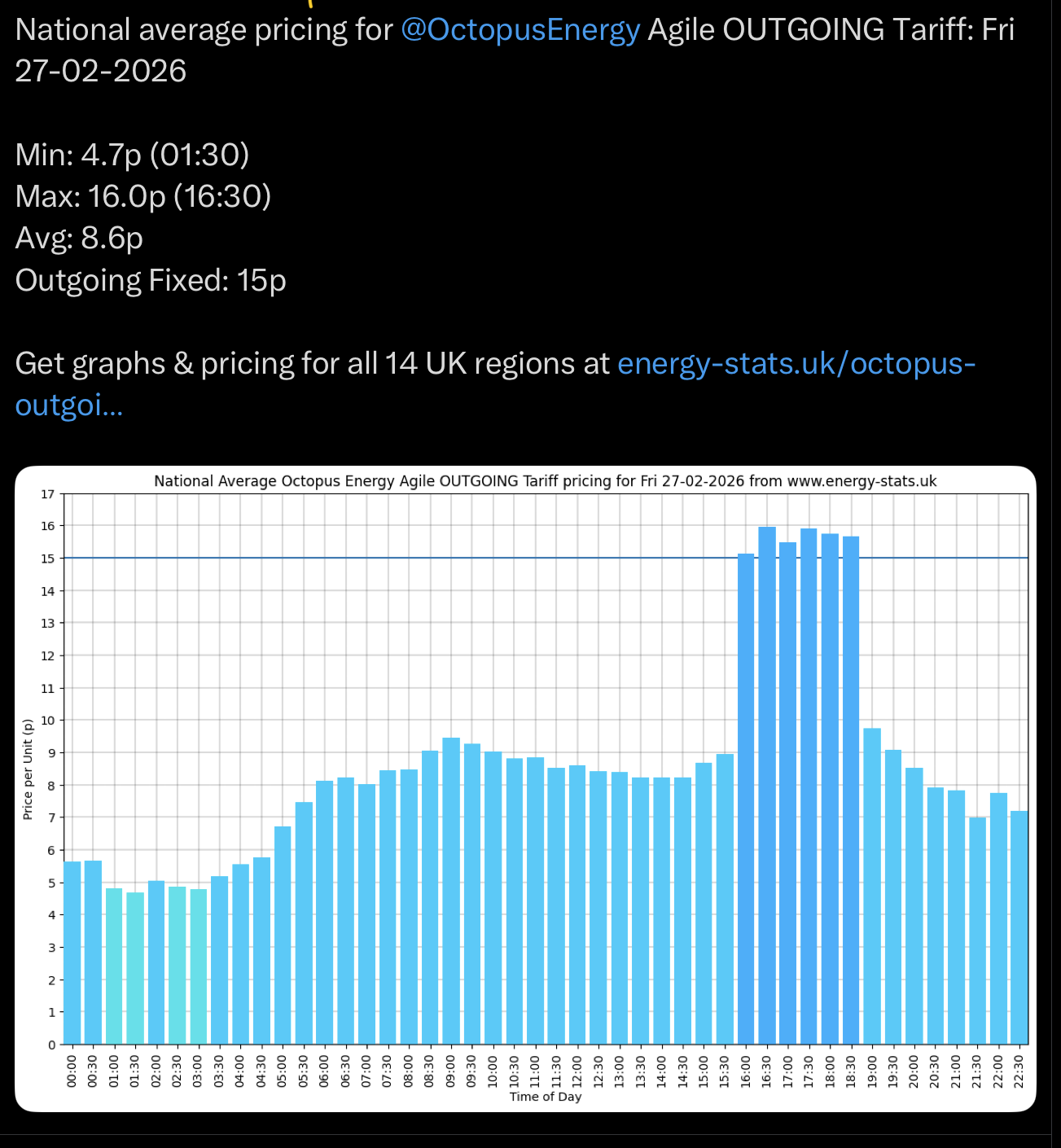
Post by Mick Wall on Twitter earlier tonight, shows very clearly why 15p rate wasn’t sustainable and I suspect 12p will be under pressure as well, probably a further reduction after the summer
The new export rates have appeared on my Predbat plan ☹️
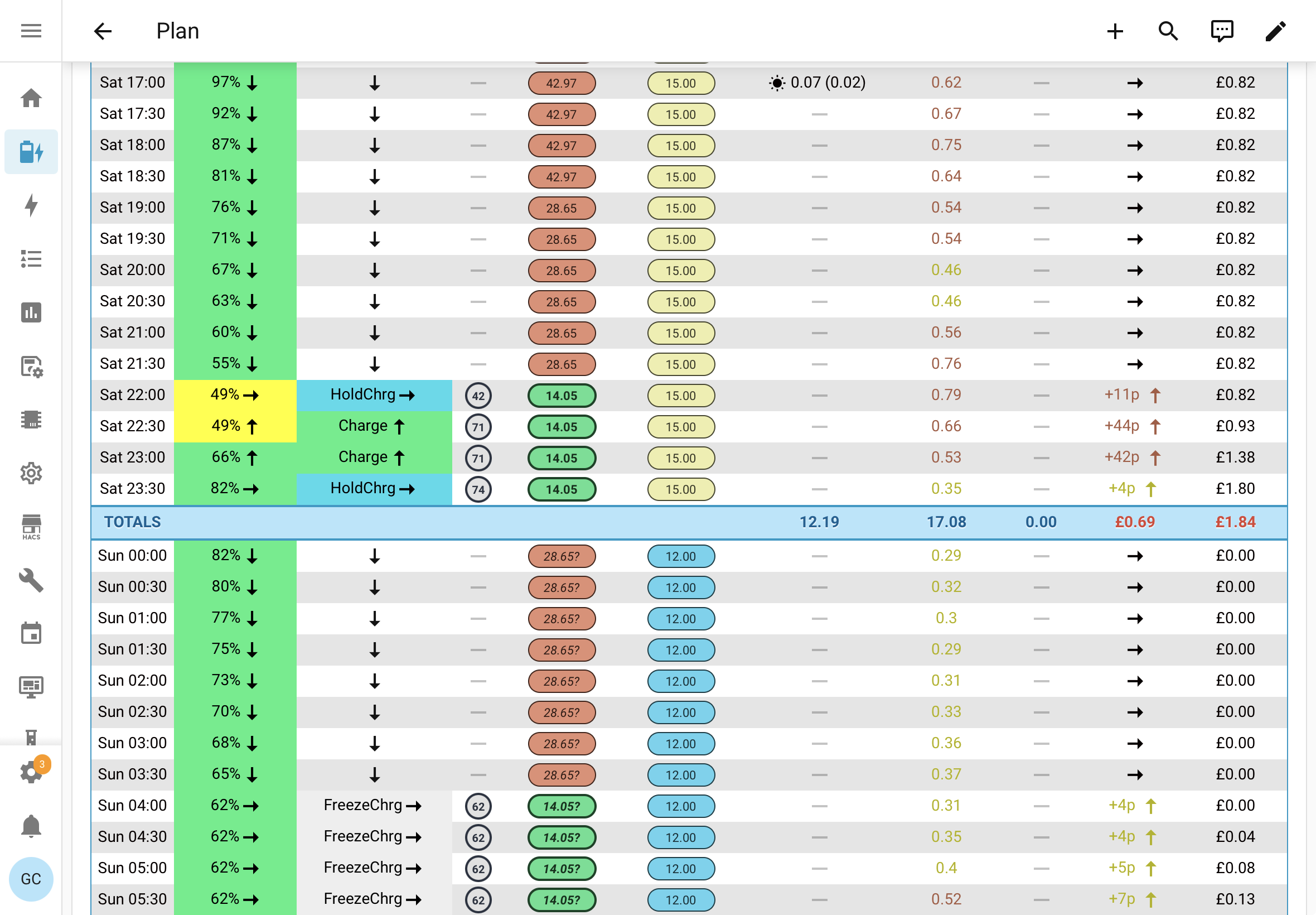
geoffreycoan at this rate I can't see how my system can pay for itself with the ROI being about 14 years. How much is the energy price cap from the 1st April per kWh?
The latest video with Greg the owner saying in 2021 they put leveys on the standing charge to cover costs, err, so the standing charge is how they are paying for everyone to charge their cars.
Marren2016 Ofgem price caps are on their website https://www.ofgem.gov.uk/information-consumers/energy-advice-households/get-energy-price-cap-standing-charges-and-unit-rates-region
Unit rates down by about 3p/kWh but standing charges generally up a bit, so depends how much you import and export as to what the saving will be. Both the price cap rates and standing charge maximums are set by Ofgem, based on complex formulae that us mere mortals can’t understand. It’s really a government policy decision as Greg said as to which costs are covered in general taxation, which are in the unit rate and which are in the standing charge.
Also most of the environmental levy costs have (in the past) been loaded onto the electricity rate, not onto gas rates, which seems the wrong strategy if you’re trying to persuade people to electrify and move away from fossil fuels.
As for EV charging, yes it does seem wrong to me that suppliers can offer overnight EV tariffs at 7p/kWh when the overnight Agile rate rarely gets down to that level. I know some of it is balanced out by the higher daily rates, but it strikes me that there is some form of internal subsidy going on with EV rates. As I said it’s not down to the standing charge per-se as the cap is set by Ofgem.
I’ll have to wait to see what changes occur to my current Cosy tariff to see how much the export tariff reduces my payback. Currently sitting at about 7 year payback.
geoffreycoan last year's numbers reported that we are importing the same as exporting in KWH. So with standing charges and gas our bill was £670 which is half what it would be without the system. The system cost 10k. So with the export dropping 20% that's gonna add more time to the ROI and if the inverter or panels fail it'll never repay the ROI.
I planned to get 4kw array installed but just before they installed it the government changed the regs which meant I was forced into having it downsized to 3kw. I feel like a fool for falling for the marketing and promotion.
geoffreycoan https://www.youtube.com/watch?v=AXgVGw5wWc0 attempts to justify EV charging rate, though I am a bit dubious. Standard Octopus Go is still pretty cheap, but doesn't offer them the same level of control.
DD Yeah that video is a load of self-serving bollox.
geoffreycoan oh yeah, there they are, mine too
I forgot it was 1st March rather than 1st April.
Vestas I have watched one or two of Nicholas Raimos’ videos, and thought that the waffle to content ratio was quite high. Just skim read the transcript for the above EV tariff video and I get that the mechanisms he describes all exist, but I’m dubious about how much they can be consistently applied night after night at volume to get sufficient electricity to sell to customers at 7p. Not every night is windy, not every night there is factories unexpectedly not operating.
@Marren2016 I’m not sure what more I can add to your concerns about solar/battery ROI other than to say trying to justify the system in pure pounds and pence you will save isn’t always easy. Solar panels are in my view the best investment for your money, but if you were curtailed in what you could install then that doesn’t help. Some battery storage is good, especially if you are on a time of use tariff where you get cheaper electricity overnight in return for more expensive electricity in peak periods, and your battery will last you through the peak period so you reduce your overall unit rate, but adding more battery storage gives diminishing returns. I’ve looked at adding more storage myself and come up with payback periods of between 5 to 22 years depending on the assumptions made.
And those assumptions about tariffs are not things that are in our control. Import rates will generally go up over time, and unfortunately export rates down as supply of solar slowly increases, and as you say potentially there will be repairs or replacements required in the future, but other than the direction of travel for these things, everything else is a guess.
Earlier I had a look back at my first export payments. Started off at 4.1p on SEG, then 32p (peak) and 19p (daytime) when I joined Octopus Flux in August 2023. Be lovely to be able to get those kind of rates again.
It might be worth you looking at Octopus Intelligent Flux for the summer, that pays a better import/export rate than any other tariff. Not so good for the winter, but great when you are generating.
Marren2016 falling for the marketing and promotion.
If someone lies to you in order to make you buy a product, that is mis-selling.
https://www.bbc.co.uk/news/uk-england-49566130
Rubikcube nobody knew what the energy prices would be. One of my customers was getting paid the same amount for export and import, it seemed to be a no brainer.
When the solar crew turned up it was only then I found out they couldn't fit 10 panels on my roof, they were about pull off the job entirely. So I said ok to 3kw (8 panels).
geoffreycoan Spot on - its nonsense. Everyone on Octopus with an EV tariff is being subsidised by ALL the other tariffs.
Anyone trying to state otherwise is either very stupid or lying.
Just curious about this. Maybe I’ve missed something.
If Octopus can buy extra overnight electricity they wouldn’t normally buy at 2 or 3p (or less, free or they get paid to take it). And then they sell it to customers for 7p. How are ALL the other tariffs subsidising them exactly?
Pete UK standing charge?
Pete UK Were that the case then Agile would reflect the wholesale price paid. It doesn't. End of story.
By that logic the reverse applies also….
(IOG and fixed export example only below);
Every time the Agile export rate goes over 12p,
or every time the Agile import rate goes below 7p;
Everyone on Octopus Agile tariff is being subsidised by ALL the other tariffs?
I mean all the tariffs that aren’t the SVR at some time could be seen as “subsidising” another tariff anyway.
There are always individual winners and losers. But en mass I bet Octopus has worked out the numbers to be fairly even.
What about when people on an EV tariff are paying peak rate? Which could be well above the Agile rate?
Not everyone on an EV tariff is 100% off peak usage. They might only be 30% or 50% off peak usage.
I bet there are a lot of EV customers that don’t even have any solar. Probably way more don’t than do. So then the “subsidising” logic breaks down.
Also an EV tariff such as IOG is unique in the way that Octopus can and will only use THE VERY cheapest overall cost, to charge all the EV’s. This isn’t always 100% convenient to the customer but it’s a compromise to get a benefit.
Overall I’m fairly certain Octopus have this all mapped out and make adjustments where required.
I guess your point is that the agile rate isn’t going as low/ high as you expect compared to wholesale prices? Is that it?
Pete UK My point is that Octopus are either lying about how they calculate Agile or their EV tariffs. Thay can't have it both ways.
When you sign up to a 12 month fixed rate tariff they buy all the energy in advance. Why don't they do this for agile? If they did I would not be paying 27ppkh as I am at the moment.
Marren2016 because that’s the swings and roundabouts with Agile, you gain when its windy and sunny with low rates, and unfortunately pay with high rates when its cold, calm, or someone decides to invade another country
If Octopus pre-paid then I guess the tariff would be no different than any other fixed price tariff, with a largely flat rate all the time
I had 18 months of Agile, all the way through Winter 23/24 and even though there were some expensive periods, it was overall quite good. Winter 24/25 was OK for October and November but became quite expensive in December 24 and January 25, so I eventually bailed and went to Cosy. I’ve stuck with Cosy this winter, fortunately on a 12 month fix from September, I see the current Cosy fixed rates are 2p/4p/6p more expensive in the Cosy/day/peak periods, so glad I did fix
geoffreycoan Something about Agile changed in April/May 2024 - rates all started getting smoothed out, not so many (none now) 30 minutes low rate here and there as you'd expect. Didn't really correlate with wholesale prices as well as before.
Not much choice other than Agile frankly for PV/battery users (if you're honest).