
Effect of temperature on PV panel output.

23 comments started 2022-07-19 last 2024-03-22
Cloud Portal
#1 Woodstock

I installed my solar PV in 2009 and have kept stats ever since. These show electricity output varying throughout the year, with more being produced in the summer and less in the winter. No surprises there. Since adding a battery last year and having portal data to peruse it has revealed how much less efficient the solar panels are in the summer.

My 3.52kWp array peaks at 3.63kW on a good day and has shown no discernible loss of output over its 13 years of operation. The portal data for yesterday (very hot!) shows a perfect bell curve (no clipping) of solar PV production but a peak output of only 2.61kW or about 72% of the expected maximum. Inverter temperature could explain a small part of this but the fan cooled Sunny Boy 3300 did not go outside its normal operating range and so the finger is pointing at solar panel temperature being the cause. It is well known that solar panels are less efficient when they get hot but I did not appreciate how much! Guess my stats have always shown a healthy increase in PV output over the summer months, which masked the drop in panel efficiency.

Experience of my solar PV is that record weeks of electricity production occur in April rather than, as might be expected, in June. I had put this down to the angle of the roof best matching the height of the sun in that month but could never explain why there were no corresponding peaks in August. I am now guessing that April is when incident sunlight versus PV panel temperature is optimal for generation.


W
#2 wilfleek

My personal records indicate a 24% reduction in solar output when temperatures soar. And yes, it is all down to the panels conversion efficiency dropping with temperature. Peak output month for us this year so far was May,

M
#3 mrand31

I'd been pondering the temperature of the panels on my workshop roof yesterday and today. I'd almost convinced myself to put the lawn sprinkler up there to give them a gentle spray of water.

Then I thought the bloody things'd probably crack due to thermal shock!

2.9kW peak today, 4kW peak two weeks ago when temperatures were cooler, albeit with intermittent clouds and no haze.

L
#4 locked

Over the 11 years we have had panels the peak output is better on cooler days. On a clear day in the spring when the temp is cool the daily output is similar to a hot day in the summer when temp is much higher and day much longer. Over the recent hot spell the overall daily output is down on good spring days.

D
#5 David43

Our panels have just been fitted and the scafold is still in place so I was able to measure the temperature of the glass on the panels which is currently 55C.

The spec of our panels seems to be .35% power reduction for every degree above 25C so that would be 10.5%.
We are seeing a peak of 290W from 360W panels which is more like 20% drop.

M
#7 mrand31

I wonder if the inverters need a slightly different voltage/curren algorithm as the solar panel's temperature changes. Or do they iterate to find the best operating point?

C
#8 CARLMW

From what I have read, the panels are output rated at 20 degrees C so cooler than this equals over performance, hotter means less. Shame really as if we were quoted for the array at 50 degrees C then they would "over-perform" nearly all the time 😆

This is also why the panels are over specified compared to the inverters. My 6kW panels with 5kW inverter does not clip on hot days for example. I suppose the bonus is that my power output curve is a lot flatter over the year as peak efficiency declines. Depending on your point of view, this means BETTER performance in March / April or Sept / Oct than expected or worse or WORSE performance during the peak summer months. Personally I like to think that they will perform better than expected in the spring / autumn!

#9 Tenkaykev

CARLMW
Thread resurrection!!
Had my system fitted in November so it's all a bit of a novelty 😁. I have an old iPad sitting on the sideboard with the excellent " Inverter " app running constantly as a monitoring device. Today is the first time I have seen theoretical peak, I have 13 x 410w Qcell panels and saw a reported 5360watts. It's about 15 degrees ambient. ☀️

#10 nophead

I think the air is often clearer on a cold bright day compared to a hot one where you can get some haziness in the atmosphere.

V
#11 Vestas

nophead No its just the panel temperature. The lower the temperature, the higher the voltage.

Roof tiles get very hot in summer and that doesn't help the ambient temperature around the panels. I think in-roof panels get hotter because there's no great amount of airflow under them in summer. ActualIy I might test that as there's power in the loft and I'm pretty sure I have a suitable EC fan....

We get about 80% of max rated output from the PV arrays in July/August but we're getting more like 90% around this time of year. Cold April/May morning and it'll hit 100%.

#12 Tenkaykev

Vestas
That's interesting. There's a house nearby that has just had an in roof system installed. It does look quite smart but I wondered about the practicalities of heat dissipation and drainage. With " conventional " installs you have an airflow both over and under the panels which must be an efficient way of cooling. With flush panels the bottoms of the panels are not exposed to airflow ( as far as I can tell ). I know some of the latest panels are rated to work at 85c, but as you say, the efficiency must be affected.Out of interest, do any of the panels have temperature monitoring, and if so is it available to the end user?

V
#13 Vestas

Tenkaykev These ones are mounted on top of modern roof membrane - ie breathable membrane - so it's not like its on top of old-style roofing felt 🙂

Drainage - basically the panels have frames which have flashings/seals/gutter kits and it all gets slotted/clipped together. Tiles above drain onto the head flashing which drains down the gutters between panels/side gutters. Bottom panels drain onto flashing then tiles. It's not really any different to an in-roof tilting window.

I'll have to remember about the fan idea - would be interesting as any change would be seen quite quickly via GivTCP/HA.

N
#14 Niceguy

I had my panels installed in September so I wait to see how they will perform in summer. But I was careful to insist on pigeon proofing that was an open wire mesh, which should allow some air-flow. I've seem some smart-looking installations with bevelled metal around the panel edges, which do look nice but can't allow much cooling.

I'm hoping that there'll generally be a bit of a breeze at the height of the panels and this will facilitate cooling.

I guess in time they'll invent a system with coolant tubes at the back of the panels. In winter a heat pump could make use of the heat source, and for hot water in summer, and in summer the heat could be dumped, possibly with some sort of passive radiator like the back of a fridge, only much larger.

K
#15 kram

Vestas

I’ve liquid cooled things for years and honestly it’s such a shame the combined panels are not a thing. It would be trivial to build a cooler which uses the coolant to preheat the flow into a hot water tank or indeed as a heat source.

Doing it as a custom system would not return on investment, but I am tempted to look at viability of such a system on a larger scale.

#16 Cdent

Niceguy it's odd they haven't got panels that can double as solar water heaters and feed into a hot water tank which would give you free* hot water and cool the panels

V
#17 Vestas

kram Its been done.

Bottom line is that all these systems require liquid pumped to your roof which will incur regular maintenance in UK weather - anti-freeze, anti-fungals, seal replacement, etc etc - and that will usually require work on the roof with associated scaffolding costs.

Same reason solar water heating tubes are rare as hens teeth in the UK these days...

N
#18 Niceguy

Vestas I agree with you, Vestas, that there are significant barriers to overcome.

But I expect over the long term as the Climate Emergency worsens and gas boilers are phased out the need for improved efficiency will become more pressing. At the moment there are still a lot of easy opportunities for comparatively cheap improvements such as large roofs not yet covered with solar. But when the low hanging fruit has been picked we'll need to look at more complicated and expensive options. So many options, such as home batteries, were out of reach only a decade or two ago, and are now well on their way to becoming mainstream.

Rosie Barnes of Engineering with Rosie fame did a youtube clip on a company in Western Australia researching an air-cooling system for solar panels, with the possibility of recovering the heat. It's main selling point was significantly reducing the performance loss from overheating solar panels.

So I'm hopeful that one day I can stick a system on my large south facing wall but I'm not holding my breath.

K
#19 kram

Vestas

You don’t need to use liquid pumped to the roof, you can have a closed loop which includes all this stuff or potentially use oils and only needs changing every 5-10 years.

I would never consider it for on roof, but in roof you could. Could also use f-gas to move heat.

I have a friend with in roof and some spare piping/connectors/coolants etc. I might ask them if they’d consider letting me cool one or two panels and see if it makes a sizeable difference.

Z
#20 Zakalwe

As with everything, you have to balance increased cost, complexity, maintenance against real world gains.

My 5.2kWp array is integrated into the roof. On the very hottest days I might lose 5-10% due to panel heating. In the grand scheme of things that is, to use a technical term, bugger all. Whatever nominal gains you would get would be far outweighed by the increased costs in purchasing the panels, installing them and then having to maintain them.
We don't have enough good solar installers at present. Imagine if we expected them to install a complicated plumbing system at the same time!

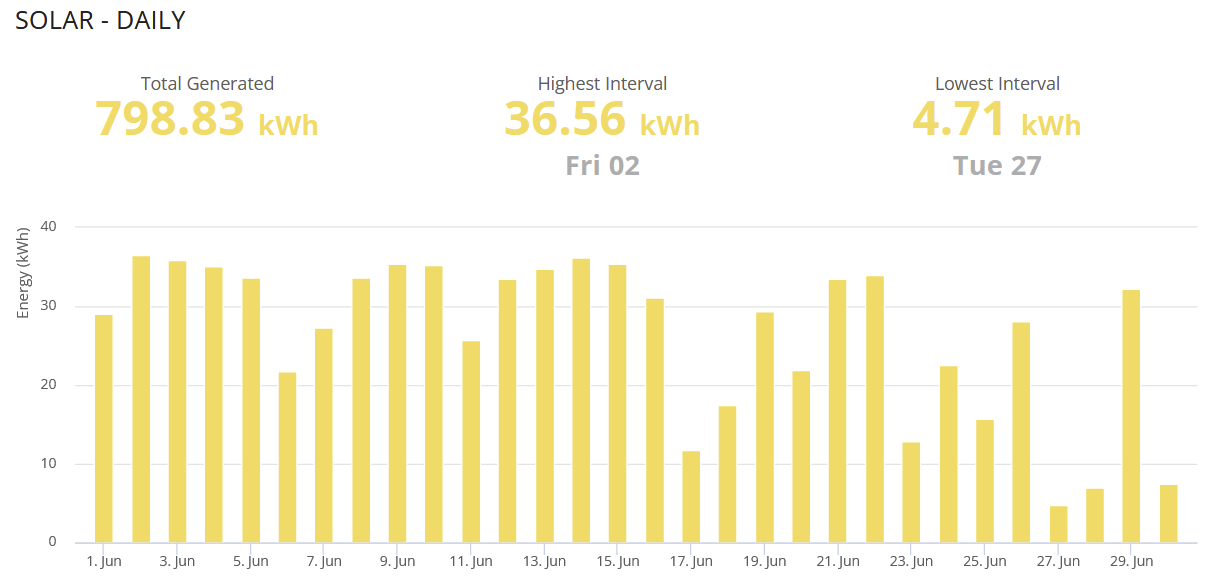
Even if we did co down this route, actually measuring any gains would be hard. Here's my output for June 2023, the hottest June on record. I produced more than the previous year...

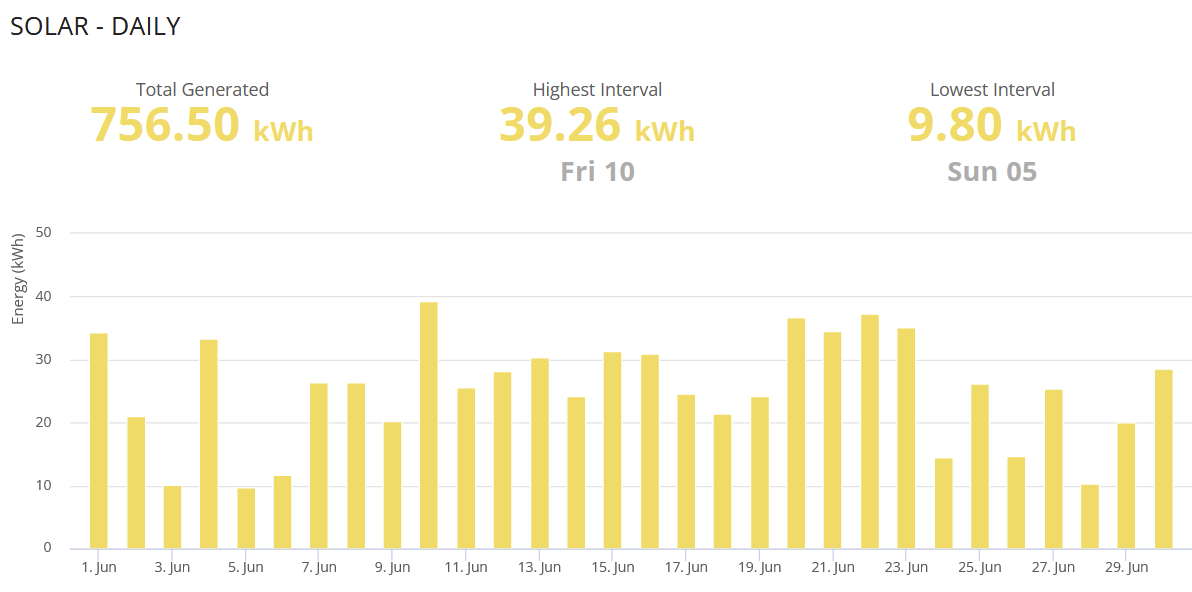
And here's June 2022:

We need to simplify installations in order to make them cheaper and more affordable, not complicate them and put them out of the reach of even more folks. Doing so plays straight into the hands of the fossil-fuel industry and their vocal mouth-pieces.

#21 nophead

There is probably 5% to be had by making the inverter electronics more efficient. The standby consumption of 40W is crazy and the conversion efficiency of less than 90% is poor for a modern converter.

V
#22 Vestas

All I said was I was going to try pointing a fan at the back of the PV panels to see if it made any difference 😃

K
#23 kram

Yeah it’s me who’s considering DLCing a panel to play..