Maximise battery longevity

24 comments started 2026-05-14 last 2026-05-21
GivEnergy ProductsBattery
M
#1 madbilly

Hi all,

As there's now no warranty support I thought it might be a good idea for me to try and maximise the life of the battery by treating it more gently. Are there any known "eco" settings (I don't mean eco mode) for the Givenergy batteries? Or is it just the usual wisdom of keep the charge level between 20-80% and charge/discharge as low as possible?

Cheers 🙂

R
#2 Rubikcube

For the AIO and AIO2 I have no idea what would be best. For older systems, batteries need to spend time at 100% to remain in good health. Everything depends on the firmware algorithms.

D
#3 DD

madbilly I think 20-80 was the recommendation for NMC chemistry used in cars. LFP is possibly more tolerant, and needs to visit the extremes to allow the BMS to track SoC.

#4 hoggy

The AIO already runs about 85% DOD internally (you get 13.5kWh but in reality inside the box is nearer to 16kWh in cell capacity) so I'd really not worry. As others have said the need for it to visit both ends of the SOC range regularly I'd just let it do it's thing.

There may be some merit in winding back it's charge rate overnight (using the AC only power sliders) such that if you have a 6 hour cheap night rate it's probably better for the inverter not to ram in the full charge in the first two hours and then sit there. So perhaps set those to 3kW or something? Just means your not thrashing the inverter charger at max every night.

M
#5 madbilly

Hi all,

Very helpful replies thanks. I suggested 20-80 because that's what it suggested for the electric cars I have and have had, so I presume they've been NMC. I had not realised that LFP needs to go to min and max regularly for the BMS to properly know the SoC, that's interesting. I had set the max AC charge upper limit to 80%, but based on your answers I've reset it to 100%. I've also reduced the charge rate to 5.4kW which will fill the batteries from empty to full in the 5 hours cheap rate we have.

I doubt I'll discharge to empty any time over the summer through normal operation, that probably won't happen until November at the soonest. How often does the battery need to go to minimum? I presume this is all part of the regular calibration.

Cheers 🙂

D
#6 DD

madbilly I had not realised that LFP needs to go to min and max regularly for the BMS to properly know the SoC, that's interesting.

It's because the voltage curve is very flat - it stays at around 3.25V for most of the charge range, so the BMS cannot infer SoC from voltage alone. Perhaps it tracks energy in/out and tries to infer it that way, but getting to the extremes allows it to reset that estimate.

https://www.embeddedone.com/blog/comparison-of-nmc-and-lfp-cell-technology

G
#7 geoffreycoan

madbilly The bit I think you are missing is that the SoC range you are presented with 4-100% is not the actual battery SoC range. There is reserved SoC that you can’t access and the battery actually operates in the 20-80% range, its just presented differently to you.

Ideally you should empty the battery fully once a week, once a month or so in order for the battery management to keep track of the SoC reliably.

M
#8 mikes01666

I run my AIO at full charge rate to date.
As an experiment I've knocked down the charge rate to 80% and extended the charge time during the 23.30 - 05.30 slot.
I'm guessing that this is a global setting so that when the PVs are pushing out 4 kW during the day the battery will only accept the 80% setting with the rest being exported?
If yes, I think I'll return it to 100% as it's swings and roundabouts.
Does it really extend battery life or is it a myth? Surely the software will look after the battery?

D
#9 DD

mikes01666 on my hybrid there are two different charging power settings: one affects ac-charging only and I leave that at 60%, which gets me to 100% overnight. The other seems to be an overall limit, affecting both PV and AC charging. I leave that on max.

But not sure if AIO has that - if it's ac-coupled, does it distinguish PV from AC?

M
#10 mikes01666

No idea. I'm a bit reluctant to start messing with settings as the system is working as expected.
I'll leave the charge rate at 80% for a few days as there's not much sun today. I'll check on the next sunny day.
Is there a 'Backup settings' facility so it's possible to restore a working configuration as playing with settings will inevitably mess things up!

G
#11 geoffreycoan

mikes01666 no, there’s no backup settings type of feature on the portal or app

Only option is a reset to defaults and then set everything up manually again

On your AIO since it’s AC coupled there is no equivalent of DC and AC charge rates as you get on a hybrid inverter.

During the day I don’t think you’d see much practical limitation of leaving your AIO set to 80% charge rate. The inverter can charge at 6kWh, if you set it to 80% that’s roughly 5kWh so you’d fill the 13.5 battery from solar in 2 and a half hours rather than 2 and a bit. Same overnight. You could easily drop it to half charge rate for minimal practical impact.

Does it help the batteries to do this? Hard to prove either way, but from a physics perspective, running a full rate charge, generating a load of heat and then stopping dead seems more stressful on the chemistry of the battery than a slower rate charge where there’s less heat and chemical activity going on with the slower charge.

Will it practically extend the life of the battery? Very hard to say but you’re not loosing much by doing this.

I set my inverters to a slow rate charge during the day so rather than filling up quickly in the morning and then exporting everything which pushes up grid voltage, I set the inverters to not charge in the early morning, then charge at a slower rate through the day. I get to the same position, the battery full by mid afternoon, I export the same, but over a longer period


A
#12 adskankster

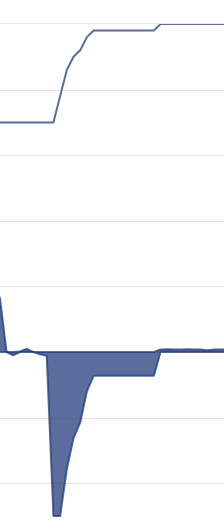
My AIO2 charges at full rate until somewhere above 80% then it drops the rate gradually for the run up to 100% The graph looks flat at 99%, until it crosses the rounding threshold and steps up to 100%.
See this screenshot, showing battery charge and percentage:

M
#13 madbilly

Yes my AIO2 charge rate slows down as it approaches 100%.

P
#14 pwdst

I can think of two reasons not yet mentioned to reduce the charge rate.

  1. Lower inverter losses at lower charge rates (largely to heat)
  2. In the winter a battery in unheated space will stay warm for longer, rather than getting hot and then cooling. In the summer slower charging could reduce peak battery temperatures. Both should be positive for cell health and might avoid BMS rate interventions.
D
#15 DD

Rubikcube For older systems, batteries need to spend time at 100% to remain in good health.

I thought I'd read on here that balancing happens when all cells are above 3.4V. From what I can tell on my system (gen-3 hybrid with 9.5kWh battery), as soon as it reports as 100%, it goes idle and the cells drop to below that.

I've modified my scripts to hold at 100% for a time, so see if I can see any effect.

R
#16 Rubikcube

DD when all cells are above 3.4V.

When ANY cell is above 3.4V. If a cell is above 3.4V, the BMS fixes it by burning off some energy from that cell as heat.

D
#18 DreadorUK

If you restrict a battery to 60% of its capacity (from 20% to 80%) to stretch its physical life you are actively paying the grid for that missing 36% capacity every single day, thus losing money now.

Not sure if your on AIO but the loss of 5 kWh is £400 a year, in paying for the grid as such to pick up the extra, thats in effect what your paying for a self imposed warranty, and don't forget the GIV warranty was questionable on if they would refund in full or partial based on age so the older the system the lower value your protecting as such.

The other thing is I doubt a LFP battery even after 15 years of daily full use would lose upto 36% capacity, its more 15-20% but your applying that limit today, my view is that if the battery does fail it wont be due to how you ran it aka chemical failure, it will be down to component failure to which isnt triggered by usage pattern.

W
#19 wrighar

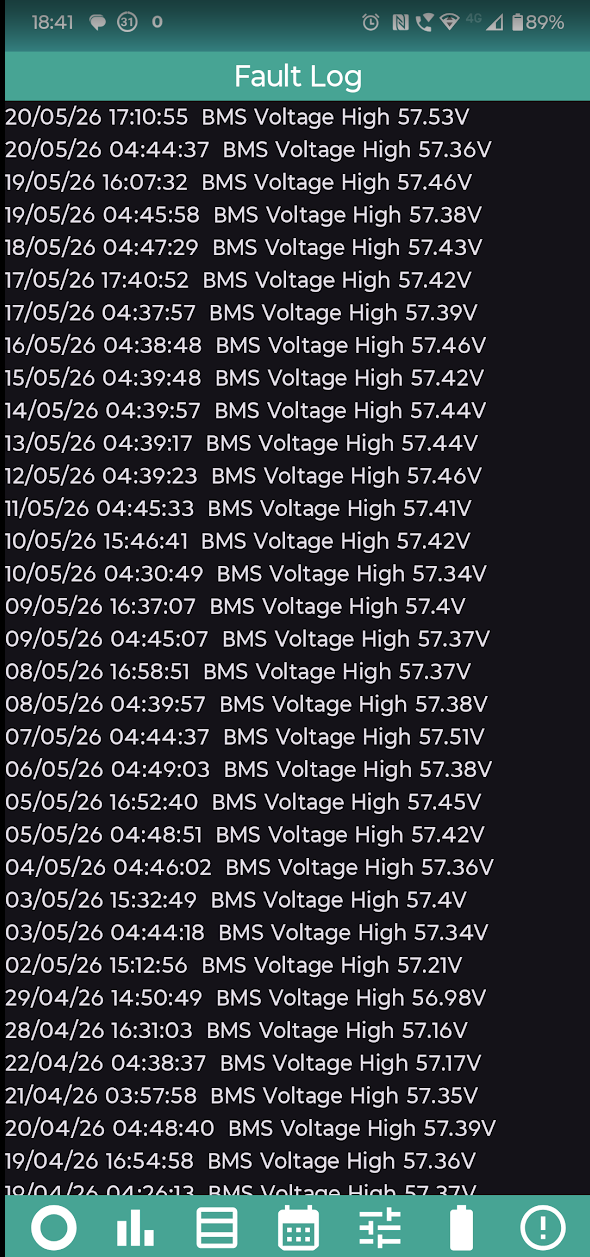
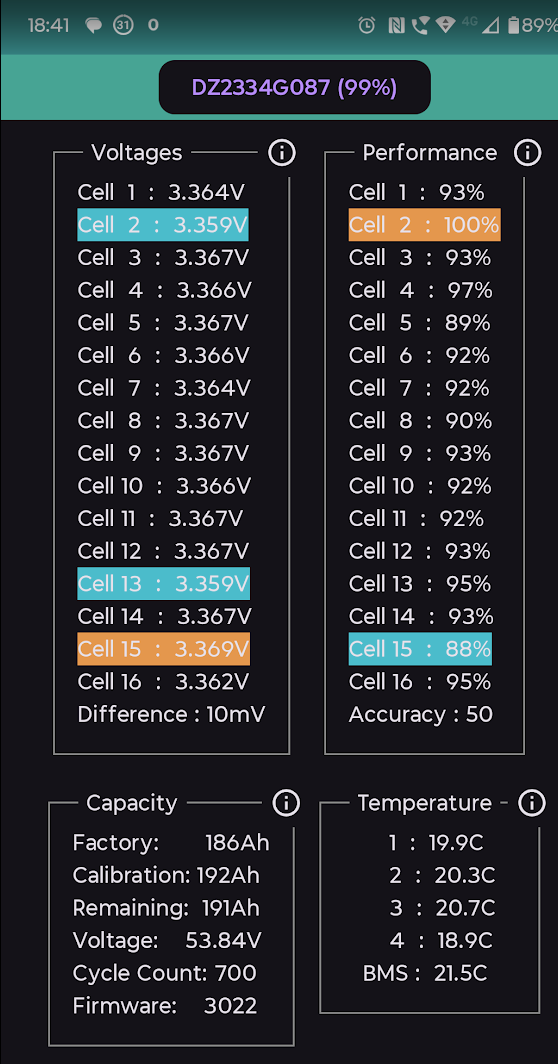
Hmm, I'm on BMS3022 and mine charges to 57.4V every night and afternoon.. (3.58V/3.59V per cell)
I'm assuming self calibrating...

And drops to about 3.366V per cell.


V
#20 Vestas

wrighar Hmm, I'm on BMS3022 and mine charges to 57.4V every night and afternoon.. (3.58V/3.59V per cell)
I'm assuming self calibrating...

I doubt it.

I'd run another full calibration were I you as it looks like actual overvoltage warnings. 3.45V/cell is pretty much "100% SoC" which is shown on the inverter. It'll be 97% on the BMS SoC.

Looks like you're charging to the "Battery Capacity" which is above the "100% SoC" the inverter records.

I've had this happen twice over the years and IME it indicated that the "Battery Capacity" figure shown in GivTCP was wrong - specifically it was too high due to battery wear. A calibration returned the battery voltage behaviour to normal but reduced capacity.

YMMV.

V
#21 Vestas

DreadorUK The other thing is I doubt a LFP battery even after 15 years of daily full use would lose upto 36% capacity, its more 15-20% but your applying that limit today, my view is that if the battery does fail it wont be due to how you ran it aka chemical failure, it will be down to component failure to which isnt triggered by usage pattern.

The cells used in GE LV batteries aren't safe (snip from cell datasheet below*) to operate below 70% of the original capacity - or 150% increase in cell resistance which is pretty much the same thing. In theory they should be disabled at that point but who knows whether that was implemented or not.

15 years of daily "full use" is 5,475 cycles. Some absolutely will be failing (going below 70% original capacity) by that time as few of them are going to be in the sweet spot for temperature all the time. For example anyone with a battery in a loftspace can expect a reduction of anything up to 60% of lifespan due to temperature. 5000 cycles @ 25C, 3500 cycles at 35C and 2000 cycles at 45C according to their tests for >80% capacity. Same will happen but worse for charging in the cold, which they didn't test. Also the charge/discharge rate has an effect, as does whether the charge is constant or pulsed (think solar with clouds).

As always YMMV.

*The battery life is limited. Customers should establish an effective tracking system to monitor and record the internal
resistance and capacity of each battery during its life. The measurement method and calculation method of internal
resistance and capacity need to be discussed and agreed between the customer and EVE Power Co., Ltd. When the internal
resistance of the battery in use exceeds 150% of the initial internal resistance of the battery or the capacity is less than 70%
of the nominal capacity, the battery should not to operate. Violation of this requirement will exempt EVE Power Co., Ltd.
from its responsibility for product quality assurance in accordance with the product sales agreement and this specification.

W
#22 wrighar

Vestas

It did 2 battery calibrations in April 2026,
1 was a half failed one as the BMS was so out of sync when a new inverter was installed which came to 108Ah so I did a 2nd forced one at 2500W charge limit rate which came out at 192.8Ah

This was down from the 200Ah of the old inverter/battery combo.

I get no messages in the portal, just the inverter app.

V
#23 Vestas

wrighar I get no messages in the portal

You won't. GE hid those from end-users years ago.

M
#24 M_J

Get the Android inverter app to see the hidden messages...

Also can be used to control locally.