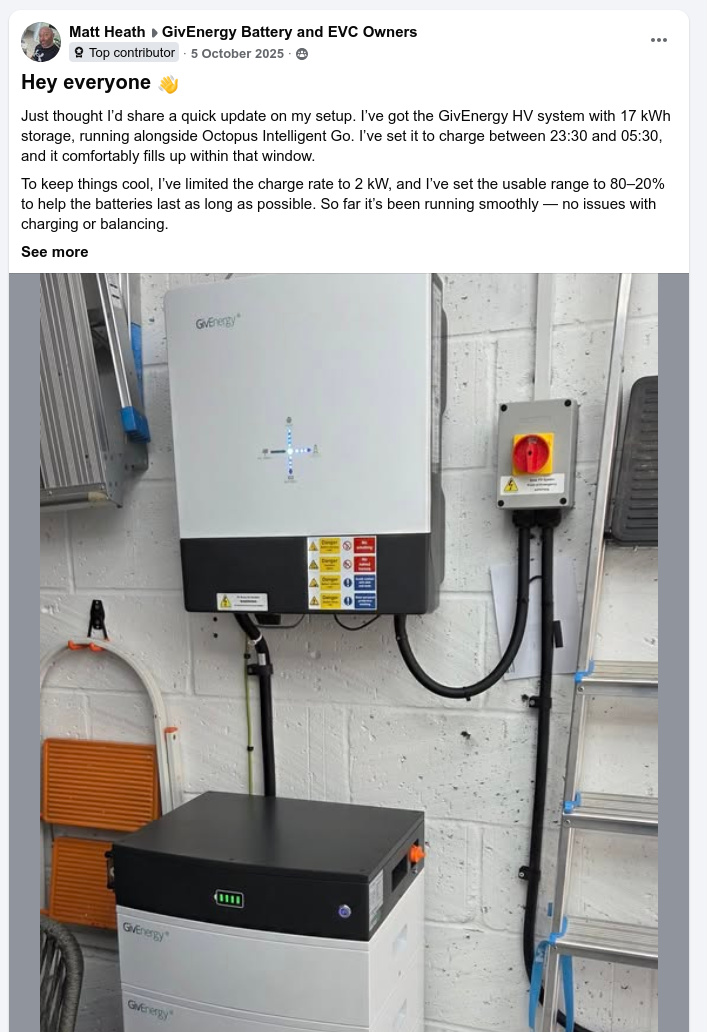
October 25 system installed and confirmed working well. Install seems reasonable quality, but note owners intention not to charge to 100%.
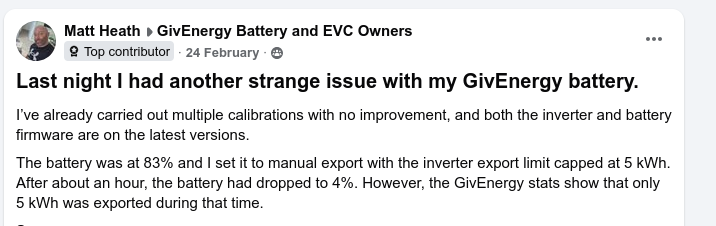
By February 26 the battery was in serious trouble having lost most of it's capacity.
In April 26 the battery red-lighted and failed.
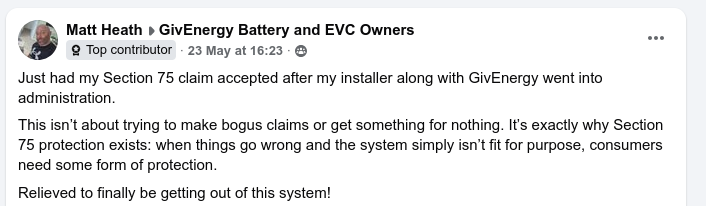
In May he claimed the full money back under section 75.
Further detail on Facebook for those who have access.
My opinion is that his decision to not charge the battery to 100% is a significant factor in the early failure of the battery. Cell balancing can only occur when the battery is at 100%.
His decision to only go down to 20% is irrelevant because the battery kept dropping itself (to 0%) and he couldn't stop that happening.
D
#2DavidHitchcock
So in order to keep our batteries going for as long as possible how long should they spend at 100%?
R
#3Rubikcube
DavidHitchcock Nobody knows. I would suggest 10% of the time (i.e. average 3 hours per day) and I'm pretty certain that will be enough. Maybe just 15 minutes a day would be sufficient, cannot be sure.
If left to themselves, solar batteries normally spend a lot of time charged, especially in summer.
T
#4TX200
I charge my battery up to 100% every night. I want to use my investment. 😁
V
#5Vestas
I don't know what precisely has happened but its not to do with keeping the battery at 100%.*
Its almost trivial to screw up the SoC on GE kit - I can get ours 28% out within 3 days in summer - and if you start a calibration when the SoC is that far out then IME you end up with a battery which will either discharge too much or charge too much. I saw voltage excursions as low as 45V on BMS v3013 and as high as 57V due to the production f/w on G1 inverters on BMS v3015 (fixed by 191/193 fw) and the battery is still here.
All you can do with GE BMS is cycle the battery regulary - run it flat and charge it full. That keeps the SoC reasonably accurate. Also the manufacturers test the lifespan by going from the true full charge to the true full discharge (2.5-3.65V on 3.3V cells).
*there are aging studies which show that LiFePo batteries don't age in the same way as lithium-ion batteries so keeping them in the 40-60% range for prolonged periods may impact lifespan.
B
#6BobB
This is really interesting. Thanks Rubikcube. Without automation, in summer those of us with largish batteries probably have two choices: Charge to 100% and accept the battery will probably never go below a reasonably high SOC (in my case, about 50%) or charge to "not 100% " and exercise the midrange (say the universally accepted EV battery range of 80% to 20%). My understanding used to be that cell balancing was tweaked in BMS 3017 and upwards. I can't find the update notes, but my recollection was that GE did some work on balancing at the low end. This could imply that it's equally important for the battery to see < 20%.
It's such a weird requirement. It follows that for those folk like my neighbour, who are not on a dual tariff and leave their system in eco with no charge at night, winter will cripple their batteries. I'm surprised GE didn't have many more warranty claims.
B
#7BobB
Vestas *there are aging studies which show that LiFePo batteries don't age in the same way as lithium-ion batteries so keeping them in the 40-60% range for prolonged periods may impact lifespan.
You don't have a link to this, do you, Vestas?
V
#8Vestas
BobB You should let it discharge completely from time to time.
That means until it cuts out at 4%. Then leave it for 3-4 hours and it may find another 5-8% SoC due to cellebalancing as the battery is idle. Let that discharge until it cust out again.
You're now at the real 4% 🙂
R
#9Rubikcube
Vestas *there are aging studies which show that LiFePo batteries don't age in the same way as lithium-ion batteries so keeping them in the 40-60% range for prolonged periods may impact lifespan.
The studies were not done on batteries running GE firmware. This is a specific issue with the way GE firmware uses the Lapis BMS chip.
It may not apply to other brands of solar battery, and certainly does not apply to batteries in general, such as EVs, power tools, robot cleaners, toys(!), phones, etc.
V
#10Vestas
BobB If you want to hunt through my posts here then there's a paper linked.
V
#11Vestas
Rubikcube It clearly doesn't apply to the vast majority of GE batteries in the field.
Colour me sceptical about this given it killed a system in 6 months (April failure - maybe late April?) and involves a S75 claim after GE go bust.
But this appears to say running at low SOC is good.
Aaaargh! the more I read and understand about these system the less they feel like "fit and forget" white goods.
Interestingly, on my system, BMS version 3018 was good at tracking the top of the SOC but always used to forget where the lower SOC limit was. Version 3020 is much better at tracking the bottom, but seems to forget where the top is! I prefer this and haven't dared/bothered to update to 3022.
I'm fully automated up. Maybe I'll just create a summer automation that hits 100% and 4% a couple of times per week.
LFP cells have an impressive lifespan but start to fail in "non-optimal" ways when they hit 70% of original capacity/150% cell resistance. Hence cell manufacturers spec for 80% original capacity on cell cycles and usually specify the customer (GE in this instance) has to disable their battery if any cell hits 70% original capacity/150% cell resistance.
The discussions on LFP cell lifespan are complex as you can imagine given how many cars they power.
If this was an issue for most GE battery owners we'd have seen it by now.
Edit - and no that's not the paper 😃
A
#15Al E.Gator
Vestas so does anyone know if there’s something in the BMS that will change the battery operation when it hits 70%? Quite concerning really as I’m already well on my way to 70% capacity remaining on one of my batteries…
R
#16Rubikcube
Al E.Gator
In theory, once a GE battery falls outside it's safe operating range, the BMS firmware will turn the status light red and the battery will no longer operate.
In practice, GE firmware is a shining example of poor programming practices, and so anything might happen.
W
#17wrefordj
Rubikcube Are there any known cases of GE BMS failing in this regard?
M
#18mikes01666
I'm not sure why we have this impulse to meddle with the settings.
I assume the Giv. software engineers weren't 12 years old and appear to have done a reasonable job.
My system (AIO 1 and Gateway) was installed two years ago and despite a couple of glitches (caused by my incompetence and quickly resolved with reference to the logs) has truly been fit and forget. On IOG, it charges to 100% every night, remains at 90 -100% for most of the day until the sun sets, then discharges to about 10% at 22.30 before repeating.
This routine has survived the App upgrade with zero input from me (OK Eco was mysteriously turned off once No problem since). Running on HA it produces as many graphs as I wish (I don't want any).
Early EVs are 20 years old, have old battery technology, ancient BMS, no cooling, subject to the weather and are still chugging along at 50% health.
Just let the Giv. system do its thing.
Cue incoming major hardware/software problem!
A
#19Al E.Gator
mikes01666 LFP batteries tend to age in a different way to NMC. Capacity retention is often excellent, but resistance growth can become the dominant issue, reducing power capability and, in extreme cases, causing voltage-related cutoffs despite a seemingly high SOC reading. NMC batteries usually show capacity loss more directly.
A
#20AnonymousHooman
Looks like that wasn't a public post on facebook. Keeping his name up, the group name up and broadcasting his disaster elsewhere isn't going to be appreciated.
R
#21Rubikcube
AnonymousHooman A group with thousands of people is effectively public. I would be more worried about Givenergy sueing me for alleging their firmware is flawed.
V
#22Vestas
Rubikcube Who's going to sue? GE Software don't have any legal rights to the firmware & I doubt a factory in China is going to take action over a defunct brand.