Do you think the charge rate for the battery should be adaptive or changeable for the charge schedule screen so instead of charging at peak power 100%, have the option to charge to 90% at x rate and then the last hr or so charge to 100% or so at a lower rate.
It could be optional for user.
D
#2DD
BirjuPatel85 Yes, that would be nice, but probably a bit too complex to be implemented directly on the inverter. (Would need multiple registers to be able to fully describe how it should behave.)
During the summer, I charge from grid to about 95%, and then allow solar to charge to 100%, which tends to be at quite low power. This may be kinder to the battery.
D
#3duplada
Wonder Watt which is a subscription scheduling service allows you to charge @ any % power that you like. You can even name your power settings save them for later and apply them to schedules with one click in the future. It works really well and I use it every day.
V
#4Vestas
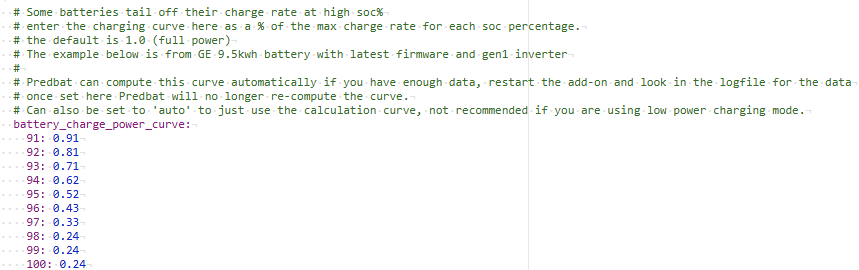
BirjuPatel85 It already does lower the charge rate from 90-100% SoC.
C
#5cluelesscris
BirjuPatel85 The BMS does this automatically. It also manages charge rates based on cell temperture. Both to minimise cell damage and protect battery longevity. You could implement dymanic charge rates this using givTCP and Home Assistant (or similar) but the BMS would override anything potentially damaging.
W
#6wrighar
Snatched this from Predbat, but the BMS power charge curve is very similar to this already:
V
#7Vestas
Worth noting that there are certain f/w combinations where the "10 step discharge rate" reduction between 90-100% SoC does NOT happen.
In my case the latest G1 production f/w for the hybrid inverter and BMS v3015 ran the battery at max charge rate all the way to 100%. This inevitably causes battery damage and reduced lifespan.
The 191/193 inverter f/w had "support for BMS v 3015" and hence charged the battery properly, whereas the publically available inverter firmware didn't.