winter charging strategies without Octopus Go

27 comments started 2022-08-08 last 2022-09-26
GivEnergy Products
#1 ivell

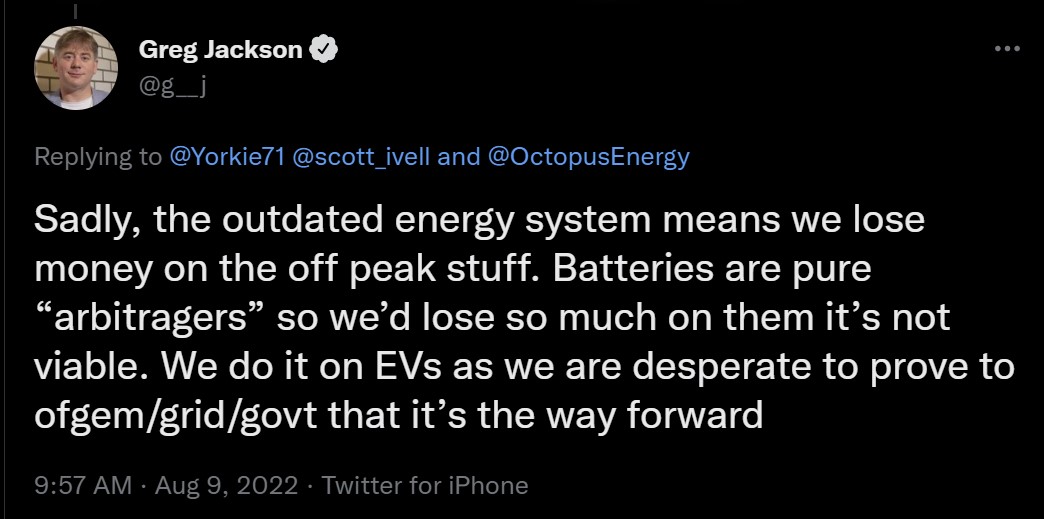
Despite having 2 x 8kw batteries, Octopus insist that Go is just for EV owners. My argument that EVs are just batteries with wheels hasn't encouraged them to change policy 😄 - according to their customer support, they are starting to be stricter on who can join the tariff from now on.

So thinking forward to autumn/winter when the price cap jumps up, I was wondering what approaches folks took to charging batteries without GO.

Does Agile represent a good option (it doesnt currently with the price cap below wholesales prices)?

Or do folks move from Octopus to other supplier - and if so, who?

T
#2 Tim

ivell Afraid to say ... what's the cheapest you can get a second hand EV or hybrid for? You could SORN it. If it was a leaf, you could use it as an extra battery? I get that some suppliers who want to protect their "green tariffs" from "brown battery" installations might not agree to you joining them (as I found out for SEG), but I do think that they are discriminating against PV battery for some reason.

H
#3 hamilton

I understand why they don't want batteries on their system. One day you may import 0 and the next you may import 16wkh. With an EV, they can see and predict your usage.
I was on Go last winter (no EV) and it worked out at £1-3 per day usage.
I subsequently jumped to Agile which was capped at 35p. During spring I made a good income by charging during offpeak and exporting during peak, some days it was 60p per KWh
This winter I intend to do the same.
I don't know how appealing the 55p Agile cap will actually turn out. Some may see it as being horrific but some those on it will see the price drop before any price cap savings are passed on (if any).

We wont see a drop in price caps until next October at the earliest. having soo much battery available, consider another provider?

#4 ivell

hamilton thanks for the reply

I'm not sure that EV argument holds up. If i had an EV i could charge from PV or batteries, so I don't see they can build a consistent dataset on usage - but anyway that's their policy. I've taken to twitter to ask their CEO 😇

I'm moving from fixed SEG to agile outgoing so hope to catch the end of summer with some export peak.

Not found a good comparable tariff from other providers, and many of course advise not to switch and are not listing alternative tariffs

T
#5 Tim

hamilton good income by charging during offpeak and exporting during peak

I think that's the whole point of incentivising battery storage users as you want to avoid the peak charge periods and time-shift to consume during off-peak. If you have sufficient storage capacity to reduce peak demand by exporting, you make some money and electricity security is improved.

hamilton One day you may import 0 and the next you may import 16wkh

Since our EV has a 50kWh battery compared to the house 16.4kWh, I don't accept that off-peak consumption for house battery is less predictable (for the energy company) than EV consumption. They're both unpredictable but the potential EV consumption is significantly greater than the house battery. In my case, we'll be charging both at times this winter. Grid import could be at a rate as high as 12kW with a maximum theoretical off-peak consumption of 51kWh (16kWh to house and 5x7=35kWh to EV). However, when we had storage heaters, we were importing at a rate in excess of 20kW although once up to temperature, they would stop being heated.

I suspect that DNOs and energy suppliers are required to provide supply for EV charging (special tariff or not) as well as those who still heat their homes with storage heaters but there's no requirement for them to give those special tariffs to non-EV owners. Short sighted I think.


M
#7 mrand31

Bulb went bust though...

C
#8 CARLMW

I think that it’s worth considering that Octopus is just a business whose purpose is to make money. They are not some sort of charity after all…

The average house battery will be far smaller than car battery, so it’s probably worth them offering Go to car users so they don’t charge there vehicles at peak times when they are loosing money. They can then make some money off customers during the rest off the day with the higher rate. With a house battery their just loosing money by offering electricity below cost price so why would they do this?

Basically how are they going to avoid loosing money from users like the OP with enough battery storage to last all day and night?

9
#9 94jdh

mrand31

Actually still running and can still sign up - being run by administrators and is likely to be taken over by Octopus.

#10 ivell

back to my question... 😉 - I was wondering what approaches folks took to charging batteries without GO?

M
#12 Martyn

Yorkie71 I do like Greg. A CEO who engages directly with customers with honest explanations has to be applauded.

Are there details of what specific changes they are suggesting.

if we had a document setting out Octopus' plans we could all write to our MP's to raise it with the new PM.

#13 Yorkie71

Martyn I recommend you listening to this Fully Charged + podcast where Robert interviewed Greg. He covered a lot of things but also how the wholesale energy system is broken. Basically because the price we all pay, including those of us that are on 100% renewable tariffs, is driven by the price of gas. Which frankly is bonkers.

It's a great podcast. Time well spent to find out more. I'd also suggest engaging directly with Greg on Twitter too.

M
#14 Martyn

Yorkie71

Thanks for the link to the podcast. I will set that for my bedtime listening tonight.

Martyn

C
#16 CARLMW

ivell I have an EV on order that has a 200 odd mile range. I only intent to commute to work, go to the shops etc. For my Outgoing Agile works brilliantly and as there is a net gain to Octopus because they are paying me less than the wholesale rate I can’t see why it won’t continue. Personally I believe that EVs for long distance driving is a year or two away from being hassle free, but my car will be outside the house long enough most weeks of the year to provide free motoring via solar. With some local free charging thrown in I think a town EV is absolutely viable, though it would take many years to save enough on fuel to balance the books vs petrol.

If I bought an EV for long distance motoring and GO (or tariffs like it) disappear then it would be disastrous! 50p / kWh is common on fast chargers, what’s coming 80p…. £1. Suddenly the running cost advantages disappear and we are just left with the extra hassle of charging up very expensive vehicles…

I think your question is more important than people may think as one day there may be no alternatives.

S
#17 sheltont

I am on economy 7, with shell. They are the cheapest with overnight rate of 17p and day 35p. It will go up after price cap but hoping to still have during winter

H
#18 hamilton

ivell The Go tariff is a hedged product. Being one of the biggest EV tariff suppliers allows them to predict quite well.
Most EVs are currently leased, those people know their annual usage and it will be remarkably stable for most users.
Octopus say they currently loose money on GO and Agile (even before the price rises)

Tim
They currently incentives this with Agile, the market is broken for all tariffs.
For your addition usage being converted into heat, that is also easy to predict as it gets colder in winter.
The DNO does not hide the fact that there is enough capacity but its not spread out and they cannot get enough green energy transmitted from the north and scotland down to the major populations.

#20 pgbish

I'm on economy 7 with Octopus and just been advised of the new rates from Oct 1st. Day has gone up to 44p but night has gone DOWN to just under 14.9p (from 20.7p). I have yet to see any figures for Octopus Go from Oct 1st, but the standard economy 7 is getting closer to go overnight costs and you get 7 hours of cheap rate!!
Being on economy 7 also allows you to export, but if you're on Octopus go, you cant export.
I'm just about to have 2x 9.5kw batteries fitted (been waiting for stock a long time!) so having 7 hours of charge is better for me.
I am still trying to get my head around how much of a % to charge batteries overnight, but its probably going to be trial and error to suit my circumstances.

Z
#21 Zakalwe

14.9p/kWh is double the Intelligent Octopus rate, which is 6 hours per night. The peak rate is just under 40p/kWh too, so I can't see how that is anywhere near.
You can also export on Go/Faster/IO, albeit the rate is just SEG (4.1p). However, if you have batteries then the strategy should be to minimise export.

A
#22 anglefire

I’m currently paying 24p for electric as we fixed last September until next October- so I can charge at standard rate and then dump in the evening at peak and make some decent money a lot of the time as I’m on agile export.

#23 pgbish

Zakalwe They only allow you to use Intelligent if you have compatible charger/car as i understand. I am certainly not going out to buy a car just to use Intelligent Octopus!!
What are the new rates for Intelligent from October??

Z
#24 Zakalwe

pgbish
I'm not sure on the October rates...no word from Octopus just yet.
You also need an EV onGo. I assumed that you had one as you made the comparison to Go.

R
#25 Ra

pgbish Do you know if that is for existing customers only? I got a quote from Octopus back in July for their Eco 7 electricity tariff and was quoted 54.73p day rate and 35.32p night rate.

Needless to say I didn't take them up on it but your tariff seems so much better!!

#26 pgbish

Ra I dont know if this just for existing customers, i just got an email with the new rates as of 1st October.
Its just a standard flexible octopus

H
#27 hamilton

Could you go on the government capped rate for incoming octopus and agile export? You could export your battery during the 2 peaks and offset the money from your expenditure?