At the moment with all this sunshine I am managing with just the panels and battery storage (8.2KW) to see me through both daytime and overnight, with hardly anything taken from the grid. But, I'm wondering what other people do in the winter, when there may not be enough sunlight to refill the battery and provide power for daytime activities. I don't have an EV, so I'm not eligible for Octopus Go or any thing similar. I've looked at Octopus Agile, but it doesn't seem as advantageous with the current price cap as it was previously, and obviously there will be more demand and hence higher wholesale prices over the winter.
I was wondering if it might be work switching to Economy 7 and charging the battery up to 100% as soon as the cheap period starts and then again just before it ends. If it is a really sunny winters day, then any excess power could heat my water via the iboost. Does anyone have any experience of using Economy 7 with a battery.
PV solar with battery - is Economy 7 a winter option
Karen When winter comes, you'll start relying on the battery earlier in the day than you probably do now and you won't be generating from solar until later in the day. Your battery is supporting your load currently but does it have the capacity to sustain you from, say 4pm to 8am (ie if you don't change to a Time of Use tariff)?
If you swap to a time of use tariff such as E7, you will be able to charge to 100% by the end of the period but if you import any energy late in the evening before the E7 tariff cuts in, it'll be at the higher daytime rate. Only you know whether the battery capacity is enough to last all day and all evening (if PV is effectively zero on a dark rainy day). If not, then there's a calculation to do to see if the odd evening import cost at higher rate is more than compensated for by the rest of your energy being at the E7 rate. You'll probably be better on E7 but you'd have to work it out.
We will certainly be moving onto a Time of Use tariff in the autumn but we have 16.4kWh which we know will definitely last from the end of the off-peak window to the start of the next.
Thanks Tim,
I'm quite a low user 3-3.5kw sees me overnight and total usage for a day is around 8KW if I don't have a "baking day", so I'm thinking that an 8.2Kw battery, fully charged should see me through. I can definitely, reschedule things like the washing machine and slow cooker to run overnight. Are you planning to go economy 7 or with something like Octopus Agile. I was a bit concerned about E7 in case I had to have a new meter - but I have a second generation smart meter - so can that do all the work for me?
K
We are quite a high usage household, approx 13/15kw a day. I have always been on Economy 7 and like Tim have 2x8.2kw batteries. Currently, the 16.4kw covers our usage with all water heating, dishwasher, washer/drier done in the daytime with excess solar. However, in winter everything changes around. Water heating, dishwasher and washer/drier are all done overnight on cheap rate and the batteries are 100% charged to provide power through the day. We have always had an economy 7 meter but your smart meter should be able to cope with these tariffs.
DIG I’m on Economy 7 with a 9.5kwh battery which can charge and discharge via a3.68kwh hybrid inverter. Our house usage is between 5 and 6 kWh but recently added a Sunamp 10kwh heat battery to exploit summer solar from a 4 kw PV array. The Sunamp needs between 3 and 4 kWh daily for a 2 person household, showers, washing up etc. now that we are GMT after Sunday I’ll put the Sunamp on its own overnight timer and cut the electric battery charge to say 75%. ECO7 here is only 16p. However if I do go for an EV next year I can get offpeak at less than 10p
Now looking at an ASHP but thinking I could do with some additional battery storage but not sure if that’s realistically cost effective. Might pick up a bargain 5.2kwh battery as some appear on EBay now and again.
billG bear in mind that a 5.2 battery is only 80% depth of discharge so only really 4kW
You’ll need to do the numbers on battery size and payback. I’ve looked at all the tariffs this year and concluded that economy 7 wasn’t right for me as the ASHP required more a day in winter than my 14kW of battery storage. I’ve looked at adding more battery but the savings don’t give anything like a reasonable payback.
Also do think about your max inverter throughput which could be a constraint to charging
We’ve gone to Octopus agile and charge in cheaper periods which are not necessarily overnight. I’m anticipating an overnight and an afternoon charge to see us through the day

I have just changed back to eco7, I can not see another tariff that works for me.
I change to charge up to value as the amount of solar changes through winter.
Currently set to 70% which with two batteries is too high as they have not dropped below 40% overnight yet.
However I also have not had any surplus worth mentioning recently so it doesn't matter.
geoffreycoan thanks for these useful points. At the moment I can charge batteries at 3.68 kw for 7 hours off peak = about 25kwh. ( if I had that battery capacity) so the inverter side is OK as it’s a Gen 2 version. At the moment working the numbers for a Cosy 6 ASHP on the Octopus Cosy tariff , and like your idea, charging my single battery in both 3 hour periods to discharge it in the gap etc between the two Cosy periods and later in the early evening.
Karen A new Smart meter can do Eco 7.
Karen I’ve a 9.5kwh battery a similar usage to mine. I’m on Eco 7 and it definitely works for me though I also have a 10 kWh Sunamp heat battery, which I charge say 4 kWh a night on its own timer, plus will put about 7.5 kWh into the GE battery . So very little peak price electricity used here since March!!! My Smart meter has a very boring display mostly 0 kW per hour😊
I have gone back to ECO7 for winter.
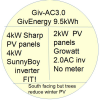
Gen1 Hy5.0 and 9.5KWhr battery. Gas central heating. 4 bed house.
I get cheap rate 00:30 to 07:30 so I can charge and run the background house load for 7 hours off peak.
During the day I can just about get by on the battery load plus whatever little solar I get.
If I have to import during the day, it is ECO7 day rate, but not some punitive 16:00 to 19:00 rate.
Typically 15kWhr off peak import per day, but I guess that will rise as it gets darker and I get less solar, so likely to get to 15kW/hr off peak (15p) plus 5kW/hr peak (33p) for a few months.

SteveCook How do you get/use 15kwh of offpeak with a 9.5kwh battery unless you are scheduling appliances through the night? Are you recharging the battery at 6.00 am?
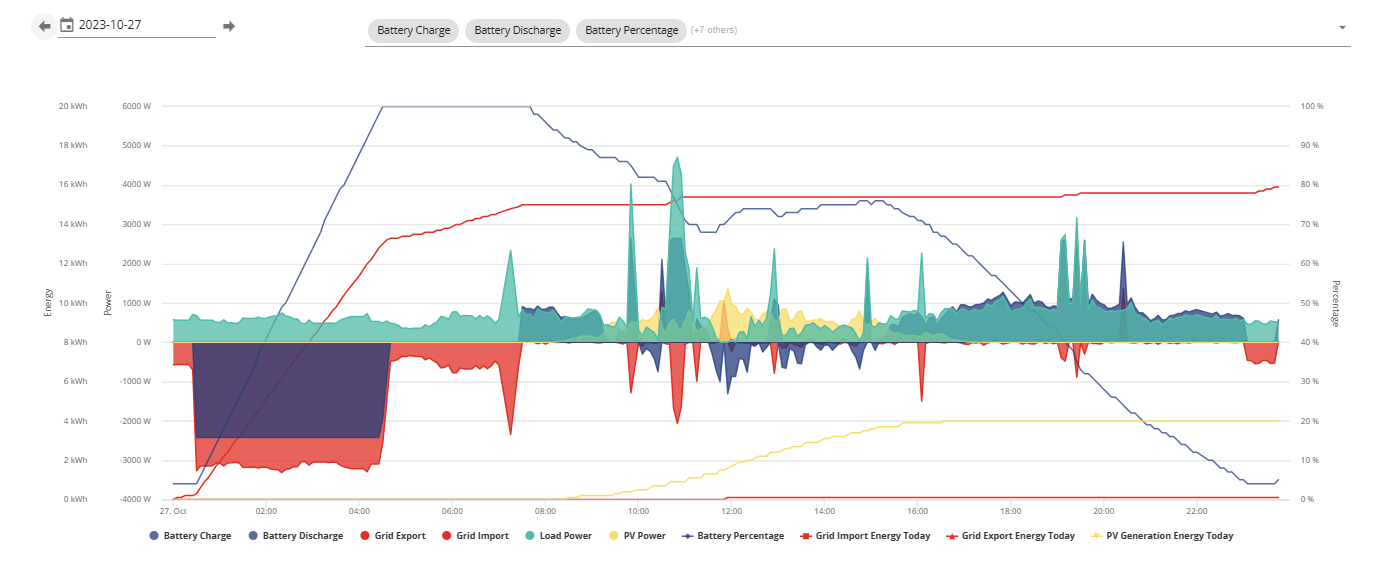
See graph above.
9.5kWhr of battery charge plus 7hrs of house background load at 500w = 3.5kWhr
9.5+3.5= 13kWhr.
Conversion efficiency losses say 10%
13 x 1.1 = 14.3kWhr import.
The base load of about 500w checks out on the graph above and a spreadsheet of everything in the house on standby etc.
Fridge, freezer, Sky Box, TVs, CCTV cameras, smoke alarm, router, couple of data switches, microwave clock, cooker clock, burglar alarm, toothbrush charger, pond pump etc. I was shocked at the number, but It all adds up.
billG if we hadn’t gone for agile we were going to go for cosy with the double dip charging period. It’s a good option for heat pump owners.
If we didn’t have the heat pump then maybe would have been economy 7 for the winter as we can just about last a day on the batteries
Just shows there is no one single best tariff for everyone
My plan was to run Economy 7 from October to March, in December I am load shifting 12kWh per day (includes 1.2KWh losses) which saves me approx £1.00 per day. The introduction of the Savings Sessions has opened up the possibility of making money but to the detriment of the national grid. Moving off Economy 7 would increase my 5PM load which would establish a baseline load which would be reduced to what I currently use by using the batteries during saver sessions. I could go further and charge my batteries the 0.5kWh they need each day at 5PM. Any thoughts?
Newman Are you on Eco7 with Octo? I asked them to move me over from Flexible to Eco7 about 4 weeks ago but nothing so far and they won't respond or explain the delay...
is eco7, 7 hours @ 15.74 p/kWh
I'm on flux at the moment
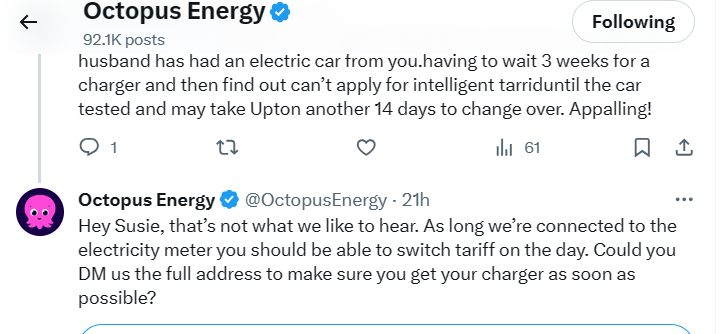
downfield If you look on X (Twitter), there is a post from Octo saying they can move you from one tariff to another while on the phone
I am on Octopus Flexible Economy 7 - 7 hours @ 14.55p / balance @ 33.56p. The changeover to Eco 7 took 3 attempts over 19 days as the meter was modified remotely, not always successful but we got there eventually.
Flux only gives 3 hours and I need 4 hours with my AC3.

Current Fixed Tariff for Octopus (Octopus 12M) has the following rates. Night rate 00:30-07:30 = 12.42p per kWh Day time rate 27.97p/kWh and standing charge 61.56p/day for West Midlands area. I was on Agile but the rates seem to be deteriorating and my average was 13p+ /kWh.
Comparing the sums between Agile and Octopus 12M fixed was pretty even. Winter is not a good time for solar production so I will lose out re net generation whichever tariff I am on.
Having just switched to the Economy 7, I need to work out how to set up the timed charging so that my battery is 100% by 7.30am. Any help on that score would be appreciated.
AlanStevens Having just switched to the Economy 7, I need to work out how to set up the timed charging so that my battery is 100% by 7.30am. Any help on that score would be appreciated.
The short answer is: just configure a timed charge using the app or web portal, with a time window corresponding to the cheap period. It's worth being aware that E7 is typically fixed UTC hours, and so different local time for summer and winter, so you should double-check exactly when the cheap period is at this time of year.
How big is your battery, and is it somewhere cold or warm ? A cold battery charges more slowly (until it warms up a bit). In addition, charging typically slows down as you approach 100% (if you plan to fill the battery).
I assume that batteries preferred to do things slowly rather than quickly, so aim to charge the battery over the whole of the cheap rate, rather than just charging it at full speed and letting it sit at 100% for several hours. I use a script to calculate power required, but in practise another script has already mostly emptied the battery to the grid beforehand, so I'm always charging from close to 4%, so it almost always charges at 2kW. (ie using a script isn't really necessary.)
If you're not tied to Octopus, EON Next Drive offers better rates for solar/battery.

We used eco7 for a considerable time, since it was the only tariff available then for us with no EV. Now with an ASHP we’re on cosy. We didn’t bother with Flux.
Charging your battery keeps it warm overnight so set it to go from 4% to 100% over the 7hrs by adjusting the charge rate.
It depends on how much PV you have but it was never worth playing with charge levels in darkest winter, but by February you can change the upper level according to how sunny you think the next day will be.
I now have an Export MPAN which will allow export at Octopus flatrate 15p/kWh. I'm still on their fixed rate E7 importing at 12.42p/kWh from 00.30 to 07.30 and 27.93p/kWh day rate. Since changing to this tariff I have only used 8kWh dayrate electricity over the last 2 months, the rest is night rate. Battery storage is adequate to prevent day rate use.
What I would like to know is can the battery be set to discharge to the grid during 4-7pm peak without me using dayrate electricity from the grid. ie can the battery be set to discharge and supply any load at the same time? I seem to remember reading somewhere that it can't do both jobs.
As solar starts to improve I will have a full(ish) battery at 4pm which would pay to export, (leaving enough to take me to the next charge session at 00.30).
I'd appreciate some thoughts on this.
I now have an Export MPAN which will allow export at Octopus flatrate 15p/kWh. I'm still on their fixed rate E7 importing at 12.42p/kWh from 00.30 to 07.30 and 27.93p/kWh day rate. Since changing to this tariff I have only used 8kWh dayrate electricity over the last 2 months, the rest is night rate. Battery storage is adequate to prevent day rate use.
What I would like to know is can the battery be set to discharge to the grid during 4-7pm peak without me using dayrate electricity from the grid. ie can the battery be set to discharge and supply any load at the same time? I seem to remember reading somewhere that it can't do both jobs.
As solar starts to improve I will have a full(ish) battery at 4pm which would pay to export, (leaving enough to take me to the next charge session at 00.30).
I'd appreciate some thoughts on this.
[unknown] can the battery be set to discharge to the grid during 4-7pm peak without me using dayrate electricity from the grid. ie can the battery be set to discharge and supply any load at the same time?
The short answer is yes, but the terminology of what you are asking for is a bit confusing.
Firstly I think you want to use any generated solar, or if that’s not enough, your battery during the day so that you don’t use any grid import at the day rate. This is simply turning Eco mode on which you presumably already have on.
The second question I think you are asking is if the battery is fully charged by 4pm, can you export the extra to the grid before the start of the next cheap rate import period at 00:30. Yes you can do this, you set a timed export on your inverter for the time period you want to discharge the battery. When you are discharging the battery like this any house load is firstly met, and the excess is then exported, so you can do both export and meet the house load.
However, you have to be careful when you start the export at because if you start it too early (e.g. 4pm as you suggested) then the battery could empty itself before the start of the 00:30 cheap rate, and then you’ll be importing at 27.93p which defeats the benefits of exporting.
Unfortunately with the GivEnergy inverters there is no in-built way for it to automatically start the discharge at the “right time” to ensure it doesn’t run out prematurely, you’ll either have to start the discharge manually or program it to start at a fixed time every day.
One way round this is to work backwards from when you need to start the cheap rate charge by. e.g. if you have a 9.5kWh battery and a hybrid inverter it can charge the battery at 3.6kWh (or a bit less if the battery is cold). You can thus fully charge the battery in around 2.5 hours.
So if you start charging the battery at 05:00 it will be fully charged by 07:30. You could thus start discharging the battery at say 00:30 and even if it was totally full at 00:30 (unlikely as you will have used some of the charge in the evening), it will have discharged fully by 03:00.
Since you are on a flat 15p export rate there is no disadvantage to discharging overnight even in the cheap Economy 7 period. This way you won’t risk running out of battery prematurely and importing from the grid at daytime rates.

AlanStevens What I would like to know is can the battery be set to discharge to the grid during 4-7pm peak without me using dayrate electricity from the grid. ie can the battery be set to discharge and supply any load at the same time? I seem to remember reading somewhere that it can't do both jobs.
The inverter can generate AC. If that's less than consumption, there will also be some import ; if it's greater than consumption, the excess will be exported. Eco mode tries to keep it as close as possible to consumption, to avoid both import and export.
So in short, yes, it can both cover consumption and export, as long as the level of discharge you choose exceeds consumption.
Note that on the flat 15p rate, there's no financial incentive to export 4-7pm. In fact there's a small disincentive since it will count against you if there are any savings sessions. So it's much easier to just wait until closer to the start of the cheap rate before exporting - less chance of exporting too much and having to then import. Note also that, after losses, there's not a lot of margin to be made by importing at 12.42p and exporting at 15p.
AlanStevens The system has to supply the house load first when you export to grid. You can't export & import at the same time - its one or the other.
So if the house load is 500W and you can discharge at 3000W then you can export at 2500W.
[unknown] i consume 10 - 15 kWh per day. I have 5Kwp of solar panels and a 9.5kWh battery.
Im on E7 and i manage to avoid peak rates. In peak of winter i have to charge battery to 80% minimum on cheap rate.
Karen i consume 10 - 15 kWh per day. I have 5Kwp of solar panels and a 9.5kWh battery.
Im on E7 and i manage to avoid peak rates. In peak of winter i have to charge battery to 80% minimum on cheap rate.