Consuming v Discharging

22 comments started 2021-12-12 last 2021-12-17
GivEnergy ProductsBattery
D
#1 Dean

Hi, I am noticing that the two figures on the top of the dashboard display differently. Consuming 536W Discharging 687W. My battery is doing nothing except servicing my house demand, so unless I am missing something here...if I am please enlighten me... should these figures not be the same ?
Thanks

B
#2 browellm

Dean You're seeing the inherent charging/discharging inefficiencies in the system. All normal.

That's why when you do your sums on say, charging up the battery on a 5p tariff, you should really put about 20% on top and do the calcs based on 6p.

D
#3 Dean

Thanks for the reply, not sure I understand. Not sure how cost would effect this, is this not simply a case of the portal showing how much is being drawn by the house v how mouse the battery is discharging to meet the demand from the house in watts ?
There seems to be a constant approx 180w difference in favour of the discharge... with makes me think where is that going to ?.. it appears that my battery is just discharging over and above demand

#4 judgepd

I think this is yet another time where the 5 minute updates on the portal really don't help to show what it really happening. I suspect the consumption and discharge in reality are much closer but you are only seeing a snapshot of what is happening once every 5 minutes.

B
#5 browellm

judgepd I think this is yet another time where the 5 minute updates on the portal really don't help to show what it really happening. I suspect the consumption and discharge in reality are much closer but you are only seeing a snapshot of what is happening once every 5 minutes.

No, nothing to do with that.

Dean There seems to be a constant approx 180w difference in favour of the discharge... with makes me think where is that going to ?.. it appears that my battery is just discharging over and above demand.

Try to visualise it like this: your house demand is 500W. If you are pulling directly from the grid, it will demand 500W (actually there are losses here too, but they're very small, a few Watts at most so you'll pull 502W for example.)

Now instead, imagine you are satisfying demand from your battery. Except the efficiency of the system is much lower, mainly due to losses through the inverter (no system is perfectly efficient). The losses will vary based on a number of factors - but they will typically be between 10-20% for a full round trip. So to satisfy the 500W house demand, you'll pull somewhere between 550-600W from the battery. Some battery systems are better than others, but there will always be losses.

Note also, the losses occur each way. So for example, if your panels are generating 1000Wh, the battery will only charge at around 900Wh, again because of inverter losses, primarily.

#6 hoggy

The conversion from Battery DC to AC is not 100% efficient, hence you always see a higher Battery load than you do house load. This is lost as heat in the inverter as part of the conversion.

House demand is not as constant as it seems so the inverter is always playing tag trying to chase a zero sum (no import or export.) hence why it often looks a bit imbalanced.
Once local monitoring is sorted your down to 10-15sec range which is the same as your in smart meter in home display and you'll see this constant cat and mouse much easier - likewise you can currently use your in home display to confirm the inverter is actually zeroing as you'll see it yoyo'ing +/-50W so long as your demands are stable.

Yes the update being slow doesn't help but unless people want to dip in their pockets and pay for it then I can't see that changing ever personally - remember we pay nothing for ongoing connectivity. It might just seem like a simple fix to "just make it faster" but multiply it by thousands of customers and it gets expensive handling all that data real quick.

#7 judgepd

hoggy I take your point about ongoing connectivity costs, but other companies manage it fine. I don't have it, but I'm pretty sure myenergi updates more often than every 5 minutes and don't require the use of a raspberry pi to achieve it either.

...that sounded a bit agressive but it isn't supposed to be, sorry...

#8 hoggy

judgepd No didn't come across as aggressive at all (I was brought up on Halo / Xbox Live Chat so very thick skinned!)
I'm a little biased on this as I've had the system a fair while so remember the old "white" app when it first came out that was very limited (so anything was an improvement - it couldn't even store your login details for a long time!)
I realise times change and competition is catching up though.

The Myenergi stuff is a lot more rapid (don't have it either) - All I can say is they have a lot more product out in the field given the amount of EVs around - I've seen inside one of them and given it's contents I highly suspect their device selling price is subsidising ongoing costs!

Perhaps it's worth putting to GE what it would take to increase rate?

D
#9 Dean

I've been in touch with support and they have apparently put my system into "5 second data state" But it still reads off between discharge and consumption. Graphs also indicate grid import when the battery is under sudden demand, i.e dishwasher at 2.2kw . To be honest, this battery is leaving a bit to be desired

#10 judgepd

Dean How long does the grid import last before the battery starts to meet the demand?

B
#11 browellm

Dean I've been in touch with support and they have apparently put my system into "5 second data state" But it still reads off between discharge and consumption.

I've explained why. Are you struggling to understand it?

It is possible to buy inverter/battery systems with lower losses through the system (5-10% rather than 10-20%) and faster response times to demand. However, they are significantly more expensive than GivEnergy (typically 3-4x more).

The losses and demand lag you're seeing will probably cost you something like £50/y in electricity.

You pays your money.....

D
#12 Dean

browellm I'm not struggling to understand it, I just recognise a poorly performing product when I see it.

D
#13 Dean

judgepd Sometimes it can be up to an hour, or so it appears from my graphs in the portal

B
#14 browellm

Dean I'm not struggling to understand it, I just recognise a poorly performing product when I see it.

If I might suggest, you're making assumptions based on graphs that aren't real time.

Do you have an IHD for your smart meter you can look at? These are typically on a 10s refresh rate. If you boil a kettle while your battery has charge, you'll see a spike as the house demand initially pulls from the grid. The inverter should respond within about 5-10s and in the next cycle of your IHD you'll see the grid demand go to zero (or very close to zero depending on the Wattage of the kettle and your house base load at the time).

I wouldn't use the GivEnergy graphs to make on assumptions about the performance of the inverter to sudden loads. The update frequency just isn't fast enough.

A
#15 andrew_bond

Dean If you're on a 5-sec monitor (I think GE call this "debug mode") you should see the battery inverter respond to demand changes much quicker than that. Mine is responding within a few seconds. I'm using a 10-second interval for local monitoring, and when I get a load coming on and off I usually get one sample at each end where there is a short import/export. (If I could, I'd add a screenshot from Grafana with an example - but I can't seem to paste the image)
I also have a Hildebrand GlowStick and I use their Bright app to see the grid load at 1-minute intervals - this is a useful sanity check. It should not take minutes to respond - that sounds like a fault to me.

#16 judgepd

Dean If this is genuinely the case then there is a fault. It should be seconds at most.

#17 hoggy

Your welcome to compare your losses/loads against mine but unless it's taking 10mins to react to a load it sounds pretty normal for any system. Live Inverter

P
#18 Phil-C

Dean I have same problem. Often 100 plus

G
#19 GrahamRead

There's sampling delays so the battery export (discharge) and house use (consumption) figures probably won't often exactly match, in addition there's a small delay while the inverter reacts to house load changing.

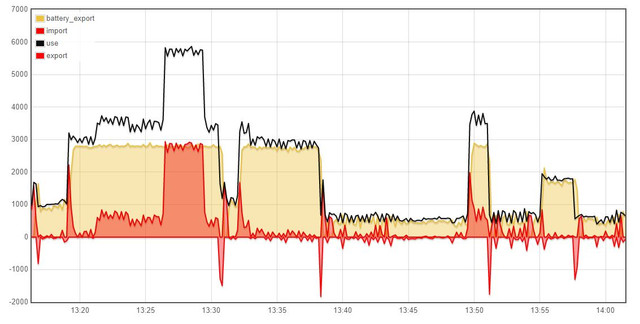
I'm don't know if this furthers the discussion or not - but for example here's a snapshot from today of my house consumption (use - the black line), the discharge from the battery (battery export - the sandy fill) and the pull or export to/from the grid (the red fill).

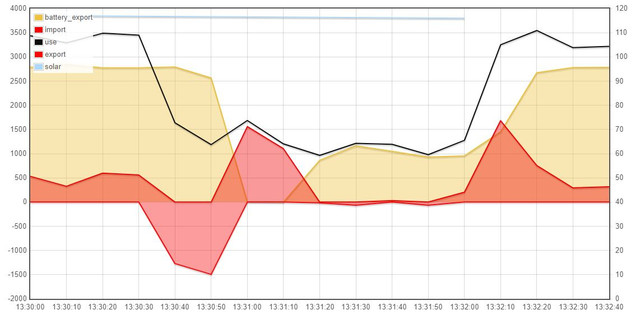
You can see that as the house demand spikes, there's a slight delay in the order of seconds until the battery discharge (the inverter) responds to meet it (up to the inverter limit). Similarly there's a slight over-run when the demand ends and there's a few seconds of grid export until the inverter responds to the lower demand.

This is using a 10 second sampling rate using current clamps (emoncms) - so the absolute watt values may not be completely accurate

url=https://ibb.co/LpzkqVM

G
#20 GrahamRead

Here's a zoomed in section of one of those demand spikes, so you can see the battery/inverter response when demand rises and when it falls (the solar was contributing about 100W at the time - really dull day!)

#21 judgepd

Really interesting posts there. Would be interested to know what givenergy would say is the official response time. I think if the battery is already discharging then it ramps up quite fast, if it's charging I think it's a bit slower to switch to discharging which is understandable.

#22 THALL

Without instant visual data I doubt what we see would ever match on that screen. The CT clamp has a delay, battery ramp up and down has a delay, getting the data displayed has a delay etc etc. When my first battery was installed my data was constantly out, the difference over a day worked out at 10 - 15% different between the GE system and my smart meter in the house. When the battery was replaced under warranty and the clamp was moved a bit things are much better. Not exact, and I dont think they will ever match. But a lot of battery systems have this delay issue, the only one I have seen repeatedly to be better is the Tesla Powerwall. But obviously that is considerably more money than a GE system.