East West cells with 5kw inverter.

15 comments started 2023-02-14 last 2023-02-17
GivEnergy ProductsHybrid
S
#1 Simonturner1

I have a gen2 5kw hybrid inverter. Is it possible to put 5kw of cells into string1 and another 5kw into string 2 (strings are on east/west facing roofs)?

Data sheet says max 7.5kw per string but will I produce 5kw on each string individually when sun allows?

Thanks.

C
#2 cluelesscris

I think you will find with two strings divided E-W you are unlikely to generate at full capacity. This would only possibly be when the sun is at it's highest in the year and then full sun will heat up the panels and reduce efficiency. Maximum efficiency would be on full sun days in spring and autumn when air temperatures keep the panels cooler but then the angle of incidence will not be enough to counter your orientation. The inverter suggests it will handle the full output as the 7.5kW limit is per string. There is an overall current limit of 13A, though.

Having said all that the 10kW total, even with the orientation, is a good match for the inverter and if you temper your expectations from the theoretical maximums you shouldn't be disappointed with the system at all. I wish I had that much roof!

M
#3 MarkyG82

I think what you are asking is if you can have an overall PV array that is bigger than the inverter can handle but with the array being split you dont ever generate the full amount.
From what I've seen this is quite common and exactly what I have done. I have 6.4PV and 3kw inverter. Most I've seen so far (since Nov install) is 2.4. What happens when the PV generates more than the inverter can handle? Dunno yet. I can definitely see a second inverter in my future. Maybe with some additional panels and steeling some panels from the original install. Make it 12 per string instead of 8. I believe this is possible as I have optimisers so a drop on individual panels is ok.

Ramble over.

S
#4 stevelewis

Simonturner1 in principle, yes. The string voltage will be the limiting factor. You can find the open circuit voltage on the panel datasheet and add a temperature compensation factor for cold days. The total string voltage must always be less than the max inverter input voltage.

S
#5 Simonturner1

stevelewis thanks. Max voltage days 580v, but then surely I could have 5 cells in series, plus another bank of 5 cells in series, then parallel both banks so as to increase current rather than voltage?

S
#6 Simonturner1

MarkyG82 to explain better/more simply, I have a 5kw inverter (currently 2.4kw of panels per string, all dacing east). I want to put the entire 4.8kw onto string one, then add another 4.8kw of west facing panels onto string 2.

Will I be able to utilise all 4.8kw of pv power in the morning, then again on the other panels at night?

I hope that makes sense.

T
#7 Tim

Simonturner1 I'm no expert by any means but in principle, I believe you could do what you are suggesting but there are other things to bring to the equation. The inverter maximum input current is 13A/ string, so with two parallel banks of 5 panels, you may be within the voltage limits but you could also exceed the current input of the inverter. The other thing about having short strings is that there would have to be plenty of light to reach the minimum voltage to start up the inverter. So two short strings in parallel might work well, but only for relatively short periods of peak light. A longer string will lengthen the period (both hours per day and days per year) that the minimum inverter voltage is reached, at the expense of peak power. You might be able to model the options, or perhaps ask your installer to provide the means to change mode a couple of times each year - two short parallel strings in summer when there's plenty of light and you want to maximise peak power and the same two strings reconnected in series for the autumn through to spring when you want to increase the harvest period at the expense of peak power.

#8 Simon_C

Not sure this very latest data-sheet for the 5 kW Gen2 hybrid is accurate. The previous version indicated a maximum total DC input of 6500 W, which is in line with the size of over-provision on many other brands of inverter.

I have an East/West roof approx 30 degree slope, with 6x410W East(-88deg) and 10x410W West(+92deg) installed. By using PVGIS5 to predict maximum insolation, my conclusion was that at 1300 BST the peak power would be with insolation of 800 W/m2 on both sets of panels at that time. There is a higher peak for one side at other times of day, but the drop off at that time on the other side is greater.

Any PV panel data sheet states the output under NMOT conditions which happens to be 800 W/m2, so multiply up that power value by the number of panels.

My panels would give a figure of 312 x 16 = 4992 W.

You really need to have the datasheet for your specific PV panels in order to check the other limitations such as maximum open circuit voltage at low temperatures. This is usually 1.25 x the Voc stated figure x the number of panels in the string.

Having 2 strings in parallel wired to 1 inverter input will likely cause problems, as 2 x say 8 or 9 Amps is 18 Amps which is above the rating of the inverter.

S
#9 sponev

If it helps I have 5.1kwp on the east and another 5.1kwp on the west. So 2 strings on a 5 kw gen 1 hybrid (soon to be gen 2). My max generation is predicted to be around 6.5 kw and so I'll clip at that. However it's safe and I'll benefit most of the time when outside of peak conditions. The limiting factor is the string voltage apparently so check that. I'm no expert but my installer and GE support approved the design.

S
#10 SilverArt

Simonturner1 I have 3.16 kWp East and 3.95 kWp West through a 6kW dual MPPT inverter, the mean direction is a little SSE wards. During what appear to be nice clear days in May/June/July last year it peaked around 4.8kW at about 1:30. In August a similar days peaked at 4 kW. However, scattered cloud days were a different story, they frequently had scattered peaks at well over 5kW and on quite a few occasions my 6kW inverter obviously clipped some higher spikes.
As a very rough guide possibly increase my numbers by 30% to show your proposed 10kWp outlook?

#11 Simon_C

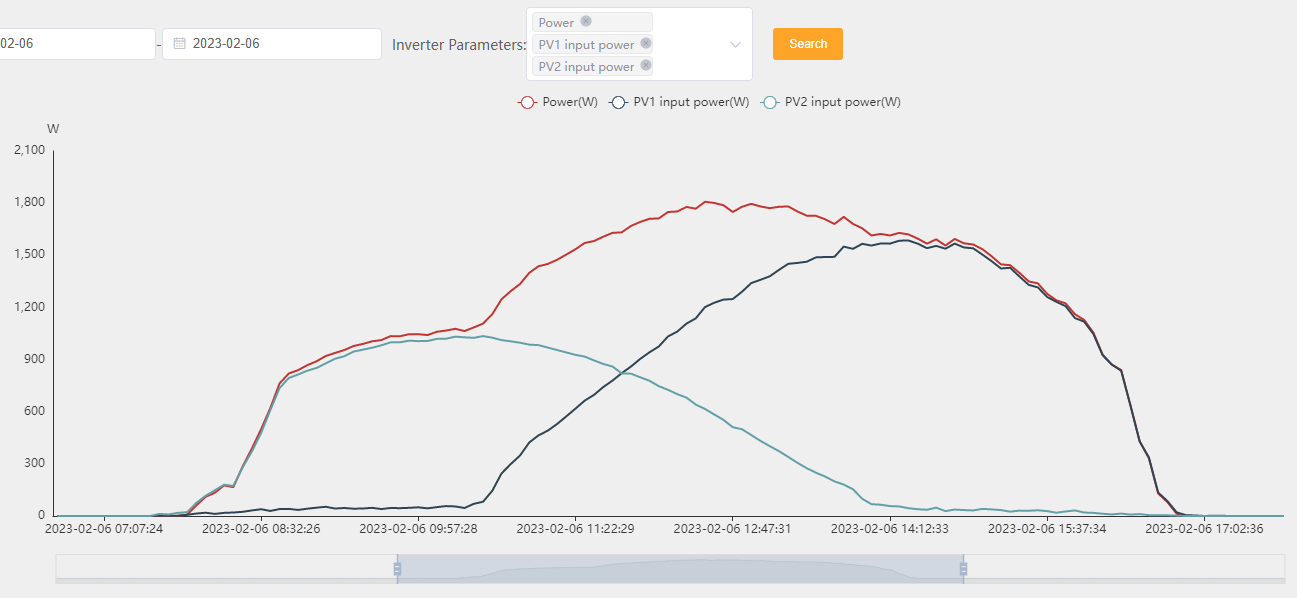
To give an idea of the relative output of East and West panels and the combined output, here is the power chart for a clear blue sky day, with a peak power of 1808 W this month. Remember I have just 6x410W on the East (PV2) so a smaller peak in the morning, and 10x410W on the West (PV1) so a larger peak in the afternoon. I chose this split to align the generation with higher consumption in the afternoon.

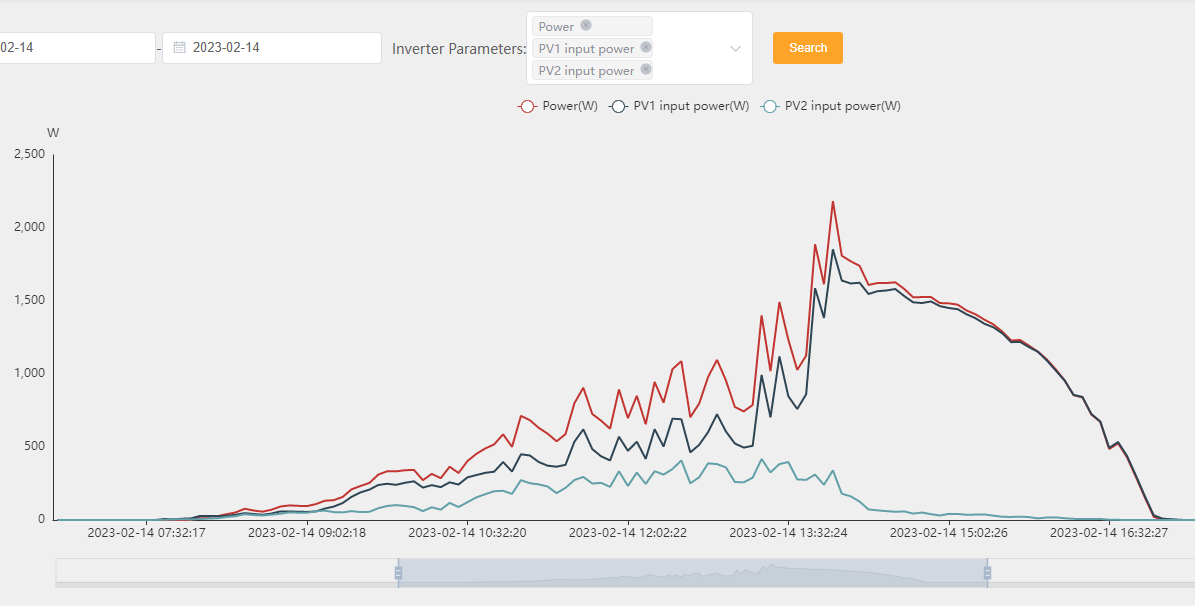
In comparison, on a day with sunny spells, the brief periods with direct sun on my panels gained extra output from reflections off the surrounding clouds, with a 5 minute peak of 2186 W.

In May/June/July these peaks will be much higher.

M
#12 Martyn

sponev May I ask if there is a specific reason for changing from Gen1 to Gen2?

S
#13 sponev

Martyn Gen 2 has a higher charge/discharge capability - 2.6 vs 3.6 kw. We ordered gen 2 ages ago but Givenergy couldn't supply so our installer got us going with gen 1. However we have a couple of appliances need the 3kw capability. It's not due to the panels.

M
#14 Martyn

sponev Thanks for that. I thought you were upgrading from 1 to 2 rather than installer replacing a temporary install.

K
#15 Karen

Several people have talked about havig a Gen 1 installed temporarily until the Gen 2 is vailable. Just curious - but wht is going to happen to all the Gen 1s that are swapped out