Exporting to the grid not charging the battery

66 comments started 2023-02-14 last 2023-04-08
GivEnergy ProductsHybridBattery
G
#1 geoffreycoan

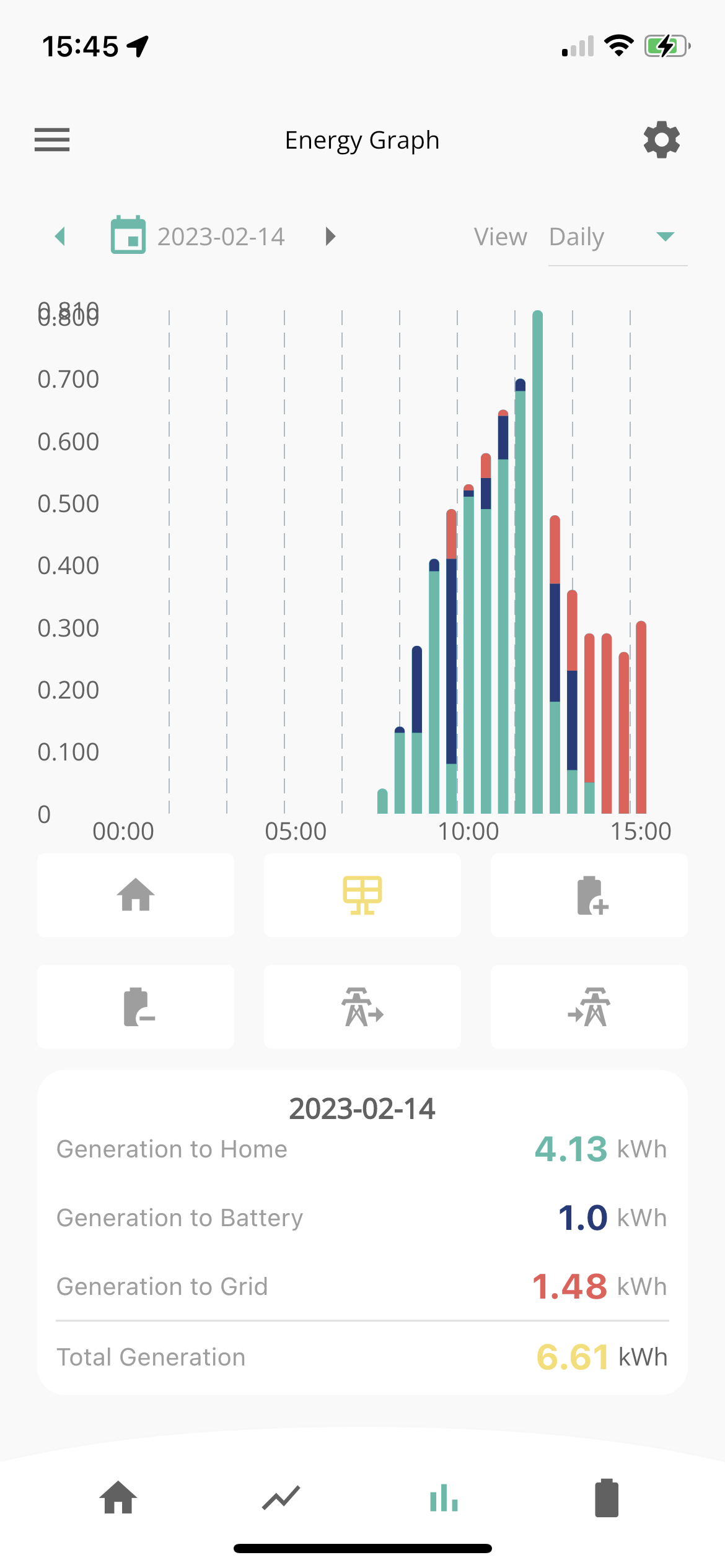
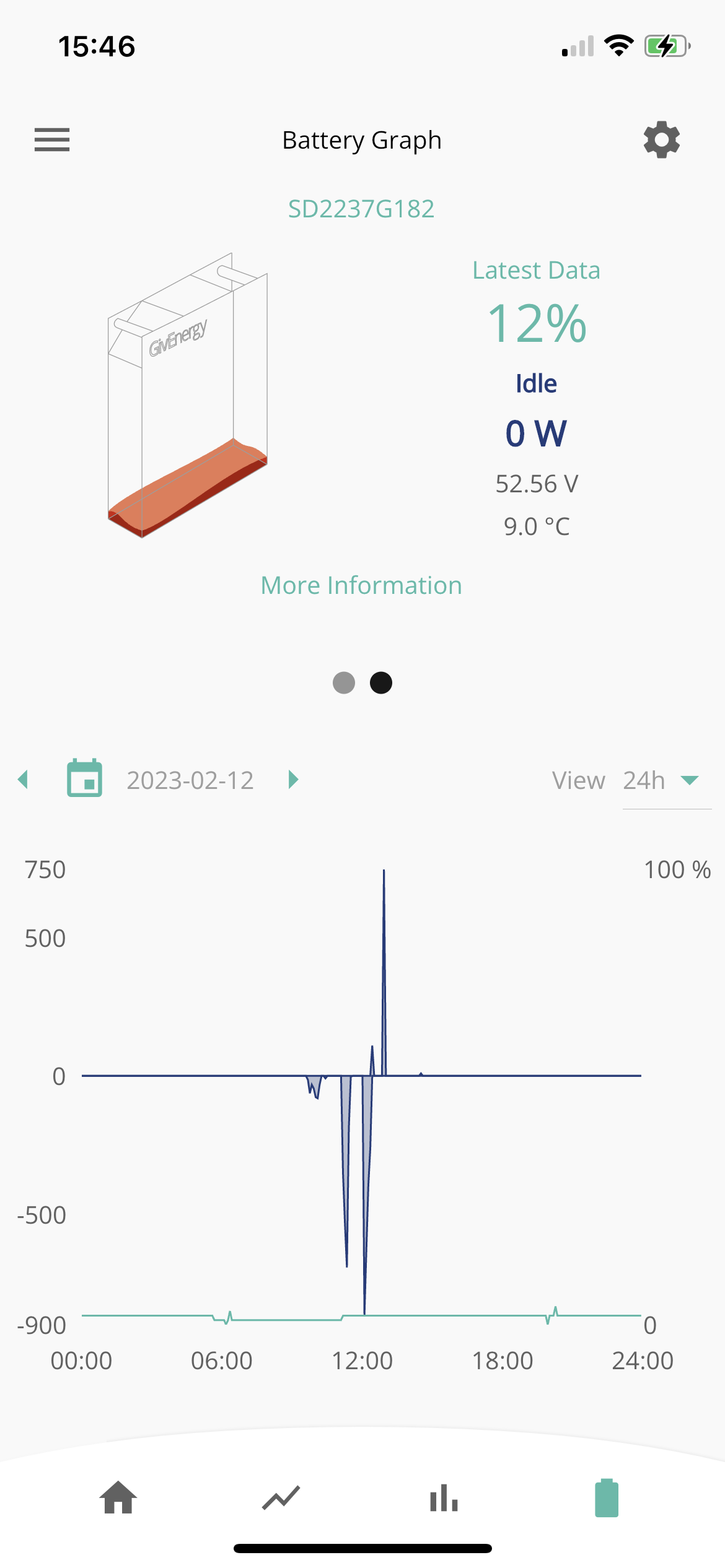
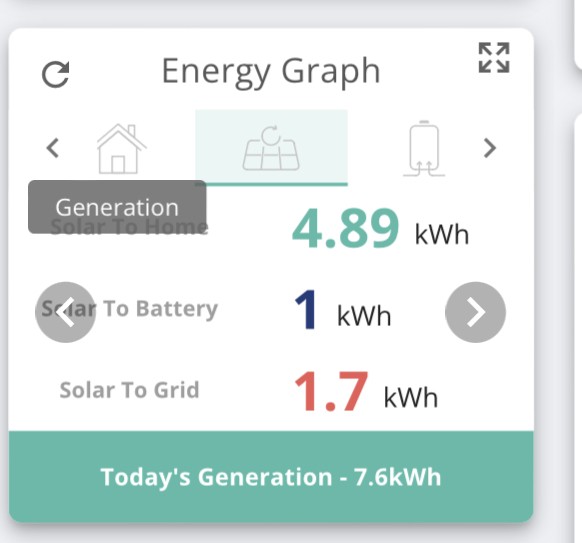
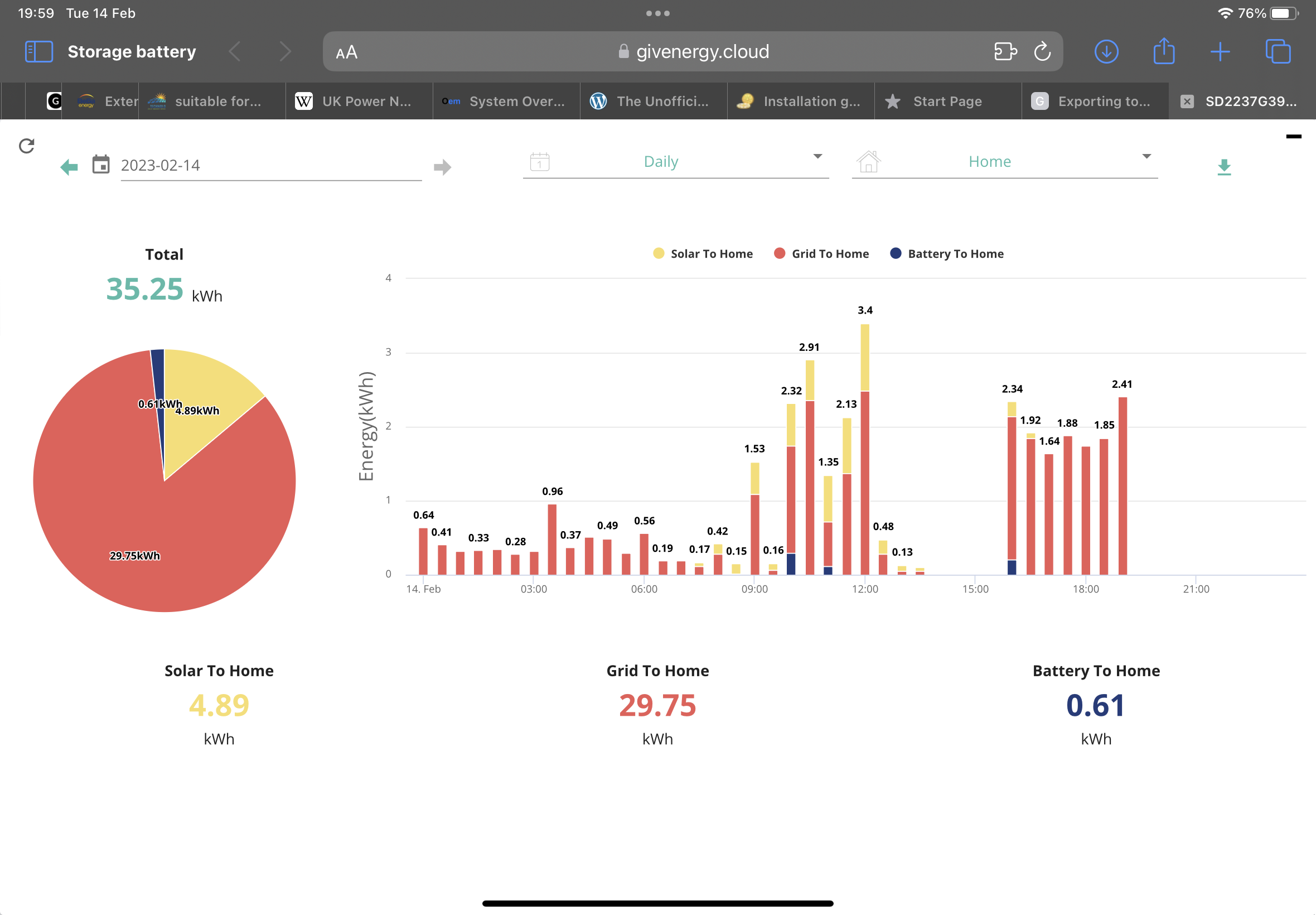
Don't understand why the inverter has been exporting solar energy to the grid this afternoon at a fair rate and not putting the energy in the battery.

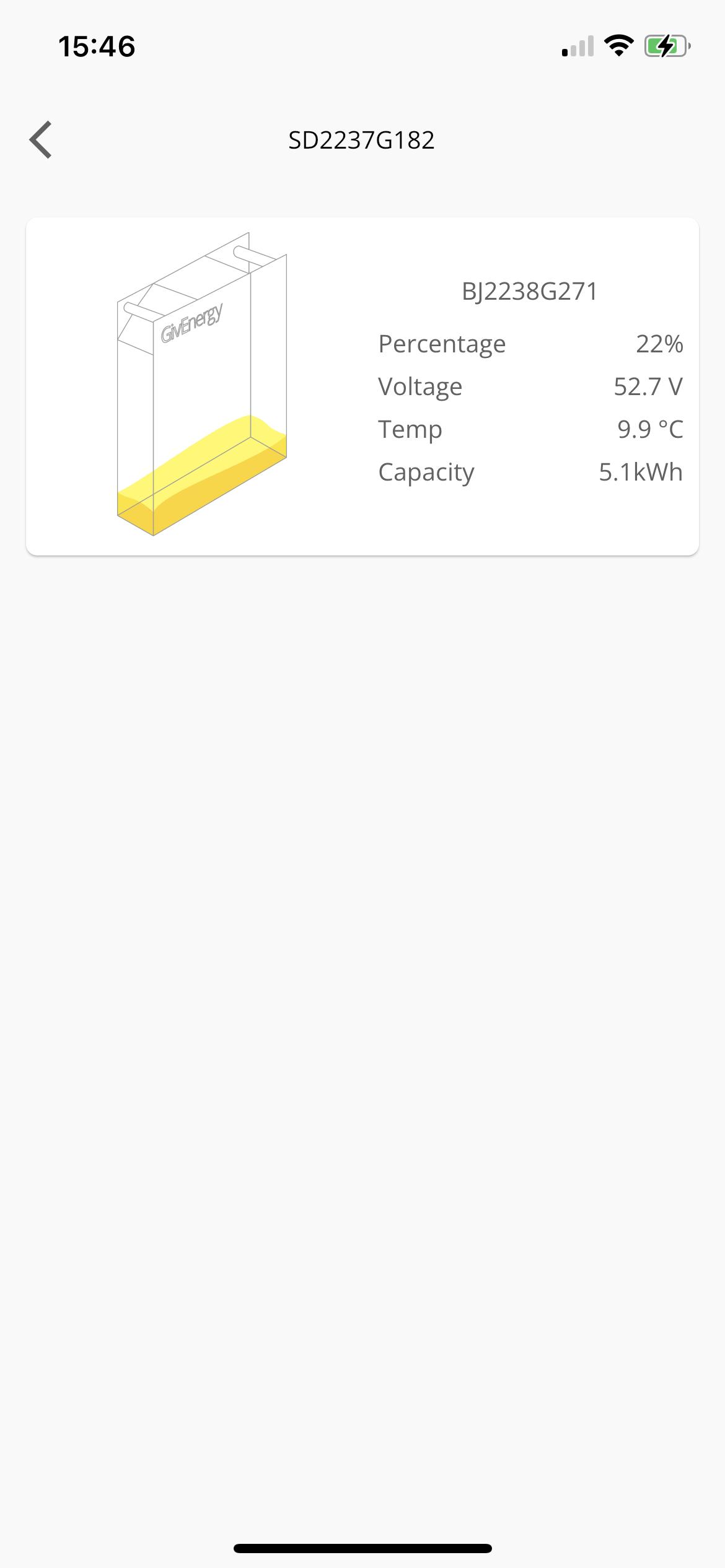
The battery isn't full, it's either 12% or 22% full depending on which screen I look at:

I appreciate that there will be some balancing of demand and grid export is never zero but this seems very strange behaviour

Cheers Geoffrey

S
#2 SilverArt

It would help if you provided the Portal > Energy Graph view.

As as starting point it would also be worth Portal > My Inverter > Settings - "RESET TO DEFAULTS" > "SUBMIT"
Make sure that you get a positive acknowledgement, if not try again.
Then see if it shows what you expect over the next sunshine period, but do check the portal against the App.

G
#3 geoffreycoan

Thanks for your help.

Heres the portal screens. Wasn’t sure whether the small or large was more useful

After I’d posted the message I tried turning the battery off and on again but by then the house demand had increased and it was importing from the grid.

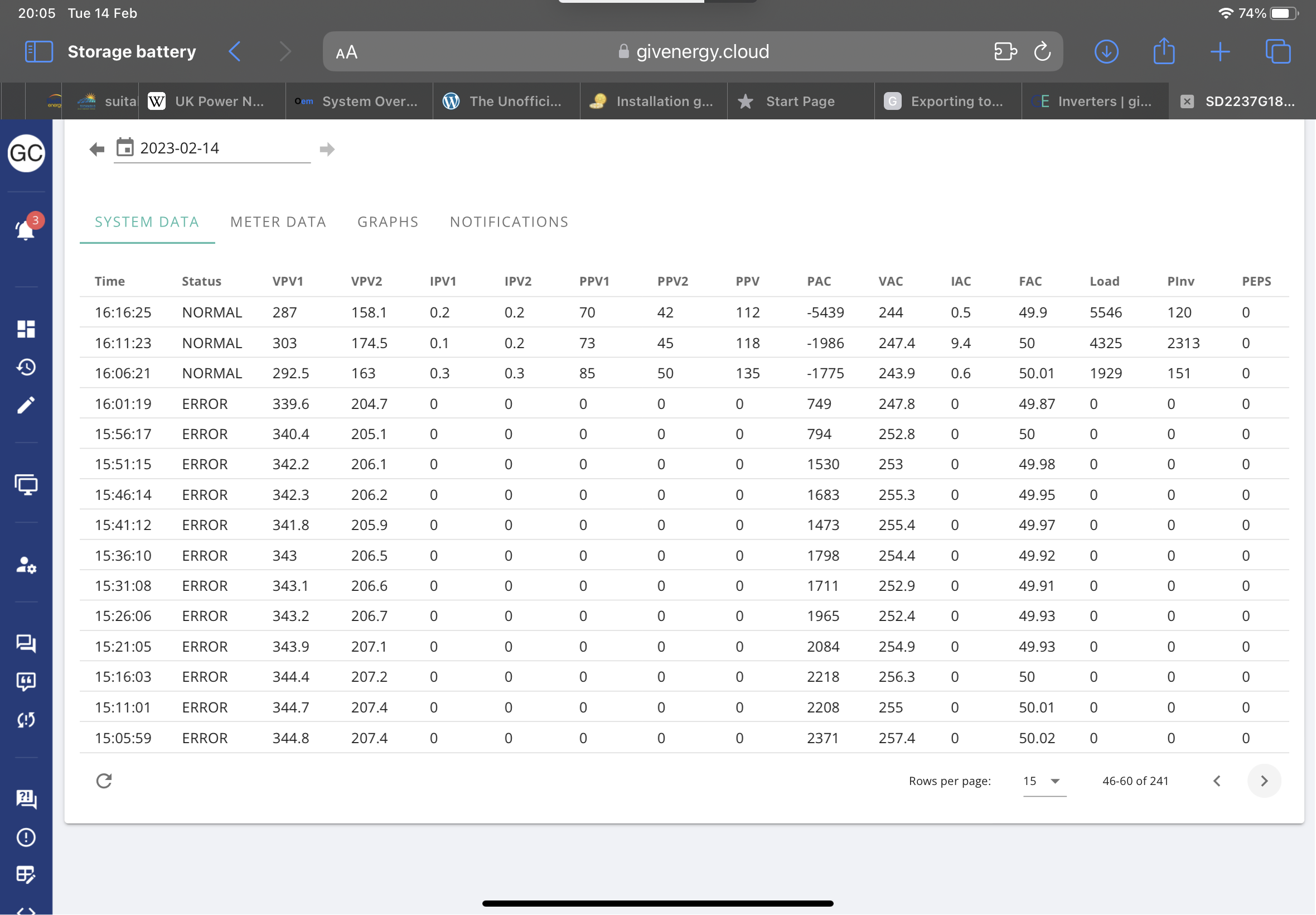
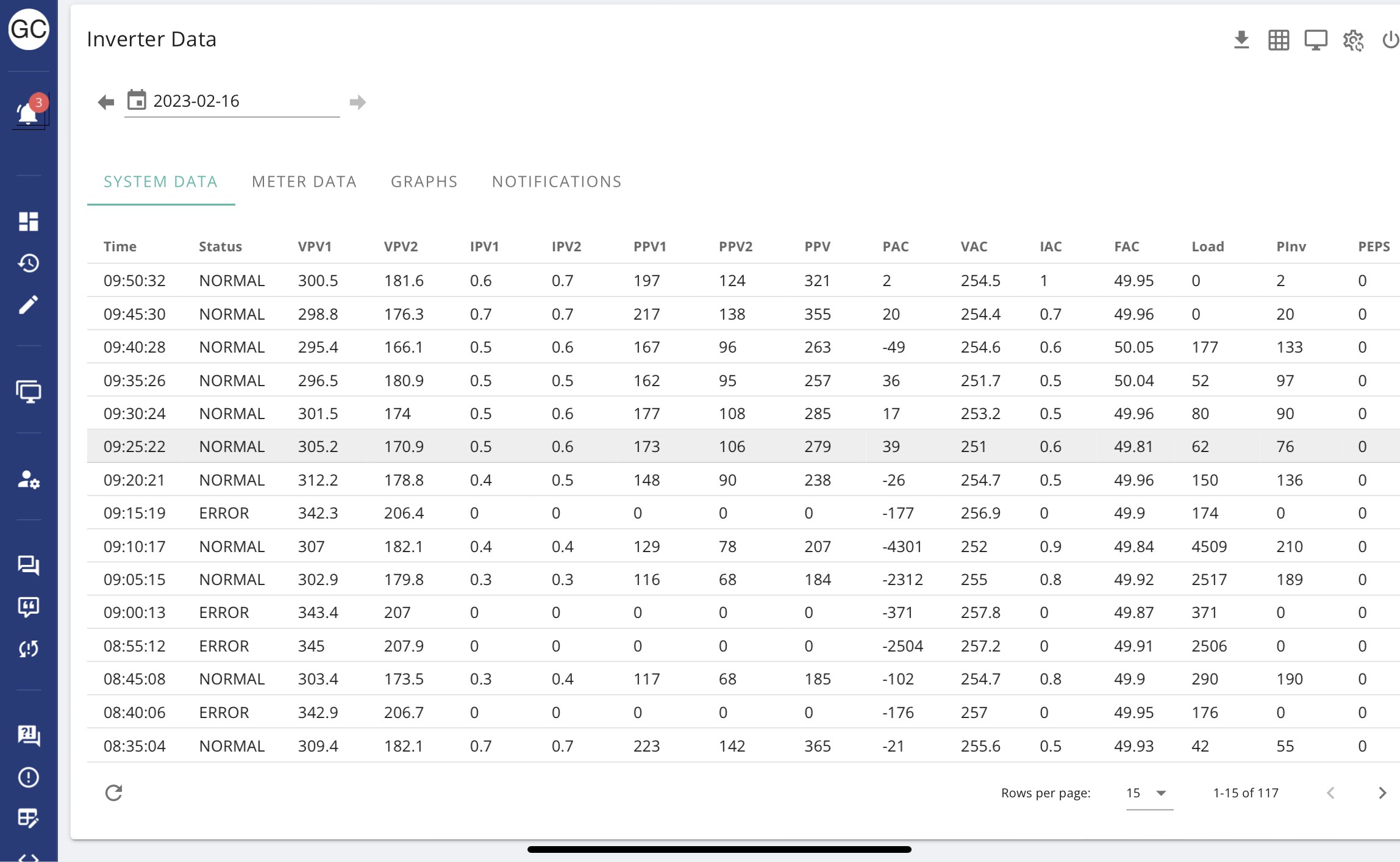
I see now on the inverter data that it was in error status for the afternoon. Now back to normal; probably around the time I turned the battery back on?
I’ve reset the inverter to default settings as you suggested.

Thanks

S
#4 SilverArt

geoffreycoan Apologies, I should have said "Power Graph" view

G
#5 geoffreycoan

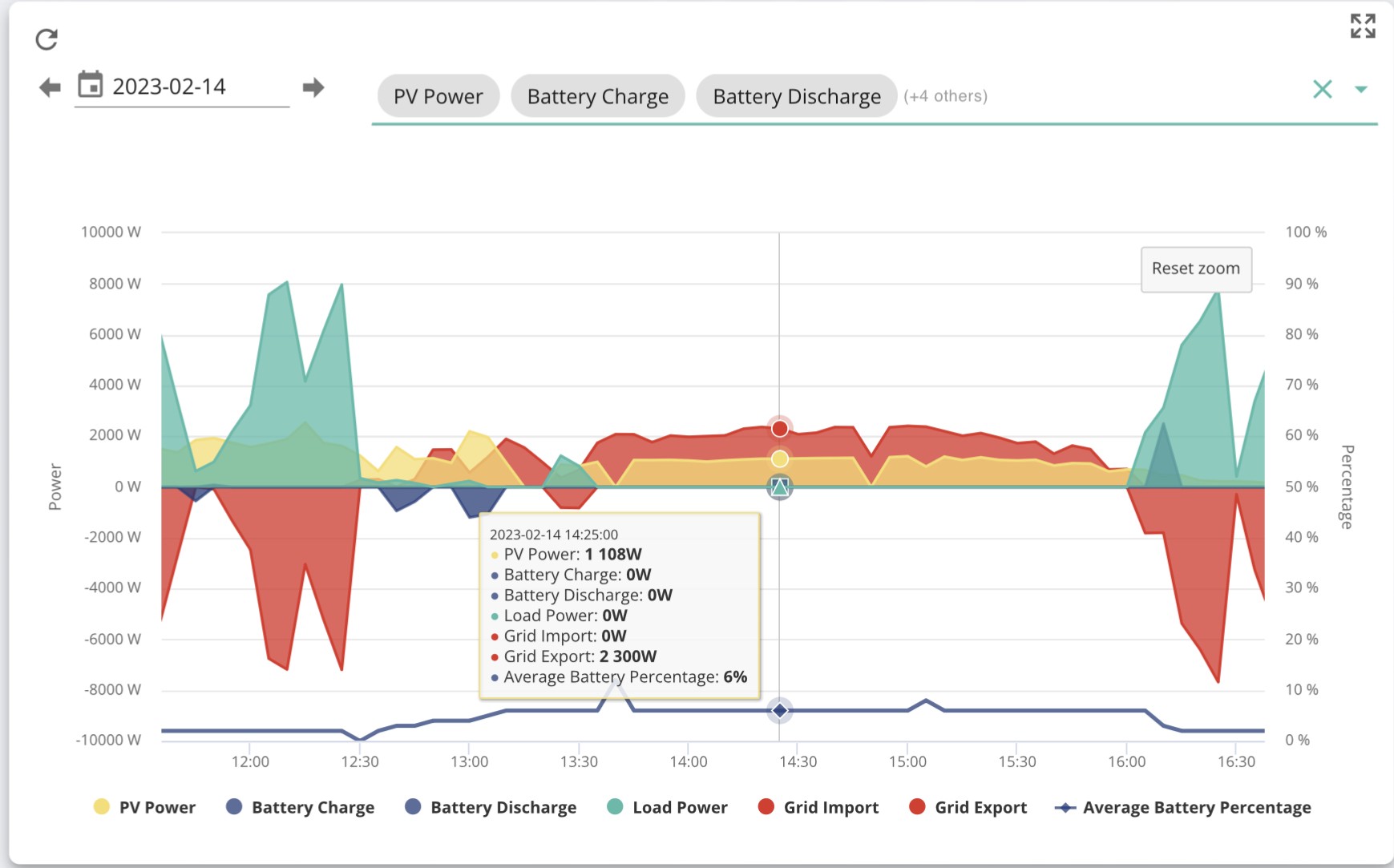
No problem. Here is the Power Graph view from the portal for yesterday afternoon. It does look like the inverter got itself confused because through the afternoon it was reporting zero home demand and zero grid import which can’t be right.

My theory about the inverter ERROR status corresponding to the period in question may not be right either, because today I see quite a few periods where the inverter shows ERROR, then NORMAL, and back and forth again. Is this indicating some underlying issue or is this normal?

The inverter was working much better today after the power cycle on the battery and inverter reset to defaults. We had our heat pump turned off all morning as a plumber was changing a radiator. With little house demand the battery filled to 100% for the first time ever which was good to see.

S
#6 SilverArt

geoffreycoan I may be totally wrong but it looks like the current values in IPV1 & IPV2 are out a long way.. Here is my 13:13 readings from yesterday. What kWp have you got on each string?

Time........ Status .... VPV1... VPV2.... IPV1....... IPV2 .... PPV1 PPV2 PPV PAC VAC IAC FAC Load
13:23:30 NORMAL 254.7 .... 0 ......... 10.3 ......... 0 ...... 2626 ....... 0 .. 2626 -3 250 0.4 50.09 2607

G
#7 geoffreycoan

SilverArt I have 28x 390w panels, 2x 5kW Gen 1 Hybrid Inverters and 1x 5.2kW Battery (with a second 9.5kW awaiting installation).

There are 16 panels on one inverter and 12 on the other; the installers told me which was powering the front/back and which the front panels, but I promptly forgot! I don’t know the string configuration for sure but looking at the way the panels are arranged I think there’s 4 strings (across the 2 inverters) split as 2.34kW, 2.34kw, 2.34kw and 3.9kW and this inverter is connected to a 2.34 and 3.9kW string.

What is IPV1 and IPV2 measuring, I don’t know what ‘normal’ is?

I also have an existing 4kW (16x 250W) FIT array on the back of the house with a Growatt inverter that separately feeds into the house. Unless I got an AC coupled battery or changed the inverter I couldn’t feed it into the new GE installation. The GE installation totals 10.4kW and the existing 4kW so I was expecting roughly 2.5 times the solar generation from the new array, and that’s about what I am seeing.

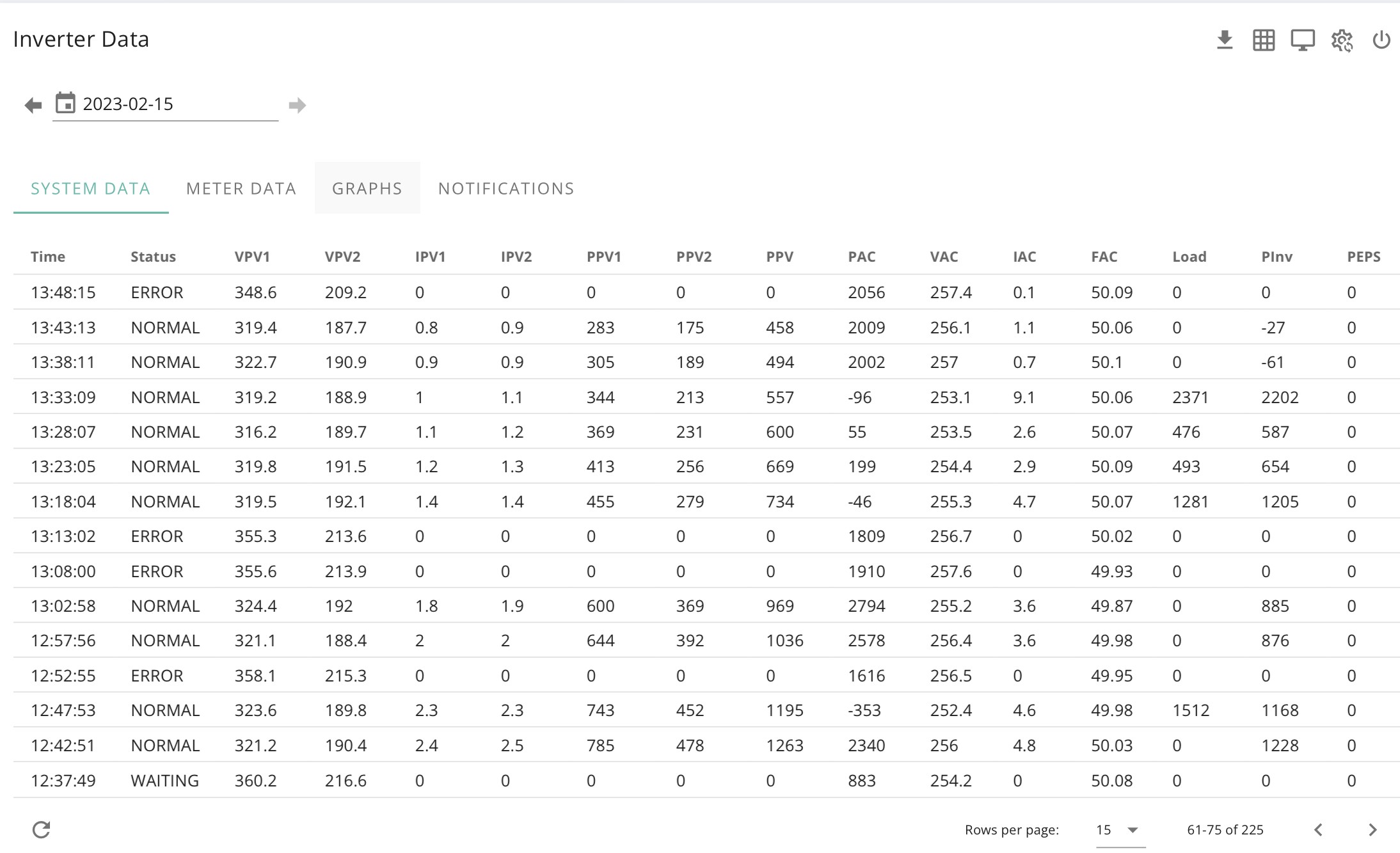
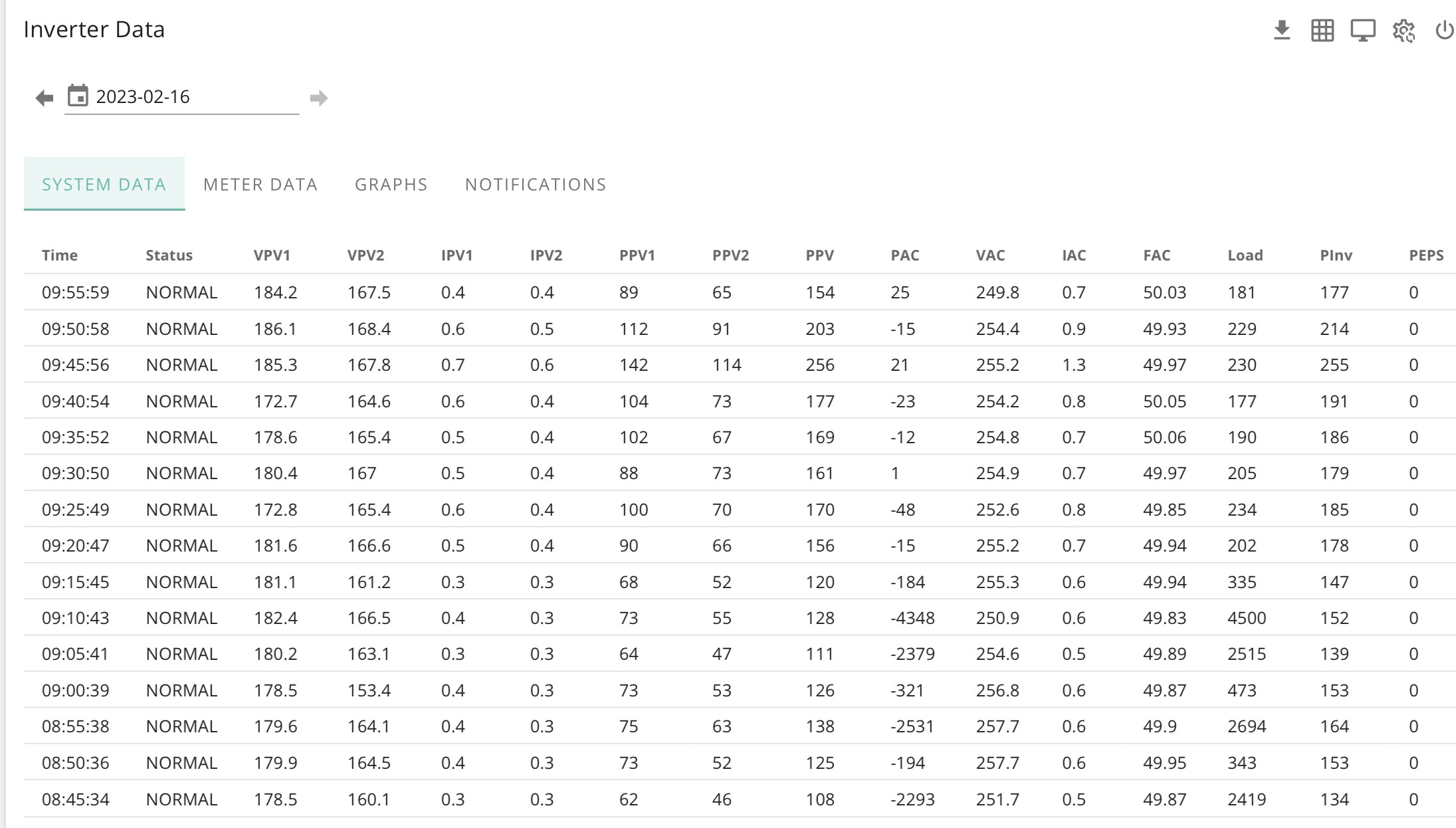
Today is a grey day so not so much solar. Again I am seeing repeated ERRORs on the inverter status, 4 so far in this one hour period, of which 3 correspond to ‘grid voltage fault’ being reported on the notifications for the inverter. This seems a lot of errors:

Here’s the same data from the other inverter (which doesn’t have the battery connected and I think has the 2.34kW and 2.34kW strings). Its not showing any errors so far today but is showing 4 grid voltage errors yesterday.

S
#8 SilverArt

geoffreycoan I would suggest that if the installer is not coming out today then you should contact GivEnergy direct.

S
#9 Slartibartfast

Grid Voltage Fault - What was the grid voltage at the time? The limit is about 255VAC - if your inverters are exporting they will drive up the voltage at your local transformer. Have you got a G99 limit? Any export limitation? If your 'normal' grid voltage is above 240VAC you may have a problem. Your DNO may have to re-tap your supply. Beware that the DNO takes months to do anything (well mine did) - or if its a true grid overvoltage they may force you to turn everything off.

C
#10 cluelesscris

Slartibartfast Hmm, this was not my experience when I first had my panels installed. About a week in the inverter reported Grid over voltage and after chaking woth my installer, I reported it to the emergency line at the DNO. A van was out within an hour and changes made at the local transformer within two hours. I was given a form to report any damage to any onsite appliances so I could claim compensation. I didn't need to but I am pretty sure the DNO is responsible for keeping grid voltage within range and they should take it very seriously if your supply goes awry.

T
#11 Tim

cluelesscris They are but if there's a fair bit of micro generation using your transformer, then that might explain why they are being driven by the G99 limit rather than the grid voltage. I wonder if it would be useful for Givenergy to have two limits on export: one being the G99 power limit (often 3.68kW); and the other being grid voltage limited to 230+10%=253V. That would prevent anyone from seeing over voltage due to micro generation and also stop my Zappi from tripping on over voltage.

G
#12 geoffreycoan

Slartibartfast Looking at my DNO approval it doesn’t mention G99 but it does say G100 and I have no export limit:

Generation Details
Agreed export capacity (including G100 devices) per phase: 10.00 kW
G100 export limiting scheme on premises? No

Now you point it out I can see that the errors correspond to when VAC (supply voltage I assume) is greater than 255V. Curiously inverter 1 is reporting errors tha inverter 2 and there are occasions when inverter 1 records an error when inverter 2 doesn’t. For example at 6:15:31 yesterday morning inverter 1 recorded 258V and an error but at 6:15:57 inverter 2 recorded 259.3V but no error?? Its as if the sensitivity of the two inverters is set differently. And 6:15am you wouldn’t think it was local microgeneration?

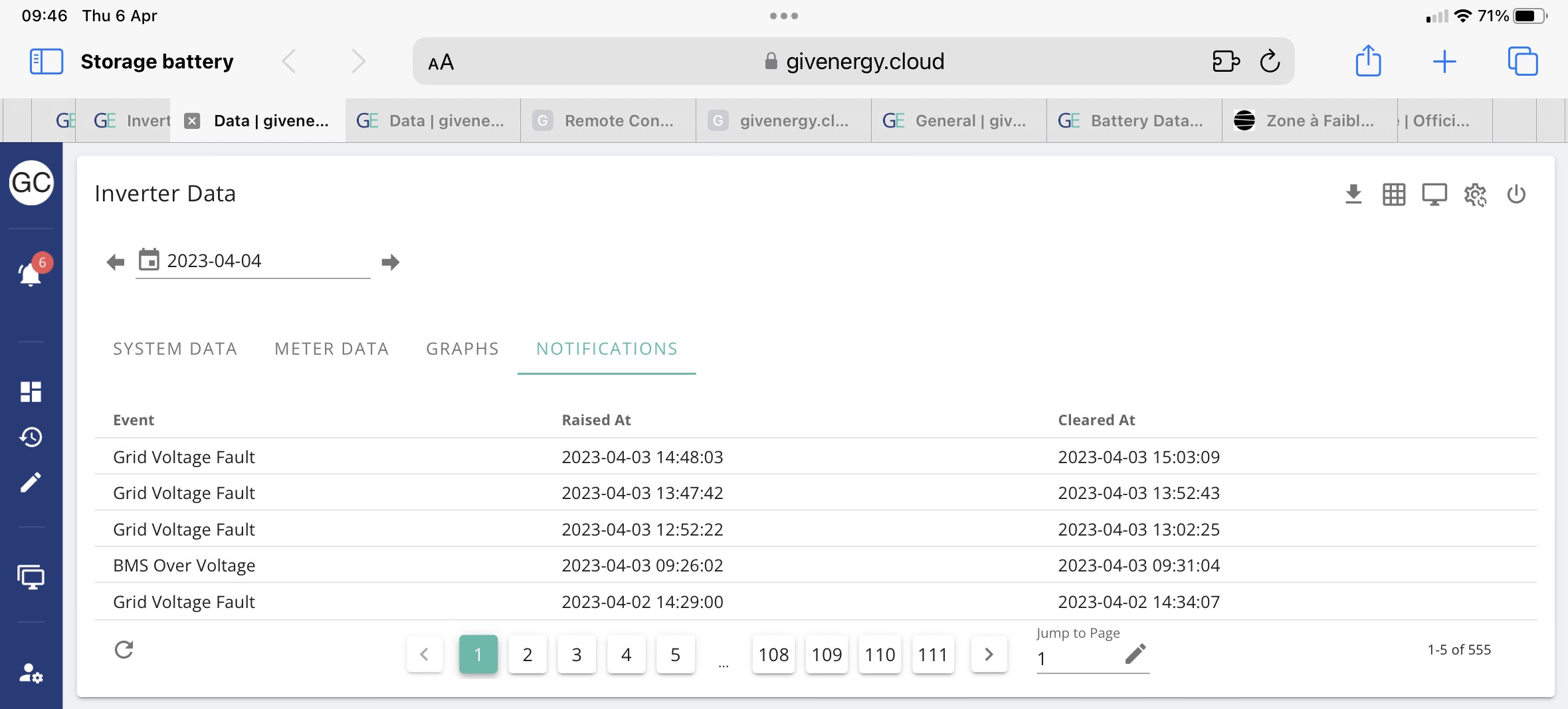
I’m happy to contact the DNO if this voltage over-supply is an issue, or is it GE as the inverter sensitivity is wrong?

SilverArt you suggested I should be contacting the installer or GE. What issue am I reporting, is it that the IPV1 and IPV2 is abnormally low?

Only had my system installed last month so its all new to me.

Thanks!

T
#13 Tim

geoffreycoan Wow! 10kW and no export limit. There must be a dearth of other micro generation in your vicinity or the local distribution network was designed with this in mind. Mind you, your new installation is 2 x 5kW but you also have an existing FIT 4kW installation which (AFAIK) ought to have been included in the G100 because the DNO is interested in the output from your premises, which could be as much as 14kW in theory.

G98 (less than 16A) and G99 (more than 16A) are being superseded by G100 (covering all micro generation less than 50MW I think) for new installations in May this year. Givenergy and other manufacturers are getting their devices type tested to G100 so that they tick the boxes for new micro generation. Yours is in the cross-over but your installers have used the route applicable to the inverter type testing.

We also have 2 x HY5 gen1 with 32x390W panels, all just west of south facing. Last summer we did generate the full 12kW albeit for less than an hour; the batteries weren't fully charged, the EV was charging at 7.3kW and we were exporting at the same time. Our export is limited to 3.68kW which the inverters share gracefully. As long as the car is connected and awaiting charge before export starts, the voltage stays within limits. If it isn't I usually have to reset the Zappi before it diverts the export. I've spoken to our DNO but they were decidedly uninterested. Mind you the letter from the DNO agreeing to ur installation specifically states a supply voltage of 230 +10%/-6%, so I may try again later this year.

The over-voltage may be a local distribution issue, or it could be your inverters.

geoffreycoan And 6:15am you wouldn’t think it was local microgeneration?

Depends on where you are. Could there be local wind or hydro micro generation? Is someone exporting from storage to supply the morning peak? Alternatively, is there a local industrial unit or factory using a heavy load that is usually constant but has tripped or shut down unexpectedly.

IMHO, I think it would be useful to speak to your DNO about local voltage fluctuations and see if there are other micro generators nearby. Also speak to your installer about whether the G100 application included the existing FIT and whether it should have done? It will be worthwhile speaking to Givenergy about what causes the logged ERROR status.

S
#14 SilverArt

geoffreycoan The reason I suggested the installer, or GivEnergy if the installer is not being co-operative, as they should be the experts. It could be as simple as a CT clamp the wrong way round, or it could be the Inverters fighting each other or anything else for that matter. That said, it is obviously wrong and it shouldn't be your responsibility to resolve it, However, it is a good way of learning about the system!.

S
#15 Slartibartfast

My inverter used to trip at about 255 VAC. Would re-set itself when the Grid Overvoltage went away - typically about ten mins later. As for the DNO being slow - the initial visit was the next day. He measured the grid voltage - 248VAC. Next week he fitted a recorder. The delays came when they had to schedule the 'works'. First attempt they found that one of the xformer isolaters had gone. So they had to re-schedule said works. Finally I've got 238VAC. However when there is a house load of over 14kW the supply voltage drops to the low limit - 218.5VAC. The joys of living in a village with a xformer up a pole ...

P
#16 pacemaker

Slartibartfast

I'm worried I might be in the same boat... village and dodgy grid. My SE inverter is getting replaced as it's throwing DC/AC over voltage errors every time I go over 1.5kW generation. Really hoping that the new one doesn't do the same, otherwise I'm looking at the grid. I have measured it at the closest point to the inverter when it "tripped" and it was a steady 240V, so maybe it just is a bad inverter...

G
#17 geoffreycoan

Tim Thanks for your reply. Yes I was a bit worried that a 10kW system would end up with some form of limiter on it, and it took ages for the DNO to process the approval, but it came through clean and with no limits required.

I did query with my installer why it didn’t include the existing 4kW FIT array on the potential output and they brushed it off, saying that the DNO approval was for the equipment they were installing and the DNO would already have a record of the first array. I’m not convinced that they’re anything like that efficient but didn’t pursue it …

The roof ridge is aligned almost North/South so we should get solar generation over an extended period as the sun moves round. I planned to get as many panels fitted as I could do whilst the scaffolding was up which is why I had 28 panels fitted. On the back (West facing) it was a tight squeeze to get the extra 6 panels in and maybe I could have got one more in. On the front (East facing), in hindsight I could have got 5 more in but I might have then be butting up against inverter limits and its just not worth it.

I will talk to my installer about the inverter errors in the first place, see what they say. If not I will try GE and then the DNO. Its strange that one inverter is recording several more than the other inverter. My DNO approval doesn’t state the supply tolerance but there is a standard they have to comply to, and looks like I am going outside it quite often. Got to ask them about the DNO approval for the 9.5kW battery anyway.

We’re in a rural village that is supplied by 3 different sets of above ground cables (in strong winds you can get 1/3 of the village off but the rest still on). There’s no real industry here to speak of other than farms of course. The over voltage errors all appear to be occurring in the day.

G
#18 geoffreycoan

cluelesscris
I think I have now got to the bottom of what is going on with my install and why I am getting grid over voltage errors that knock the inverter into error status, sometimes for hours and hours on end - even when the VAC figure on the portal drops to ‘normal’ levels the inverter frequently remains in error state for much much longer. Sometimes I spot it and restart the inverter from the portal which then gets it going again

e.g.
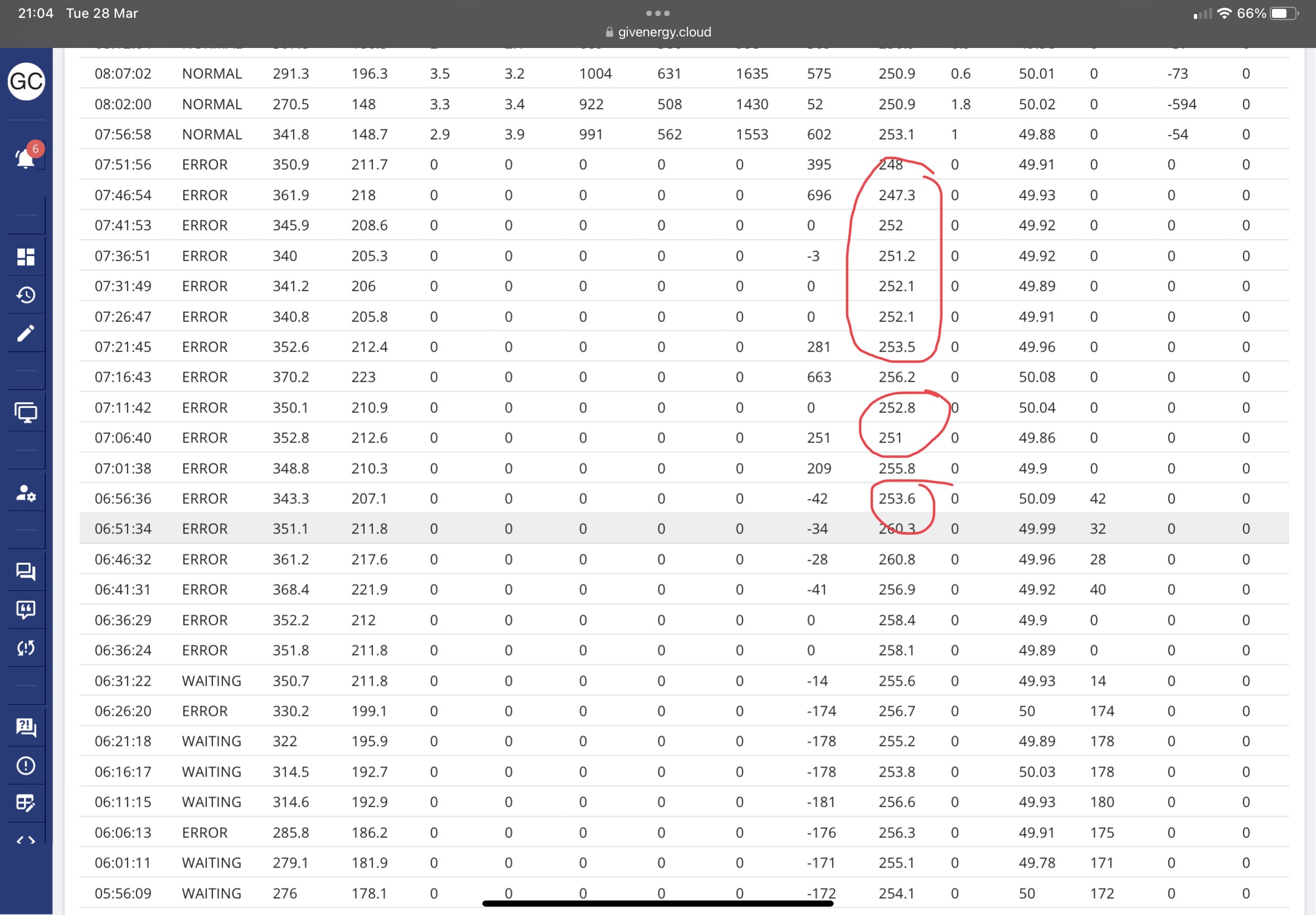
There are I believe two problems. One is a sporadic supply over voltage, these usually only last 5 minutes or so and can be seen at odd hours of the morning or night. When I have fixed/got a way forward with the big problem (see below) I will probably raise these with the DNO, but for now these are not my real concern.

My big issue is the number and length of what I can only call self-induced over-voltages. These happen a LOT and for a long period of time, and I think are happening more frequently. I’ve had 518 notifications since January on the inverter that has the two batteries connected and most of these are I believe self-induced.

Our system comprises of 28x 380w solar panels (plus a separate 16 panel 4kW Growatt inverter FIT array) and as there are so many panels the installer had to fit two 5kW Hybrid inverters with the panels split across the two inverters. As of two weeks ago I now have two batteries, a 5.2 and a 9.5, both connected to the inverter with 16 panels on it, with no batteries on the other inverter (with 12 panels).

Basically its the second inverter that’s dumping its AC power into the house that is causing the over-voltage and is knocking the first inverter into an error status.

When I turned the second inverter off the first inverter then ran for the remainder of the day and all the next morning there were only 3 over voltage errors, all of which cleared within 5 minutes. But when I turned the second inverter back on I had 11 further errors this afternoon, some of which were 10 or 15 minutes long, and today was a grey overcast rainy day so little solar. Turning the 4kW FIT array off didn’t make any noticeable difference to the over voltage errors so I have been able to leave it on.

I now know that this is called a plant setup and GE don’t recommend it. I spoke to their technical support today and they mentioned the ‘in manufacturing’ box to enable the multiple inverters to talk to one another, but at the moment as the guy explained to me, the two inverters are not communicating to each other in any way which is why GE don’t recommend it. Also of course the AC power generated by the second inverter has no way of being stored in the battery as both batteries are connected to the first inverter. I did ask about moving splitting the batteries across the inverters (and have seen other forum posts where the batteries keep charging and discharging each other) and GE didn’t advise that. Their advice was to leave the second inverter turned off.

I am waiting to receive a call back from my installer to see what they have to say about why they’ve designed and installed a system that GE’s website FAQ’s says they don’t recommend. Turning the second inverter off is not something I really want to do but if it means that at least half of the system works and can charge the batteries from solar then it is something, but means I have a paid for a lot of kit thats going to be turned off until GE produce this plant solution.

☹️

T
#19 Tim

geoffreycoan I do wish that Givenergy would properly brief their staff about multiple inverter installations! They have one configuration for multiple inverters which is multiple AC3s connected together over Modbus with one AC3 configured as master and others as slave devices. This configuration can work but not as slick as they would like. I am not aware of anyone with a Givenergy hybrid and a Givenergy AC3 but there are plenty of people with other manufacturers Solar inverters with a Givenergy AC3 and they work just fine most of the time other than odd Charge to % and SoC drops, the same as everyone else. The third combo is what you and I have; dual hybrids. This is not a recommended configuration but ours just work because they know nothing of each other.

Thinking about the configuration you have, it would make sense to me to have half the PV on each side of the house connected to each inverter so they both see some early morning PV and also late in the day. I’d also make sure that each had battery storage (otherwise an AC-coupled would suffice). If this configuration threw up over voltage caused by one of the inverters, I’d be looking to Givenergy to sort out the hardware or firmware as @TheDragon (GivEnergy) posted a week or two back, the inverters should limit themselves to 2-3V above grid for export purposes but with a firmware stop (for UK at least) of 253V.

S
#20 SilverArt

geoffreycoan I had a similar situation last year, a call to the DNO telling them that I was seeing over voltage errors (256.1) solicited a very quick response. Engineer checked here and then beetled off to check the local substation. Within a few days there were no more errors.

S
#21 SilverArt

Tim This is not a recommended configuration but ours just work because they know nothing of each other.

That's the same as your neighbour 3 doors down with solar who's on the same phase as you are? The controlling factor is the grid voltage, After having the overvoltage problem here (Growatt 6kW Inverter and GE AC3) I just keep an eye on what is happening and can certainly see the challenges the DNO's have in terms of voltages as the solar contribution goes up.

T
#22 Tim

SilverArt I agree about the coming ubiquity of renewables and the fact that the DNO has no say in what goes where, just the responsibility of making sure that the system is secure and reliable. I was unaware until a couple of weeks ago that inverters (for the UK market) have a firmware high voltage stop. Question is, are all inverters configured with this stop enabled? My Zappi cannot be relied upon to charge the car while we are away from the house because it trips on over voltage regularly. Last week it was 258.3V, a pretty regular trigger level. This week it was 262V. When I checked my inverter logs for the period I had been out, it never went above 250V in the 5 minute log. I can see other properties with solar on from ours but I know that they are from a separate 11kV pole transformer from our supply. I have contacted the DNO but they were less than helpful, even saying they'd do nothing unless the voltage exceeded 264V! I didn't speak to that individual, just got a relayed message, but I suspect he had his training 40 years ago and didn't get the memo about the supply voltage and tolerances being harmonised with Europe. My DNO agreement letter specifically states 230V±10%. Maybe I need to write to them?

#23 RHardie

I had the same issue with high grid voltage causing problems. What concerns me is the inverter gave no notifications to say it was high. Instead it would just start importing from the grid to supply load instead of discharging battery. It would also throttle back the PV generation when battery was fully charged. Does anyone know the grid voltage value that triggers a notification? The highest mine went was around 256v but this was enough to cause problems but no warning or notification. Before I worked out what was causing it I spoke to GE who looked at the logs and said they needed to send an engineer out. They didnt spot the problem from the inverter data! Then decided to go through the data myself and as soon as I spotted the high grid voltage I reported it to the DNO. They knocked the door within 30 minutes and agreed the grid voltage was at the high end of what is acceptable. An hour later they had replaced the local grid transformer and problem solved!

G
#24 geoffreycoan

Tim I agree, the ideal configuration would be to have the inverters managing panels on opposite sides of the house (my roof ridge is almost North/South aligned) and then using the movement of the sun to reduce the over-voltages.
Unfortunately I can’t do that, partly because of the way the system’s been built as two installations, but more the number of panels I have.
On the back I had a 16 panel 4kW FIT array installed 6 years ago. These are West facing and are on a Growatt inverter.
This year I had the extra 28x 390w panels installed with the GE hybrid inverters. On the back (West) of the house they could only fit 6 panels in and around the existing 16 FIT panels, so that’s one string on inverter 2, and on the front where they installed 22 panels, 16 on the front of the house (East facing) are split into 2 strings on inverter 1 and the remaing 6 panels on the garage roof are the second string on inverter 2.
So in the morning both inverters are lit up.
Do you think getting one battery put on each inverter would definitely improve the situation? Logically I can see that the excess solar would then have somewhere to go but it introduces the risk of the two systems getting confused, both trying to power the house when the load requires it (so more over-voltages) and the batteries charging and discharging each other.

SilverArt great to hear the DNO were so efficient. Looking at todays log, with just one inverter powered on I had three errors at 6:30am, voltage rising to 258.1, but its been stable and the battery charging up OK

T
#25 Tim

geoffreycoan risk of the two systems getting confused

They will know nothing of each other. Switch the kettle on; they both see grid import and start to ramp up. They bth ramp up at the same rate, so the import reduces by 2x the ramp up rate and both inverters should get there at the same time. Same situation when the kettle boils, they ramp down at the same rate and reach the same point at the same time. I've even restarted one inverter after the other, so that over-voltage issues on the Zappi are sorted, and within a few minutes, the two inverters are load balanced again.

As for having two batteries on one inverter and none on the other; where does the inverter with surplus PV put it's output? Answer - to grid, along with the FiT system. Meanwhile the other inverter is charging two batteries but only for the period the sun is in the sky. Personally, I'd put the smaller battery on the system with fewer panels and leave the other with the larger battery. That way, you can get 2.5kW (or 3.6, depending on gen1/2 model) from battery from each inverter for house load and also charge at those rates overnight if needed.

As for over voltage, I think I'm calling Givenergy to ask them to check that our inverters have the 253V firmware stop enabled, if that's how it works.

S
#26 SilverArt

Tim Not knowing the Zappi I had a quick look and it would appear that over voltage errors are not unknown. Could it be a Zappi configuration/calibration problem?

S
#27 SilverArt

geoffreycoan I would suggest that you find a way of physically measuring the grid voltage safely, surely the recent installer can do it if you haven't got a safe way of measuring it yourself.
I wouldn't have thought that the grid would be 258.1V at 06:30am, If you look at the My Inverter > Waffle > Download - the data for the day in question and open it in a spreadsheet and make a graph of column 'J' it may help you get a picture of what is happening? (Grid Data gives the same but I just found a spreadsheet more flexible when I had the problem)

T
#28 Tim

SilverArt Thanks for the pointer. I wasn't aware that others suffer from this safety feature. Do you know what others have done to resolve the problem? I don't want to get into a three-way (no sniggers please) with Givenergy, DNO and myEnergi about where the problem lies (poor inverter voltage control, local conditions, over-sensitive voltage monitoring). ⚡️

G
#29 geoffreycoan

Tim I phoned my DNO this afteroon, UK Power Networks (covers London and the South East).

Working through the options on their website I decided that I would try declaring this as a power safety issue. Helpful guy on the phone, I explained the over-voltage issue, that it was sometimes reaching above 260V and that it was tripping my inverter off, sometimes for extended periods of time. They asked me whether it was causing any other problems in the house, when it first started, and whether it was blowing any fuses (maybe I should have said it was).
Logged it and said that they would send someone round when they were next in the area.

Couple of hours later, unfortunately I’d gone out, and there was a man at my house to look at it! I said he could access the supply meter box as its on the side of the house, he disconnected the master fuse and measured the grid supply at my property. It was when he measured it 256V which he confirmed was high. He said In the UK, the nominal voltage is 230V and the tolerance is -6%, +10%, giving an allowed voltage range of 216.2 volts to 253.0 volts (see https://www.spenergynetworks.co.uk/pages/voltage_changes.aspx)

Interestingly my neighbour was receiving 242V and his house and mine were built at the same time down a small private driveway.

He said they would arrange for someone to do a line test. So its real, notwithstanding the self-inflicted over-voltage from my inverters, I do have a grid over-voltage. Thanks for everyone encouraging me to call the DNO. Not fixed yet but I’m feeling positive.

Update 10pm: Less optomistic now. Two UK Power Networks guys have been out, looking at the supply on my pole. They say it is 253V, which is on the high side but within limits. They asked whether it was my solar system causing it and I explained what was happening and showed them the GE inverter logs, including power peaks at 6:30am and midnight which clearly couldn’t have been from my solar. And that I’d had 240 grid power errors recorded on the inverter since January (the other inverter with the batteries had seen 540 errors).
They said the line tested OK and since it was within limit there wasn’t much they could do, but they did acknowledge the errors I was seeing. They’ll report their findings and maybe see if the DNO can turn the overall transformer voltage down a bit, or replace the transformer as it is an old unit.
I’ll wait to hear…

S
#30 SilverArt

geoffreycoan Well done, a major step forward.
The fact that the first guy saw 256V and line guys saw 253V (the maximum!) I would have thought should prompt them into action. It will be interesting to see the final result.
What may be useful is to take note of what your inverter voltage readings were when they were there whilst you remember exactly when it was. It will give you ready access if you need a comparison in future

S
#31 SilverArt

Tim IMHO there is no reason for a three way argument, you just need to look at the size of the sledgehammer, the grid voltage drives everything. I would suggest that there is no way that one household solar system is going to affect the local grid,, (unless it is the one that breaks the camels back) any extra voltage to generate export would just get absorbed. (Unless of course there is something very, very unique about the installation.
The challenge is having the right tools/experience/confidence to nicely challenge them and as geoffreycoan has found it does work... so far.

T
#32 Tim

SilverArt the grid voltage drives everything

I guess you're saying it lies with the DNO? I agree but they've batted it back and unlike @geoffreycoan I don't have Givenergy inverter log data showing voltages in excess of 253V, even when I know almost exactly when the Zappi tripped. The Zappi isn't any help either as I can't access any voltage logs (AFAIAA) for that and worse, it doesn't notify me when it trips on overvoltage.

geoffreycoan my neighbour was receiving 242V

A simple fix for the DNO is to put your property onto the same phase as next door. Doesn't solve the problem, but moves you away from it. Their issue is that if they change the tap on the distribution transformer, it will be for all three phases, not just yours.

S
#33 SilverArt

Tim In which case what does the Zappi installer tell you? Have you verified that it is set-up/configured correctly? As far as I'm aware the Zappi (I could be wrong) is only a 'load' device therefore cannot influence the grid voltage other than putting extra draw on it therefore
if your GE logs are not showing anything approaching 253V then the problem is more likely to be the Zappi.
My GE inverter tolerates 253.4V if memory serves before it drops out
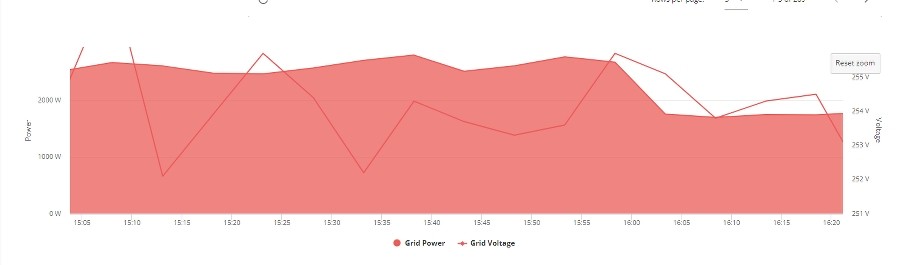
The above is an example of when I had the problem, this was viewed in My Inverter > Grid Data - zoomed into 15.05 to 16.20 the grid voltage peaks are 267.9V, 255.7V and 257.7V
I found it easier to monitor it in a spreadsheet by dowloading the inverter data (My Inverter > Waffle > Yesterday's date - Download) and pasting it into a spreadsheet (after sorting it into ascending time order) that way I could customise the headers to make it more user friendly and also just split out the column that really interested me.
Sad I know, but having started, I do it every day and the overall power trends are interesting. You can see when they're doing grid re-schuffles / experimenting with power saving etc and exactly what the problem is they are trying to manage.

S
#34 SteveCook

I am sure you will have checked this, but when trying to sort the wires on the EM115, the BMS plug was accidently inserted into the CT port.
The portal all worked fine but I kept getting Battery Voltage High readings

T
#35 ToothyChris

I really wish that GE would compile and publish a list of faults and their symptoms. Would save GE and users lots of time.

T
#36 Tim

SilverArt if your GE logs are not showing anything approaching 253V then the problem is more likely to be the Zappi.

Could be, or it could actually be a >253V spike. I don't have any idea whether the Zappi trips on overvoltage instantaneously, or if it has to be sustained for short period. I've never seen the Givenergy inverter logs above 252ish but the Zappi regularly reports tripped at 258 and recently 262V. It's a pity that the Zappi can't notify me of it tripping on overvoltage, or at least logging the fact, as that would be useful.

S
#37 SilverArt

Tim Tim, ever so sorry to repeat myself but: In which case what does the Zappi installer tell you? Have you verified that it is set-up/configured correctly?
Faulty Zappi?, Bad connection? Faulty CT clamp?
I really would be surprised if you were getting that number if over voltages on the Zappi and not seeing at least some of them in the inverter logs.
Doesn't the Zappi App. provide any assistance?

G
#38 geoffreycoan

Tim A simple fix for the DNO is to put your property onto the same phase as next door. Doesn't solve the problem, but moves you away from it. Their issue is that if they change the tap on the distribution transformer, it will be for all three phases, not just yours.

Yes we did discuss that option with the linesman. There’s a pole at the top of our drive from which an underground cable runs to our house and next door. Somewhere along the cable there’s a tap off with next door receiving one phase and us receiving another so the system was balanced.. Two of the three phases were high, next doors was OK.
Moving us to another phase would mean doing a dig for the DNO.

I have seen high grid voltages at all times of the day and night and I showed the linesman the GE inverter logs on my ipad. He could see that there was a spike at midnight one night for example. It was suggested that some of the high voltages could be caused by neighbouring solar installations and it occurred to me afterwards that he really should be measuring the voltage during the day which is when I care more about the issue. The inverter occasionally erroring at midnight I am not really bothered about as long as its transitory.

I believe the DNO can put a voltage recording thing on your house to capture voltage over the day. I also could just read it myself with a multi meter and note it down periodically. Will have to see what the DNO and my installer do

T
#39 Tim

SilverArt Faulty Zappi?, Bad connection? Faulty CT clamp?

The Zappi works fine except on days when there's lots of sunshine and it's not in use when sometimes it trips on over voltage. If the EV is plugged in in the morning on a very sunny day, it'll charge up fine as though it's holding the voltage down by consuming energy. So I don't think the Zappi per se is faulty. A bad connection would manifest itself as a low voltage under load, which isn't happening and a faulty CT clamp would not cause an over voltage trip, just get the grid export divert wrong.

The Zappi installer also did the PV system and it is set up correctly. The Zappi app provides no logging as far as I can see. The Zappi's protection is compliant with the regulations for EV charging installations which require it to trip "... within 5 seconds if the voltage at the charging point between the line and neutral conductor is greater than 253 V rms or less than 207 V rms".

The issue is whether a voltage in excess of 253V which would cause the Zappi to trip, is actually happening (not logged in the Givenergy portal), or if the Zappi's protection is causing it to trip at a lower voltage. The Zappi LCD panel indicates over voltage trip at (usually) 258.3V, so it evidently is measuring that value, but whether it is correct or not I don't know. If 258V is actually being applied at the consumer unit, then that would suggest to me that the inverter is pushing out 258V during export, but such high voltages aren't being logged in the Givenergy portal. That is why the DNO is saying it's not their problem, Givenergy saying their inverter just wouldn't do that and I haven't bothered asking Zappi why their charger is tripping on over voltage in compliance with the regulations. The only resolution I think would be to put a calibrated voltage recorder on and see what the actual voltages are, but DNO aren't interested.

S
#40 SilverArt

Tim Multi supplier environments are always very difficult, in some ways exactly why there are the installers sat in the middle.
So, what is your installer doing to help fix the problem with the equipment he has installed?
Simple step might be to get a low cost power monitor £21.99 (or less) on Amazon for example, looks as if it might do the job? NOTE: I haven't tried it myself and it would need careful use by the look of it. You obviously need to break the deadlock somewhere. (AC 80-260V 100A Current Voltage Amperage Energy Meter Monitor)
It is CT clamp monitoring device so I guess you could get readings from the various contenders!

Also thinking about it some smart plugs will also give voltage reading, never tried it, but if you have one that does perhaps you could use it to do the monitoring.

T
#41 Tim

SilverArt Thanks for your help. I haven't been in touch with the installer as it's all working just fine except when there is an over voltage trip of the Zappi. There's nothing amiss with the installation; it's the local distribution network, the inverter or the Zappi that's causing the trip.

However, your suggestion to use smart plugs is useful. I have been able to use Home Assistant to review voltage logged there from the Zappi over the last month or so and can see voltages recorded by the Zappi in excess of 255V. When I checked the same period on the Givenergy portal, the Grid data was showing about 251V but the inverter Data was showing 254.9V. Now I know I can ask Givenergy to check the inverter settings to make sure it doesn't output in excess of 253V. Nice one!

S
#42 SilverArt

Tim Right. I thought you said that you didn't see any excess grid voltages in the GE logs. so now.
OK a polite call to mr/ms/other DNO I have two electronic devices that record the Grid Voltage, both are showing me voltages in excess of 253 volts very regularly and it is causing one of them to regularly trip out. I'm extremely worried that there is a safety hazard due to the excess voltage. What can be done about it please?
Hopefully it will get some positive action. The problem is high Grid voltage, not the GE kit, it is only reacting to the Grid voltage which is too high in the first place.
Remember, that when you are getting solar benefit so is everyone else in the area which makes matters worse, so downrating your GE kit will not help the problem, the sledgehammer is the Grid

T
#43 Tim

SilverArt didn't see any excess voltages in the GE logs.

I needed a clue as to where to look, although I could have downloaded every day's data to an excel spreadsheet and filtered on voltage.

SilverArt The problem is high Grid voltage, not the GE kit,

No, the grid voltage (EM115) is saying 251V (high but within spec) when the inverter is pushing 254V. The problem is on my side of the DNO fuse, caused by the inverter pushing voltage above 253V, which it is not supposed to do (according to @TheDragon (GivEnergy)). It's Givenergy that I need to speak to to get them to check whichever register it is that has the 253V limit in and make sure that voltage limiting is enabled.

G
#44 geoffreycoan

Tim The problem is on my side of the DNO fuse, caused by the inverter pushing voltage above 253V, which it is not supposed to do (according to @TheDragon (GivEnergy)). It's Givenergy that I need to speak to to get them to check whichever register it is that has the 253V limit in and make sure that voltage limiting is enabled.

Why would GE inverters ever push out more than the ‘allowable’ limits. Surely they should be automatically limited to 253V? I can’t see this setting in the portal but am wondering whether this is a contributary factor in my over-voltage issue?

S
#45 SilverArt

Tim OKI think I can see the cause of the confusion.

To export excess solar power the inverter has to present a very slightly higher voltage to the grid to enable export to happen and that is what I think the "Inverter AC Voltage" is reflecting. In the grand scheme of things in itself it is a toffee hammer that has absolutely no affect on the sledgehammer of the grid voltage, it just allows the current to flow out, the 'excess voltage' just gets absorbed, leaving the grid voltage exactly where it was, well perhaps up by a miniscule amount but in itself not enough to cause a problem if the Grid is working properly. Reducing the "Inverter AC Voltage" if if were possible would just stop you exporting at times and not touch the Zappi problem, it would still be there.

The challenge comes when the grid voltage is set on the high side as in geoffreycoan DNO acknowledged problem and the transformer phase requires a tap change if that is possible (or it may mean the transformer needs changed in odd cases) to reduce the Grid voltage so that the Grid can stay within limits. and I strongly suspect that is what is needed in your case.

Happy to be proved wrong but I really do think you need to get the root cause fixed.

S
#46 SilverArt

geoffreycoan

geoffreycoan Why would GE inverters ever push out more than the ‘allowable’ limits. Surely they should be automatically limited to 253V? I can’t see this setting in the portal but am wondering whether this is a contributary factor in my over-voltage issue?

They don't "push out" as such, they present a voltage to the grid to enable current flow and that effectively gets absorbed by all the users of that part of the grid. So, assume a 1000 usera and you want to export solar you present Grid+2V to the grid and the current flows out, that immediately gets grabbed by the 1000 users so the Grid in this case goes up by .002V, possibly a massive over simplification but it gives the picture.

The challenge the DNO's have is that with more and more people adding solar, and with solar farms springing up, the overall Grid voltages are increasing and they have the challenge of keeping them balanced.

S
#47 SilverArt

SilverArt Edit: Just had one other thought... Could it be the positioning of the Zappi CT clamp, or routing of the wire? For some reason causing it to read high?

Tim

#48 Simon_C

SilverArt , no because the CT clamp only measures the current passing through the cable it is clamped around. The Zappi will have a separate voltage measuring device built-in, and like all electronic devices will have tolerance of accuracy to the actual.

Only by comparing with a calibrated instrument (with it's own tolerances, but much smaller error) will the accuracy of the Zappi voltage measurement be known.

T
#49 ToothyChris

Just a thought.......if there is a slightly high resistance in the feed in from the grid (e.g. a bad connection in the meter box), this might force the inverter to put out a slightly higher voltage than otherwise needed. This in turn might cause the over-voltage trip.

You could probably test this theory (if you are comfortable with measuring mains voltages), by seeing how much the grid voltage falls (measured in the house somewhere), when you turn on a high load like an oven. But you would need to turn off/isolate your solar/battery system first.

Or could it be in the GE wiring somewhere?

T
#50 Tim

SilverArt OKI think I can see the cause of the confusion.

I don't see any confusion. On a dark night, the grid voltage peaks at 242-245V. During the day, micro generation local to me, on a sunny day all vies to export to the grid. If all of the micro generation inverters behaved well, none would exceed 253V but at some point some or all would reduce output to ensure that the 253V ceiling was never exceeded. Our grid (EM115) voltage, under these conditions rarely gets above 252V but our Givenergy inverter reported voltage and the Zappi voltage both exceed 255V. The DNO looks at the voltage at their transformer and it's within spec. If voltage rises to 253V, they'll probably actually see reverse power (LV side of the distribution transformer feeding the HV side). The issue I am observing is either one of a difference in voltage calibration of the various devices, or the Givenergy inverter is not behaving in the way in which it is designed to; maybe it isn't set up for UK maximum voltage operation. Asking the DNO to change the tap on the distribution transformer would help somewhat but unless the inverter 253V maximum output voltage is set correctly, it'll still cause problems on the local system.

ToothyChris bad connection in the meter box

This could be a factor but I believe it isn't because the grid voltage is being measured by the EM115 from the consumer unit. All evidence (AFAICS) points to the Givenergy inverter not controlling maximum voltage correctly.

#51 Simon_C

You have very little leeway if the EM115 is accurately reporting 252 V with all your neighbours generating. Any undersized cable, bad connection or bad MCB within your property will result in an over voltage condition certainly at your inverter.

I specifically asked my installer to oversize the power cable to the inverter, not just based on allowed volt drop for current carrying capacity (IEE regs), but also because at the time my grid voltage regularly hit 250 V so I wanted to avoid over voltage at the inverter when it is generating. Since then the DNO has had multiple applications for solar gen in my street, so must have changed the transformer tapping resulting in my grid voltage averaging around 240 V now.

Being competent with a multimeter, I would be testing the operating voltage at various locations under 2 test conditions, one with a large load, and one with large grid export to determine where the bulk of the volt drop is actually located.

Also it would confirm how accurate the voltage readings on the EM115, Zappi and inverter actually are.

T
#52 ToothyChris

I'm not convinced that one, or even a few micro-generation systems in the area could have a significant impact on the local grid voltage. The grid will have a much lower impedance than the micro-generators - unless there is a high resistance somewhere, which would allow a voltage drop (so standard grid voltage on the grid side, and a higher voltage (from the inverter as it exports), on the other/house side, somewhere.

I think Simon_C is right, regarding a multimeter and some static test conditions.

T
#53 Tim

ToothyChris I'll put my (uncalibrated) multimeter on various points when I'm back home to rule out poor connections but the only source for voltages in excess of 253V must be the Givenergy inverter. Even if there was an open circuit between the inverter and the consumer unit, it shouldn't raise voltage above 253V in attempting to export, but it does seem to.

T
#54 ToothyChris

Agree. The high voltage is probably coming from the inveter. But I wonder which measuring point is used to prevent the inverter from exceeding the max. If it is the EM115 meter, then it could be after a poor connection.

If you were exporting 2kW, and there was a 0.5 Ohm bad connection, you would see 4.2 Volts across it. Which could be enough to push you over the limit.

Just a theory though.

#55 hoggy

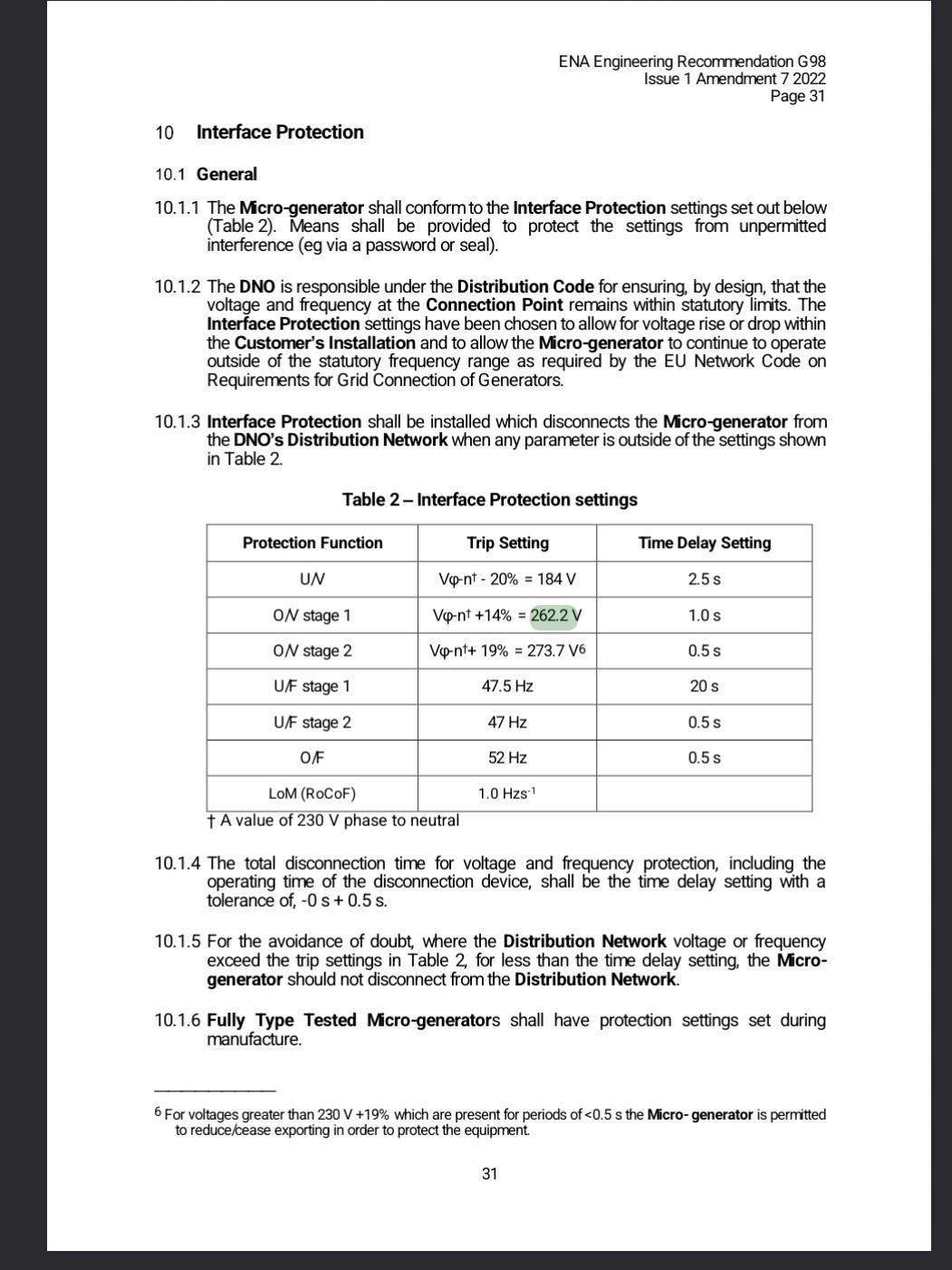
The inverters output is allowed to be higher than the DNO limits for export. 230V +14% so 262.2V
ENA Test Doc here

#56 Simon_C

hoggy , so with 261 V at the inverter, it should not disconnect.

Maybe @Tim needs a higher resistance cable to the inverter, so that the Zappi and other household loads are not exposed to the full voltage from the inverter (just kidding). May be the topology of the power cables could be modified for the inverter and Zappi to reduce the effect.

The root cause is the high DNO supply voltage even if they deem it to be within tolerance. It is rather contradictory for the DNO to give approval for Micro-generator connections knowing they will increase the supply voltage whilst at the same time having the supply voltage so close to the upper limit under no load conditions. In other words they are using the high voltage to restrict how much micro-generation can actually be fed in.

#57 hoggy

Page 62 goes in to more detail of how long they should specifically be able to ride-through but brief excursions up to 261V should not disconnect. Same on the way down it should sync down to 184V. (The internal AC battery chargers do get upset before that lower limit however so it'll likely be doing weird things like no charging or slow charging by then anyway)

It's to stop trip cascades (generator ride-through)
On a larger scale this is what contributed to the 2019 blackout. Generator trip settings weren't flexible enough to ride out big swings while the HV sides auto breaker attempts to reset.
Slightly less important on the high limits but on the low limits what you don't want is everyone's generator disconnecting making a local low voltage situation even worse.

#58 hoggy

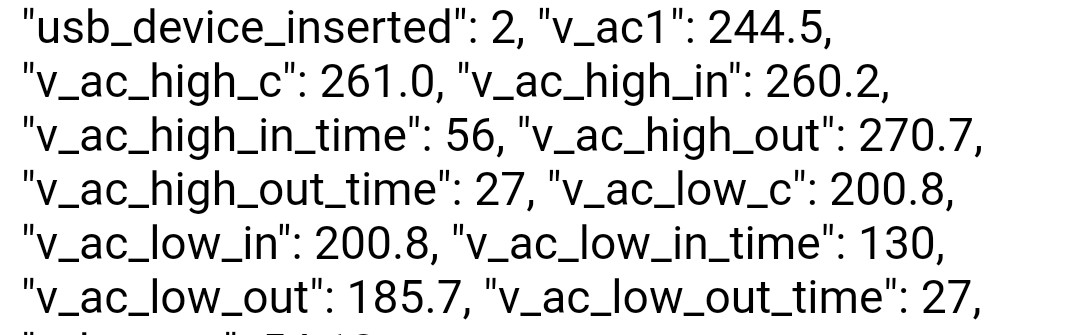
@Tim you should be able to see what yours is set to from the GivTCP raw output:

S
#59 SilverArt

Simon_C

Simon_C so with 261 V at the inverter, it should not disconnect.
I don't think that is what is being said.
I think that there are a few Voltage limits but they do need to be taken in exact context and can't necessarily be directly compared.
For example there is a hell of a difference between load and no load voltages with unlimited shades in between.

The only thing that should really concern us as users is Grid Voltage and I totally agree with your comments on DNO's etc, however, just seeing what happens locally I can appreciate their challenges.

R
#60 Rubikcube

Doesn't help that GivTCP is sorting alphabetically. I think the relevant registers are 63 thru 83. My inverter registers are set as follows (as installed and I have no intention of messing with these!)

063: 1840 Low AC Voltage Stage 2
064: 2740 High AC Voltage Stage 2
065: 4700 Low AC frequency Stage 2
066: 5198 High AC Frequency Stage 2
067: 126 Low AC Voltage Stage 2 Timeout
068: 27 High AC Voltage Stage 2 Timeout
069: 24 Low AC frequency Stage 2 Timeout
070: 28 High AC frequency Stage 2 Timeout
071: 1840 Low AC Voltage Stage 1
072: 2620 High AC Voltage Stage 1
073: 4745 Low AC frequency Stage 1
074: 5200 High AC Frequency Stage 1
075: 126 Low AC Voltage Stage 1 Timeout
076: 52 High AC Voltage Stage 1 Timeout
077: 948 Low AC frequency Stage 1 Timeout
078: 28 High AC frequency Stage 1 Timeout
079: 1755 low voltage
080: 2837 high voltage
081: 4700 low frequency
082: 5200 high frequency
083: 2740 protection voltage

T
#61 Tim

hoggy Thanks for pointing out the raw output and @Rubikcube for the register list. The raw output seems to make sense but the register values? Are they decivolt? eg 2740 protection voltage = 274.0V and 5200 high frequency centiHertz (52.00Hz)?

I do wonder if this is one occasion when our dual hybrids aren't playing nicely together? They both have 3.68kW export limit set but both could be pushing the local phase voltage high as they vie for export against each other? It didn't occur to me until a couple of nights ago. When I get home, I'll run some peak sunshine tests by limiting inverter output on one and then the other to see what happens. If the problem is as simple as that, I can create an automation to dynamically reduce inverter power to say 1.5kW above house load (which would include the Zappi). That way, they will both be able to export at full (throttled) inverter power but within the 3.68kW limit. If that works, it'll solve the issue of why grid voltage rises so high and where the culprit is.

#62 Simon_C

SilverArt , but the local voltage at the inverter can be higher than 253 V, which then has a knock-on effect on the operation of the Zappi.

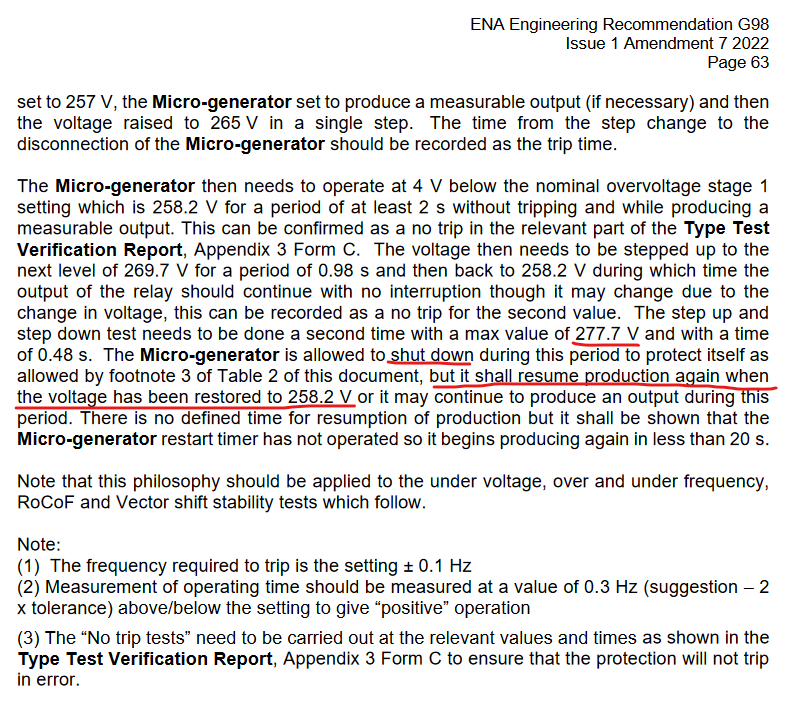
The G98 requirements also include voltages that the device should not trip, certainly this section indicates that after having tripped at 277.7 V the device should resume production again when the voltage has been restored down to 258.2 V which will definitely upset the Zappi.

If the grid feed to the property starts off at 252 V under no load conditions, then any generation by the inverter will increase the voltage at the house CU depending on the cable sizing and resistance of the local installation, but there will also be a slight increase in the grid voltage at the DNO fuse because the DNO feed cable from the transformer to the house does not have zero resistance (low, but not zero).

G
#63 geoffreycoan

Tim As for having two batteries on one inverter and none on the other; where does the inverter with surplus PV put it's output? Answer - to grid, along with the FiT system. Meanwhile the other inverter is charging two batteries but only for the period the sun is in the sky. Personally, I'd put the smaller battery on the system with fewer panels and leave the other with the larger battery.

Thanks @Tim and @SilverArt and everyone else for your input and suggestions, I think I am am now largely sorted with this particular issue. I think it was a combination of the DNO tweaking the transformer and dropped the supply voltage a touch and moving the two batteries so I have one on each inverter which has resolved the issue,

Previously I was repeatedly getting ‘Grid voltage error’ on the inverter notification log. Sometimes middle of the night but more often during the day presumably when both my solar and other neighbouring solar were taking the grid voltage (VAC) sometimes up to 260V. The inverter would go into error state and stick there sometimes for hours and multiple errors a day. Resetting the inverter would clear the error until the next time it happened. My inverter log shows 550 errors since the system was installed on 7th Jan 2023!

Since 31st March I have had 6 Grid Voltage Errors. Some days without any, and the errors I have had have lasted 5-15 minutes, not hours. The 3rd of April which was a clear sunny day was the worst with 3 errors, but even these were short lived. For the first time both batteries fully charged in the morning of the 3rd and after that the system worked as I would expect it to, drawing from the battery as the heat pump kicked in in the afternoon, charging the battery back up when the demand was lower, and only exporting the excess when the batteries were full.
Even though the two inverter setup isn’t recommended by GE its now been flawless and I am a lot happier. Much pissed with the installer for not understanding/explaining things properly and putting two batteries on one inverter.

One final Q, what does ‘BMS over voltage’ mean? Its just happened the once on the 3rd that big sunny day. I assume it was as a result of the battery getting too full?

T
#64 Tim

geoffreycoan with the installer for not understanding/explaining things properly

Maybe the installer is competent to do the installation but when it comes to string length and power distribution, it's outside their experience. Anyway, you've got to where (IMO) you should have been from day 1.

geoffreycoan BMS over voltage

The BMS is measuring battery voltage in excess of the maximum it is set to charge at. It's nothing to worry about unless it is regularly being initiated.

T
#65 Tim

Tim When I get home, I'll run some peak sunshine tests by limiting inverter output on one and then the other to see what happens

@TheDragon (GivEnergy) I attempted yesterday to reduce inverter power output to zero to see how the local distribution voltages vary with our inverters effectively shut down. I had planned to do this via the portal remote control page but that has had a bad gateway for two days now. All the other pages/links are working fine, just the remote control page.

Is there some work going on with the portal? Is this a temporary issue?

#66 TheDragon (GivEnergy)

Tim No work that I know of, its Easter.
Could just be busy