Hi all,
A new user here. On 25/02 we finally had our gen 2 inverter and 9.5kwh battery installed. The installer charged the battery and over a period of time it completely discharged itself to the grid. I understand the is supposed to happen, so not worried about it.
The next day I set up the parameters so that the battery would charge at night to 80% so we would have some for the day. However when I woke I saw the battery had discharged during the night at full power to the grid. Why did it do this? I can't see any settings (not that are on anyway) that would allow this. What am I missing or is this normal still for a couple of days?
Ta, Peter
T
#2ToothyChris
Make sure you only have Eco mode enabled, plus your timed overnight charge. Do not fall into the trap of thinking that you need to set any kind of discharge period during the day (ECo mode handles discharging to the house).
If you are confused, just post a picture of your inverter settings, from the GE Portal.
K
#3Karen
Your installer should have warned you that the battery will do a calibration run. The batteries come to you about 50% charged. During the calibration run they fully discharge and charge (from the grid if nothing else is available) in order to establish the upper and lower charge limits for the battery. ToothyChris is right - put the charge rate back to 100% and just leave it on ECO for a day or two, then think about adjusting your timed charge % to match the weather.
R
#4Road2Ruin
Hi guys,
Thanks for the prompt reply. I was informed about the calibration, but I thought it was just the once, could it be more?
The issue I am trying to resolve is that my wife charges her car at night, so I don't want the battery going into the car.
With this in mind I have set it to charge between 00.30 - 04.30 (Octopus go cheap rate hours), but I don't always want it at 100% as we get a good amount of solar in the morning and no one is home.
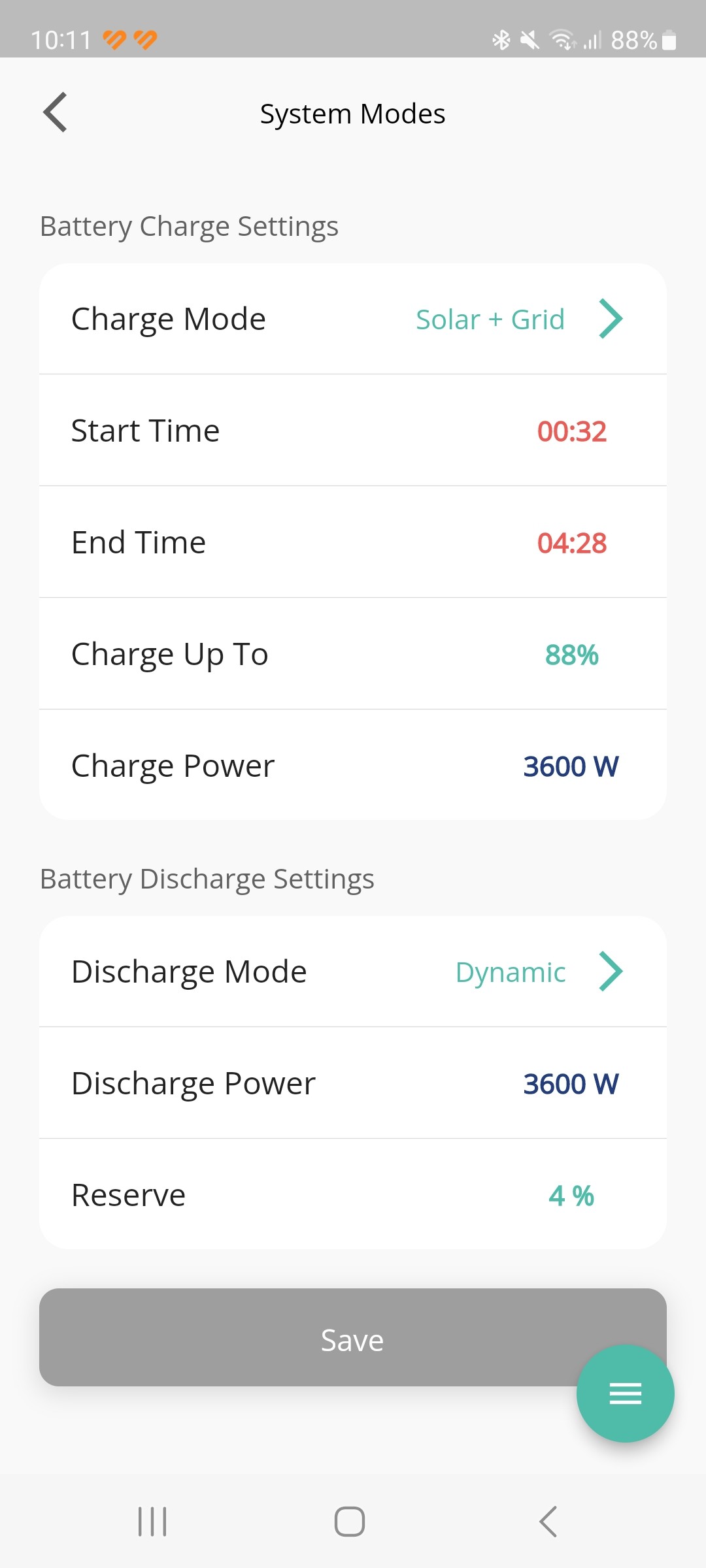
I have also set the discharge to timed and set it to 04.30 - 0.30 so, in my mind anyway, it should only discharge during those hours. I see this morning though it had charged to 80% as I asked, but then after 04.30 it sent everything to the grid. I will see if I can post up a pic of my settings.
Z
#5Zakalwe
Reset everything to default.
Set it in Eco mode (using the web portal).
Set a Timed Charge for your off-peak period with the desired SoC that you want to exit the cheap period with.
In brief, Timed Discharge and Timed Export do not work as expected unless you do manual intervention after the period ends. For most users these setting just seem to deplete the battery fully.
#6Cdent
Road2Ruin it's the timed discharge that's caused the issue here. It doesn't actually do what it's supposed to and is a known issue to GE.
Reset to defaults + submit
Set to Eco + submit
Set timed charge 00:30-04:30, setting charge to percentage + submit
Check everything as submitted ok and you should be fine
R
#7Road2Ruin
Here is a pic. I have changed the discharge to dynamic as I noticed when I checked the battery wasn't charging at all, all solar was going to the grid. Changing it to dynamic, it is now charging the battery.
So confusing.
Z
#8Zakalwe
The web portal is much clearer as it gives some descriptions. Plus it seems a bit more stable, though the app has improved massively.
It really doesn't help when GE insist on using different terminology in the web portal and app. Having a consistent nomenclature is clearly too much for these guys.
Zakalwe If you are correct that the App and Web Portal use different nomiculture this is a software disaster in the making suggests split teams and two ways of doing things.
I am very new here [commissioned yesterday] got as far as finding out that my battery needed configuring last night no advice from installer. So far support =DIY. I just have the GE app running what where is the Web Portal please?
Thanks found it and confirmed that inverter is set to eco mode. Have set up over night battery charging via Web and after making sure I am on same WiFi as battery etc. it confirmed new data saved.
Still can't understand that I am exporting energy to grid when battery is only 60% charged and the solar generation is greater than Home use. Is there any algorithm safety conditions? Is there a DC current limit on the battery charging?
#13hoggy
Installers seem to forget that the Knowledgebase exists.
It's not perfect as things gradually change as updates are done but it's a far better start than prodding around in the dark:
L174559 Post your graph from the dashboard. We might be able to spot something else.
H
#15HairyNeil
We have a similar issue (our system was installed on 24th Feb). I raised it with GE yesterday and they have restarted the calibration process, 24 hours later and it still has not completed.
I've asked for an update but they have yet to respond.
L
#16L174559
cluelesscris
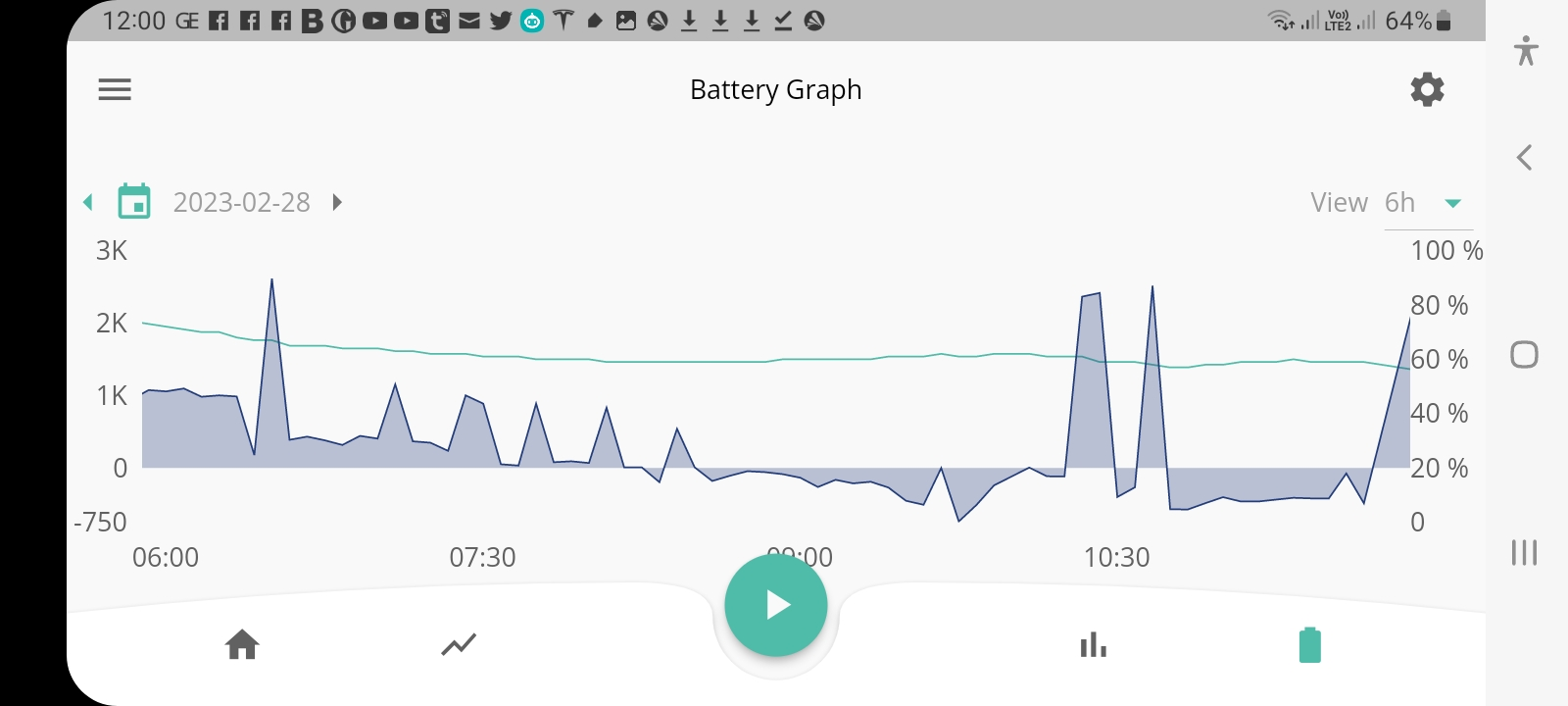
My attemp of screen shot of battery charge discharge graph.
Any other way?
L
#17L174559
HairyNeil Thanks for the heads up my install was yesterday. It was a second attempt as first inverter failed at switch on. After wiring etc checked it was determined that the inverter was faulty. Electrician suggested that the main relay may have shorted.
So if you get an explanation from GE I would like to add my two penny worth.
C
#18cluelesscris
L174559 Almost, Let us see the main graph - so we an see the generation, load and grid information too. However, looking at what you have here your battery is charging (the bits below the line). We just need to see if it is charging by the right amount.
L
#19L174559
cluelesscris
Hi Thanks for the help
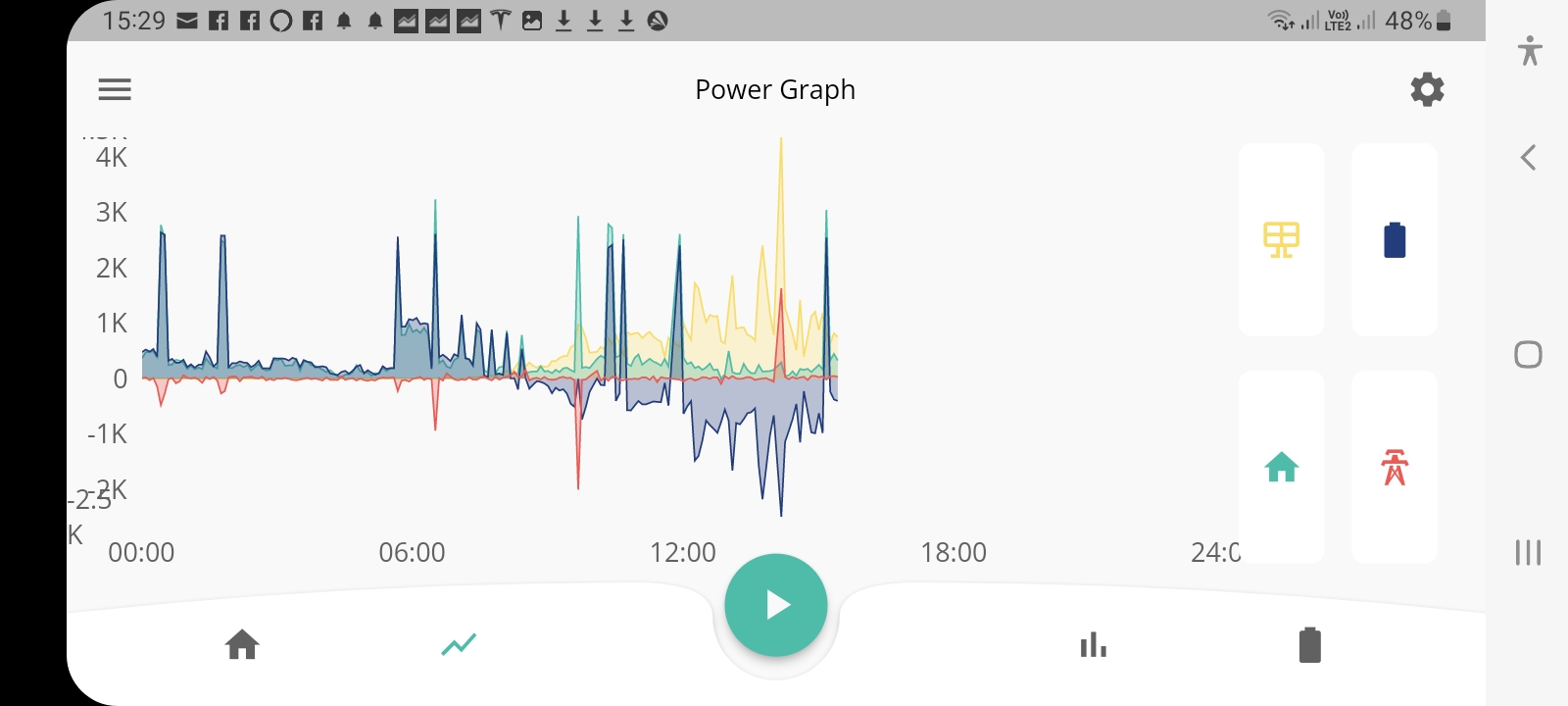
Here's the power graph
C
#20cluelesscris
Well you are definitely charging according to this graph. It all looks pretty normal. I can't see an overnight charge though. Nor can I see a wholesale discharge to grid from the battery.
L
#21L174559
Last night battery charged from grid according to schedule snd as I was hoping
My query concerns the minute to minute leakage of energy from the battery or solar to the grid when the battery is less than 100% and the home is calling for power from any of the 3 sources. Its just very low levels in the order of 1-5 up to 100 Watts.
#22Cdent
L174559 this is to be expected. The inverter takes a short amount of time to ramp up/down to demand, up to 30 seconds. Also the data points in the graphs are taken every 5 minutes so show a single point in time.
L
#23L174559
So nothing yo worry about. Have you any tips on how to set up my system. I charged the battery to 100% on Tuesday night and that was enough to power the house all day and the battery ended at 46%. But some of the solar energy generated during the day ended up going to the grid for £0.00 in my case as I'm currently with OutFoxthearket and they do not do SEG. Trying to move to Octopus.
Z
#24Zakalwe
You don't need to be with Octopus to join their SEG. Under the SEG scheme you can have a different provider and SEG importer. This means that you can choose whichever SEG account that takes your fancy.
Small amounts being sent to get grid and vice-versa are perfectly normal. Look at the trends, not the individual data points.
#25Cdent
L174559 unless you look into some of the automation stuff like home assistant, or use tools similar to the one @stevelewis built, you'll have to manually change it each day. www.github.com/salewis38/palm
As @Zakalwe says you don't have to be with the same supplier for SEG and import, but there are benefits if you do (Octopus pay 15p instead of 4.1p, and you can get access to Agile which could be even more lucrative).
Z
#26Zakalwe
Cdent (Octopus pay 15p instead of 4.1p, and you can get access to Agile which could be even more lucrative).
Octopus pay 4.1pence per kWh on SEG, not 15 pence. You are confusing export tariffs and SEG. Totally different kettles of fish.
#27Cdent
Zakalwe I'm not confusing anything, just happened to type the wrong thing. Whoops. Edits aren't possible after a while it seems
I think that the forum software only allows edits for a couple of minutes after hitting the Post Reply button. Bit of a PITA!
K
#29Karen
Try looking at the weather forecast the night before (or some people use Solcast) and if it is going to be cloudy and rainy then charge to 95-100% from grid during your peak period. If it is going to be sunny then reduce the amount you charge - overcast but not raining 85-95%,, sunny intervals 80-85% - really sunny can go as low as 50%. As the days get longer and sunnier reduce the amount you charge - in a month or two you should be able to run off solar completely. If you have any problems setting less than 100% then try reducing the duration of charge or the charge rate to reduce the amount you import from the grid. If you are home during the day then you can set the dishwasher or washing machine to run when the sun is out to mop up any spare solar. Some people also have an Eddi or iboost tied to a tank and immersion heater. This will kick in and mop up spare solar once the battery is full to give you a tank of hot water.
C
#30cluelesscris
Zakalwe Edits are only allowed on the last post. As soon as something gets posted after you edit disappears.
T
#31Tim
L174559 As @Karen suggests, you don't have to make changes every night. We do it more seasonally than checking weather. Late Autumn we enable timed charge to 80%; by December it's 100%; in January it's back to 80% and by February it's 60-70%. We disabled timed charge a couple of weeks ago now because we have enough solar to charge the batteries fully before dark. If we have a glum day, we can enable timed charge as a one-of to get us through to the next day. Grid import is now less than 1kWh/day - the usual "noise on the system" caused by inverter ramp up times.
L
#32L174559
Tim When you say "timed charge" do you mean the "solar + grid" setting?
I am now attempting to connect communication between my Solar & and Battery system and my Zappi car charger.
Finding my way around the Myenergi app snd Web site is a bit tedious though.
L
#33L174559
cluelesscris
Hi Thanks for the help please just have a look at this snap shot of today's action.
Still a lot going to grid? Is it because the battery has a rate of charge limit?
T
#34TX200
Is it a 5.2 Bat?
If so, 2.6 charge limit
T
#35TX200
Now would be a good time to use the washing machine, lol. 🤣
Looks spot on to me.
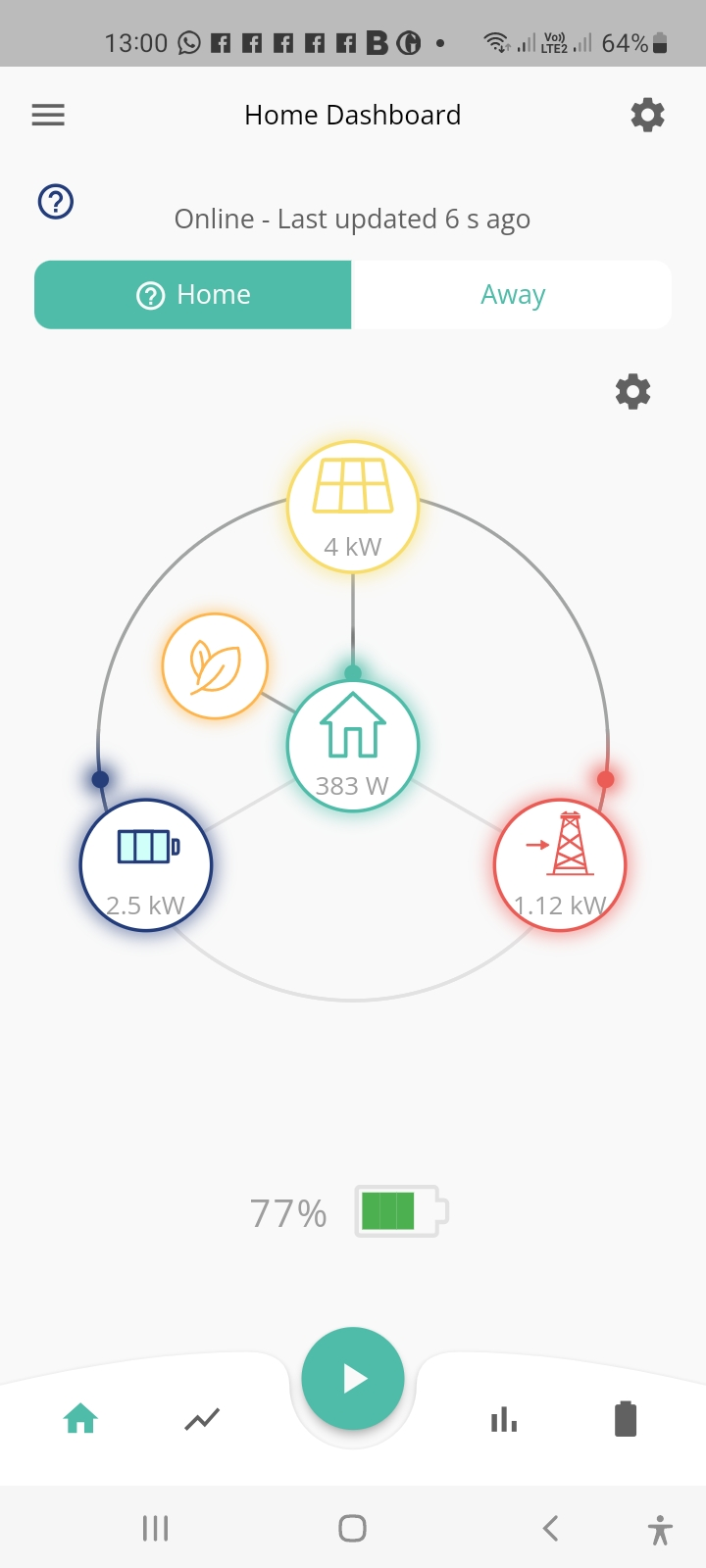
The panels are generating 4kW. The battery is charging at max rate (or close to it). The house is consuming only 383 Watts. The rest has to go somewhere, so it is being exported.
A hot water diverter might be worth considering....dump some of the exported power into heating your water, assuming that you use gas for DHW and you can use a diverter.
E
#37EnergyEnthusiast
I'm glad I stumbled on to this thread, I've had support cases running with GivEnergy almost since my installation was completed on the shortest day of the year and have struggled to believe that the 9.5kwh battery and Invertor are working properly. I've only seen my battery hit 100% charge once in the two month period despite there being plenty of energy produced, instead I have seen a lot exported back to grid, this is really frustrating. I was told the system had to be on ECO mode for the battery to charge during the day but this also means any time the production drops due to sudden clouds then the battery discharges to the home, ultimately it's reducing my electricity import demand but I'd planned on the battery providing energy in the evenings when more appliances are in use. The timed settings in the web portal or from the app seem completely pointless if ECO is the only solution?
Is there any way that the system can charge the battery effectively during the day with minimal export to the grid and ensure it is all available to provide only the power being used during the evening? - I found the battery would export back to the grid if the home consumption was less than the discharge maximum setting e.g. 3kw.
any time the production drops due to sudden clouds then the battery discharges to the home,
surely if the house demand is high enough during the day, when the clouds come, you want your home to be powered with solar + battery? Not solar + grid...
I'd say in winter you just have to suck it up, because the amount of solar is never going to keep your battery at max, other than full sun days like today. I'm charging from grid at night so that what energy it does use from battery in the day is "cheaper" or free electricity, rather than grid peak rate.
T
#39Tim
L174559 the app works fine (Solar + grid for battery charge and dynamic for discharge) but the web portal does make so much more sense to so many of us (ECO minimises grid import/export and timed charge does what it says on the tin).
WRT Zappi, just search this forum for ECO+. It can work perfectly with Givenergy even without any API connections or automations. It can be done with settings on each system separately.
It is a 9.6 kWh battery with a hybrid inverter. It was supposed to be a second revision inverter.
But the first inverter failed at commissioning the current one is a replacement but it required a change of mounting plate to be installed. So I'm not sure what version of inverter it is. Is there a way of finding out?
L
#41L174559
Zakalwe
We have a combi gas boiler and no space for a immersion tank. Researching phase change heat batteries as a possible future option.
Not too keen on heat pumps of the current design for both central heating and water heating as it would require a water cylinder and warm air conditioning not impressive with a unit needed in each room etc.
T
#42TX200
L174559 the battery max charge rate is usually 0.5 of the capacity, although I'm not sure about the newer batteries. Guess 4.8 in this case.
The inverter also has a limit as to what it can convert from AC to DC or vice-versa. Although in this case being a hybrid inverter, it should be DC from the panels to the battery.
Something doesn't quite add up so to speak!
Might be worth resetting the inverter back to defaults via the web portal, then ensure eco is on and setup a timed charge if you need to (e.g. if you have a cheap rate overnight).
Try to avoid setting timed discharge and export unless you have read the other threads about the issues and are happy to get frustrated! These two options are best with custom automation (GivTCP/HomeAssistant/etc) as you'll need something to reset things after the timed period ends.
H
#43HairyNeil
L174559 We had a response from GE, they were of the opinion that it was the CT clamps not being installed correctly (in other words the flow sensors were not working properly). The installers were back yesterday and found that the clamps were both orientated in the wrong direction, they were re-attached the right way round and fingers crossed it seems to have done the trick.
The installers had been issued with two sets of drawings for the installation, a detailed schematic and a less detailed set aimed at the end user. The schematic showed the correct orientation, the other set didn't... you can probably guess which set the installation team used the first time they were here...
T
#44ToothyChris
HairyNeil If only GE included a check, as part of the commissioning process, to make sure that CT clamps were installed correctly/giving valid data - they could save themselves (and the installers) and the customers so much hassle.
T
#45TX200
ToothyChris during commissioning could be a good time to check that. Are we exporting now? Are we importing now? Etc.
#46hoggy
It's supposed to but the amount we see here that are back to front suggests it can be bypassed or just doesn't work:
**Step 5 - complete checklist
This section will check your info you input as per the systems configuration, it will run tests to ensure it's working. Please note that this will test readings for the load but if the CT is in the incorrect place as per the installation manual, it may still allow you to pass.**
#47Woodstock
My installer checked very carefully that the CT clamp was the correct way around and found that it wasn't. His solution was to reverse the connections to the EM115. It works fine but the arrow on the clip points the wrong way and confuses everyone! 😆
T
#48Tim
Woodstock His solution was to reverse the connections to the EM115. It works fine but the arrow on the clip points the wrong way
That sounds like a double negative. If they didn't reverse the connections and turned the arrow the right way round, nobody would be confused?
#49Woodstock
Tim Exactly! If it is humanly possible to do something wrong way then sooner or later someone, somewhere, will.
I often see advice on here to have the arrow on the mains CT clamp pointing in the direction of the consumer unit and think "that is making an assumption that the other end is connected to the EM115 the right way round". 😄
Z
#50Zakalwe
#51Dougal
As a newbie I made the same mistake setting a Timed Discharge and wondering why solar generated went straight to the grid. I discovered through an email exchange with Tech Support to do away with any Timed Discharge. Letting the system do its own thing seems to work fine. On Agile I just set Timed Charges. So far so good.
#52Dougal
ToothyChris It doesn't help that all too often it would seem CT clamps are incorrectly marked. I have a theory that somewhere in China where these CT clamps are all made someone is deliberately switching the label on every twentieth clamp. We had one on our GivEnergy installation incorrectly marked and one also incorrect on our separate Zappi installation.
T
#53ToothyChris
Dougal Another possibility is that the installer has wired it the wrong way at the inverter, in which case it would 'appear' that the arrow is pointing the wrong way.
T
#54Tim
ToothyChris It'd be the EM115 where the wires are swapped over. The Modbus between EM115 and inverter is a digital signal, which could also be wired incorrectly but (AFAIK) that would result in a "meter comms fail".
T
#55ToothyChris
Yep, quite right Tim - my mistake 🙂
M
#56Mwf
I have a similar question. We often notice that the battery discharges to the grid for no apparent reason. Right now the speaker and battery are just about meeting our consumption. Now and again we draw from the grid. That is all clear and good.
But now and again the battery discharges to the grid, some times Rony amounts occasionally more significantly.
We don’t yet have a grid balancing contract so I expect no battery experts to the grid. So why is it happening and can we stop it?
S
#57SilverArt
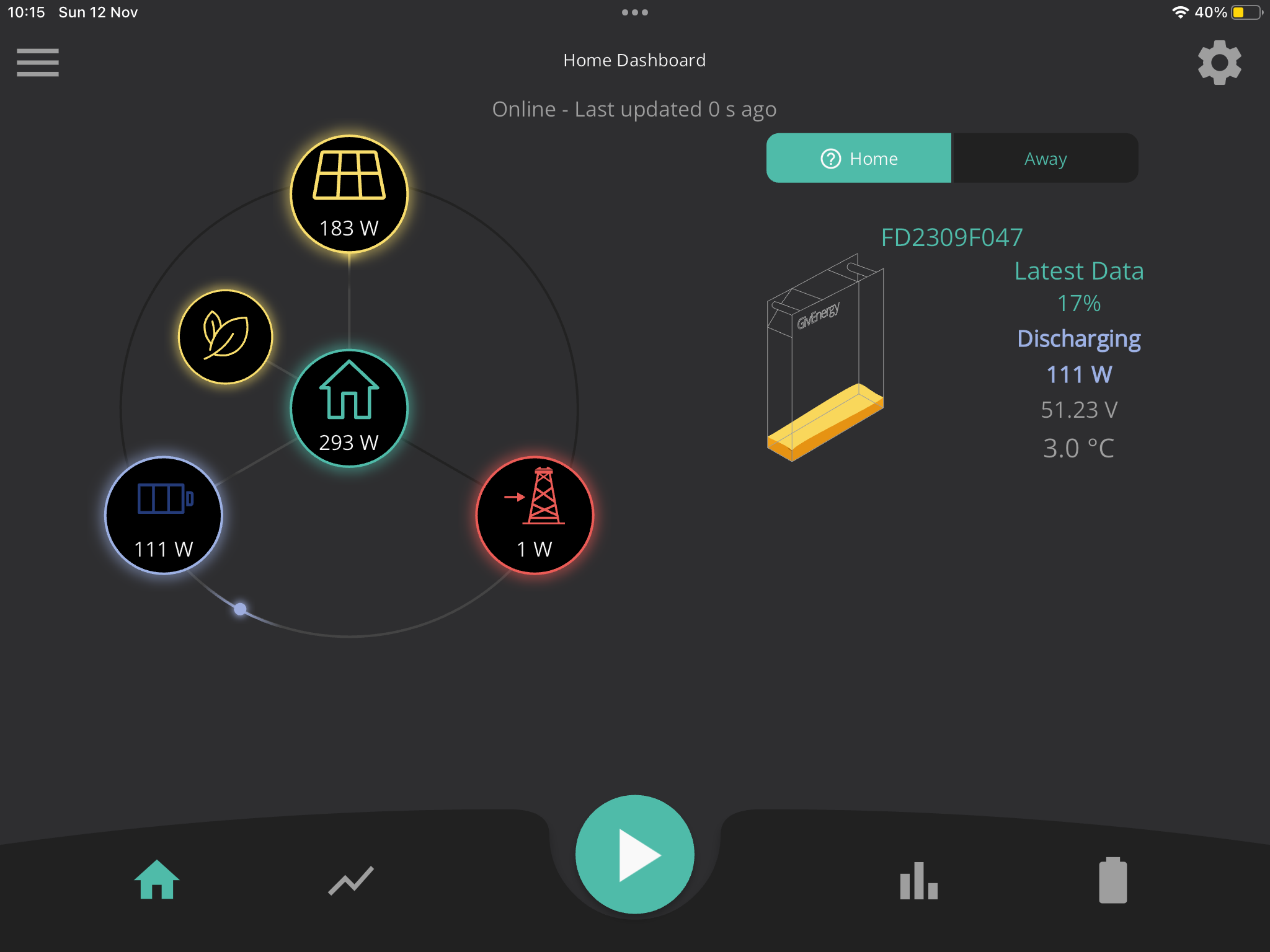
Remember that the numbers you see are best guestimates that the system can make at any given point in time, they are not an exact science and the 1w 'discharge to the grid' was just 1w that didn't have a 'home' in the millisecond that the calculation/reading took place.
As an example: in my case the 'readings' reported by the system for a seven day period for Grid export from the solar and the battery was 11.84 kWh of which 0.85kWh was apparently from the battery. However, the export meter reports 9kWh, which at best case could be 9.9kWh, leaving about 1 to 2 kWh 'lost' in calculation. However ,also bear in mind that that is based on the GE half hourly readings.
The key in looking at the system is looking at overall trends and doing a periodic sanity check against the actual meter.