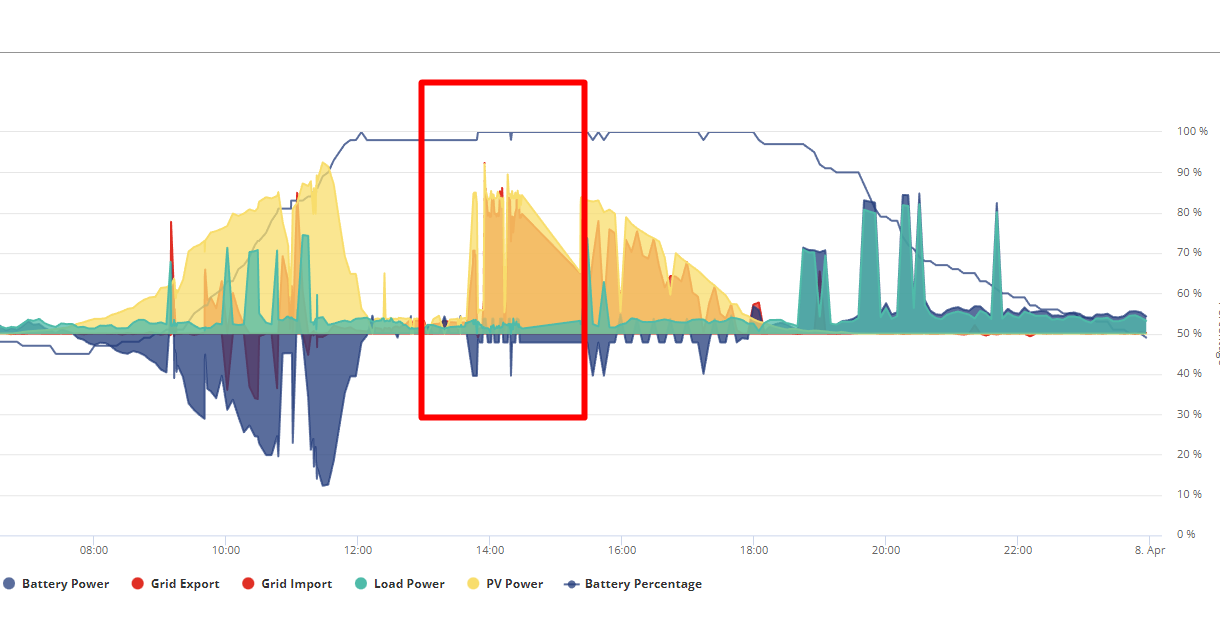
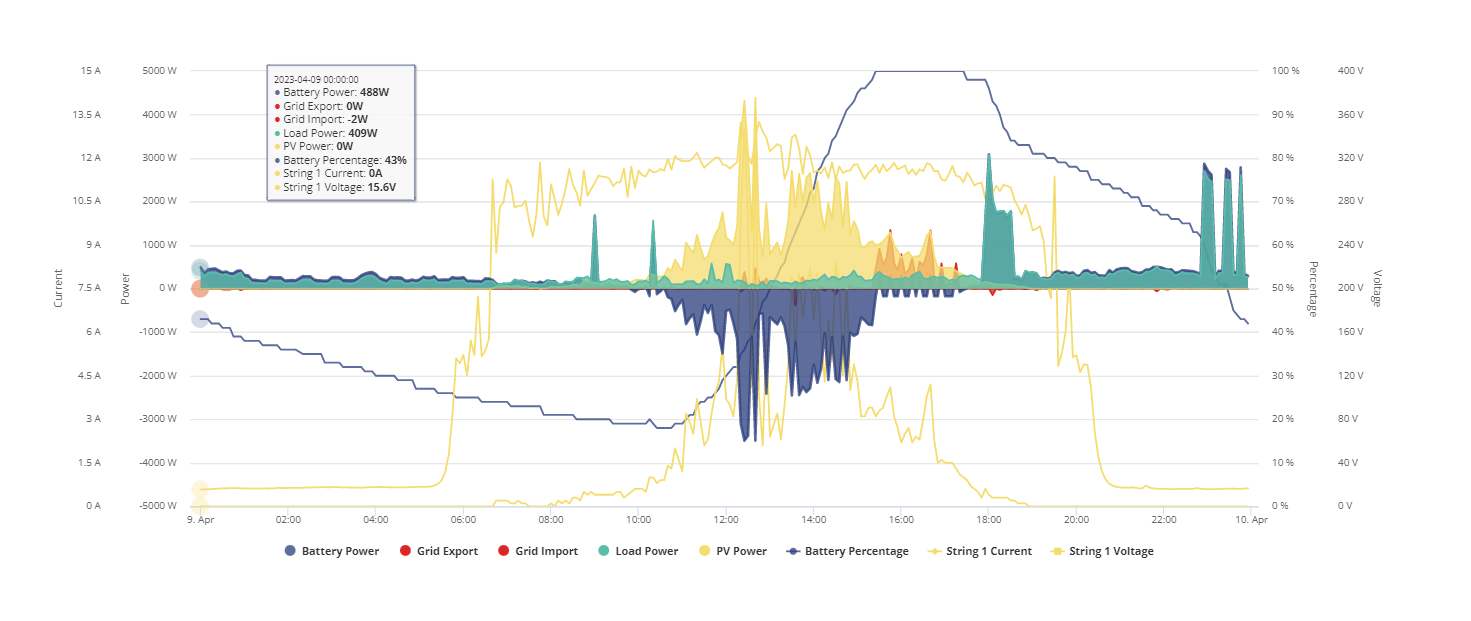
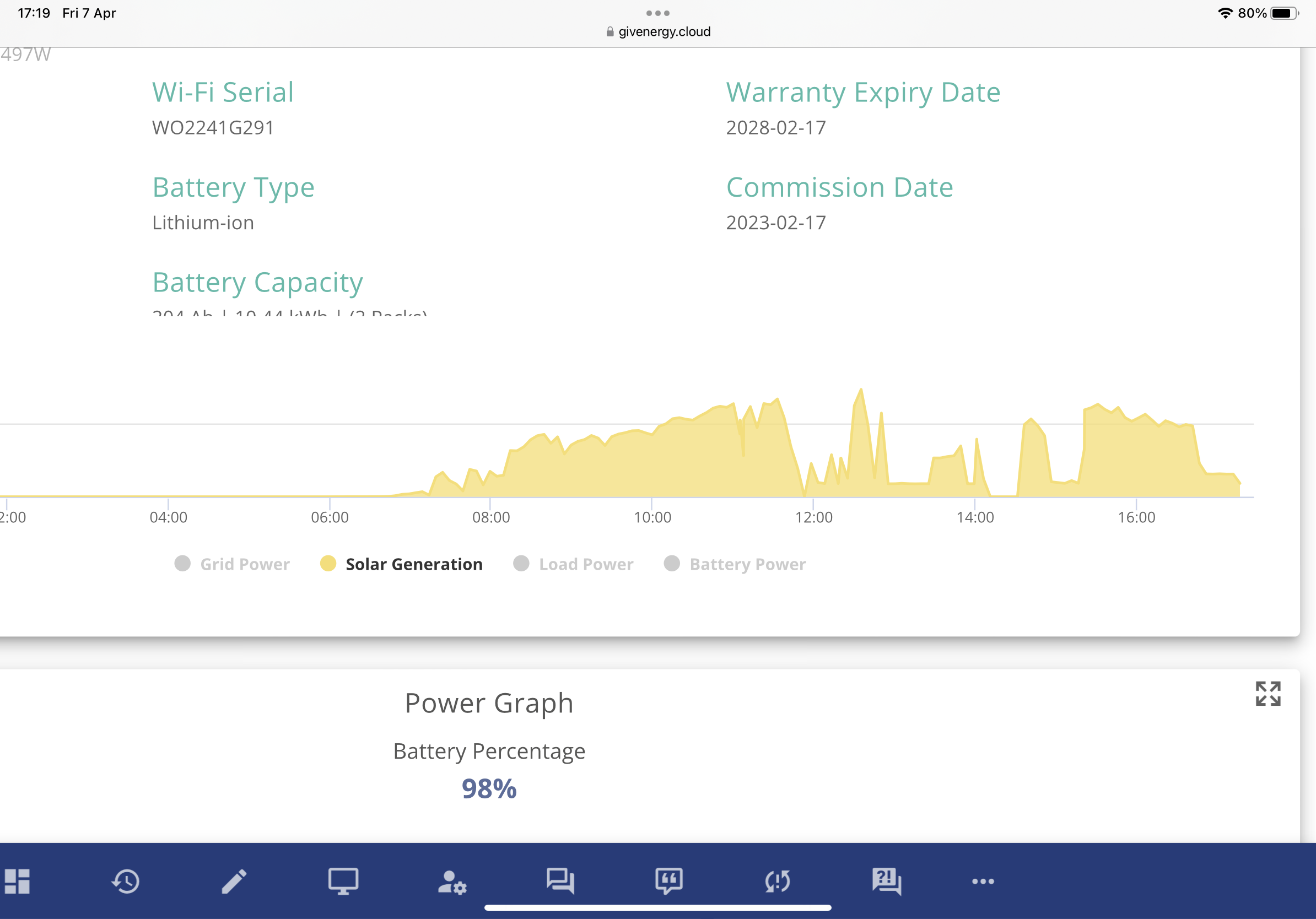
I’ve had lovely sunshine all day with no clouds and no shading but my pv generation is up and down like a yo-yo.
Sometimes dropping down to as little 6 watts from 3kw or more!
It’s done this before but not as much.
I’ve reset the inverter and turned off and on eco mode to try to reset it all but it’s still happening.
It’s driving me crazy! Some days it works a treat and other days it just seems to go to sleep?
Any ideas anyone?
Tia
Why is my Pv generation up and down like a yo-yo?
is it limiting the export?
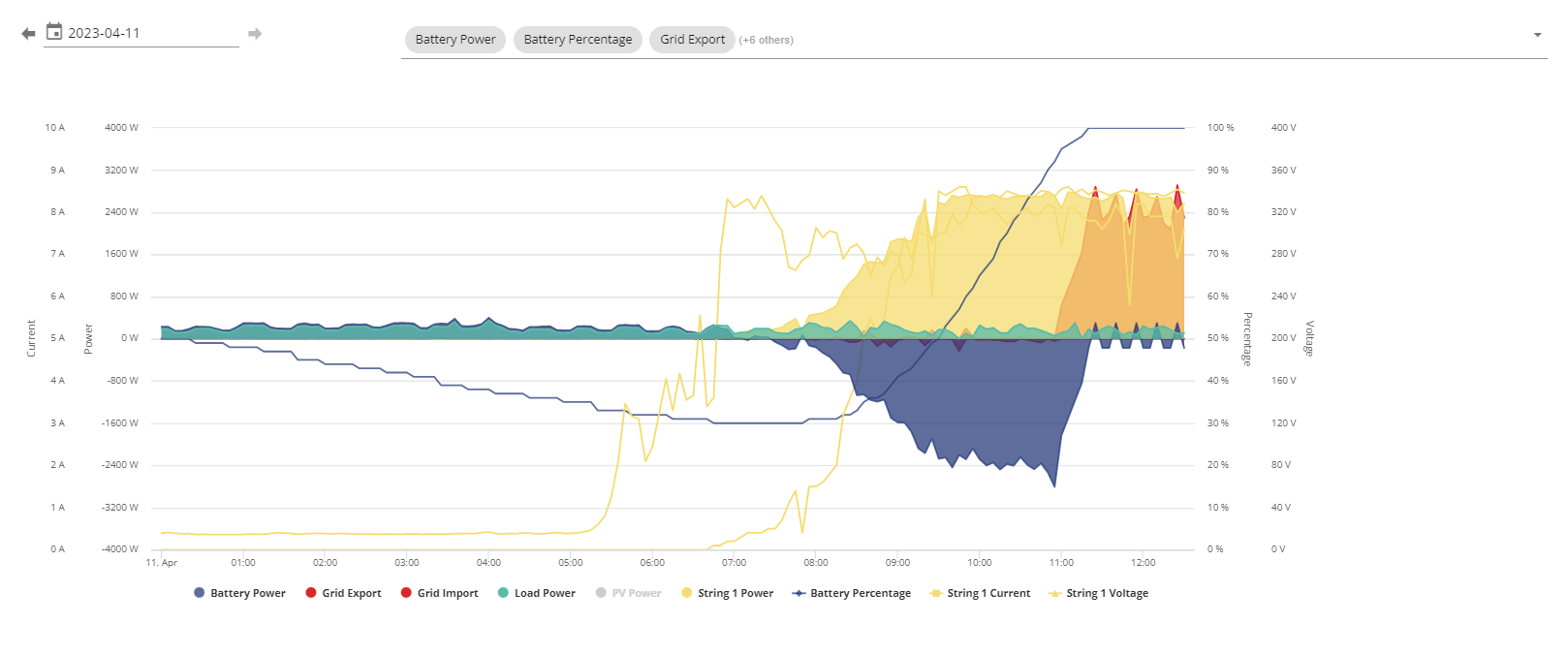
I’m getting a similar issue and have done on every recent totally clear day. It seems that as soon as the battery is fully charged then solar production drops off sharply despite constant sun, no shading etc. The result is that the inverter will then not export. I want it to export so my Zappi will then see the required 1.4kW export and start charging the car.
I’ve tried many different combinations of settings but the inverter continues to be reluctant to allow an export.
This afternoon the system was however fooled by my son briefly putting the microwave on! With that demand to the home the solar quickly ramped up to meet it, when the microwave went off, the excess solar was then exported for long enough for the Zappi to then start charging the car which it has been doing ever since. Success - sort of, but it should work better than this!
I'm fairly sure that my export is being limited for some reason. Any ideas anyone?
Iainq if you got a G98 from the DNO its 3.68 kWh export limited. So if you're generating enough to export over the top of that limit, the inverter will pull back the solar generation AFAIK.
pacemaker hi thanks for replying, there is no export as the generation just drops off and any house load has to import from the grid when the sun is shining and no clouds in the sky.
If I bought a car like this I would return it promptly!
Iainq looking again at your chart you're not exporting anything either so... something odd there.
Looks like @Dewy has same issue
pacemaker I had the system fitted in mid February and I have emailed the installation company dozens of times and still not received a single bit of information regarding certification/ guarantees extended or otherwise, dno acceptance, handover pack , so to answer I dont have any export that I am aware of.
Sorry but this is really getting me down.
What is your grid voltage according to the inverter at the point the solar drops down? If the inverter wants to export but grid voltage is already too high it will throttle back the solar to prevent issues.
Iainq thanks for replying, yes seems to be the same sort of issue. Sometimes mine rights itself after turning something on but sometimes just imports from the grid while the batteries stay idle!
Dewy that's disappointing - installers at the moment are in my experience... overwhelmed and not being great at all... You're owed all that stuff from them, definitely the MCS, DNO approval etc etc.
That said, you will export regardless. I was installed in late Jan and have been exporting (FOR FREE) ever since. I got my paperwork from the installer and just waiting for Octopus to enable export so I can get paid for it... anyway point is, your inverter will export regardless of what paperwork you have.
Phil_H hi thanks for replying,
Sorry but do you mean the solar panel voltage? If so that’s roughly around 300ish volts when it all starts dropping but it doesn’t always drop ? Some days it works as it should.
Which really confuses me.
I have this exact issue on D0.906-A0.906 firmware with version 3009 for the battery. @Dewy what are your firmware versions?
pacemaker they keep promising me it all but nothing ever comes through! Really disappointed in them now.
SolSucker hi, yes exactly the same versions.
Should have been best day so far since install , but spent most of the day monitoring it and getting stressed!
Dewy no, on the inverter card on the portal there is a tab called 'grid data', there will be a voltage field in there. If it is above 253 then I don't think the inverter will export.
Grid voltage today steady @ 249v max 250.5v but yes very little export. Because of the solar throttling back though I’m missing sizeable chunks of potential production/export/car charging. Firmware is 906.
Phil_H ahh thanks, grid data shows highest voltage today was 250.8 volts so didn’t reach 253 volts at all?
Iainq same here too, it’s really not what I was expecting from this system.
Dewy OK, so no grid voltage issues. Do you have a smart meter with access to 30min import/Export values? If so do they line up with what the givenergy graph is showing? (trying to rule out some kind of clamp misplacement giving you dodgy data)
Phil_H no smart meter only a digital economy 7 meter. It seems to happen when the batteries are full or sometimes charging but mostly when generation should be good.
But as I say it doesn’t always do it or not so often.
It’s so annoying and is stress and money costing unnecessarily.
Same thing happening here too.
GivEnergy know about this issue. I have been experiencing the same problem for a while. There is an beta update which they tried to instal remotely but didn’t work for some reason. They sent me the file and I manually updated the firmware on my gen 2 inverter and it’s fixed the issue. It sounds like the update is nearly ready to roll out.
Leon_shaw hopefully it will fix mine too and sooner rather than later. Thank you.

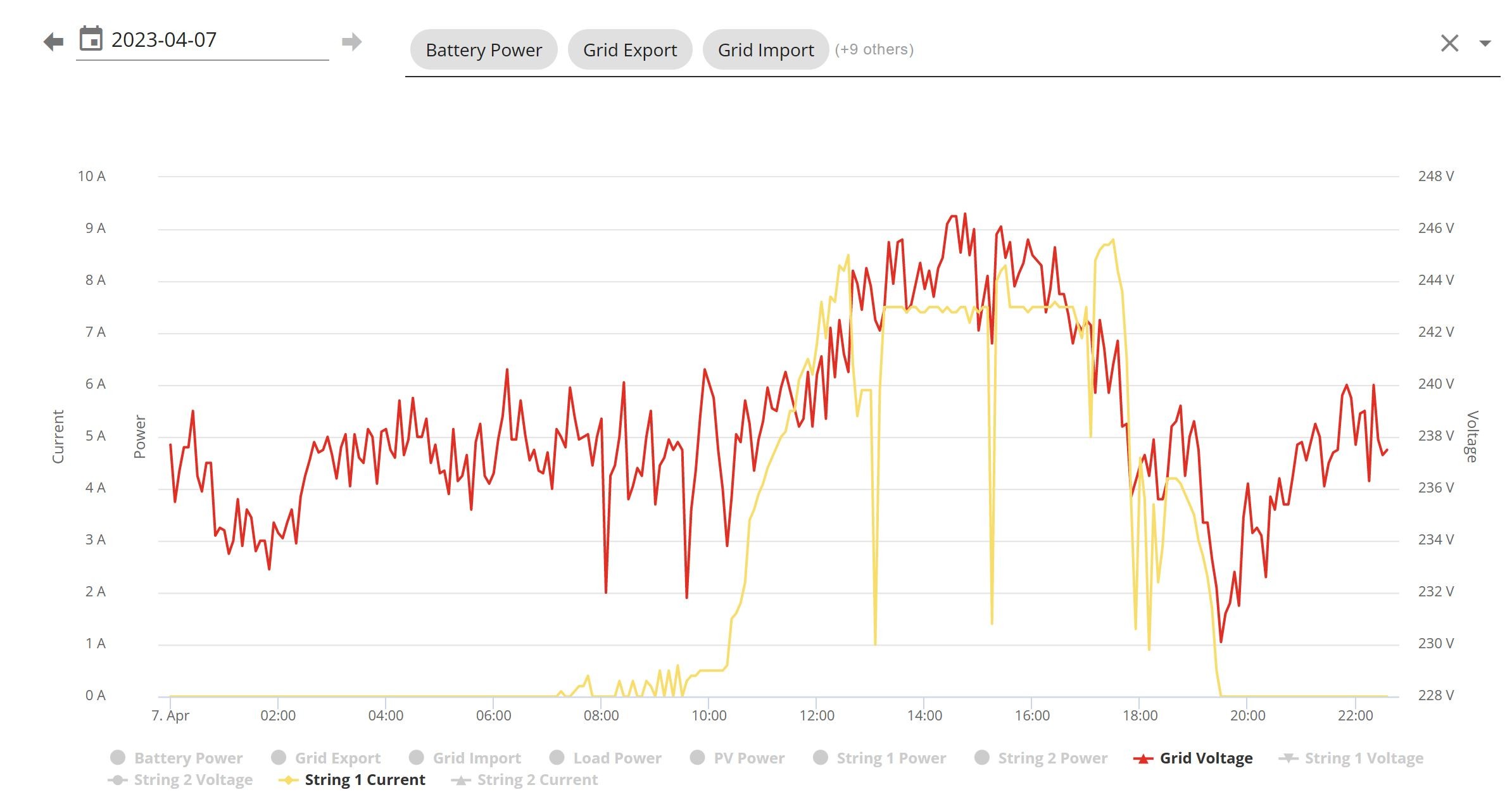
So, the current produced by the panel is related to the solar intensity and panels have their own performance characteristics. So, if i look at one of my string's current for today

i can see two big drops, even though the day was a good solar day. Were these drops just some passing clouds ? I looked at the string voltage at the same time. At the first dip the voltage was 310 with a current of 1.4 amps. With 8 panels thats 38.75v per panel. (the voltage i show on the graph is the grid voltage not the string voltage). Now looking at the charts for my panels it would appear at that time the panels were operating at or near the limit of their capability. The string power reported at this time was 116w and that sort of tally's with the voltage current graph. Now it's late and i am new to this so could be reading this all wrong.

I had a a similar drop yesterday afternoon and it was down to the Grid Voltage being too high and the inverter (I have an GE AC3 and a Growatt inverter) correctly throttled back

Maxwell , the GE graphs only contain instantaneous values that are captured once every 5 minutes normally, and the String 1 Current may not have been captured at exactly the same time as the Grid Voltage.
The Graphs provide an overall trend of what was happening, but they cannot capture every fluctuation in the different system values for the level of analysis you are trying to apply.
If you happen to be watching/recording the App display on the Home network with updates every 10 seconds you are more likely to capture what you are looking for, but only in terms of solar gen values.

Please contact support, I have authorised pre release of the Gen2 FW, to resolve this issue. Explain your solar is cutting out once battery is full or over 95%, then is choppy and wont export it.
The new FW will export the solar instead of backing off, upto your export limit, or the inverter output limit
There are still a couple of minor bugs relating to AC charge set %, stopping solar above the set level, so leave it at 100% and dont use it.
Apart from that, the Gen2 is ready.
It will be married with a BETA battery FW, 4074. Which is still being tweaked, but it too it nearly ready
Hi, my firmware is D0.996-A0.908 on my gen 2 3.6 hybrid inverter which was updated yesterday and is was working much better since. I have noticed the battery power now runs higher than the house load power since update. Is that a known issue ? Or is this how it should run ? My battery is still on 3007.
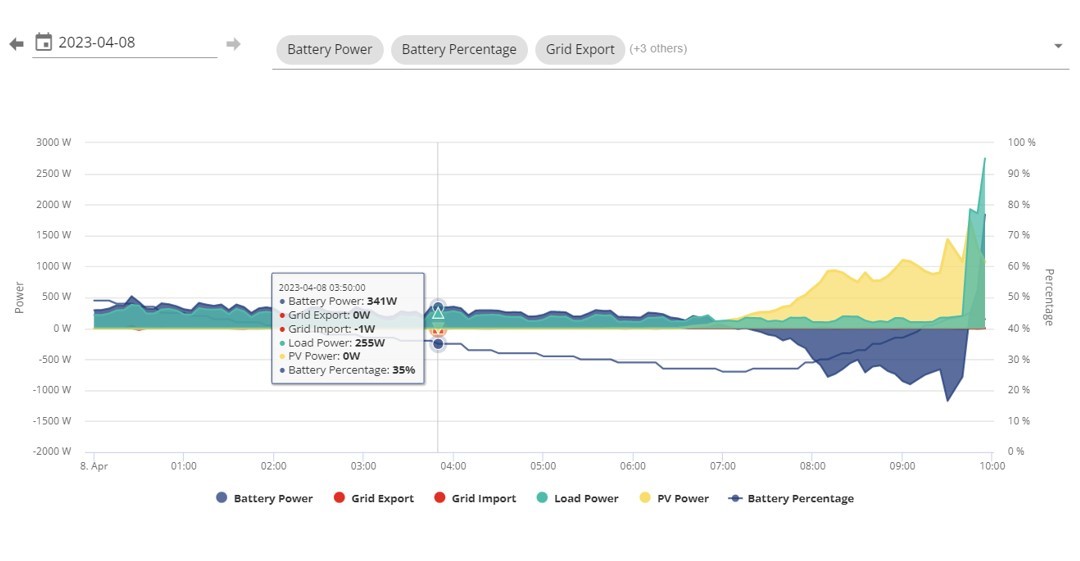
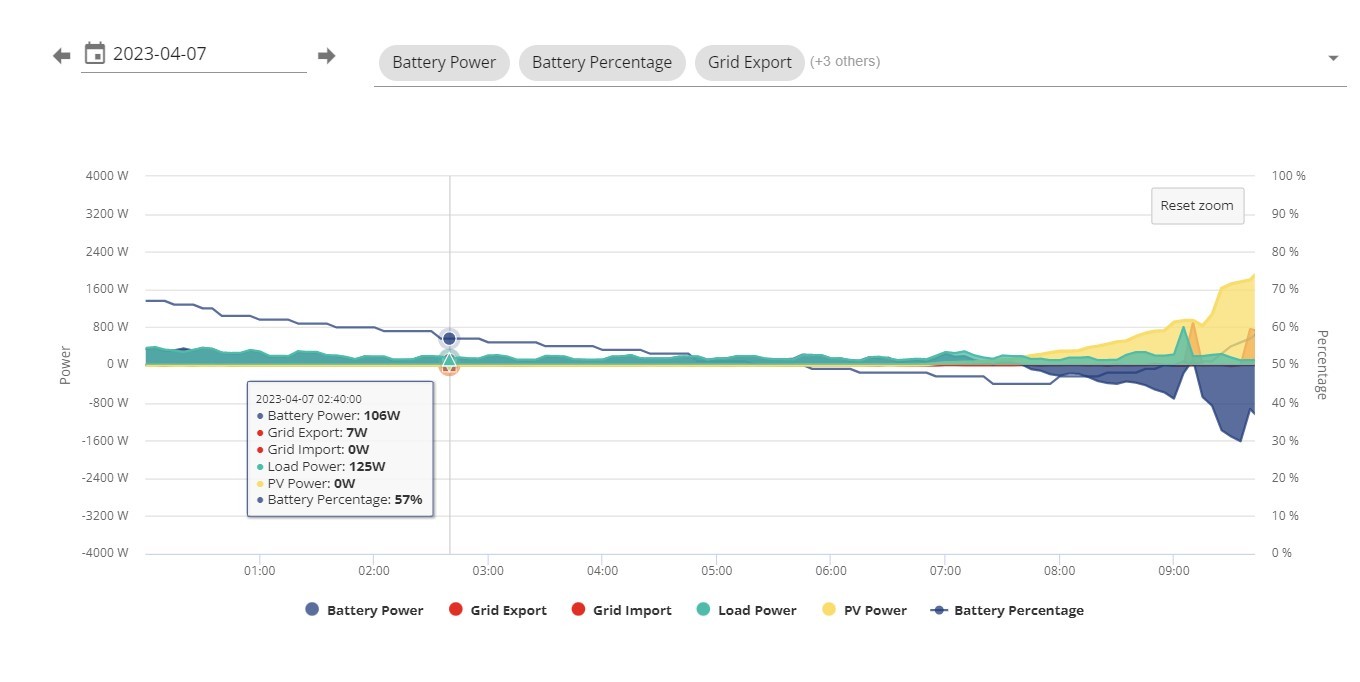
Images below before and after update it is easier to see at night when house load is more constant.
After update -

before update -

Leon_shaw I think the battery will always run at or above the house requirements because of AC/DC conversion losses. I haven't had the above problem with cutting out, and have an AC3.0 set up, but my system has always run like this

The battery should have also been updated to 4074 beta version.
But happy to see 3007 legacy version is at least talking to the new FW

Karen Correct.
DC will always be higher than AC on discharge, the opposite on charge.
5-10% difference, depending on grid voltage needed to be overcome. Higher grid voltage, needs more work to overcome

Leon_shaw Your FW was upgraded here

TheDragon (GivEnergy) Ok so how do I get the Battery FW updated please ?
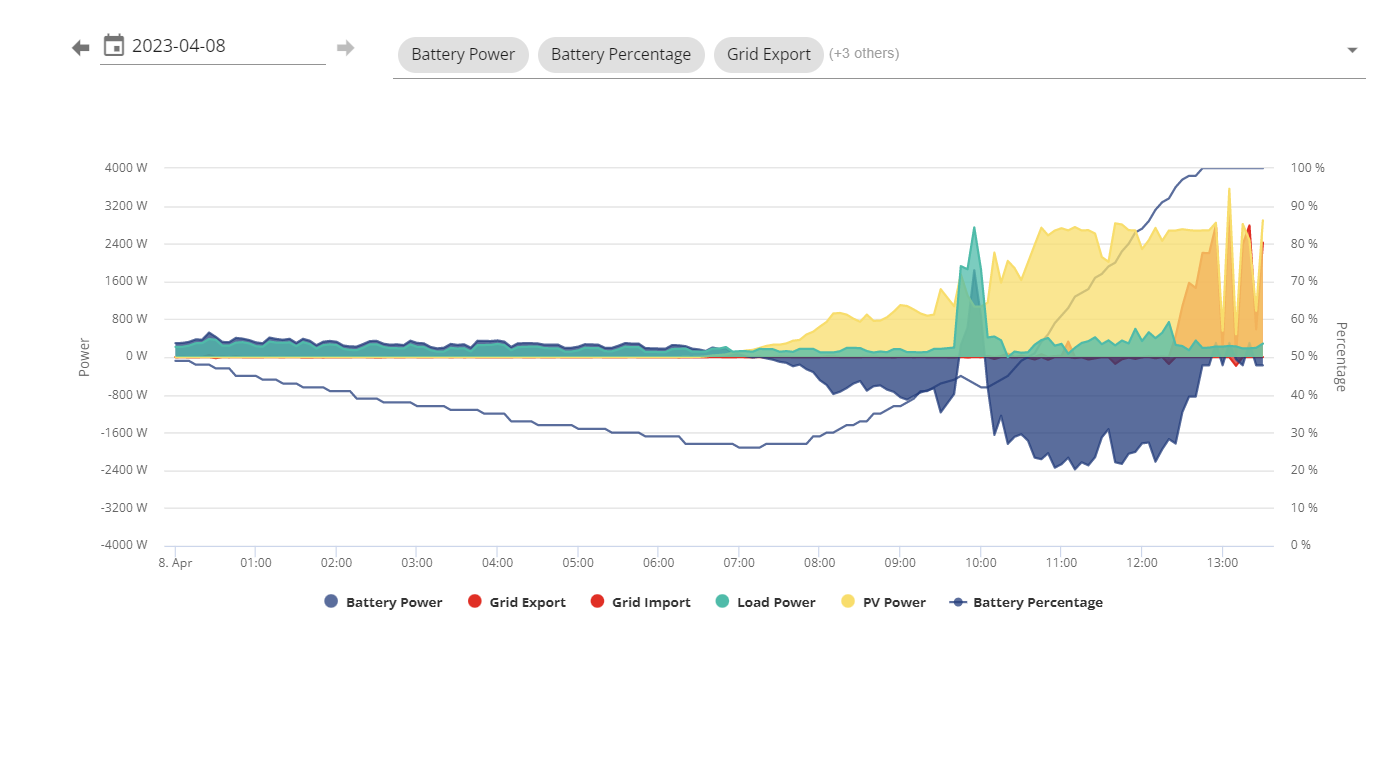
TheDragon (GivEnergy) yes that's correct. If you look at today's chart, since update today my solar seems to be topping out at around 2.6 / 2.7 kwh. It's almost forming a flat line across the top of the chart. I have a 10 x 405 w JA solar mono panels on a south facing roof and it's clear skies today. I usually reach 3.8 kwh to 4kwh in this kind of weather no problem at all. Is this a new bug ?


Leon_shaw If the battery is full, the Inverter AC side can only output so much.
Had a quick look at your system, you only have string 1 connected?
If the battery wasnt full the solar could do more, but as its full, its all going to grid.
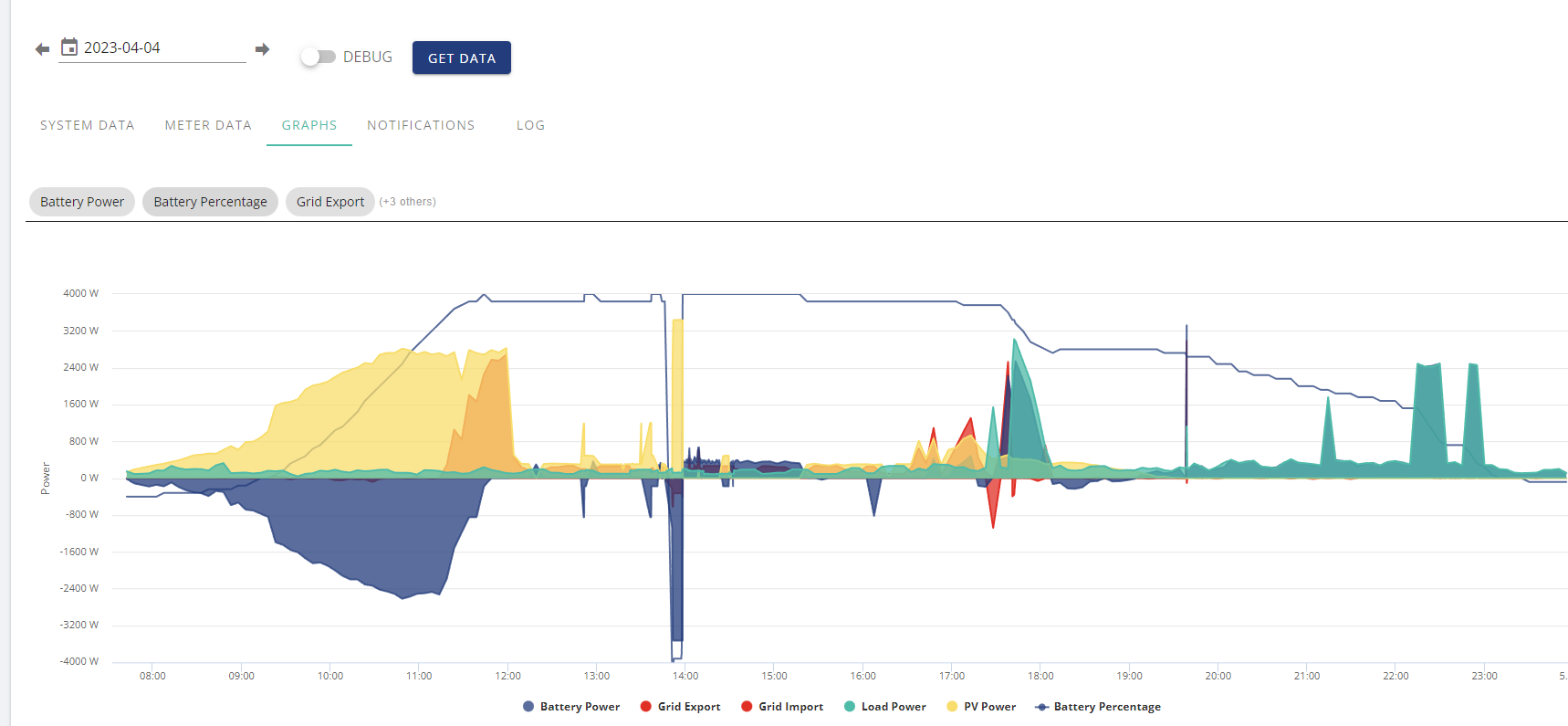
Here is a graph from the 4th, similar plot, the solar has reach its limit, ither than short bursts
TheDragon (GivEnergy) I should be able to export any surplus at 3.6kwh to the grid though, doing this is restricting the amount I can export ?

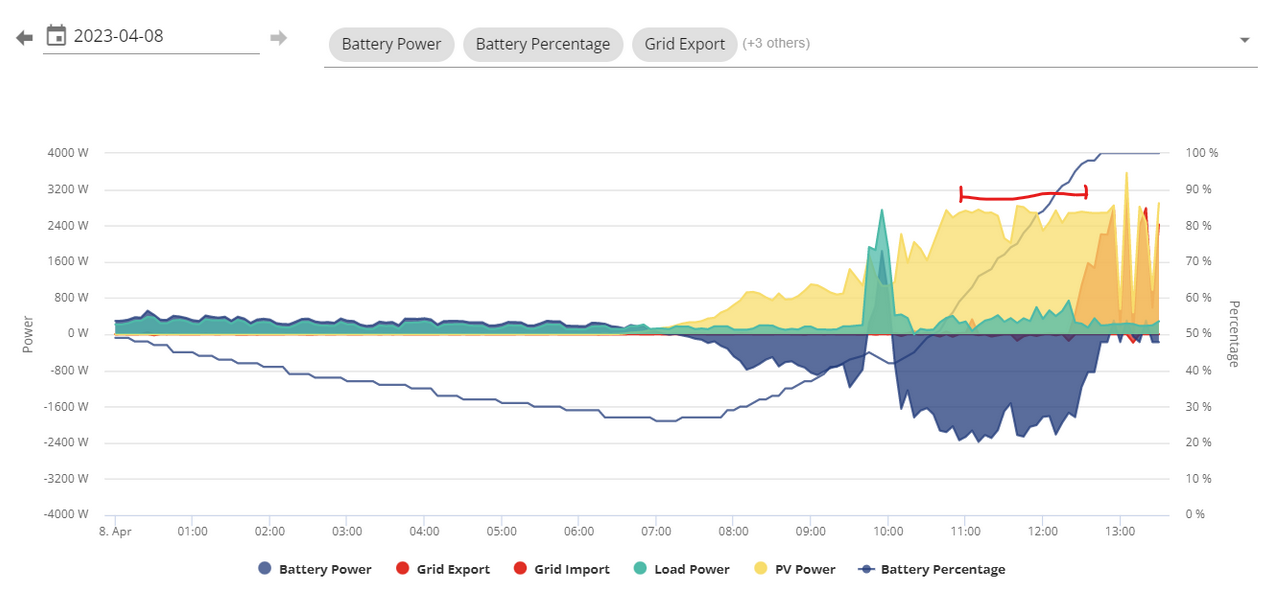
Leon_shaw , your power graph includes a period between 1030 and 1230 when the battery was not full, yet the solar gen is generally flatlining at around 2800 W.
As you say, with the panels you have installed and previously seen performance, you would expect higher than the 2800 W solar gen. So what is limiting it? It may be worth checking the My Inverter data for PV voltages and currents along with grid voltages to see if any allowed limits are being hit.

TheDragon (GivEnergy) thank you for your help, I’ve been out most of the day today but came home in between at 2ish and the batteries were charged and the pv was once again down to 6ish watts when it should of been 2kwh+ !
So I changed the charge settings for tonight to 100% and reset the inverter and it all started working okish? So I’m going to try to keep charging the batteries from the pv when the weather is good and still set the % on ac when the weather is not so good? Hopefully this might work temporarily until the new firmware is available.
Otherwise I assume I will have to charge the batteries every night to 100% even though it’s going to be a sunny day tomorrow If I have the new firmware?
Only tried this today and have had to go out most of the day but it seemed to be a little better, fingers crossed.
Simon_C thanks for the feedback, its definitely throttling at 2800 ish w since the new FW was installed, not sure what i'm looking for with PV voltages and grid voltages or what the tolerances are ? How do I find this out ? Forgive me but this is all new to me.
All I know is system produced higher peak levels of solar before the updated FW was installed yesterday. To be fair though previously as soon as the battery was fully charged the system tanked and solar production reduced to around 300w. During daytime whilst solar was produced and battery was fully charged it would use the limited level of solar along with grid over batteries so even now this is much better as we now hardly pull from the grid.
Today I also dumped some of the battery to test @dragon2905 theory previously stated about batteries being full and as far as I can tell generation was still capped at the same level. As I said I have gen 2 Hybrid 3.6 kwh inverter so it should be capable of exporting this amount to the grid on top of the average house load around 400w as panels are capable of 4kwh ??
I think you are falling foul of the limitations of the installed equipment.
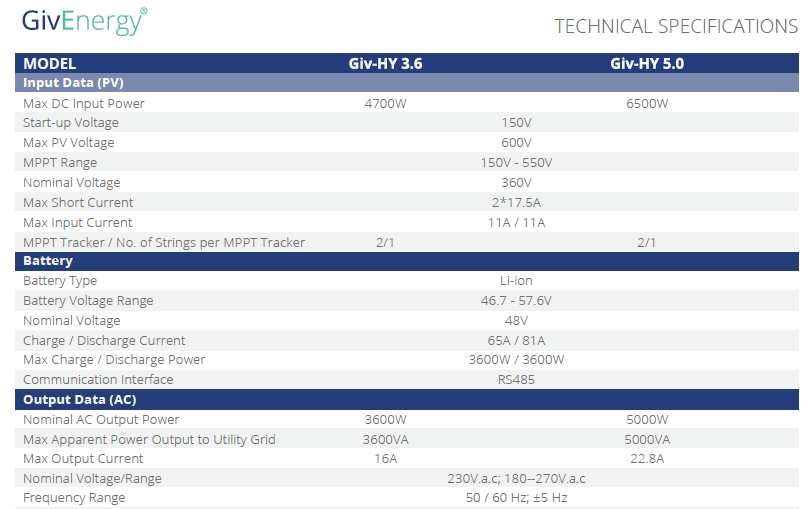
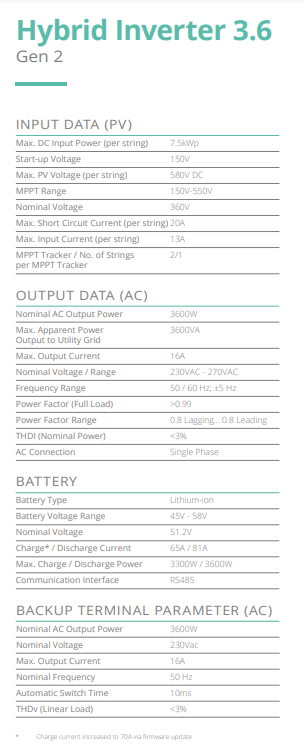
Your Gen 2 3.6kw Hybrid Inverter has the following limitations:
Max. DC Input Power (per string) 7.5kWp
Nominal AC Output Power 3600W
Battery Max. Charge / Discharge Power 3300W / 3600W.
If you generate 4kw and there is no house load you can export 3.6kw to the grid whilst the remaining 400w is, to all intents & purposes, lost.
If you generate 4kw and the battery can charge at maximum 3.3kw, then you will export 300watts to the grid = 3.6kw and the remaining 400w is lost.
If you generate 4kw and the battery can charge at maximum 2kw, plus your house is using 1kw then you will export 600watts to the grid = 3.6kw and the remaining 400w is lost.
Solar Panels like Cold Weather with Sunshine. So sunny winter and sunny cold springtime days generate the most PV (as they are more efficient).
As soon as the temperature starts increasing the efficiency of solar panels decreases but offsetting this is the fact that there is simply more sunshine for longer.
Your installer has overprovisioned your panels to your inverter (which they should do really). BUT they should have also advised you to upsize your inverter to a 5kw rather than the 3.6kw.
Gen 2 5kw Hybrid
Max. DC Input Power (per string) 7.5kWp
Nominal AC Output Power 5000W
Battery Max. Charge / Discharge Power 3300W / 3600W
It's getting a bit silly that installers aren't automatically advising this but it comes down to (lack of) knowledge or understanding the limitations of the systems being installed.
With an eye on the future and as we move forward with Electrification the minimum installed Inverter should be 5kw or even 8kw+. Not so much that it can be maxed out with Solar PV but so that large enough battery arrays can be installed to power Electric Hobs (3-8kw), ASHP (5-22kw), Kettles (1.7-3kw), Ovens (1-4kw) etc at the same time.

dragon2905 , but on the graph between 1030 and 1230 the totals are not reaching 3600 W.
Battery charge - peaks at 2400 W
Load - Approx 400 W
Grid export - around 0 W
Total = 2800 W, the same as the flatlining solar generation, and certainly not the 3600 W a/c limit of the inverter.
@Leon_shaw , you have not stated what size battery you have. The smaller ones may have a charge rate limit less than the inverter is capable of.
Would be nice if people would put up their own posts rather than hi Jack other people’s posts in their comments, as quite often the original poster gets lost in the confusion when they are looking for help.
dragon2905 Thanks for coming back to me all the help is really appreciated. I'm sorry but I am confused by all this.... Earlier you said that the system was limited as the inverter AC can only output so much. You say nominal AC output is 3600w. Today is a sunny cold springtime day in the uk max temp 13 to 15c. I have peaked production at 4kwh plus in much worse weather conditions.
You say....
_"If you generate 4kw and there is no house load you can export 3.6kw to the grid whilst the remaining 400w is, to all intents & purposes, lost. This I understand but my point is when the batteries were full I should have definitely been generating more solar than what I have today as per the panels installed and weather conditions and the average house load used you can see clearly in today's chart its almost a flat lined capping production. Average house load lets say 300w, solar production average capped at 2700w totals 3000w ? Solar gen barley went above this amount all day no matter what the house load was throughout the day. It was as low as 118 w and as high as 4486w yet solar gen topped out around the average 2700w mark ?
I've achieved 4kwh generation plus previously on numerous occasions prior to updated FW you can see from the data.
Today average house load is around 300w when battery was full and still solar is topping out at around 2700w ? Thats 3000w / 3kwh not 3600 / 3.6kwh which should be achieved. This has not happened until updated FM was installed ?
With a full battery and house load of 400w should I not be exporting 3200w and panels showing production of 3600w as that is what I would expect from today ?
Simon_C hi Simon you have explained that far better than I have in my waffle and in far fewer words. I wish I had seen your response before typing mine lol.
I have a 9.5 kwh battery & gen 2 3.6kwh hybrid inverter.
Dewy Apologies but i do think it is a related issue
dragon2905 To clarify your examples, should the AC Limit and dc limit not run in parallel? You are DC to DC charging the battery from PV ?
In both your examples of 4kW PV, 3.6 inverter, during battery charging, I would expect 2.5 or 3.6 kW could be soaked up by the battery AND the AC limit of 3.6. so nominal max of 6.1 or 7.2 kW of PV used. So all 4kW should be used, no throttling. Then when the battery is full, AC limit only of 3.6, whether exported or used, so then 400w would be throttled.
I have been looking back over historical data after yesterday's experience and it has multiple times performed far better than yesterday which was surprising considering the weather we had here in UK yesterday.
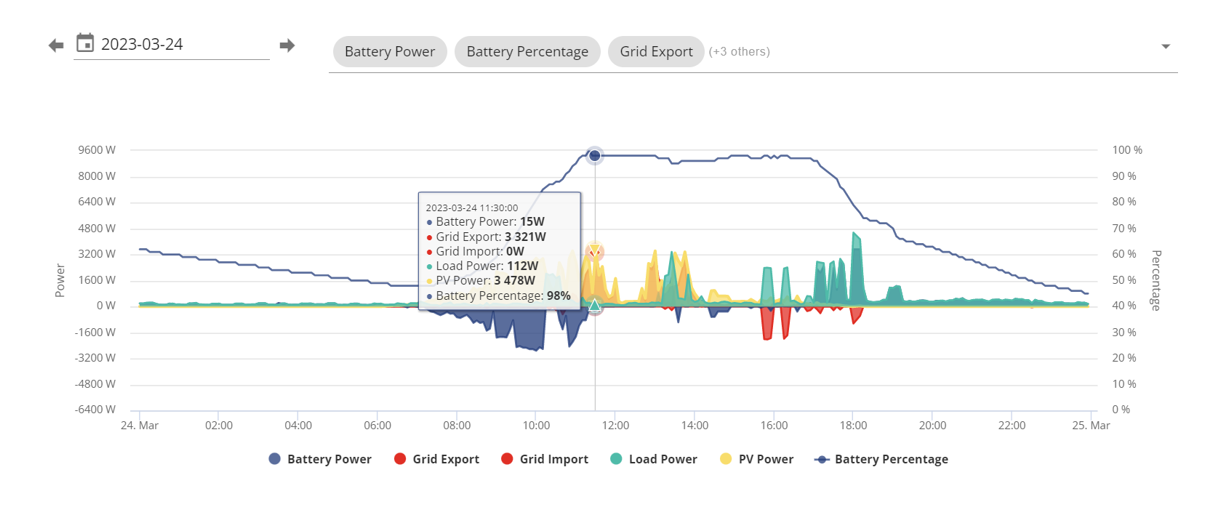
Previous example below with full battery solar gen 3478w house load 112w export 3321w with minimal battery power 15w

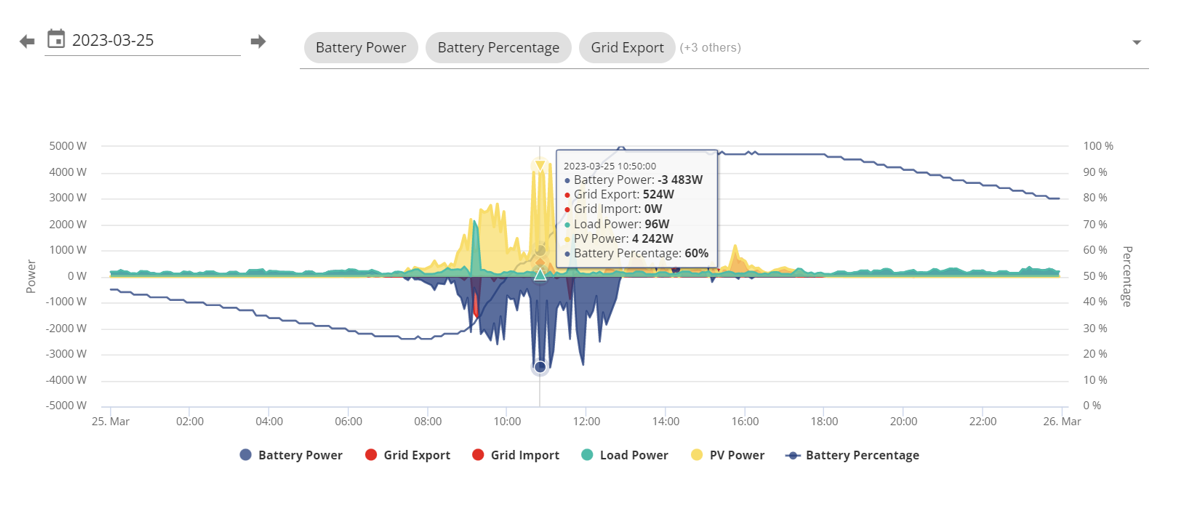
Chart below shows capability when battery not full and solar production is above 4242w the system is powering the house 96w charging the battery at 3483w and sending 524 back to the grid.

Yesterday something was throttling my solar generation capping it and I am not sure what it is @dragon2905 ?
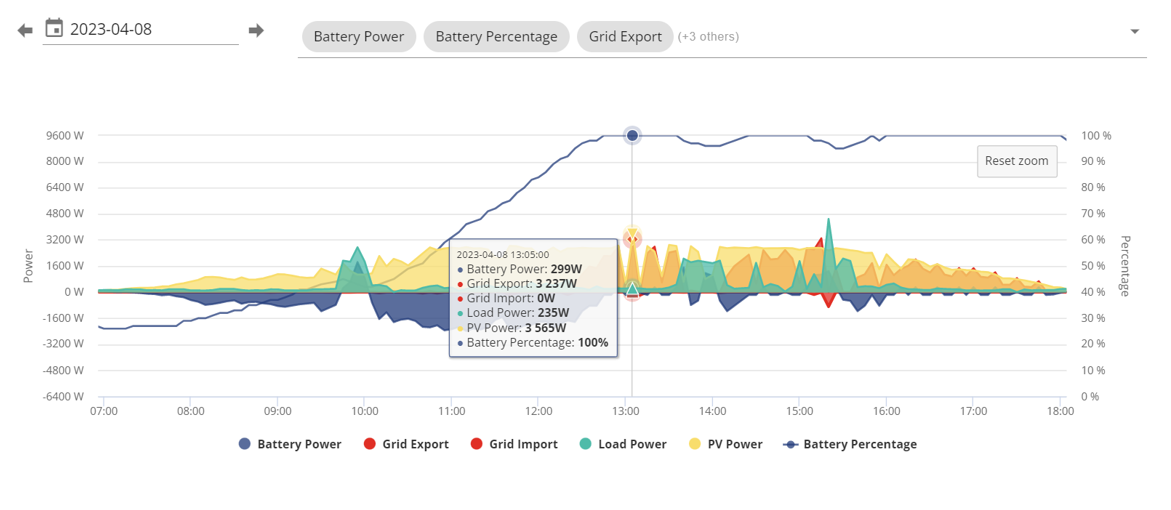
Even when the battery was not fully charged solar was still being capped as mentioned by @Simon_C and then once it reached full charge is stayed the same. There was one point for a short period of time the solar gen rose to where I would expect it to be shown below. This chart also shows the rest of the day it was being throttled.

justpassing no the limit is 3.6kw hence 3.6kw inverter. How you get to maximum 3.6kw that the inverter will handle is dependent on where the energy can/will go.
I should say that this is for hybrid inverters, not sure what the AC only does.
Leon_shaw I think we are getting into the specifics of how PV Strings work (or don't) as the case may be.
Rather than me typing for a long time and trying to explain and perhaps getting something wrong I suggest that you google you tube videos on the pros or cons of Serial PV Strings versus Parallel PV Strings.
Essentially you entire Series String will only perform as well as the worst performing panel in the string (in actuality as the panels are mostly "Half Cut" meaning that each individual panel is in effect 2 panels) your entire string will only perform as well as the worst performing half panel in your string.
Just as an example if one HALF panel only outputs 5 Amps instead of 10 Amps then your entire string is reduced to 5 Amps
You have 10 x 405 w JA solar Panels which I assume are wired in 2 strings of 5.
So the output would be 5 Panels @ 40 Volts per panel = 200 x 5 Amps = 1000 Watts + 5 Panels @ 40 Volts per panel = 200 x 10 Amps = 2000 Watts = Total 3.0 Kilo watts
The numbers are only to illustrate one reason why you can see "capped" PV generation.
Here are some decent videos.
https://www.youtube.com/watch?v=GFjL0-r6LbY
https://www.youtube.com/watch?v=NYyhy3JTEik&t=252s
https://www.youtube.com/watch?v=9XAQ4fD1a70
Optimisers Worth It or Not
https://www.youtube.com/watch?v=UQ9Szhl1ceQ&t=851s
https://www.youtube.com/watch?v=E9NVLB_OYSU&t=83s
@TheDragon (GivEnergy) do you have any ideas on the above ?
dragon2905 I agree with @justpassing that the maximum PV that an HY3.6 can consume is 4.7kW according to the datasheet. Nominal battery power is 2.6kW and maximum AC power is 3.6kW. If the inverter had the maximum of 4.7kW being generated from PV and the battery required charge, the battery would charge at 2.6kW (assuming the battery could accept charge at this rate), the remaining 2.1kW would be available for house load and/or export. Once the battery was fully charged, the maximum the inverter could output (from the 4.7kW PV available) would be 3.6kW to house or export. This is a good reason to reduce battery charge rate at times of peak PV so that export can start sooner, or be diverted for other purposes, reducing clipping on the system.
Tim Thanks for your input....so I am right in thinking from what you are saying that the system should not have been limiting my solar production to around 2700w yesterday ? With a full battery solar should have generating 3.6kwh then distributing this to house load and export based on what the house is using ?
Tim the maximum PV that an HY3.6 can consume is 4.7kW according to the [datasheet]
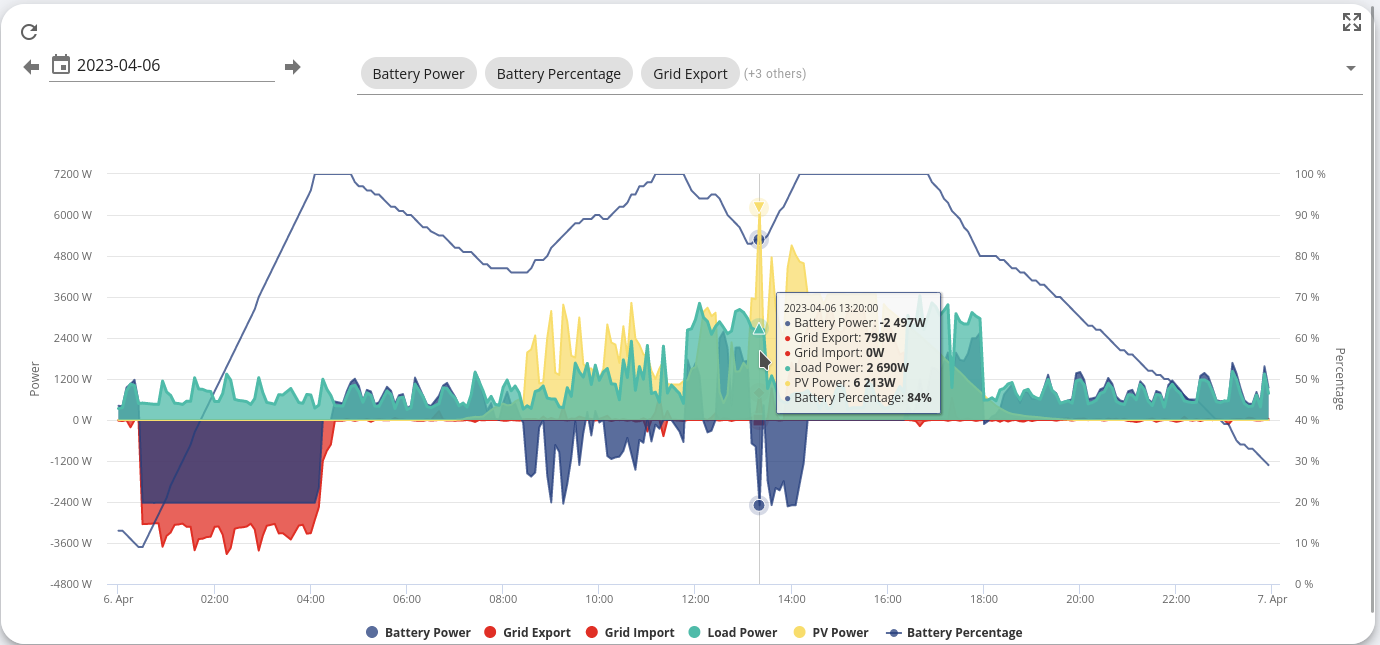
Don't think my HY3.6 has read the datasheet. 🙂 Highest PV I have seen recorded on the portal is 6,213W. Often exceeds 5kW.


dragon2905 , as per another thread.
Do modern panels not also have multiple bypass diodes so that a poorly performing panel will pass the current generated by the other panels?
In my mind that would result in ((5 x 40V) - 0.6V [diode]) x 10 A = 1994 W or thereabouts for the string with the bad panel.
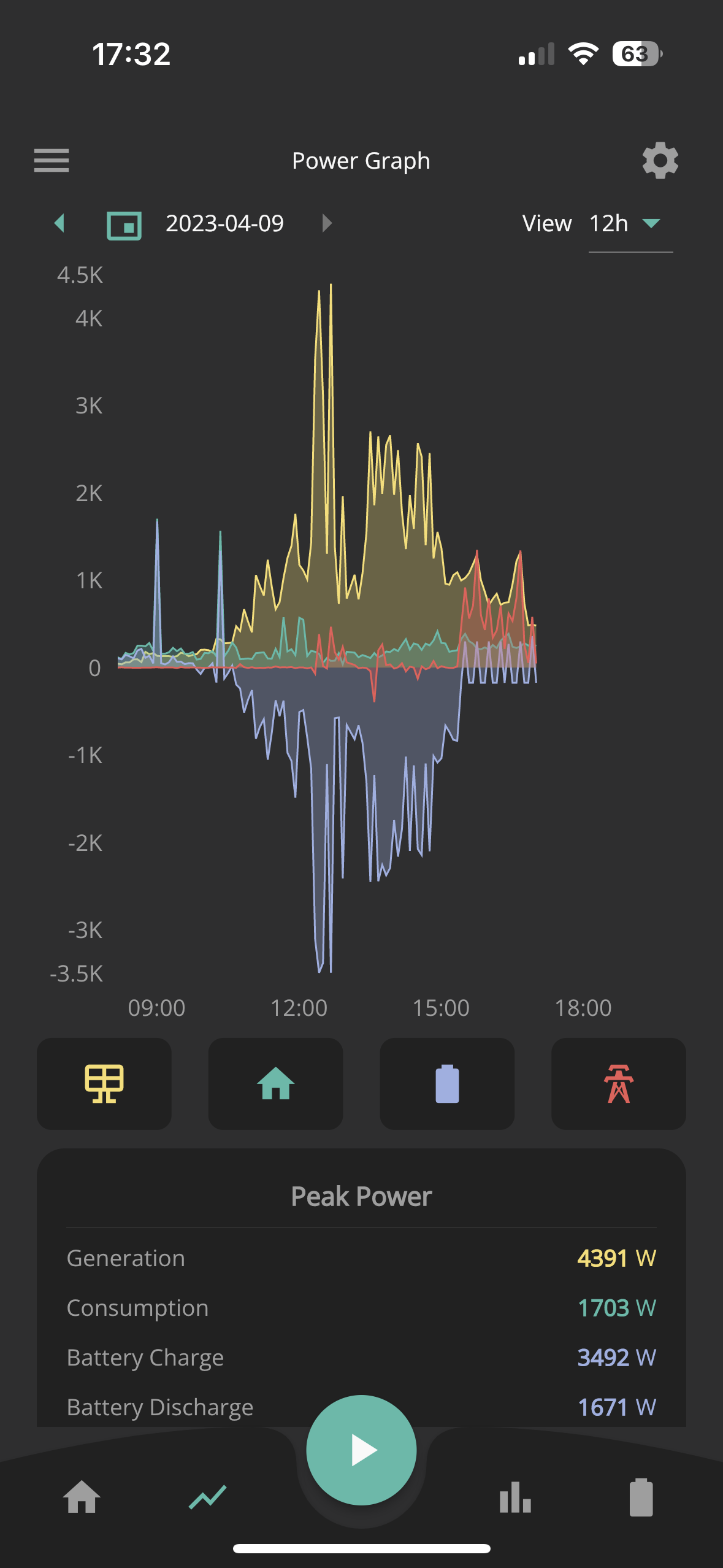
Simon_C I don’t think there is anything wrong with the string as panels produced higher levels of solar again earlier today peaking at 4391w before capping production again around the 2700w mark for most of the day as regardless of battery level.
I think it’s an inverter / FW issue.

Simon_C going a bit off thread, but: What I found by shading parts of my string.
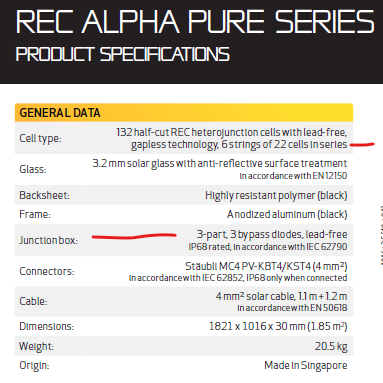
The half cut panels share a single diode for 2 half columns. So 6 sub panel strings, 3 pairs, 1 diode per pair.
So you can get several scenarios. Shade a whole column, and the diode bypassed both Half's, you lose 1/3rd of power from panel, but rest of panels unaffected. Same as a standard panel.
If you shade half a column, which shares a diode, then the current from the half column can drop to half, say 5 amps. This affects the whole string.
The inverter mppt can try to choose between the two scenarios, by tweaking current/ voltage, forcing bypass diode to kick in, and mimicking the standard panel behaviour. My experience was sometimes it did, sometimes it didn't, so shading half column can reduce the whole string by 50%, due to a single half column still working, but at half current.I am hoping all the tweaking to the firmware will improve this.

justpassing , is this what you are describing in terms of the panel characteristics?
Not sure all new panels have exactly this.

Simon_C21 hours agoEdited
dragon2905 , but on the graph between 1030 and 1230 the totals are not reaching 3600 W.Battery charge - peaks at 2400 W
Load - Approx 400 W
Grid export - around 0 WTotal = 2800 W, the same as the flatlining solar generation, and certainly not the 3600 W a/c limit of the inverter.
As you had stated previously....... that's nothing to do with inverter limitation(s) - the limit in that case was the PV Generation. If the PV Generation is only 2.8kw and the load is 400wish then the excess will go into the battery (if not full) or export if it is.
Also as you said that's the exact behaviour shown in the graph.
As to reasons why output might be lower than "usual" see my reply regarding the limitations of panel efficiency when installed in Series. Any number of reasons could cause a reduction in the string efficiency (for example even a bird poo)

dragon2905 , just trying to logically eliminate any other limiting factor that could cause the solar gen to flatline at 2800 W when the system has previously been able to generate 4 kW with the previous production firmware installed.
A flatline between 1030 and 1230 is certainly not the normal shape curve for solar gen with all panels unshaded and facing in the same orientation.
Simon_C yes :-)
dragon2905 I’m pretty sure panels are performing fine they are only 3 weeks old no bird poo they reached 4391w this morning then something triggers and generation is throttled. Pretty much similar to the issue I was having before FW update when battery reached full charge and solar production throttled down to 300w.

Leon_shaw if you can gather some graphs over a few days. Comment them and I will collate in case others see this too.
There is a current limit of 13A on the Gen2
TheDragon (GivEnergy) Thank you, I will do. Is there any specific data options you would like adding to the graph ?
Yes, most modern panels have bypass diodes.
A panel is usually referred to as "Half Cut" see my post responding to your same query here
https://community.givenergy.cloud/d/2095-two-strings-different-production/4
Tim6 hours ago
dragon2905 I agree with @justpassing that the maximum PV that an HY3.6 can consume is 4.7kW according to the datasheet. Nominal battery power is 2.6kW and maximum AC power is 3.6kW. If the inverter had the maximum of 4.7kW being generated from PV and the battery required charge, the battery would charge at 2.6kW (assuming the battery could accept charge at this rate), the remaining 2.1kW would be available for house load and/or export. Once the battery was fully charged, the maximum the inverter could output (from the 4.7kW PV available) would be 3.6kW to house or export. This is a good reason to reduce battery charge rate at times of peak PV so that export can start sooner, or be diverted for other purposes, reducing clipping on the system.
Tim it actually doesn't say it can consume 4700watts. It specifically quotes "Max DC Power".
Modern PV Inverters use Modulating Power Factors to cope with higher input DC values.
Lets use the Gen 2 Hybrid 5kw Inverter as our example as it offers the chance to use some extreme numbers in its illustration. Here are the data sheet numbers;
Gen 2 5kw Hybrid GE Inverter
INPUT DATA (PV)
- Max DC Power (Watts) (*inferred) 15000
- Max. DC Input Power (per string) (Watts) 7500
- Max DC Voltage (Volts) 580
- Start Voltage (Volts) 150
- Max PV Voltage (per string) (Volts) 580
- DC Nominal Voltage (Volts) 360
- MPPT Range [PV Nominal Voltage (Volts)] 150-550
- Nominal Voltage Range (Volts) 150-550
- Max. Input Current (per string) (Amps) 13
- Max. Short Circuit Current (per string) (Amps) 20
- Number of Independent MPPT Input 2
OUTPUT DATA (AC)
- Nominal AC Output Power (Watts) 5000
- Max. Apparent Power Output to Utility Grid (VA) 5000
- Max. Output Current (Amps) 22.8
- Nominal Voltage / Range 230-270
- Frequency Range (Hz) 50-60
- Power Factor (Full Load) 0.99
BATTERY POWER
- Nominal AC Output Power (Watts) 3600
- Max Charge (Watts) 3300
- Max. Charging Current (Amps) 65
- Max. Discharging Current (Amps) 81
BACKUP OUTPUT
- Max. Power Output (Battery + Solar) (Watts) 5000
- Max. Power Output from Battery (Watts) 3600
So in theory we could wire up 2 x 7500w Strings for 15kw Peak.
Lets assume that we have a nice cold sunny day and we generate 15kw for a couple of hours.
Under YOUR premise we would be able to CONSUME all 15kw being produced - charge our battery @ 3.6kw (going to assume we have spare capacity) with 11.4kw available for the house load or export.
But that's NOT what will happen.
Yes our generation may well say that we are generating 15kw as that is what is happening.
But inside the inverter it is varying (reducing) the Power Factor to reduce that 15kw to something that it can handle ie 5kw. The power factor would be 33.33%
This can then be distributed 3.6kw to the Battery and 1.4kw to the house or export to grid.
Lets look at a different time of the day. This time the PV is producing 6kw Peak. Again this is the reported value as that is what is being generated. But once again the inverter is reducing the power factor this time to 83.33%
Lets look at a different time of day. Now the PV is only producing 4kw Peak. This time the power factor stays at the maximum it can be 100% and we produce 4kw. Once again this can be split to battery/load/export.
So why would we even bother installing 15kw Peak of Panels. Well during summer there would be a lost of wasted solar PV but on cloudy days or during winter we may still be able to generate 5kw or more.......
Inverters are sold based on their capacity to distribute power in kilowatts.
So a 5kw can distribute 5kw, a 10kw distributes 10kw and so on. The specifics of how that can be proportioned are down to the choices of the individual manufacturer's of each piece of kit.
There are "No Free Lunches".
Coming back to reasons why a PV string may be capped during a particular period. There are many reasons - firmware is one of course, inverter settings another beyond that there are far to many reasons to try and diagnose remotely.
If you have 2 strings with the same number of panels in the same orientation then comparing the PV data for those strings is a good starting place.
Understanding how the panels, should, have been wired helps to highlight if there could be an issue.
Inspect your panels and see if there is anything obscuring part of one or more panels. Look underneath and see if a Bird has built a nest underneath (or is sleeping there) and caused the panel in that particular spot to be hotter than the rest.
If your looking at historical data can you be 100% certain that there wasn't a cloud passing over, or a plane or even a bird.
Hopefully you get the idea that LOTS of things can impact panel production.
That's how I understand Inverters to work. If I am wrong then I am wrong.

Leon_shaw string voltage and current. With the power.
Of each.
dragon2905 Under YOUR premise we would be able to CONSUME all 15kw being produced - charge our battery @ 3.6kw (going to assume we have spare capacity) with 11.4kw available for the house load or export.
dragon2905 That's how I understand Inverters to work. If I am wrong then I am wrong.
Perhaps if you read what I posted, you would understand that you are wrong. The Givenergy hybrid inverters are rated at 3.6kW or 5kW. That is their maximum DC-AC capability (from PV or Battery or both). If there is sufficient PV installed (up to the maximum DC Power of the inverter), they can concurrently charge a suitable battery at up to 2.5kW (gen 1) or 3.6kW (gen 2) while providing house load with the surplus. If you had 15kWp of PV on a gen 2 HY5, your maximum DC-DC to charge the battery is 3.6kW and the maximum DC-AC for house load and export is 5kW; a total of 8.6kW in theory. That's what the data sheets say. You could wire up 2 7500W strings to a gen2 HY5 but unless they were facing in different directions, it would be a waste of money.
This topic has been covered before in another thread where there's a quote from Givenergy about it.

@Tim my Gen 1 hybrid was doing 6.5kW the other day so it does work - 1.5 to the battery and 5 to the house. Ran out of amps on the string though so couldn’t get to 7.5 annoyingly to prove a point.
Anyway back to the problem,
I personally think your export limit has got nerfed so it’s throttling back. You never seem to export anything hardly so I’d ask GE to check that (it’s a non user accessible register)
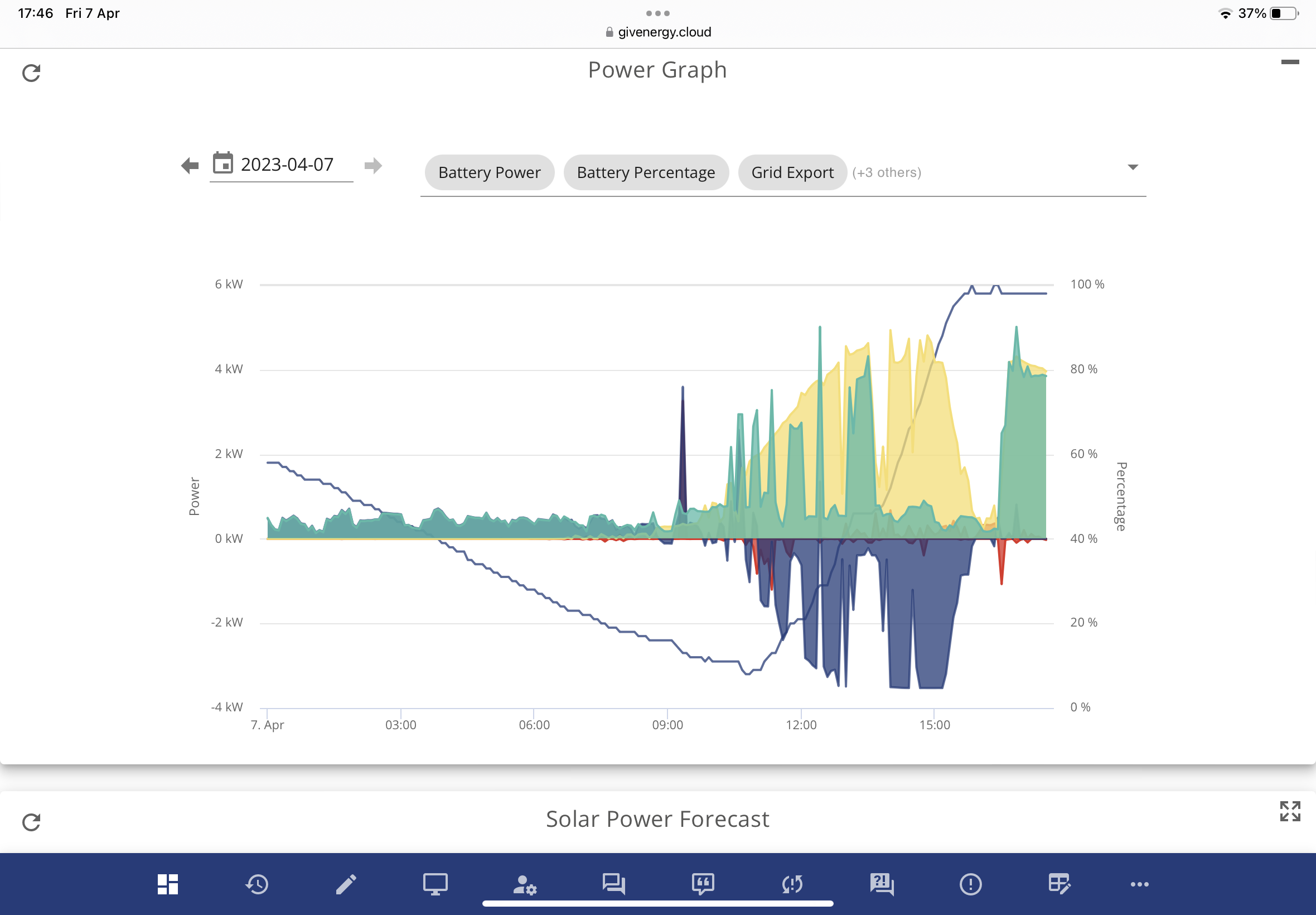
Hi @TheDragon (GivEnergy) I have noticed the system is capping again around the 2700w mark for solar generation both before the battery is 100% charged and after. Chart below shows all usual info and both string voltage and current with power.


Leon_shaw What spec are the panels. I see only one string providing any power
I will use this in my discussion with FW engineers
TheDragon (GivEnergy) there is only one string JA 405w panels 10 in total. These are all together on a south facing roof in two lines of 5 panels.

All on one string?
Looking at the documentation the max input current per string is 11amps. At 240 volts that would equal about 2640watts.
I’m no expert, but I think that may be your problem. Someone else should be able to confirm though.
Hook 13amp on gen 2 apparently. Not sure i'm no expert but pre new FW update panels regularly achieve 4kwh plus. They achieved this yesterday morning and then began to throttle around 12:30. See below.


Leon_shaw , there appear to have been various versions of Hybrid Gen2 data sheets over time.
This is one I downloaded during April 2022. which indicates a maximum string current of 11 Amps, so there is certainly some confusion about matching specific solar panels to the GE inverters.
May be you can switch off some of the lines on the graph to provide better clarity of the string current. Switch off load and battery power may be.
Either that or use the raw 5 minute data from My Inverter - PV Data for the same day and time period.

Simon_C Thanks Simon but this is going over my head a little. Which lines would you like me to remove ? I will look into the 5 min raw data this is not something I have ever done before.
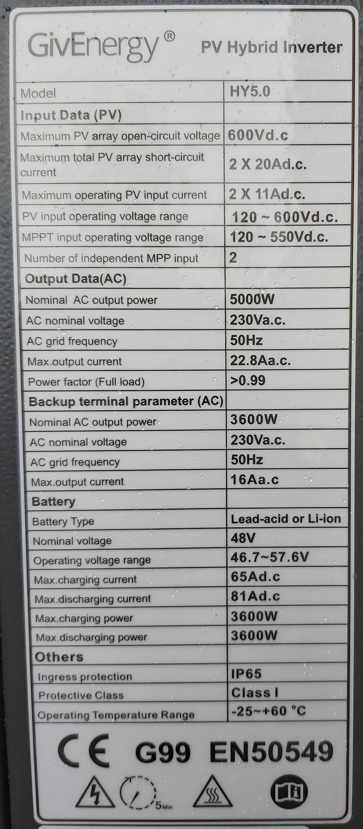
My inverter was installed on 14ths March so pretty new and I know they have been out of stock for months bu tthe latest data sheet states 13a as below. I will check the side of the unit later today when I get home.

Simon_C That looks suspiciously like the Gen 1 Data Sheets

dragon2905 , it definitely states Gen2 on the front page, and the battery max charge/discharge power is 3600 W which is not Gen1.
It could be a mix of the Gen1 and Gen2 before GE got all the details fully clarified.

dragon2905 , yet my actual HY5 Gen2 has a sticker on the side that also confirms the same PV input current.
Manufactured 2301 - 2023 Week 1.

Simon_C The data sheets and stickers all seem to be a mess, i got quite tangled up in them before install, so asked questions of Givenergy. Part of one of the responses was ;
"Some of the original Gen 2's shipped over had 11A at first, this was then upped to 13A through firmware. I can confirm it will do 13A on the latest firmware."
apparently 905-905 or above for 13A on the gen2.
TheDragon (GivEnergy) I've been experienceing the same problem. Firmware D0.906-A0.906 on a Gen 2 3.6 hybrid inverter. Once the battery is full the output drops to just above the base load on the house. I saw from your post that I could get a different version of the firmware. So I called technical support and was offered a downgrade to D0.904-A0.904. This hasn't resolved the issue. Am I right to think you actually offered the other customer an upgrade to an early beta version? If so what version should I ask for? Does the battery need an update at the same time. I have a 9.5kWh battery with version 3009. Thanks.
I have the exact same issue, I have been downgraded as you have but it has made no difference. I emailed support and they are no longer taking beta testers but assure me that full rollout will be soon. fingers crossed as I should be getting piping hot water and export with all this lovely sun about.
welshrat I've received a beta version of the firmware D0.996-A0.908 and a battery firmware upgrade to 4073. It has resolved the problem.
I only requested the beta software because the inverter was basically not working. If the firmware upgrade hadn't fixed the problem I'd have requested a replacement inverter.
If you explain that your inverter is not working properly I would hope that you would be offered a beta version of the firmware.
Seems like you were lucky, I contacted them again and received the following reply.
Thank you for your email.
I do appreciate this and do understand the issues you are facing. I have asked if there is any room for this for you but unfortunately, there is still no room and we would not be able to take on more for this firmware testing.
This is also not a guaranteed fix as the firmware is still in Beta.
We appreciate your patience and can assure you that we are working hard on this fix and aim to have it out as soon as we possibly can
@TheDragon (GivEnergy) I don't suppose you are able to assist here ? Basically no generation after battery full and no surplus to hot water eddi system. Downgraded to D0.904-A0.904 but made no difference. Battery on 3008.
Fair enough if you can't don't want to cause any trouble, I just want working system.

welshrat, you could possibly add some scheduled boost periods on the Eddi to heat the water either before the GE battery gets to 100% or once it has.
This should keep or pull the GE battery % down from 100% and allow the solar gen to re-start.
Just a temporary work-around I know, but it might help you get the best out of your panels until the final firmware is on general release.
Similar to what I have done at times. Force export for a bit when it gets to 90% if I'm confident of more sun later. (Don't have eddi or a EV..yet)
Tried that today, manual boost however what is weird is it seems to pull some from the mains, say 2kw solar 1kw mains which is very odd when the sun is high in the sky and I have seen the system generate 5.4kw when the house and battery need it. Fingers crossed for this new firmware.

welshrat, I have my Eddi configured with a 6.0 Amp device limit so the immersion can never take more than 1.4 kW. It stays on for longer but provides more even heating of the water in the tank, AND if the kettle goes on at the same time the total power does not exceed my 5 kW inverter rating.
Simon_C What is the 6 Amp limiter that you use? I think I could do with that for my immersion which is on all the time apart from evening peak rates.

wrefordj, it is a setting specifically on the MyEnergi Eddi solar diverter.
Use the display and buttons to navigate to, and then set the required value.
Main menu - Settings - Advanced - Passcode - Supply Grid - Device Limit, set to 6 A.

The reason the beta FW is case by case, is someone has to manually load it. 30 mins each, then half a day to monitor and make sure the calibration all goes well and you as the customer don't need to watch it
So yes the Beta will go out to some on a case by case, but the issue is if a new beta comes in, before the final (New bug found) its again manual, and gets exponentially harder to track each one. Leaving many inverter un looked after, if not logged on my list of tracked inverters.
Eventually yes, everyone will upgrade via the automatic blue button, option, this is yet to be coded, as this upgrade is far from straightforward just load. Its a totally new set of code, not an upgrade. So all previous inverter registers, settings are void and need clearing out, if there not and left behind, odd things happen
Understood and won't hassle anymore its just a bit of a kick in the teeth getting a system installed and then it only half working. I have had some success setting eddi to come in at 50w export rather than 150w so this may be enough to give me some hot water which then subsequently started exporting near a kilowatt. I will track this over the next week. Please do update us on timeframes though as would be good to know I will be in a position to export properly over some point in the summer.
I am however in a position to monitor our systems as I work from home as a software dev.