Hello, I've been spec'd the Giv-HY 3.6 inverter for a 6.9kW array and 10.4kWh of batteries. I was wondering if this has been under spec'd? I have an EV charger and plan to charge during the day. My daily house usage (ex car) is around 8kWh. I'm located in Essex with an unshaded 'S' facing roof.
Should I be requesting the 5kW inverter? or am I expecting too much for the UK sunshine.
I appreciated there's a G99 application involved. It's not all about a quick payback for me.
Thank you.
L
#2Lmcde3
I think the 3.6 sounds under spec'd based purely on the size of your PV.
I have 5.8 PV and 5kw inverter - this is regularly clipping to 5.2kw at the moment so unless you're North facing or the 6.9 is split across multiple smaller roofs & have no chance of ever generating much over 3.6kw I think you should expect the same.
A good way to check would be to go to Solcast and get a roof top estimate of your output. That will answer your question 👍
A
#3anglefire
My 3.6 inverter will clip if the battery is full - and I have 4.7kwp split over a south and west roof.
I would say for a south roof you should be looking for a 5kw unit.
B
#4Billywizzer
chickengeorge
I would suggest you upgrade to the 5kw inverter with that size of panels.
I have a 5kw inverter and 6.5 kWh panels and when at max output the temperature rises considerably.
There is a comment on this site about inverter cooling using computer fans.
I have just installed these on my inverter and managed to reduce the temperature from 50C to below 40C when running at max output.
The comments will explain why the cooling is beneficial better than I can, but I was convinced enough to install them
C
#5chickengeorge
Thanks everyone for your replies. I'll push for the 5kW inverter.
Thanks for the heads up for Solcast, I'll take a look.
I did see the thread about cooling. I'll be sure to install some fans.
Cheers
S
#6stevelewis
If having enough peak power to charge an EV is a primary consideration, you could be better off with a separate 5 / 6 kW inverter and an AC3 for the batteries. That would give you >8kW of power in the middle hours of sunny days.
C
#7CARLMW
chickengeorge I think that installer’s just don’t like the G99 route because they will have to wait to get your money! I too have 6.1 kw panels and have seen 6.4 output on cold days, so actually wish I had a bigger inverter and I have the 5kw unit!
#8dbt85
we have 3 systems here but all with AC3's rather than hybrids (just not possible due to locations) and the 8kw and 6kw arrays will both be sending loads of juice out for the grid to charge someone 30p for at peak times, as the inverter can only chuck 3kw into the battery and the house load might only be 500w at that time of day. For the 8kw system at least I want to get an extra inverter added. Not sure why they only do a 3kw one and not something with more pep.
#9THALL
dbt85 There was chatter about a 3.6kw AC unit. But as yet nothing.
#10dbt85
THALL an extra 600w. I'll try not to spend it all at once. 🤣
I guess the majority of their market is running 4kw systems and a single battery so can't have much scope for sucking down say 6kw and maxing 2 batteries simultaneously.
#11hoggy
To be fair I have a 5kW hybrid fudged to kick out 5kW and its not that often it gets beyond 4kW load (and if it does its usually by a huge margin that even 2 inverters still wouldn't cover it anyway!)
Y
#12yandards
South facing roof and 6kw peak array for me, my 5kw inverter does manage ok but if it's going to be a long sunny day I need to reduce the charge rate on the battery to prevent inverter clipping.
It's worth noting that any power not used by the inverter has to go somewhere, this will lead to extra heat in the PV panels which in turns reduces power output.
Given my choices again and especially for EV charging I think an 8kwp array is the minimum, that's enough to run the household background load and charge the car at its maximum rate when those sunny days are there.
C
#13chickengeorge
stevelewisyandards
When I drive to work I'm out all day so will have to charge off-peak when I get home. If I'm working overseas then my car is sat on the drive for a week, so there's no need to charge a max rate.
yandards
I'm not sure I understand the theory behind reducing the charge rate to the batteries to help prevent clipping?
S
#14stevelewis
chickengeorge " I have an EV charger and plan to charge during the day."... hence my suggestion of a system that would enable you to do just that! 😁
Y
#15yandards
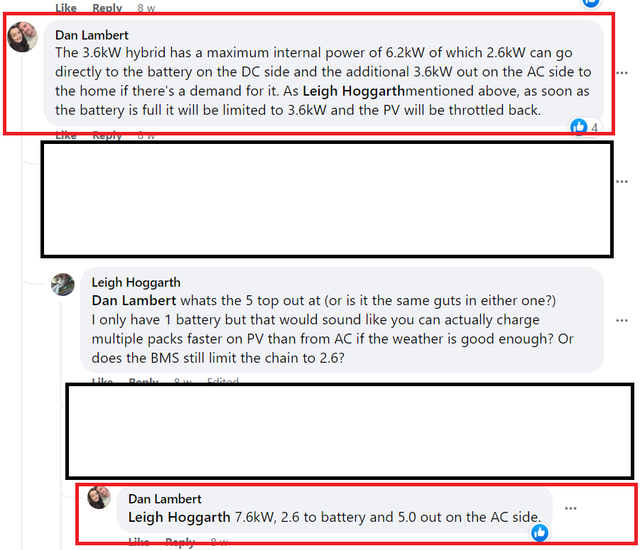
chickengeorge with a hybrid inverter it can charge the battery outside of the inverter limit, so up to 7.5kwp from a HY5 if 2.5kw is going to the battery.
So if I charge the battery at a lower rate it'll use the generation above 5kw instead of clipping it as long as the battery continues to charge.
Sadly it does involve micromanaging the system although I'm sure some clever code types could automate it.
A
#16anglefire
yandards I sort of get the logic of what you are doing. You are slowing the charge to delay full battery charge until later in the day? But ultimately surely it makes little difference? If you have spare to charge the battery in the morning what are you gaining by limiting the battery charge? Ie where else is it going? If it’s going into an ev or diverted into water then it makes some sense otherwise I just don’t see any real benefit
Or I’m missing something!
#17Simon_C
yandards
I understand your logic in keeping some battery capacity free for the peak period of the solar output, when the inverter is able to pass more than 5kW for the total of the battery charge and a/c output, as long as the energy is usefully used earlier in the day.
If the battery is full at this time, the PV output is limited to the 5kW a/c output presumably by the MPPT trackers moving the operating point to a non-optimal power with higher voltage and lower current from the solar PV.
Not sure on your 7.5kW figure though, when the inverter data sheet states 6500 W for the maximum DC input power.
By minimising clipping, the total output from PV for the day is increased, resulting in maximising export to grid at whatever SEG Tariff you're on, whilst fully charging house and car battery and heating your hot water. Reducing the rate at which the batteries charge might also be beneficial in the long-term, I'm not sure.
T
#19Tim
Simon_C Not sure on your 7.5kW figure though, when the inverter data sheet states 6500 W for the maximum DC input power
@hoggy has posted about this before. I think I recall him saying that on the gen1 5kW hybrid, the DC-DC PV-Battery connection was limited to 2.5kW but that the DC-AC was limited at the same time, to 5kW, provided: that there was sufficient PV; the battery was able to take the full 2.5kW due to its charge state; and the house load/export was able to consume the AC. From memory, the gen 2 Hybrid can pop out 5kW DC-AC concurrently with 3.6kW DC-DC, again with the proviso of sufficient PV, battery consumption and house load/export.
#20hoggy
Tim Yes that's from Dan at HQ. There is plenty of margin on the DC side on Gen1 Hybrids to both charge the battery at max rate while at the same time deliver 5kW AC (should your PV array be big enough!)
By minimising clipping losses I am getting to use the PV generation, this has the added bonus of not turning that lost energy into heat too as it has to go somewhere.
I've seen a sustained 5.5kw over a 4 hour period from my 6kwp array which is an expected level of generation on a good sunny day, it's even gone as high as 6.3kw!
That said it's pointless at the moment as my battery has had a complete wibble yesterday and is only storing around a kWh of energy...
C
#22chickengeorge
So I'm 5 days off my install day and my installers are saying they can't get the 5kW inverter. Not sure whether to delay the install (potentially until September) or go ahead with the 3.6kW install...
I'm interested in people views.
Thanks
S
#23stevelewis
chickengeorge if it's worrying you, go for the AC battery as suggested 3 weeks ago.
C
#24chickengeorge
Hi Steve, thanks for your suggestion. Unfortunately it's not an option.
C
#25CARLMW
chickengeorge to be honest this is an installation that’s going to last many years so worth the wait. Whatever people have they tend to want more of a good thing and in the cool spring I was getting over 6kw of power for many hours like the poster above. If you have permission for a 5 kw inverter then wait for it, you will have many years to regret not doing this!
S
#26sponev
chickengeorge I've got just over 5kwp going on the east side and just over 4kwp on the west side in the coming months. I have a 5kw gen 2 hybrid specified and even there, I'll get some clipping as the sun transitions east to west. I was worried that 5kw wouldn't be sufficient but I'm sticking with it rather than changing suppliers. I wouldn't go with 3.6. Two models set up on Solcast suggest I could peak in excess of 6kw so a similar ballpark to your array. 3.6 seems undercooked to me but I'm certainly no expert!
C
#27chickengeorge
Thanks again for the replies. The sales rep finally decided to answer my emails. They have never installed a 5kW GE inverter so therefore they will not install one... I've cancelled the install... Time to look for another installer.
Cheers
S
#28sponev
chickengeorge Sorry to hear that but probably better off with someone who knows what they're doing. The downside is that the market is very busy at the moment and installers are generally flat out and seem slow to respond. The upside is that the new gen 2 GE gear is apparently imminent and so the leadtimes for that should hopefully be a lot better. Good luck with it!
T
#29Tim
chickengeorge I think you may have dodged a googlie with that installer. If they think that the rating of the inverter changes the process, or the skills required, then you're better off with someone who understands what's needed. Feels a bit like, "We've only ever changed 60W light bulbs before and this one's a 100W, so we don't think we can!"
Y
#30yandards
Sounds like they didn't want to install anything!
Any installer who is recommending a 3.6kw inverter for a 6kw coupled with performance models that suggest nearly double that output at certain times of the year is not for you.
I'll put some money that they cap at 3.6kw as it means automatic DNO approval for install. I had a quote from a large installer/electricity provider who quoted 3.6kwp of panels - despite me having space for a lot more!
I'm in Essex. So, apparently they have 'found' a 5kW inverter especially for me.... and are doing the G99 application which will take a few weeks, so are going to push back the install. I can't blame the company for 1 single sales rep not doing their job properly. They have good reviews on 'Check a Trade', I just got unlucky on getting a guy that can't do emails.
Anyone know any reason why a G99 application might get rejected? And the likelihood?
9
#3394jdh
chickengeorge i think it all depends on your location and availability to the grid. My understanding was networks tend to limit export when capacity starts filling up. At worst case you would only be limited to 3.68kW to the grid by the installer settings.
T
#34Tim
chickengeorge As @94jdh says, I think that the DNO is obliged to take up to 3.68kW (16A) of your export. If that causes problems locally, they'll have to resolve that. If on the other hand, there's reason to allow more than 3.68kW, they will.
From my experience, if your installed capacity exceeds 3.68kW but you are happy to limit your export to 3.68kW, your installer can apply for a G99 Fast Track which is usually a formality and happens very quickly (a day or two) as whatever your installed capacity, you are basically making the commitment to always limit output. On the other hand, if it's a Full G99, they will charge to carry out a survey of the distribution network and assess what your export should be limited to. We did this and it took them about two weeks and £300 to decide that they should limit our export to 3.68kW!
9
#3594jdh
Tim that's a pain, being charged and still limiting - as far a I know from my current experience Western Power doesn't charge currently.
chickengeorge
I'm having a full G99 ( not fast tracked) and it's not chargeable with Western Power.
Y
#38yandards
We were also charged for a full G99, although it was less the network capacity, they wanted to check the install as the GE equipment wasn't fully certified as far as they were concerned - it was definitely a waste of everyone's time.
£300 for a chap to come out and look at some wiring and get the installer to stick another 'Caution Solar PV' sticker on one of the distribution units.
DNO is SSE and their process is bloody convoluted as best, installer said they deal with a few DNOs and their response times and costs or not vary widely.