Rcd specification for hybrid inverter.

11 comments started 2023-05-02 last 2023-05-03
GivEnergy ProductsHybrid
A
#1 anglefire

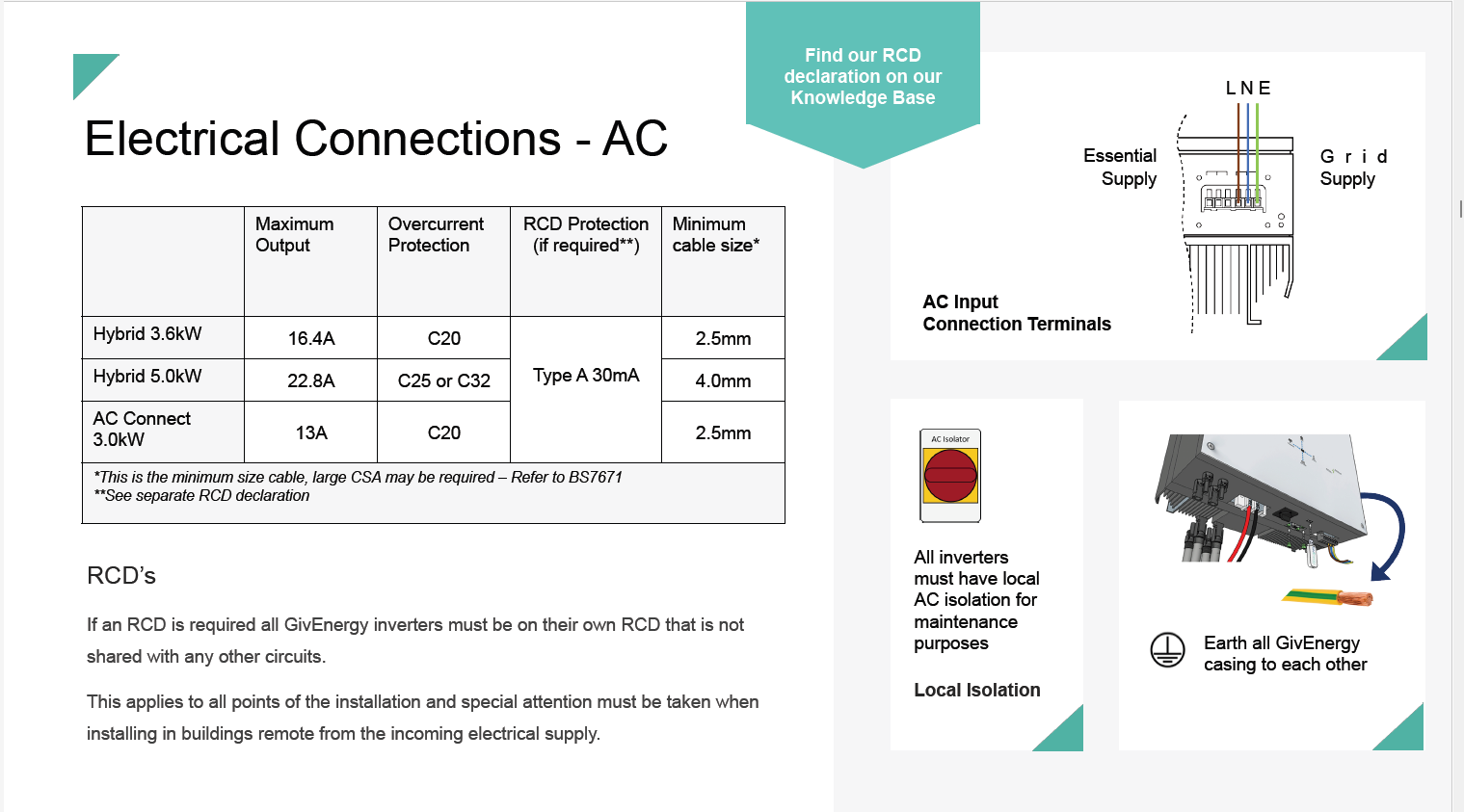
I’ve seen various posts about rcd on solar inverters and that they need to be minimum type B.

However when I was looking around yesterday I found this on the knowledge base.
https://kb.givenergy.cloud/article.php?id=63

Which basically says the inverter has the required protection built in and if additional is required a type a is ok.

Mine does have another rcd and it is type A. Presumably it’s ok?

D
#2 dragon2905

I must admit that I am not entirely clear what you are asking about or more importantly why...

Your inverter, if installed by a credited MCS installer, should be installed with all the correct circuit protection as required by default.

Typically this would some sort of MCB or RCBO either in your existing Fuse Board/Consumer Unit or within its own small Consumer Unit, typically a repurposed "Garage Unit". This is often done as the DC production can cause nuisance tripping on the main Consumer Unit.

Whichever option your installer has decided to fit contained within that I would expect to see a Main Switch then either, (1) a RCD then MCB or (2) RCBO (a RCBO combines the function of an MCB and RCD for every circuit).

Whether additional equipment is required beyond that depends on
1) What your specific equipment required
2) What your specific use case is for your equipment
3) Where in the regulation cycle we are.

I hope that alleviates any concern you might have. No doubt other people with more experience will chime in too.

A
#3 anglefire

dragon2905 I thought I had made it reasonably clear!

My question is that on here (And elsewhere) its stated that RCD + MCB or RCBO is required for protection, which should be type B (RCD Element) as a minimum - one other place it states it is here: https://electrical.theiet.org/wiring-matters/years/2019/77-september-2019/which-rcd-type/
The document I referred to from Dan does say that the inverter has the required protection built in - as a further question, how do you test it?
Oh and the DC element may cause nuisance tripping of a Type A RCD - but is actually more likely to blind it to AC faults.

R
#4 Rubikcube

Type A RCD is fine, no reason to replace it. For a new installation, type B would be a better choice.

No matter what RCD is protecting the grid supply you can still electrocute yourself with the power from the panels, so no RCD can provide complete protection to a micro-generation system.

D
#5 dragon2905

Type AC ---> Type A ---> Type F (used in industrial 99%) ---> Type B

It should be noted that the different types of RCDs (AC, A, F and B) are nested one within the other like Russian dolls: type B, for example, also complies with the requirements of type F, type A and type AC.

So the reason they say you should use a Type B is that it is the only model that is equipped to deal with Constant or Pulsing DC currents, which could conceivably leak into your system and cause nuisance tripping.

In fact we had exactly this issue but then the installer came out and installed a dedicated mini consumer unit for the PV.

It's only fairly recently (last 2-3 years) that Type B RCD's even became available and many manufacturers still don't appear to offer them.

As it's now compliant to only install same brand switchgear into consumer units (ie Hager into Hager) it's pot luck if you can finding a Type B RCD from the manufacturer of your consumer unit.

Hager offer 25A & 40A versions at £300+VAT, Fuzebox have a 63A, thats about £120+VAT, Lewden only introduced them in 2021, doesn't look like BG have one currently nor Live, nor Premspec/Verso, Wylec list price is around £400-£430+VAT

TLDR if it was a legal requirement from either the Electrical Regulations and/or MCS certification then installers would be fitting them (regardless of cost) and simply pass on the added expense to the customer.

If you want something to worry about I would be more concerned with the increasing Neutral faults on the power grid. These will essentially fry every electrical component you have installed.

https://www.northernpowergrid.com/news/grimsby-neutral-fault-customer-update#:~:text=The%20fault%20occurred%20at%2002,to%20internal%20electrics%20and%20appliances.

#6 positor1

dragon2905 As it's now compliant to only install same brand switchgear into consumer units

An electrician can mix brands but he then assumes responsibility for its "manufacture"

T
#8 TX200

TheDragon (GivEnergy) has the advice recently changed.

My install, they just used a spare circuit on the consumer unit. The GE inverter is protected by the same RCD as the circuits for my solar inverter, energy meter, ground floor lights, first floor sockets (don’t ask why the builders did that!) and shower.

#9 TheDragon (GivEnergy)

TX200 has the advice recently changed.

No. When I installed my own in Feb 22, it was the same then.

T
#10 TX200

TheDragon (GivEnergy) I guess when the GE engineer visits, they might make some recommendations to the installer!

Hopefully anything that needs sorting can be corrected at the installers cost!

They're a nice team, but if they've not followed the recommendations...

A
#11 anglefire

TheDragon (GivEnergy) interesting. Mine has a 32a MCB.
Not deeply stressed over that as long as it’s 4mm cable. Which I think it is.