I have a 3.4kw solar power + 9.5kw battery. I have iboost so can set a time to heat water. My Gas charge is 9.6p per kwh, but I can export via Octopus Flux 21.4p per kwh. So what am I missing, gas seems cheaper so should I turn off the iboost and immersion heater and only use as a backup.
Should I heat water via gas boiler or via emmersion heater
Need to consider the efficiency of using gas. You won't get the whole of each gas kW as heat in the water; there are losses in the boiler itself, and then residual wasted heat in the pipework and boiler when it's finished. It's probably worth actually measuring how much gas you use to heat the water every day (probably best to average over a week).
While you're also using gas for heating the house, it's probably not too bad, but firing up the boiler just for hot water may be quite inefficient.
Another worth thing that might be worth considering, if you are in a hard water area, is that the immersion heater will scale up, whereas gas doesn't have that problem.
Based on the gas and export prices you have quoted, my gut feeling would be to use gas for the hot water and sell any excess electricity.
DD I have a new boiler, 96% efficient
New2022 Don't you just love marketing BS? Condensing boilers can get to this level BUT in order to do so you need to run them at a much lower temperature than we used to run our old boilers at. The boilers need to be run so that the flow temperature is less than 54C. Above this there is no condensing and even the most 'efficient' boiler will only manage 85% or so. To achieve your 96% you would probably need to run your boiler with a flow temperature of around 35C. Very few people will be doing that. That's lower than most ASHP's run at and won't heat your water enough for a decent shower and your radiators won't feel warm - just tepid. And here's the kicker. If you do run the boiler at to achieve 96% the water won't get hot enough to eliminate legionaire's from your water tank!
cluelesscris wow, I thought my initial question was simple, this abrasive tone is not necessary.
So I ask again, should I use solar power to provide power to the emmersion heater or should I just sell it back to Octopus and use my gas boiler to heat the water.
New2022 Sorry. The first sentence was aimed at the boiler industry who persistently advertise in such a misleading way. And to answer your original question? I originally put my system in to move away from fossil fuels so my answer then would have been immersion. However, I was never that bothered about pay back periods, etc. For me the mitigation of the energy crisis is some very nice icing on the cake. The rush to put these systems in now is directly related to the absurd cost of energy now. If you are in that bracket then gas and export would seem bang on and you should take it while you can. Who knows what the differentials will be in 2 years time.
Indeed, I put a solar diverter in to move away from fossil fuels. The money savings are obviously a bonus.
To put it figures wise, I just used my gas to heat my water the other day and the cost was £2.05 for a morning/evening use. So £61-63 a month depending on if it’s 30-31 days. An Eddi is £435 approx at the moment, so 7-8 months at that usage and after that I’ve paid off the Eddi.
Before the energy crisis it was nowhere near this expensive so would have taken significantly longer to cover the eddis cost.
The way flux works suggests that selling your export or battery will be your 'cheapest' option and you may even be able to make a profit - assuming of course you hold enough juice back to not need to draw at the middle rate of an evening and assuming your GivEnergy battery doesn't regularly slam to zero when it hits 30-40% SOC , robbing 2K from your 6K investment and meaning you can't plan at all.
grumblegrumbleguesswhosgonnabeonthephonetoGEforyetanotherrecalibratetodaygrumblegrumble.
Long story short: if your main driver is cash, then if you've got the juice to run the house after exporting in that Flux peak export period - export.
If you have a solar diverter then over the summer months based on my install with a small 3.6 solar array you're barely going to use any gas on the water anyway (I've had 2 days in May already where the tank did not bother to top up overnight due to the level of charge it finished the day with).

It is a real dilemma but on the face of it even allowing for the true cost of a kwh of gas as @cluelesscris has pointed out, gas has to be the financial choice.
However having paid 2k for a giant water tank / Eddi and pipework I struggle with the idea of not using it now.
as a compromise I will allow eddi to have surplus until 4pm when flux export gets decent.
I can say if i had my time over I would have just stuck with the combi boiler
If you're on Flux tariff, then rather than using excess solar during the day, it's slightly cheaper to heat from the grid overnight then export the excess solar. Overnight import is around 20p, whereas daytime export is at least 22p (in my region).
So it's the nighttime import price you should use in your comparison with gas, rather than the daytime export.
it's the nighttime import price you should use in your comparison with gas, rather than the daytime export.
Nicely summarised!

If on flux then using your gas to heat the water will be the cheaper option. It's designed entirely to encourage you to sell your PV and import at 2am to fill your battery.
As for condensing boilers, they only need the return temperature to be under the dew point, not the flow temperature. Unless you run your rads at 70 or 80c then they should be condensing quite often.

DD
True but at 20p per kwh, even allowing for boiler inefficiency the gas will be cheaper.
positor1 Probably. For me, my boiler is so bad (old) that, when I measured it, gas worked out at around 40% efficient, so overall cost was about the same as electric.
Perhaps not an entirely fair comparison, since the immersion doesn't heat the whole tank, but it gives us enough hot water for our needs, which is the important thing.

DD
out of interest how did you measure the efficiency of your boiler?
I had pretty much same question as this a few days back, but instead my conundrum is heating oil vs iBoost.
https://community.givenergy.cloud/d/2220-heating-oil-immersion-and-export-with-octopus-flux/
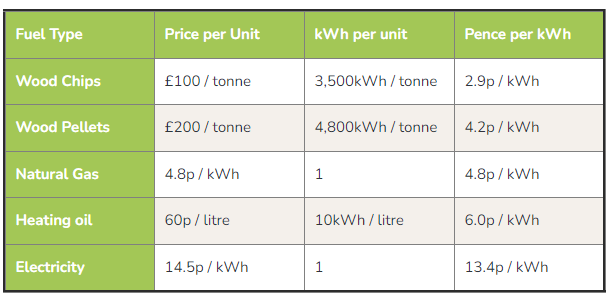
It costs me currently around £0.06p a kWh (60p a litre, 10.35 kWh in a litre). As stated above, even with boiler efficiency calculated it's dramatically cheaper to heat via the oil and export the kWh on flux. I can get £0.23 to £0.36 in export per kWh.
Doing basic maths the tank takes around 8kWh to heat the entire thing. That would cost me 48p in oil, or I heat it for free on the iBoost, but miss out on £1.80+ at minimum exporting those 8 kWhs.
So at the moment my preference is only use iBoost on the 100% sunny days where I export so much anyway. My goal being to pay back my investment asap. Wish I'd known the flux prices when I agreed to get the iBoost tbh, probably would have not bothered for now. Yesterday I exported 22kWh, which was £5.80 in payment to me, AND I fully heated the tank with iBoost. For one day that is pretty good!
All that said I do appreciate the climate impact too, so that leans me more to use the iBoost when I can.
New2022 should I turn off the iboost and immersion heater and only use as a backup.
Self-consumption for me always wins out over income from export. If I could find a Sunamp for 20% of the list price, I'd definitely buy one but until then, we'll use the oil boiler for hot water.
positor1 Just assumed that electric was 100% efficient, and compared how much gas it took to heat the water, vs heating direct. Before I switched to using electric, almost all gas use last summer was for hot water, so I have a pretty good long-term average for that.
(It is a very poor way of doing it, since the two systems have different thermostats, and they aren't heating the identical volume of water. I was really comparing "enough hot water from electric" vs "enough hot water from gas", rather than the efficiency of the boiler directly. I am being a bit unfair to the boiler, since I have better control over the electric, and can heat different amounts of different days of the week, which isn't something I can automate with the gas. So gas is probably rather better than 40%.)
Thank you everyone, good discussion thread. I think the iboost and ibuddy I have is now a nice to have rather than necessary. But it future proofs the system and has emmersion heater time control. Will stay with gas for heating hot water for the time being and export more electricity. I will review in July when/if the gas and electricity prices change.
Everything you said is correct.
However Combi boilers have separate temperature settings for Central Heating & Domestic Hot Water. So if correctly set up then you can achieve better boiler efficiency and should be reaching the condensing temperature of 54'C or less.
Also worth pointing out that you can also get the same affect, ie. separate CH and DHW temperatures, with System and Regular Boilers just takes a bit more configuration.
The average Central Heating requirement across the UK is 8kw. As a nation we have always installed too big Boilers and/or too big radiators.
The former is a problem as a boiler that is too large in heating output will struggle to modulate (ie reduce) its heat output to satisfy your heating needs. eg. you have a 30kw boiler but in reality only have 6kw requirement to heat your home then the boiler needs to reduce its heat output from 30 to 6 which is a modulation ratio of 5. There are some boilers that will do this but many will not. So you will be wasting money overheating your central heating.
Want to know what your room/household heat loss is

dragon2905
I have had an argument with many plumbers over the years with regard boiler size, with respect to combi boilers if you want a decent hot water flow rate you have to have one of the biggest.
Some of the smaller ones would take an age to fill a bath even.
positor1 sure there are many variables to consider.
Hot Water Flow rate is just one. However it is pointless to get a large combi boiler with say 20ltr/min flow rate if your cold water pressure only provides 10ltr/min. You would be limited to the mains pressure of 10ltr/min regardless.
If you are concerned about being able to fill a bath at a reasonable time then you should probably consider a different approach. Either a System or Regular Boiler combined with a Hot Water Cylinder.
A reputable plumber should be looking at incoming flow rates, incoming temperature, size of house, hot water/heating requirements of house and last but not least carrying out a heat loss calculation.
Typically what actually happens is that you need to replace your boiler and a plumber simply replaces like for like.
Whilst there are many "old skool" plumbers out there who just keep on keeping on there are some who think outside the box and have interesting ideas to improve installations.
Alternatively you could opt for a Combi Boiler that has a Hot Water Priority Feature and combine this with a small hot water cylinder.
Urban Plumbers shows how this would work in practicality and he also has some other great content on his channel (I am not affiliated just an interested consumer)
https://www.youtube.com/watch?v=_UQlGryL3JA

Just before I installed my solar in February, Octopus started taking signups for the Tracker tarriff.
Because of the cost of gas and electricity I changed my mind about getting an Eddi, as it didn't seem cost effective anymore.
Today's electric price for me in Birmingham is 17.93p and my gas price is 4.38p. I went for the fixed export of 15p as I'll mainly be exporting during the early afternoon and want my battery for the evening.
This is an interesting thread though I don’t have gas but like some folk have an oil fired boiler. I recently had a 4kw array installed with a 9.5 kWh electric battery and 10 kWh heat battery . We now only use the oil boiler for space heating and the Sunamp heat battery for DHW. From April onwards , before the Sunamp was installed we were dumping 150 kWh to the grid ( for free , we don’t have a smart meter) we now use about 120 kWh per month to charge up the Sunamp ( 4kwh per day for our needs) This is free , plus in summer we don’t buy ANYgrid electricity either!
In winter we will use cheap offpeak electricity to fill the electric and heat batteries at15 p a kWh plus 750 litres of oil for space heating( £500, but our pensioner winter heating allowance pays for that!!!😊)
I bought a £37 timer to control the Sunamp, it takes about 100 mins on a sunny day , early afternoon ( the PV has recharged the electric battery by then ) and use the boost button if it’s a dull day. The Sunamp can hold its heat for a couple of days ,it loses heat at 1/4 the rate of an insulated hot water cylinder.
Check out SUNAMP’s website.
Bill
billG Sunamp are cool but you need to have space for them.
There's also the similar concept https://tepeo.com/
What's really annoying is that there are plenty of solutions but to my mind no manufacturers offer the perfect solution.
What would be ideal for 99% who already have Hot Water Cylinders would be a 3kw Air Source Heat Pump that could be mounted in the loft.
A 3kw ASHP would provide 9kw of heating or hot water can easily be run from an Eddi, iBoost, Immersun etc or directly from a SunSynk ECCO inverter (these have the solar divert function integrated into the inverter)
Yes it would require a change of Hot Water Cylinder but as it would be a "dumb" cylinder rather than a smart "mixergy" style version it should be MUCH cheaper. Over all it would probably arrive at the same ball park cost but the differences between the two in terms of efficiency/performance should be night and day.
The ASHP should operate easily between 300-500% efficiency depending on temperature setting or whether it is a High Temp (HT) ASHP.
It would need to have a Coil for the ASHP, a Coil for the existing Gas Boiler, 1 or 2 Electric Immersion elements at different heights in the cylinder. There a few of these on the market, albeit with a single or no immersion.
There is some room here for using buffer tanks but finding out the details on these ie. costs/benefits etc is proving difficult.
There may even be some headroom to use such an ASHP to provide some of your heating requirements but that's a bit beyond where my personal knowledge goes and there doesn't seem to be any product, available, currently in the UK.
The final option that I have been looking into are ASHP Water Cylinders.
There are a few products on the market as you can see. But the many of the better known brands don't offer them for sale in the UK. And those that can be specifically installed into an existing Gas Boiler installation (eg. have 2 separate coils) appear to be from brands with little historical reputation, give me concerns for ongoing maintenance and repair, and/or appear to be at the top end of what I would expect to pay.
https://www.aircon.panasonic.eu/GB_en/model/paw-dhw270c1f/
https://www.heatershop.co.uk/dimplex-edl270uk?cat=9101
https://www.projectcurv.co.uk/air-sourced-hot-water-cylinders/
https://www.vaillant.co.uk/for-installers/products/arostor-domestic-hot-water-heat-pump-58880.html
https://rointe.com/uk/water-heaters/heat-pumps/dalis-pro-air-source/
https://www.totalhome.co.uk/ventilation/?pid=596
https://www.shop4-waterheaters.co.uk/section.php/170/1/rointe-dalis-pro-electric-air-source-heat-pump
https://coolenergyshop.com/products/cool-energy-ecostore-ce-es300-all-in-one-heat-pump-hot-water-system?variant=21926950469721¤cy=GBP
https://www.shopclima.it/en/daikin-ekhhe200cv3-monobloc-water-heater-in-heat-pump-dhw-200-2nd-generation-capacity-200-lt.html?srsltid=AYJSbAepYeC8LPclVQ591JdiGN8VvPKs2cHanTC1rqCxTwfFD5aZ0tjDdzg
As others have pointed out, if you had a new boiler fitted... but didn't replace all of the radiators for much... MUCH... larger ones. Then you won't be getting the benefit of that efficiency.
The house I bought, also has a nearly new efficient condensing boiler... to make the most of that, the flow temp needs to be around 45ºC so that the return flow to the boiler is around 30ºC range.
To run it at that temp with the stock sized radiators... means it takes 3x as long to try and warm a room up... and in some cases... it simply can't achieve that in colder months.
So I had to set mine back to a 60ºC flow rate.
Thankfully, we are reasonably insulated (aside from the roof space that needs extra adding). So our winter bills were not extreme... and the heating will be shut of for the summer in the next few days and won't be back on until at least Oct.
So only using gas to heat hot water for 5-6 months and with no water tank to heat at all... we spend about £10-15 a month on gas during those months.
my system has evolved over years and the recent rise in energy costs has caused me to accelerate that evolution, we are in a rural location without mains gas so have a 1000ltr propane tank, for central heating and HW, in the old days with a rather inefficient boiler we were filling that 3 times a year. we also have a Woodburner with a back boiler which didnt integrate with the gas system. first improvement was to add a clever little panel invented by a plumber which made the two systems work together and reduced us to 2 fills a a year especially after we upgraded to a condensing boiler. 8 years ago we had 10kw of PV installed ground mounted which gave us free electricity during the day & a FIT payment but we were still using quite a lot of gas & mains electricity. in April last year we added an iboost and turned off the boiler for the summer after paying £1400 to fill the gas tank.
That worked well and i finally realised that we produce quite a lot more electricity than we use and after managing to get a smart meter and switched to Octupus with outgoing at 15p a kw, i also ordered 2 * 9.5kw batteries and an inverter although due to limited supply we didnt get that installed until December 2022.
the improvement then was spectacular, even with the worst time in the year for PV our bill dropped dramatically, especially as the government was topping up our account. from the 31st March i moved onto Flux, my last bill for march 22 - April 22 was £15 for import and £98 export, so we got £83 credit, using the Octupus watch app, it says the last 124 days from 1st jan we are £34 in credit & our gas tank is still at 40% full after more than a year.
I have gone off on a bit of a tangent there but to the original post, i dont really consider the cost difference or if its better to use or export, I have the app on Eco all the time, now we are out of the dark days of winter the battery is back to 100% by 11:00 am most days, excess goes into the iboost until the hw is up to temperature, then it exports at flux rates. we get through the night with the batteries usually above 60% by morning. I also have an old solar HW panel that had burst, I got it down and took it apart and was able to replace the tubing and get it going again so on sunny days we have more HW than you can use.
The jist of all this is we are pretty much self sufficient in energy now, and able to harvest our own wood so its just the LPG which i need to sort. The down side of all this is it did cost 10k for the batteries and i could worry about payback time, but i have already forgotten i ever had that money 😉
The Sunamp 10 kWh Heat battery we bought for DHW is equivalent to a 210 litre hot water cylinder, but half the size. We are still on oil for space heating in the older months. Believe it or not here in a Scotland in rural areas ( we are ) we can get a £9000 grant to install ASHP.
However as we are in a 4 Bedroom Victorian building rebuilt in 1919 with central heating installed by the previous occupant a plumber in about 2000 I worry about how much electricity an ASHP might use daily 20kwh?
Might be feasible if I had more batteries?
Bill G
Size, weight and space considerations not withstanding the issue with Sunamp, Tepeo and many others is that they are only 100% efficient.
I don't mean that in anyway that is "deprecative" just that Heat Pump technology is at worst going to be 250% efficient and at best as much as 500%.
We are in the ridiculous situation that with a new build house, well a few years old anyway, that is plumbed in 15mm plastic in the ceiling with 10mm drops to radiators.
If we wanted to change out our Gas Boiler to an ASHP that would require, at a minimum, changing all the 10mm pipe behind the plasterboard walls and, in an ideal situation, completely changing the plastic Hep20 pipework to copper (as low temp heating in plastic promotes bacterial growth) which is bacterial inhibiting.
It might be possible to go down a route of a hybrid system but they run to even larger costs than a standard ASHP install. Plus to achieve what benefit?
In an even more ridiculous state of play we recently discovered that the heating plan for the property was designed (circa 2018) with a Flow Temperature of 80'C with a Return Temperature of 60'C. Despite the 'Condensing Gas Boiler' not going into Condensing mode until the the Return Temperature reaches 54'C or lower. So it would seem that they designed the heating for the property to only be at best 80% efficient.
And yeah unfortunately our money tree in the garden isn't doing so well what with all the climate change!!
Sunamp batteries are heavy. The Uniq 9 one I bought is 186 kg= 9 bags of cement! Fortunately my utility room that links to an outside oil boiler is on the ground floor with a tiled cement floor.
There are no Legionnaires issues with them and the hot water they produce is potable. Much of my copper piping is 15 mm but there are some 10 mm stubs, most of the radiators are twin with fins and the bigger rooms all have two rads. . I’ll try and get an installer to come and have a chat about ASHP . Sadly with concrete floors downstairs and 600mm stone walls with lath and plaster , adding insulation isn’t an option though.
Regards
Bill G

Anomnomnomaly The house I bought, also has a nearly new efficient condensing boiler... to make the most of that, the flow temp needs to be around 45ºC so that the return flow to the boiler is around 30ºC range.
To run it at that temp with the stock sized radiators... means it takes 3x as long to try and warm a room up... and in some cases... it simply can't achieve that in colder months.
So I had to set mine back to a 60ºC flow rate.
Sadly that means whomever fitted the system didn't do their calculations properly.
The house I bought, also has a nearly new efficient condensing boiler... to make the most of that, the flow temp needs to be around 45ºC so that the return flow to the boiler is around 30ºC range.
That doesn't sound correct at all.
Its the return temperature that needs to be below 54'C. So flow temp of 55'C if your getting 15'C difference would give you 40'C Return temp. That's well inside the condensing upper limit of 54'C.
Does sound like they didn't calculate the heat losses correctly and/or adjust your boiler output to meet the heating requirements of your existing radiators.
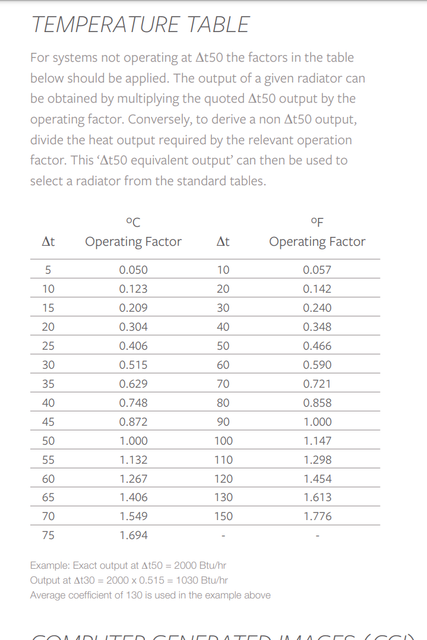
55+40=95 / 2 = 47.5 Mean Water Temperature
Deduct 20 for Living Room Temperature = 27.5 Delta Temp.
You then have to work out your heat loss per room and size radiators accordingly using Delta 27.5.
https://www.stelrad.com/basic-heat-loss-calculator/
So a radiator that outputs 1000watts @ Delta 50 is only rated for 515Watts @ Delta 30
Radiators are typically listed with Delta 50 outputs in Watts or BTU (although there are many ebay sellers who list them with Delta 60)

Try the Air to Air heat pump route. I had a quote for an ASHP plus new HW tank. He insisted that ALL of the rads needed changing. Total cost £17000. Hence my interest in Air2Air.
In the old days cowboys had a horse - now it's a van with Eco written all over it.

At the risk of being accused of thread drift I would love some advice.
I have a small, off grid, well insulated bungalow with a new solar system. (See icon) It has a log burner and an old oil fired combi heat/water boiler running double radiators which I need to remove from the kitchen.
Do I replace it with another or …… what??
An electric combi and tank in the loft has been suggested by a friend, but the thought of using electric in the height of winter scares the wotsit out of me!
Suggestions and ideas please.
Watcher look at a Sunamp heat battery that can be charged cheaply overnight in winter on offpeak and solar PV in summer to provide your DHW. Bill G

Thanks Bill, anything for the central heating?
Watcher you can check out the tepeo Zeb
Watcher I’m currently on an oil boiler for space heating but I think I’ll only need 750 litres pa now that I’ve separated the DHW to the Sunamp. 750 litres= £500 with an oil litre price of 65p just now. As pensioners we get £500 as a winter heating allowance😊 So the oil is effectively free.
Amazingly in our rural situation in the Scottish Borders we can get a a £9000 grant if we install a heat pump, but being in a Victorian stone cottage makes me wonder if it’s worth the effort and likely considerable rework of radiators etc. plus we have a open fire and a log burner in each of the main living rooms. I have two years of logs from ash trees cut down with die back in the garden.
Bill G
billG are you saying that I could run radiators from a Sunamp? (At the moment I'm on an oil-fired central heating system which is over 20 years old)
I too have been mulling over this problem and with my setup have found that for me the immersion heater every time.
I do have a blown air 1980's gas boiler which British Gas tell me regularly is incredibly inefficient and i could do better.....but it works for me. I live in a very hard water are and have had for a number of years a water softner running.
I have run my system with both immersion heater and gas to see for me which was best.... and now we are into spring and getting quite a bit of sunshine i have lots of surplus energy so immersion heater for me. Interestingly , the immersion heater also heats up the water to a higher temperature than my gas boiler..
All the best and kind regards to all.
netty I don't think that's what was meant. The Sunamp can get the temperature high but the quantity of heat in the store wouldn't be enough to heat the house.
Tim Oh I see.
Thanks for explaining.
I can't see how I can get away from oil in an old house such as this.
netty What about an air to air heat pump system. These can be multi split so that one heat pump can supply hot air to several rooms. Units can be mounted like a radiator, in the ceiling or high up on the wall and heating is almost instnt - no witing hours for the heat pump radiators to get to temp. The two main advantages are that - they act as air conditioners in the summer and can provide cooling - and you could leave your existing oil fired radiator system in place until you are sure they are right for you, or to top up extra heat when really cold. True - they need electricity, but they are cheaper and many are more efficient than the wet radiator heat pump systems. Try looking on you tube - there are some good videos from people who have installed them, talking about advantages and disadvantages
Karen thanks for this ...
What about this tepeo ZEB thingy? Anyone got one of those?
Heat Loss Calculation
Before any of you make decisions you should really do your own Heat Loss Calculation!!!!!
Get paper, pen/pencil and a tape measure and record the dimensions of each room (Length x Width x Height) and each window (Vertical & Horizontal) and each door (Vertical & Horizontal) then plug the numbers into the heat loss calculator.
https://www.stelrad.com/basic-heat-loss-calculator/
When you have your total home heat loss you can then start to work out which system might be best for you.
Fabric First
No matter what you decide you should always look to improve the insulation and heat retention of your property as much as is practical, possible or affordable.
Gas / LPG / Oil Boiler Efficiency
If your going to use a Gas, LPG or Oil Boiler bear in mind that they are both only about 80% efficient if they are not operating in Condensing Mode. At best they are around 93-96% efficient ONLY when condensing as much as is possible (the lower the return temperature into the boiler the more efficient).
Domestic Hot Water Priority
If your boiler will support it you will want to ask specifically about Domestic Hot Water Priority. This decouples the heating output of your boiler for your heating (as low as possible to be comfortable) and hot water (as hot as possible for the shortest period of time). This should ensure that your are bringing your return temperature to as low as possible (below 54'C your boiler will start condensing which simply means that it gets its more and more efficient)
Combi Boiler + Hot Water Cylinder
Combi Boilers by design can have different temperature settings for Central Heating and Hot Water. What is not usually considered is that, again if your boiler supports it, you can set up a, typically, smaller Hot Water Cylinder to ensure a good store of hot water so you don't run into those low flow issues.
This video shows just one example being used on a gas combi boiler
https://www.youtube.com/watch?v=_UQlGryL3JA&t=156s
Oil Boilers
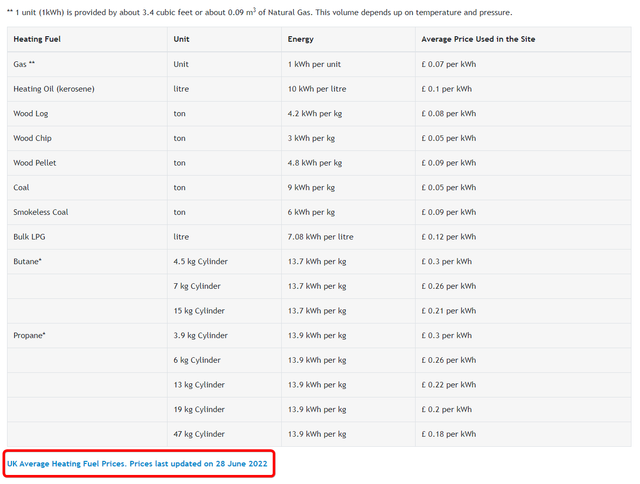
Bear in mind that 1 litre of kerosene (fuel oil) is approximately 10kwh of energy.
So if your heat loss is;
1kw then you will burn 1 litre of fuel every 10 hours
(for daily use 1 / 10 x 24=2.4ltr/day)5kw heat loss you will burn 1 litre every 2 hours
(daily = 1 / 2 x 24=12ltr/day) and so on.
LPG Boilers
99% of NG boilers are available using typically simple and relatively cheap conversion from NG but due to be phased out from 2025 onwards.. (assuming it happens)
https://www.confusedaboutenergy.co.uk/technical-zone/domestic-fuels/fuel-prices.php

BioMass Boilers
Personally I don't have a great deal of info on these. Here are some sources:
https://energysavingtrust.org.uk/advice/biomass/
https://www.greensquare.co.uk/biomass-boilers-product
https://www.thegreenage.co.uk/tech/biomass-boiler/
Not sure how correct these prices are looking at the Electricity Price!

Hot Water Cylinder
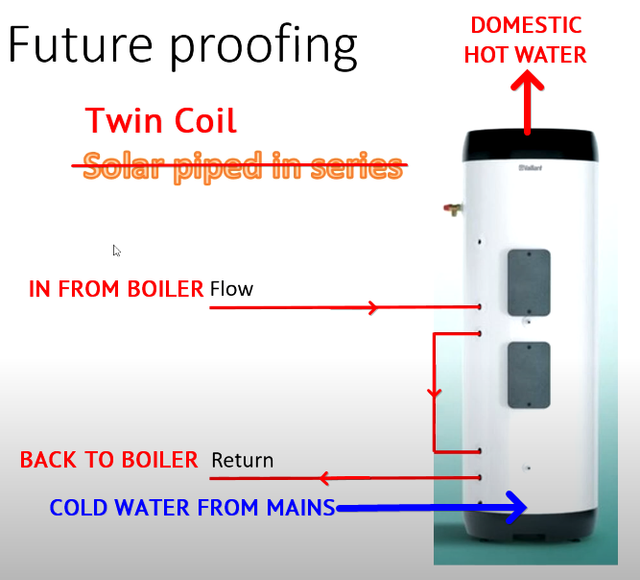
If you are replacing a Hot Water Cylinder then I suggest you watch this video. It's worth watching the entire thing or you can skip to 21:05 where he suggests how to make the best of your Oil/Gas Boiler by installing either a Heat Pump Hot Water Cylinder or a Twin Coil Solar Cylinder (plumbed in a certain way) due to the larger coils inside the cylinders which make more efficient use of the heat your boiler generates.
https://www.youtube.com/watch?v=Add97mtnQUA
Hot Water Cylinder ASHP
Nowadays you can purchase Heat Pump Tumble Dryers, Heat Pump Fridges/Freezers. They all utilize the same underlying technology as Air Source Heat Pumps.
Internationally it's been possible to purchase Hot Water Cylinders with Air Source Heat Pumps installed onto them (typically on the top).
These can either be Direct eg. they are heated only from the ASHP and the Immersion or Indirect they will also accept heat input from another source such as a gas/lpg/oil boiler.
Here are some brands/models which may or may not be available in the UK.
https://www.vaillant.co.uk/for-installers/products/arostor-domestic-hot-water-heat-pump-58880.html
https://www.aircon.panasonic.eu/GB_en/model/paw-dhw270c1f/
https://www.dimplex.co.uk/professional/heat-pumps/hot-water-heat-pumps
Heat Pumps
There is a new generation of heat pumps called High Temperature Heat Pumps. Unsurprisingly they operate at higher temperatures than a typical heat pump. The catch is that with higher temps comes lower efficiencies.
If your thinking of why to use, or even why not to use, a Heat Pump then have a look at the following:
https://www.youtube.com/watch?v=WuAunibSIoA
https://www.youtube.com/watch?v=gMMyhBku6Ic
https://www.youtube.com/watch?v=2jM_oKWptaI
https://www.youtube.com/watch?v=yW1NEslvvwM
Remember even a heat pump that is operating at:
- SCOP of 2 generates 2 units of energy for every 1 you put in
- SCOP of 3 generates 3 units of energy for every 1 you put in
- SCOP of 5 generating 5 units of energy for every 1 you put in
Alternatively you can think of it in these terms:
- SCOP 2 your normal peak cost of energy @ 33pkw becomes 16.5p, off peak @ 9p becomes 4.5p
- SCOP 3 your normal peak cost of energy @ 33pkw becomes 11p, off peak @ 9p becomes 3p
- SCOP 5 your normal peak cost of energy @ 33pkw becomes 6.6p, off peak @ 9p becomes 1.8p
Electric Heating Sources (other than Heat Pumps)
Electric boilers, immersion heaters, Sunamp, Tepeo and all other electrically powered heating systems are 100% efficient. So you put 1kw in you get 1kw out
https://sunamp.com/
https://tepeo.com/thezeb

dragon2905 (the lower the return temperature into the boiler the more efficient)
Surely the return temp would have to be higher than the hot water desired temp would have to be higher than the desired water temp ( by x Centigrade) for transfer to occur?
I use a combi for heating and with a y plan configuration a hot water tank too, the radiator temperature setting is then the same for the water. what would be the best temp to set?
I do have a twin coil cylinder , both coils combined at the top for maximum transfer.
positor1 there are a few things to unpack there;
Surely the return temp would have to be higher than the hot water desired temp would have to be higher than the desired water temp ( by x Centigrade) for transfer to occur?
When talking about Flow and Return Temperatures we are specifically talking about the temperature of the water when it comes back into the boiler.
You set the Flow temperature on your boiler say 60'C and the boiler fires up until 'and/or' 1) the flow reaches 60'C 2) the required demand is met eg your Thermostat is satisfied. If the thermostat continues to call for heat then the boiler will modulate (turn up or down the gas) to maintain the 60'C maximum outgoing Flow Temperature.
For the boiler to operate at it's most efficient, ie condensing mode the Return temperature needs to be below 54'C. The efficiency is on a sliding scale. So in non condensing mode you may get 80% efficiency, at a Return Temp of 54'C you might get 85%, at 45'C 96% (those numbers are purely for illustration only!)
I do have a twin coil cylinder , both coils combined at the top for maximum transfer.
So a "COIL" is simply a length of tube that allows the transfer of heat. Its just a radiator but inside your Hot Water Cylinder.
If we take a 2 x 2 x 2 room and install an appropriate size radiator we can that volume (room, air or water) effectively. If we double the size we can either choose to heat that same volume twice as quickly (keeping the heat going into it the same) OR we can reduce the heat going into the radiator and heat that same volume at the same time.
The end result is the same in terms of the heat energy we use to heat the room (or water).
However, by running at a lower temperature we improve the efficiency of the boiler so get more output for less cost which would you choose?
A standard single coil cylinder might have a 10kw coil inside, a twin coil cylinder might have 2 x 10kw coils inside and a heat pump cylinder might have a 30kw coil inside. As the heat travels through the coil it transfers it's heat to the water around it so the incoming temperature is higher than the water exiting it.
I use a combi for heating and with a y plan configuration a hot water tank too, the radiator temperature setting is then the same for the water. what would be the best temp to set?
It's obviously impossible to comment on a specific installation setup but the benefit of having a Combi Boiler (other than space requirements ~ usually no Cold Water Tank/Hot Water Cylinder) SHOULD be that you can (1) set different temperatures for the CH and DHW and (2) can modulate the boiler settings - this means that say our home heat loss is 8kw but you have a 24kw Combi, you can reduce (modulate) the boiler so it only fires at 8kw when CH is required but can fire at full 24kw when you need hot water.
There are many ways and many reasons a boiler setup might have been used. Sounds like you should have a conversation with your plumber to find out exactly how it has been configured and why. There are just too many ways it might have been setup to provide specific advice.
The key things to find out would be can you add Weather Compensation to the controls ~ savings of upto 11%. Can you set up Domestic Hot Water Priority in some form. How can you best setup your system to ensure it is entering into condensing mode at as low a return temperature as possible. If your HW Cylinder has 2 coils how is it plumbed. Unless there is a specific reason not to can it be plumbed in series like this?

Tim Sunamp are working on a project to have their heat battery linked directy to a heat pump for space heating V1 applications. I’ve applied to be a test site but haven’t heard much since I applied. You’d need a big heat battery perhaps 40kwh ? Which would be compact but very very heavy 300+ kg. Would be dependent on cheap rate offpeak grid electricity in winter.
Bill G

dragon2905
You certainly know your stuff! thank you
My cylinder has two 1.5m ². they are joined to give 3m²
The combi was existing and the cylinder was added as a result of solar pv and eddi, the desire to reduce bills.
It seemed sensible to have the ability to heat the DHW from the boiler too and to have the choice of hot water from the combi or the tank when hot. this is achieved with a simple two port manual diverter valve on the hot water outputs.
The boiler can heat the tank if selected, that is tapped off the radiator flow and return with a honeywell 3 port motorised.
It was all a big experiment TBH , I had not considered for example that in periods of no solar and the combi supplying hot water taht the cylinder water could be going stagnant.. live and learn huh.
billG I thought the 210 that you have was about 180kg and heated up enough on 4kWh of solar to supply hot water all day? I'd have thought that a space heating requirement would be at least 10x that for 24 hours in winter, requiring 10x mass of thermal store?
Cool beans. Sounds like you got a plumber that was prepared to think outside the box. Sadly they are a rarer breed than they should be.
Out of interest how big is your cylinder?
Different Boiler Configuration
Can't think, offhand, any reason why you couldn't plumb the DHW from the combi directly into the cylinder. Hot out from boiler goes to taps as usual, cold into boiler is plumbed to hot out of boiler and then mains cold into cylinder.
The boiler has a temp sensor on the IN (normally mains in) so should reduce the heat output to raise the temp to its setpoint.
Hmm just thought of one, Legionnella.
0°C to 20°C legionella is dormant,
20°C to 32°C slow growth.
32°C to 42°C Optimal growth for legionella is 32°C to 42°C (maximum growth rate at 37°C)
42°C to 45°C is slow growth again
45-50˚C its dormant again.
Around this temperature or above is where we can cleanse or pasteurize stored hot water to safe levels.50˚C 90% of legionella dies between 80 & 124 minutes depending on the strain, lets say 2hours
10% won't die after this time but will definitely remain dormant and not multiply, so remain totally safe provided the temperature is kept here continuously or the water is refreshed.55˚C 90% of legionella dies in approximately 20 minutes and 100% is killed over 5 to 6 hours.
60⁰C 90% it dies in 2 minutes and 100% in 30 minutes.
65⁰C 90% in around 10 seconds and 100% in 2 minutes
70⁰C It’s instant death for legionella
Note numbers are approximate and vary with strains.Sterilisation / Pasteurisation or Anti-legionella Cycles
If you do store hot water as low as 40 to 49°C we would suggest at least being aware of anti-legionella cycles (ALC).
This is essentially where hot water temperatures are temporarily increased to kill off any bacteria that might have formed.
If your water is fully turned over once every day or so on average this won't be needed. But if you are particularly concerned, for peace of mind, you could do a one off sterilisation after a holiday or once a year.
Simply turn up your hot water to at least 60°C and run all outlets for 5 mins, making sure that you have turned up temperatures past any safety limiters.
Legionella Protection
Which raises the question of how your ensuring your hot water cylinder doesn't grow legionella in its current installation?
Our Eddi is obviously used all the time but we also have it set to use off peak electricity at 4:00-4:30am and the Cylinder Thermostat is set to around 60-65'C. We have a Kingspan Tribune Cylinder that uses a proprietary cylinder thermostat / immersion.
Most Cylinder can make use of one of these which has an anti-legionella cycle.
https://www.tsmart.co.uk/product-selector
https://www.youtube.com/watch?v=f7zyMAcCLBo
Automation of your Manual Diverter Process
If your technically minded you could probably automate the whole process using a combination of Home Assistant, Shelley or Salus Relays (or other devices) and a mix of Cylinder, Pipe and/or External Thermostats. You would have to change the manual valve to a wired version also.
https://hubitat.com/products/hubitat-elevation-sup-%C2%AE-sup-model-c-8-uk-irl-version
https://shellystore.co.uk/product/shelly-1/
https://saluscontrols.com/gb/product/sr600-16a-smart-relay/
https://saluscontrols.com/gb/product/ps600-pipe-sensor/
Our Wishful CH/DHW Designs
Our system is gas fired, we added an Eddi to the HW Cylinder & the PV & Battery setup but are still seeing export of 12kw+ on the best of days recently.
What would have been perfect for us would be a small, lightweight ASHP say 3kw or less. Something that was light enough to get into the Attic.
We have looked at changing to to an ASHP but can't really afford it atm and would have much larger install costs due to having to change our pipework supplying the heating. It's 15mm in Ceiling/Floors and 10mm in the drops to the radiators, this gives difficulties with flow rates. All installed behind plasterboard to boot. Plus it's plastic HeP2O which can permit bacterial growth at low design flow temperatures (copper pipes are naturally bacteria resistant). To get round this you have to add additives/glycol (antifreeze) which also reduces the transfer of heat.
So we have been trying to look into 2 different scenarios instead both to be powered by the Eddi and using a 3ishkw ASHP. That would technically give in the region of 6kw heat output even assuming a low SCOP of 2 (1unit in 2 units out) or a modest bump in SCOP to 3 would give 9kw heat output (1 unit in 3 units out).
1) A thermal store for the central heating loop. This would be in the range of a 75/80/90 litre (we have to do some math on the current volume of the system to determine what would work best) central heating, blackwater, storage with either a loop and/or immersion to allow us to heat this. The Flow in would come from the boiler, the return would go to the radiators then back to the return of the boiler itself.
This would allow us to use off peak electricity at worst and whatever free solar pv is produced to remove some of the load/cost from the gas boiler. And during those spring/summer/autumn months when it gets as bit nippy at night should supply a large proportion of the necessary heating.
2) The second would be to replace our DHW cylinder with a dual coil version, you can use plate heat exchangers (this is what mixergy currently use) but they are less efficient externally installed than an internal coil. This would be plumbed into one loop of the dual coil cylinder the other still going to our gas boiler. The Eddi can then power the ASHP first to get the water upto around 50'C (or perhaps even higher) and will still then be able to top it up using the immersion heating element.
Sadly there aren't many 3kw AS heat pumps around and those that are still tend to be big lumps in both size and weight.
I did find one, a brand I had never heard of, that looked perfect, but the company had recently gone bust....... I am loathe to use any non mainstream brand just because of getting parts or anyone to service them.

Tim my Sunamp is only for DHW. The new trial (£9.5m!!) will use offpeak grid electricity to charge a 40-50 kWh heat battery which in turn will preheat the feeds of a heat pump during the day. No details have been released so far …
The heat stored is a cubic volumetric calculation so not a straight factor as regards weight? BillG
billG preheat the feeds of a heat pump during the day
Now that starts to make sense. Primary heat source of limited capacity, then use that with a heat pump with a Coefficiency of Performance of 1:1-1:4 depending on temperature delta and you’re starting to optimise the off-peak thermal storage from grid with the PV-driven daytime use. Neat!

dragon2905 Out of interest how big is your cylinder?
238 litres, that is not a miss type.
My reasoning was (with no similar systems to learn from) that during high pv months I would have far more hot water than i need and that would allow for odd days of low production. It has dual immersions and I was pleasantly surprised at how well the stratification effect gave half a tank of usable hot water in low pv months where the bottom element never turned on. 75mm thick insulation also helps with heat retention. out of interest the temp variance can be enormous , i have seem 80°c top (middle of tank by immersion heater) with only 40°c bottom. I have just added a brit therm bronze pump and check valve to allow mixing but I wont use the Eddi auto pump control as in low pv months i would then lose the usable hot water at the top of the tank. I have it controlled by a dual channel wifi switch on Alexa, the other channel is for the boiler radiators (heat call).
I opted for twin coils ( 2 x 1.5m²) so that either a ASHP could be added - though the construction of my house effectively means that would never work unless i have the house externally wrapped.
Or i could use both coils combined with an auto air release bleed at the top so the boiler transfer was more efficient.
another option i have pondered was to use the second coil to supply the radiators, another reason for such a giant tank. in reality it seems i would rarely have sufficient hot water for this but my data is only some months old so far.
My thoughts also were that using Eddi the hot water was effectively free so get as much as I can. of course I know realise that using it for hot water against gas is losing me 10p / kwh (not allowing for efficiency/ losses etc)
BTW the plumber is me...though I am not a plumber by trade.
I had the cylinder made by newark cylinders
Different Boiler Configuration
Can't think, offhand, any reason why you couldn't plumb the DHW from the combi directly into the cylinder. Hot out from boiler goes to taps as usual, cold into boiler is plumbed to hot out of boiler and then mains cold into cylinder.
The boiler has a temp sensor on the IN (normally mains in) so should reduce the heat output to raise the temp to its setpoint.
That was my initial plan, when i bought the boiler many years ago I spoke to their technical to ask what the maximum input water temp was which if i recall was 40°c but i had no clue what would happen if when the temperature went above that, would the boiler shut down with an error, would it continue to modulate and output the desired HW temp?? It would have been a lot of work to experiment so abandoned this.
With regard to changing the manual two port valve to a motorised, I emailed Honeywell to enquire that pressure variance value of the v4073 (could it withstand mains pressure water), they told me to email a different sub company who never bothered to reply so again that was abandoned.
Thank you for the legionella chart, i have saved that information. wish i had had your expertise at the design stage.
One last thought, I have also this week added a high temp mixing valve on the tank HW output, the temperatures were frightening some days from the taps and i realised the mixer shower would not last long with temperatures higher than 65°c , the same is true for monoblock taps that use cartridges, I often have to replace them for people where the HW temp is too high.
That's wicked. Yeah I know Newark Cylinders used to live Newark side of Nottingham in fact it was more convenient for my parents to take me to Newark A&E than Queens in Nottingham, maybe 10minutes more and usually seen within a couple of hours (when I was a kid ofc).
I always thought that they would be hellishly expensive.... You mind me asking what sort of money you had to pay?

dragon2905
£1500. stainless steel with safety / balancing valve and high temp / pressure safety, expansion vessel 18litre. (potable) . CH thermostat and two immersion elements.
do you know if the honeywell diverter valves will work at mains pressure?> and are they in fact potable?
That seems remarkably good value, about the same as a high end cylinder but less than some brands.
Sorry I don't know the answer to either
Tim I bought a 2nd hand one for £550 = a Uniq9 = a 210 litre cylinder from a firm near Sheffield try googling Zonzini ( they rent out stair climbers) They had a LOT of 2nd hand Sunamps. Best thing I’ve ever bought on EBay. Holds 10 kWh of hot water available on demand. My one is charged by Solar/ grid but there are other variants.
billG I'm puzzled... did you buy it on Ebay (there is only 1 available, new) or did you buy it from Zonzini direct?
There are some immediately evident downsides though
1) They are super heavy good luck carrying them upstairs - your model weighs 185kg.
2) They are only at best 100% efficient when being heated with electricity.
3) There isn't a single model than can be adapted to multiple circumstances (however that's no different to a HW Cylinder)
4) Appear to be about twice the price (new) of a standard HW Cylinder and about 50% (approx) more than a custom made cylinder (dependent on spec/size etc) from Newark Cylinders
https://midsummerwholesale.co.uk/pdfs/sunamp-uniq-heat-battery-brochure.pdf
They do offer better Standby Heat Loss Rates than a traditional HW Cylinder though.
Hi I bought it on EBay in about May, they had sold 3 on EBay before I bought mine. Yes they are a lot dearer than DHW cylinders that why I bought a 2nd hand one😊They are made locally in East Lothian and my heating engineer had installed a few locally. The one I bought is only charged electrically as I wanted to cut out 600 litres of oil consumption each summer as I now have a 4kw PV array and a 10 KWh electric battery. It paid for itself in 6 months! In autumn winter I’m currently charging it for just 1 hour a night on an ECO7 rate of 18p/kWh . Takes about 3kwh + for that hour. It’s a 2 person household.
I knew it was heavy! I went to Sheffield with my VW T4 camper. They forked it in at Zonzini. I was installing it in a downstairs Utility room and it was rolled out of the van on a ramp Directly from the side loading door on steel rods and onto a £30 trolley from Homebase to take it where it was to be installed. All good fun. Very simple install. Cold water in , hot water out at mains pressure. Great for showers! Spent £37 on a electronic timer. Wish I had got an internet version so that I could control it from anywhere . It’s about half the size of the washing machine that it displaced. Got the old hot and cold tanks removed and the new Sunamp installed + a new shower installed for £750 all in one day, freed up lots of space with the removal of the twin hot water cylinder in a upstairs cupboard giving us new wardrobe!
Youd need a Zonzini gadget to get it upstairs as it’s effectively 10 bags of cement in one lump.
If we get a run of dull days sometimes I’ll take some power out of the Givenergy battery to top up the Sunamp in the daytime.
No regrets!
Bill G
dragon2905 It’s also 1/4 the size of an equivalent cylinder. No circulation pump needed for the DHW circuits.
Don't get me wrong they certainly have some benefits.
I recall a youtuber in the Scottish Isles had 2-4 installed and I think 2 failed (started leaking). But they were replaced under warranty.
That was an earlier type and used for space heating I think. They’ve now made over 50,000. They are now working on smaller versions to provide stored heating in EV’s plus larger ones closely integrated with heatpumps to do whole house solutions.