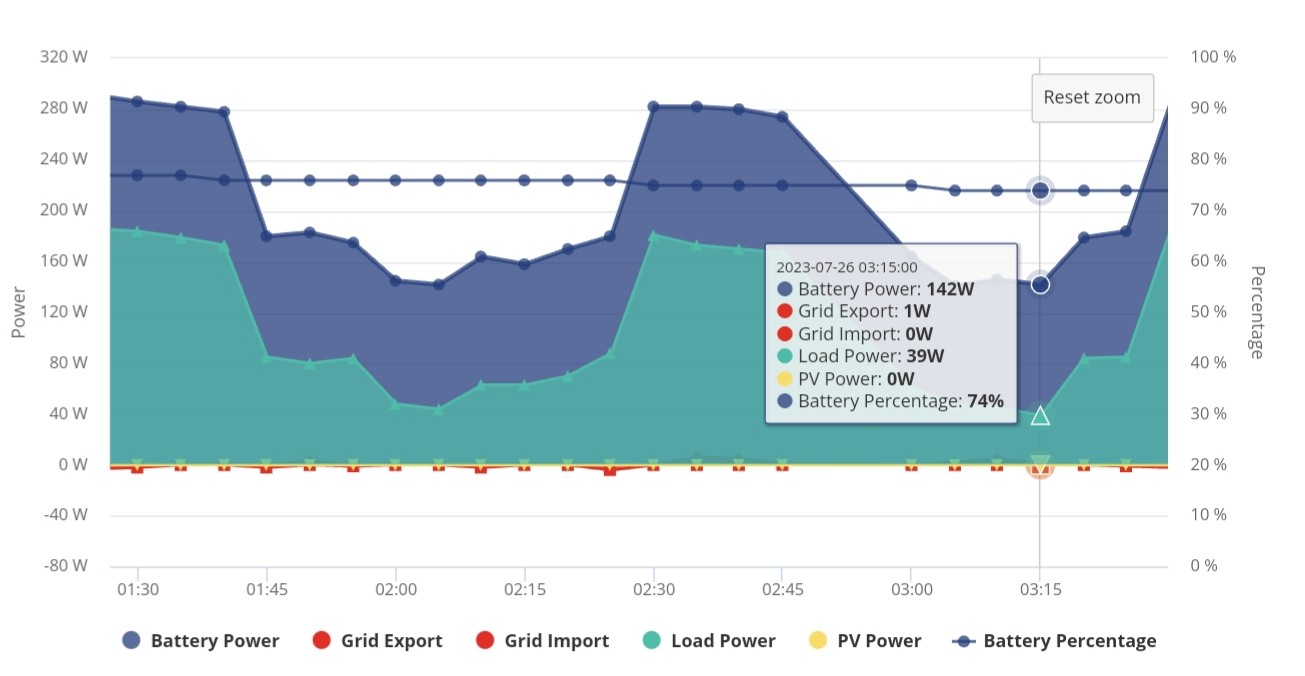
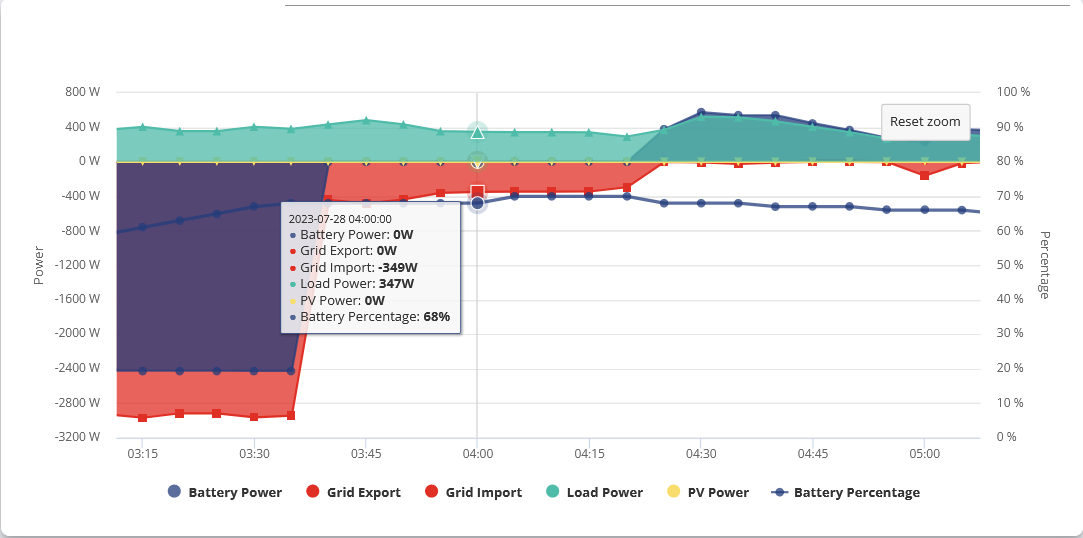
Battery loss exceeds all loads during the night

14 comments started 2023-07-26 last 2023-07-29
Beta PortalCloud PortalGivEnergy ProductsHybrid
M
#1 MikeP

I have a recently installed system and the cloud dashboard shows there to be a loss of about 100w from the battery during the night when it is ticking over. Is this self consumption or something else?

I have the gen 3 inverter. The inverter spec says self consumption <5w.
Thanks in advance

R
#2 Rubikcube

In the early hours of the morning when the battery was "empty" I did a test by turning off everything at the consumer units except the inverter. Smart meter display read 16W for my gen1 hybrid.

I believe the BMS would still be powered by the battery, so 16W is just inverter, dongle, and EM115. Difficult to measure BMS consumption.

M
#3 MikeP

Thanks for the tip. I should give that a try.
It seems crazy that this would increase my daily consumption by 2.4kWh or more per day. We only use about 8kWh per day at this time of year.

We have the GIV-HY5.0 inverter and a 9.5kWh battery. 3012 firmware

M
#4 mrand31

Bear in mind that the battery voltage drops a bit as its temperature falls. This shows as an apparent loss of capacity.

P
#5 Phil_H

Mine has consistently show similar (Gen2), at base loads of around 100-150W I have on overhead of about 70W when taking that power from the battery. I have put it down to inverter use, BMS use and low power inefficiency of the DC-AC inverter.

Yes it increases the notional usage of the house (also about 8 kWh currently) but the energy was free from the sun anyway and there doesn't appear to be anything I can do about it.

M
#6 MikeP

True. Thanks for sharing that. So it seems to be the operating cost. Will try to figure out how that varies on state and maybe some things that might reduce it.
At 100w it is quite an overhead (800kWh per year).

T
#7 tcmck

Recently installed 9.5Kwh battery with AC coupled inverter. I've noticed there seems to be a difference of roughly 60w between inputs and outputs. I assume this is inverter self consumption. Wonder whether this is what GivEnergy would expect.
Makes a difference particularly at night when consumption is low.

V
#8 Vestas

Its the DC-AC losses incurred by the inverter converting dc battery voltage to ac grid voltage and is pretty much a constant while you're running on battery. You'll get similar losses charging the battery AC-DC, less losses if its a dc-dc charge from a PV array.

You could always pause the battery overnight if it works out cheaper - or set a target SoC Level for a fixed period so the battery charges to the target and is held at that charge until the time period expires. Eg set a time from midnight to 6am, target SoC 50% will charge the battery from midnight until it hits 50% then will prevent discharge until 6am.

M
#9 MikeP

Thanks for the tips Vestas

J
#10 Jellybaby

I noticed something very similar with my system and had been in contact with GE as well, granted my unit is an AIO but its basically all the other stuff tucked into one which you would find in the individual units.
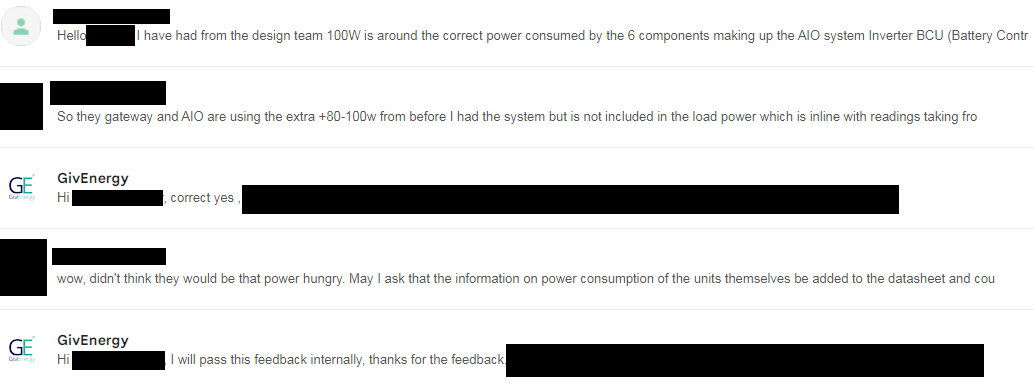
Got the monitoring stuff for grid and system, BMU as well as inverter, guess it all adds up.

Consumption of all electronics should be one of the main things in everything regardless of what it is.

Cost of it at 80, 90 and 100w at 30ppkwh
Day £0.60, £0.66, £0.74
Month £17.86, £20,09, £22.32
Year £217.25, £244.04, £271.56

Obviously with Octopus you can make the day rate back in an hour on a good day buy the bills for me have still dropped by £100 so far a month going by smart meter readings but I only got my lot installed 10 days ago so still waiting all handover information like certificates and whatnot before going over to Octopus.

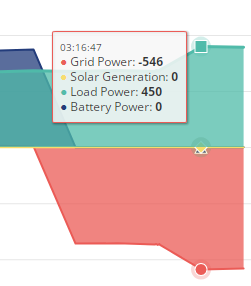
Even when running off the grid you will see it
V
#11 Vestas

You shouldn't be seeing that if the SoC target is set - I certainly don't on a G1. Maybe it does that on an AIO?

D
#12 Dom66

I can accept the fact all the parts use energy to work. I would quite like to see it reported, rather than having to get to the value using all the other data and finding out what’s missing. I have done the calculations on my setup for a snapshot of various conditions (Gen 2 5kW inverter with Gen 2 8.2kW battery):
Base load of 160W: 55W
Battery charging from grid at 3.4kW: 315W
PV charging battery at 1.2kW: 75W
PV charging battery at 3.5kW & 300W export to grid: 200W
Battery discharge at 2.8kW —> Load: 130W
Battery discharge at 4kW, 3.6kW to grid: 215W

I also have Tigo optimisers so I can also see the PV values they report compared with what GivEnergy use. There you find another missing W which is presumably the losses getting to the inverter. At first, I assumed the difference was attributed to these losses until I realised that the numbers didn’t add up. The app has a “Show Calculated Load” option which I untick so the difference is evident on the app.

V
#13 Vestas

Dom66 Your figures look about right to me in terms of AC-DC-AC losses.

Around 9% peak for charge(AC-DC); 5-6% discharge(DC-AC). 15% total loss is pretty much spot on, knock off 5% or so from that loss if you charged DC-DC from the PV.

On top of that you'll have actual battery losses - you never get 100% back from the battery cells, depends on temperature/charge rate/discharge rate etc.

Your losses on the DC cabling are predictable. Sparkies will fit the AWG gauge cable the regs specify but provided there's no bend radius problems routing cable it'll probably cost £50 more to put thicker cabling in.

The tl;dr is there's a lot of variables and (AFAIK) no real methodology which allows side by side comparisons without reading reviews (which may be nonsense).

J
#14 justpassing

Vestas interested in your assumed losses for conversion and storage losses. When you suggest ~ 5 % PV to battery charging losses, what numbers are you actually comparing ? I am never very sure with all the available power and energy numbers which ones are sensible to compare. I only PV charge my battery at the moment, and depending on whether I use the portal, for battery in, battery out, or various methods of givtcp changes in soc, etc you get very different results. It's not clear which values are derived, and which measured. The geek in me wants to run some experiments on efficiency 🙂