M
#1 MitchP
Hi,
I am getting regular notifications about a grid voltage fault. Any advice on what I need to do?
Thanks,
Mitch.

Hi,
I am getting regular notifications about a grid voltage fault. Any advice on what I need to do?
Thanks,
Mitch.
MitchP talk to your dno if it’s over 253v as that is the max limit. Lots of pv in the street will cause the voltage to rise as that is how it’s pushed back to the grid.
MitchP As @anglefire says, talk to your DNO.
I’ve had the same happen to me, on sunny days I get periodic grid voltage faults and looking at the inverter monitoring the VAC (incoming supply voltage) is high. Sometimes up to 261v. The errors usually clear within 5 minutes or so but I do get them regularly.
When I phoned my DNO (UK Power Networks) I raised it as an electrical safety issue as that seemed to be the best match of their menu choices. Someone was round later that day, they measured the voltage and it was high but not over 253v. Next day two people came with a lift vehicle and went up the pole that supplies our house, again checked the voltage which was high but not over limit.
They’ve then been back and have installed a monitoring box that will record the voltage and current for a week. From there they’ll decide whether the transformer needs to be replaced/upgraded or they can adjust the supply voltage to our street.
anglefire The only thing I'll add as it is a weekend. Is this a new occurance this weekend/today? If so it may be that they are working on the network and have temporarily rerouted the supply which can cause short term problems. Possibly worth adding the area you are in.
SilverArt I'm in Suffolk. I'll keep an eye on when it happens.
geoffreycoan I gather from your post that in a grid income issue and nothing to do with my system?
In the portal dashboard, bot to "My Inverter" and select GRID DATA.
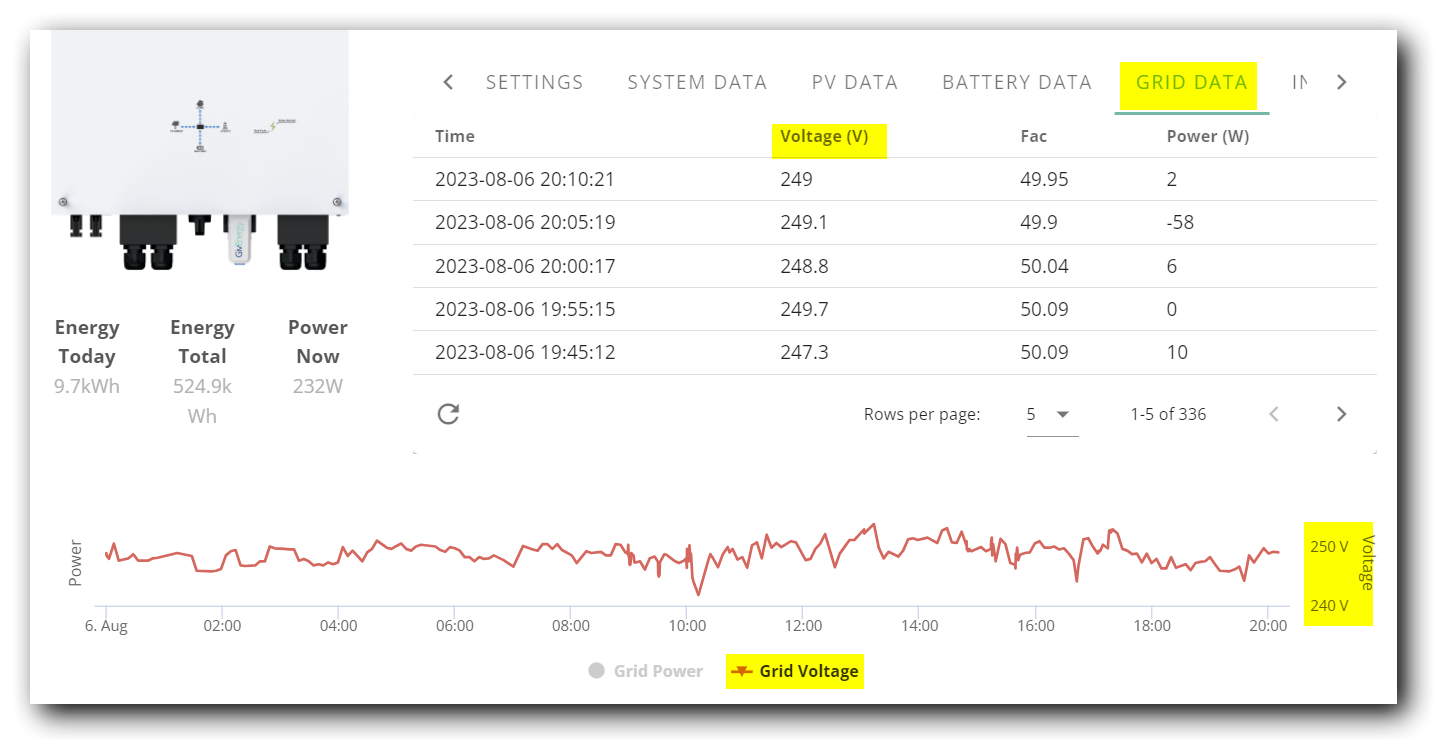
UK grid voltage is nominally 230V, but is allowed to be up to 253V. Hovering the mouse over the graph will show you the readings, or you can click on the Voltage column heading to sort by voltage, which will show you the max values.
If you're seeing much over 253V, ring your DNO (probably UK Power Networks) and they should come out within a week to check and/or install a logger.
Nothing wrong with your system, however as mentioned multiple PV systems in a neighbourhood all exporting to the grid will cause grid voltage to rise. If the voltage goes over 253 (ish) while exporting, the inverter must throttle PV generation. This is one of the reasons why you need DNO approval to export over 13A
MitchP That’s what the DNO is trying to ascertain, whether it is a problem with my equipment generating too high a voltage or whether it is the incoming supply.
My setup is complicated by the fact that I have two Gen 1 hybrid inverters, which both report as seeing high grid voltage although one reports far far more errors than the other. I also have an older Growatt FIT array inverter.
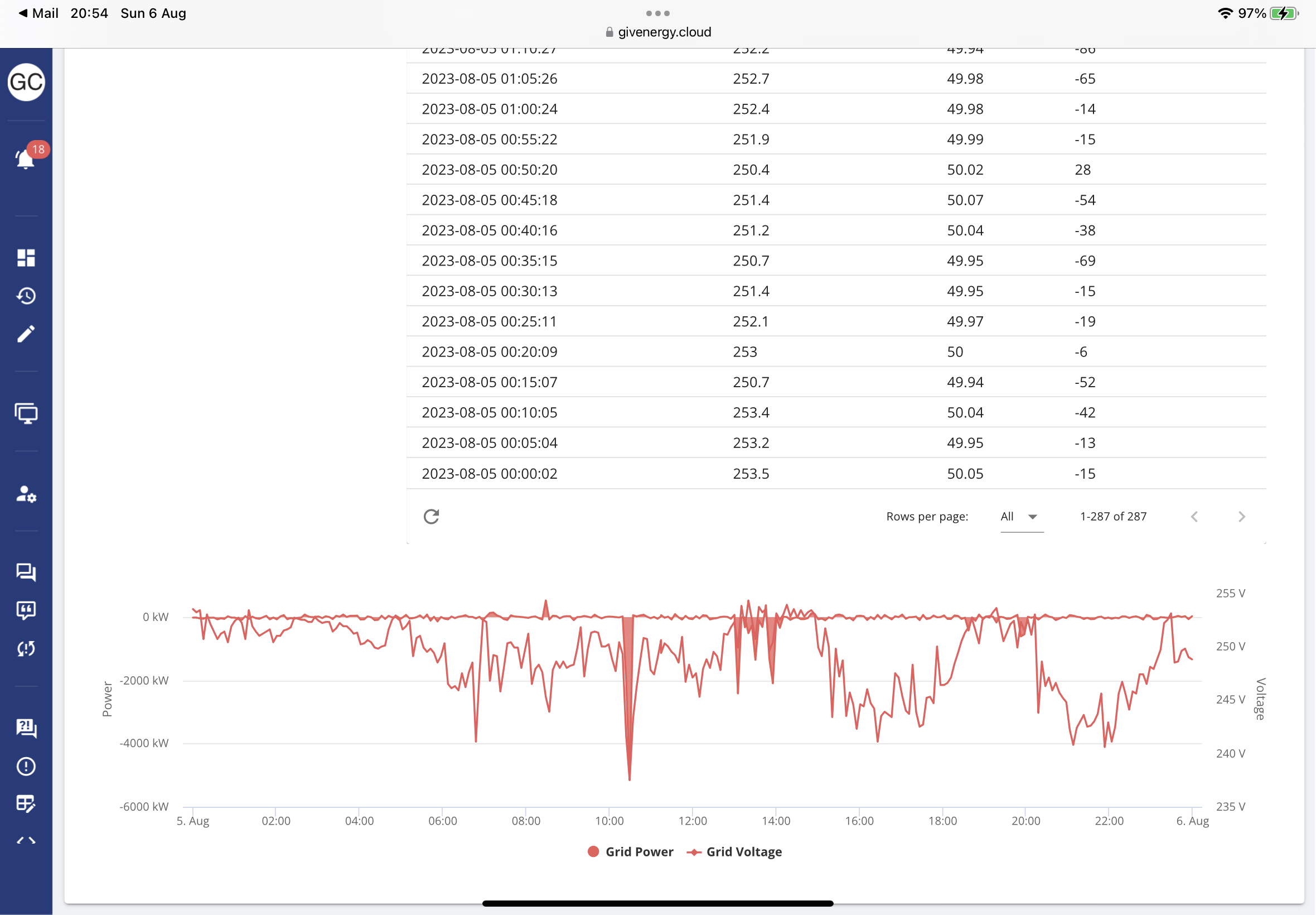
I suspect the issue is going to turn out to be on the grid side as my supply voltage tends to be on the high side anyway so it doesn’t take much to tip it above 253v. Whilst most of my high voltage errors are in the afternoons, I sometimes see them at odd hours of the morning. e.g. this is yesterday morning, 253.5V at midnight:
geoffreycoan This is exactly the problem that I am seeing. The problem IMHO appears to be that the dno's haven't caught on to the fact (or will admit to) that their supply maximum voltage at local level should not exceed say 246 volts - one tapping level below 253V to allow for the feed in provided by all the local solar.
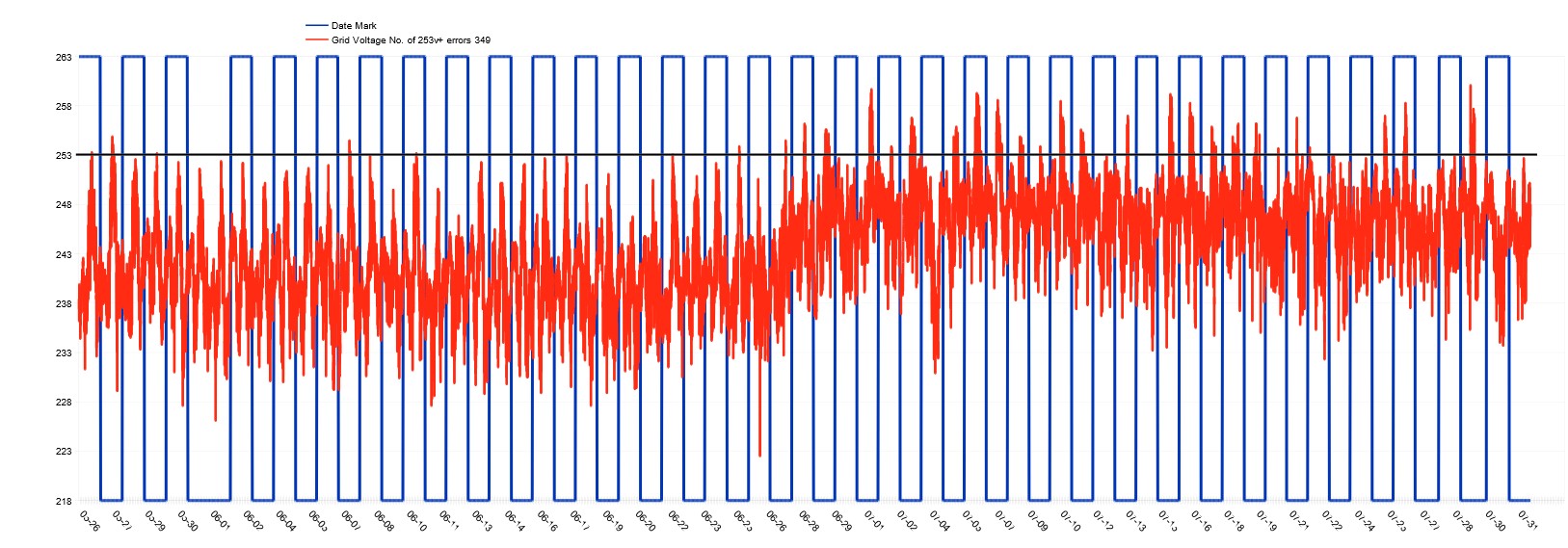
Following is my June/July monitoring where the dno did something that caused the overall average voltage to increase at the end of June, oddly enough by a voltage tapping level. However, I do not believe that this was necessarily the local one, I think whatever feeds the local substation was increased, possibly making thier solutuion more difficult.
SilverArt That’s interesting, definitely an upwards spike in June. There is quite a bit of voltage variation every day though which must make the DNO’s job harder with household solar sometimes pushing the voltage up and sometimes not depending on the weather.
I’m fairly sure a lot of mine is due to solar installations, there isn’t a lot in our village but there’s definitely a correlation between voltage errors and sunny days.
The UK Power Networks man has just come and taken their monitoring box away and will write to me next week with the results so we’ll see what they propose. One thing he did say last week when installing the monitor is that they’re not allowed to turn the transformer tap down live any more, they have to turn the transformer off and do the work. That means writing to all the 40 or so houses off our transformer and telling them that they’re going to be disconnecting the power. I won’t be telling the neighbours that the power cut is my fault …. 😉
I think high voltage on the grid is a common issue and gets picked up by things like EV car chargers. I had the same issue a few months back. The car charger kept showing a "bad/high voltage" error message and it interrupted any excess solar diversion to the car during the day.
I contacted my DNO (SP Energy) and they did what I think they probably all do, come and check and confirm high voltage as a spot check then get someone to come and fit a monitor, then analyse the results of that before arranging to turn the transformer down a notch or two. I think it took around 2-3 weeks all in to get it done so reasonably quickly for me. The DNO guys I spoke to said it was a very common issue these days with so many people getting solar and car chargers.
I think I may be fortunate in that there are only 2 or 3 houses coming off the transformer that is in the field directly behind us and so disruption to others was minimal.
Before the adjustment each day the max/min grid voltage was about 245-255 with peaks up to 260 or so. Now we get 235-245 give or take.
This new voltage value seems to make everything work better. The car charger no longer trips out and the Inverter/solar setup does not suppress solar generation when the voltage is high. I am getting more out of the system all around now that the grid is within tolerance.
I was warned that it may drop lower in the winter but as our minimum is around the midpoint of the voltage range I would be surprised if we dropped too low. We shall see.
killythebid The DNO guys I spoke to said it was a very common issue these days with so many people getting solar and car chargers.
Exactly. and that is why they need a mind shift away from 'distribution' to one of 'multiple source supplier'/re-distribution. They need to take into account what the Customers are feeding back to the grid.
At a local level if a number of PV households feed into the grid that will reduce the power demand on the network. When that happens the background 'grid' voltage will go up as there is less demand. The problem that gives is that the PV equipment will up their voltage to compensate so that they can export. Therefore it is easy to see why over voltage problems are on the increase.
SilverArt they need a mind shift away from 'distribution' to one of 'multiple source supplier'/re-distribution.
I don't disagree but the DNO doesn't generate energy and they don't sell energy (although parent companies with the same name may do either or both). Their role is to distribute the energy locally on an infrastructure that was initially designed over 60 years ago when power stations fed into a transmission network which connected to the DNO distribution networks. Their funding is finite and they have to adapt an existing network design for energy flowing in one direction for energy to be able to flow from anywhere (albeit in limited quantities).
Those who want to see the standing charge disappear and want their export limit removed and also want a guaranteed grid connection might benefit from remembering that they may get great deals from Octopus, but it's their local DNO who keeps the lights on.