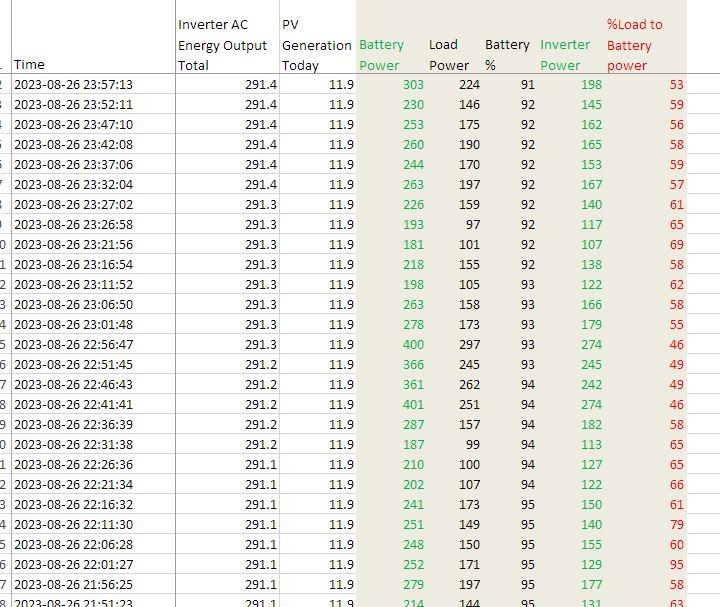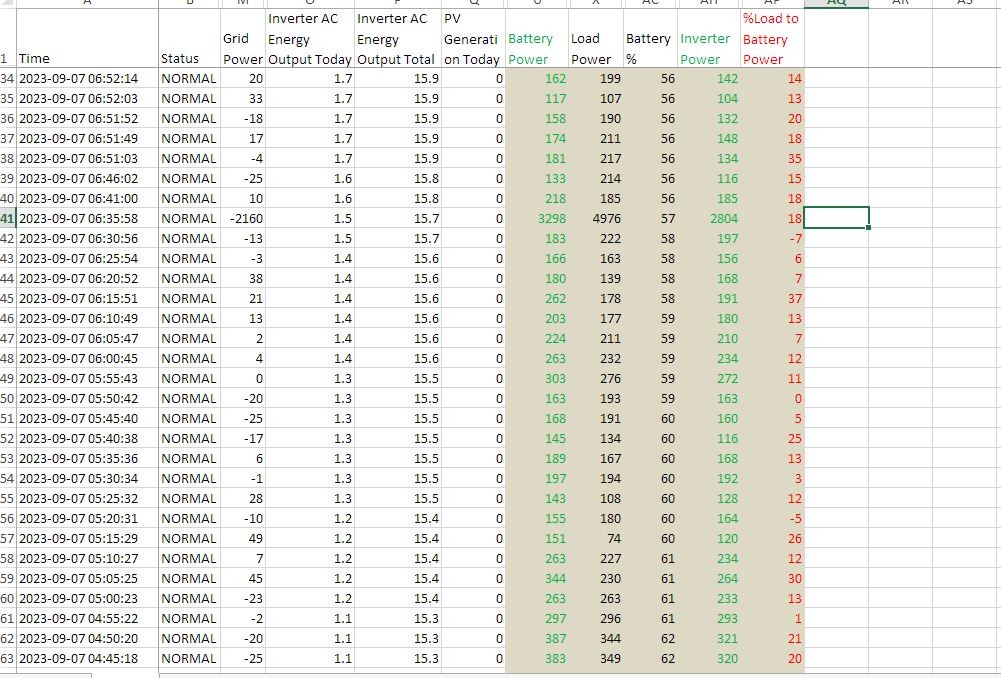
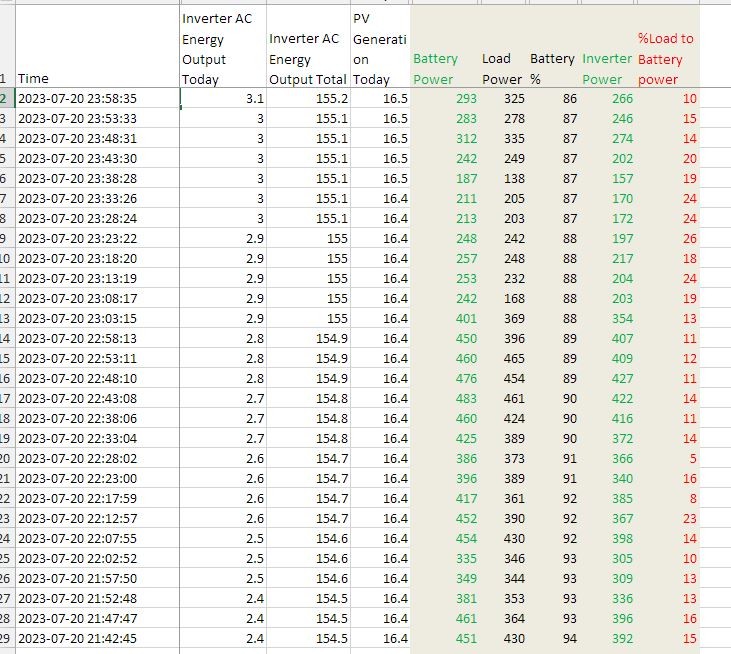
CE2232G118 Energy conversion losses since load of 3013 build on 14th August

13 comments started 2023-09-01 last 2023-09-07
GivEnergy Products
J
#1 JOHN_ELEY

Hi there to everyone,
I am new to GE, having had a AC3 coupler and 9.5kw battery installed on the 26th May 2023.

Everything was working fine until I pressed the button to upgrade to 3013 build on the 14th August.

Outwardly everything is still fine, the battery charges from my 3.75kw array, discharges and meets most loads in the household (apart from the 10kw shower that is), I have experimented with timed charge and all works fine.

HOWEVER .....

Looking on the GE app Power Graphs I note there has been an increase in the Battery power discharge for a given load during "hours of darkness when the Sun has set" and during early hours of the morning prior to sunrise.

I have downloaded sample data from the app PRE and POST 3013 software update and find that :-

Prior to 3013 build loaded 14th August 2023, the average conversion losses (rough calculations difference between Inverter power and Battery power) taken from data downloaded 20th July 2023 is on average between 14 and 39% more Battery power used for a given Inverter output Load power. I accept this as a conversion loss for the inverter to convert from DC to AC.

POST 3013 build load 14th August 2023, the average conversion losses (rough calculations difference between Inverter power and Battery power) taken from data downloaded 26th August 2023 [but the same sort of values for any other dates after 3013 loaded] is on average 55% more Battery power for a given Inverter Load power.

I have raised my concerns with GE Support and currently in discussion , has anyone else come across a similar issue with their system?

Links to spreadsheet screen shots below.

Many Thanks for your anticipated replies.

John E

#2 hoggy

I'm on Gen1 so guess my input on this is limited & suspect this is more a reporting error than actual increase in losses.
However, the excess has to go somewhere if it has jumped up and that realistically can only be to heat.
So I guess the rough way to find out is - for the above periods does the inverter & battery now run hotter?

P
#3 Phil_H

Checking before/after 3013 data I don't see the same thing. I was running 3012 beforehand so pretty close. To be honest I wouldn't expect to see any difference from a battery firmware change either positive or negative. The conversion process and therefore the losses happen in the inverter and are therefore down to the inverter firmware.

What I did notice while comparing these numbers is that since my inverter upgrade to 911 (Gen 2 hybrid) the absolute losses for converting low power levels (100-200W load) have dropped from around 70W to around 45W so there might be something useful in the inverter upgrade!

S
#4 simont

See my post here (and the linked one at the bottom), mine changed on a specific date, not on a firmware update but there was a significant change. GE say its within expected limits. I added a fan to the inverter as they suggested(!) and the inverter hovers between 30 and 40 decC but has made no difference to the losses.

https://community.givenergy.cloud/d/2778-battery-power-more-than-load-power

J
#5 JOHN_ELEY

My observation was that prior to a software update a 20% loss was probably acceptable for DC to AC conversion, but afterwards an extra 20 or 30% inefficiencies cannot be justified, it will mean extra expense going into the winter months. I look forward to GE getting back to me. I might be totally wrong but the output data appears to show a marked increase. : (

S
#6 simont

JOHN_ELEY Yes, I agree, I have the same, good luck with GE...

Emails from GE:
It may be higher than previous dates - but it is still within expected ranges so its not something we can really advise on. Like I say, there is nobody else reporting this.
the only correlation I can really see is inverter ambient temperature is different, which can cause more losses. On the 20th your inverter temp was around 30deg C most of the day, today its been 40degc continuously, and going upto 60degc.

As stated within that thread though those are losses expected, and again it wouldnt fall outside of our reasonable range we've advised, the only thing we can see is a difference in ambient temperature, perhaps a good test would be to try and put a fan on the inverter for a day to bring its ambient temperature down and compare the differences in efficiency, its a well known fact that the inverter prefers a cool, room temperature enviroment at 20 degc, and although it will get warmer when its operating, the cooler the better in this circumstance.

R
#7 Rubikcube

The load power seems to have reduced. Is there anything connected to the EPS output? Have any appliances (fridge, etc) been changed, or has your heating system been turned off?

K
#8 kram

I seem to remember that tye getacsoftware had a much faster response time, so would detect loads and start supplying power from the PV/Battery faster.

I am probably a million miles wide here, but I assume this isn’t accounting for extra draw?

Perhaps look at load, battery and grid draw and see if grid goes down a corresponding amount ?

S
#9 SimonP

simont That's rather a confusing reply from GE. Ambient temperature is that around the inverter, not the temperature of the inverter. As far as I'm aware they have no way of determining ambient temperature. They can see the inverter temperature and if your perception of increased losses is a reality then those losses would appear as heat -- and guess what, the inverter is hotter! It would take some more detailed analysis of ambient versus inverter temperatures to see if there's any correlation with losses. Personally I doubt there will be much effect on efficiency with varying temperature, within a normal sort of range likely to be experienced in the UK.

S
#10 simont

SimonP Yes I agree but I got nowhere so I gave up. I now have some fans on it and it remains between 30 and 40 degrees and still has the increased power differences, I used to get 30-50W difference @400W load but now I get around 90-120W.
I also have a temp sensor in my garage and (using HA) I can monitor the ambient vs inverter temps vs load.

J
#11 JOHN_ELEY

I have gone through a process with GE Support to regress to 3012 build to see if it would restore the conversion losses, to about 20% more battery power used for a given Inverter output. It was not straightforward, I had to load a software file on the Battery (removing front cover) then removing / replacing memory stick with added file. So far so good. Second part was to load two files to the Inverted by removing the wifi dongle adding the files and replacing into the Inverter, at that point IT SHOULD load the files and update the Inverter, unfortunately it blobbed at this point. With help from Matt Butler at support I had to reprogram the wifi dongle to set it up again as it appeared to have lost some data.

Battery was out of action overnight, following day I spoke with various support team, Stephen Jackson was very helpful and suggested I reload new files using the manual process, as soon as the wifi dongal was inserted into the Inverter, it was a case of hey presto success, OR NEARLY and build updated. Selected the update option on GE Web site and the battery started loading and calibration process.

Last Night, once fully calibrated I notices that the Solar PV, the Imort / Export and Load elements on the portal or app were not reporting correctly so sent off email asking for support to investigate and hopefully "reset" something to start the counters.

This morning at 6.30am, had a shower (thought you might be interested) and the Inverter went to MAX OUTPUT 2800 watts, battery 3300watts to assist with the load and carried on discharging to grid at MAX, until support sorted.

Help desk do not open until 8.30am, but the team member quickly reviewed parameters, rested some counters and Inverter dropped to zero output due to Solar PV generation.

Currently the battery is topping itself back up and no further issues.

Looking at the discharge values yesterday it would appear that this slightly involved process may have corrected my problem with Battery discharge maybe 20% higher than when 3013 first loaded.

Will give a final report when I have a few more days info to view.

I would certainly like to thank all the guys at GE Support 1st & 2nd line in making this happen and helping to resolve the hiccups during the updates.

I myself have accumulated valuable knowledge on how to manually update the battery and inverter and manipulate the wifi dongle, a bit hairy at times but should be easier second time around (hopefully will not be required again)


S
#12 simont

JOHN_ELEY how to manually update the battery and inverter and manipulate the wifi dongle

Yes, they asked me to do that but I was not about to do that when I've paid over 16K for the install. If it does show to be an issue they (GE) need to issue a new OTA firmware that solves it

J
#13 JOHN_ELEY

One last post from me.

Having had a "refresh" of battery data I used the GE Website to download the Inverter data for today and reviewing that data from midnight to first Solar generation find that the AVERAGE difference between battery power supplied against Inverter power used is about 18% (shall we say the conversion factor), this is actually better than the original and 20 to 30% reduction of losses than when I updated to 3013 build a couple of weeks ago.

A little bit of a roller coaster to update but well worth it in the end.

I will certainly be steering clear of any future updates unless they are forced upon the system.