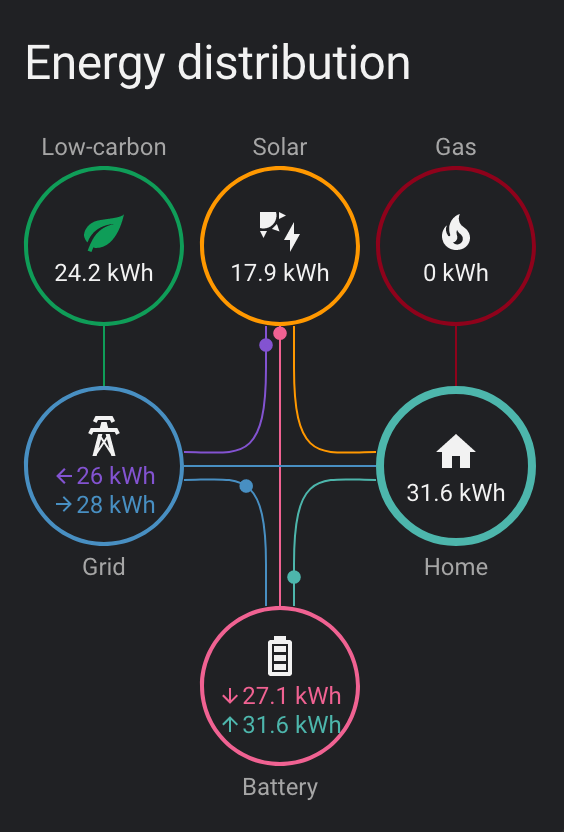
I've been taking advantage of the Agile price drops over the past couple of weeks, dumping battery at 15p/kWh to recharge at average below 3p/kWh.
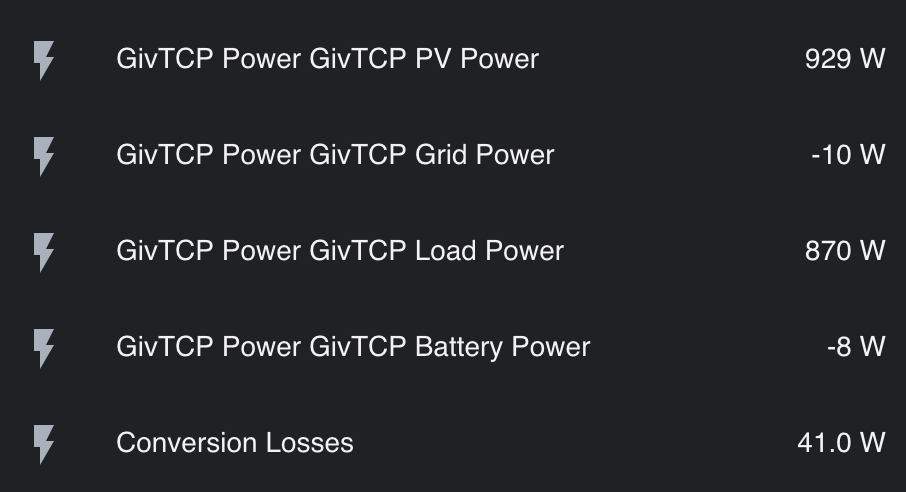
I've noticed a reporting issue with the Home Assistant energy panel, over home consumption, and whilst investigating I've noticed a variance between the GivTCP load data and the calculated energy usage.
Ignore the 31.6 home use, that is the error in HA.
If I add and subtract the net value is 24.4kWh used though the day. Grid In + Solar In + Battery Out minus Grid Out - Battery In = 24.4.
GivTCP reports home load at 19.8kWh.
I put that delta of 4.6kw down to conversion losses. Would 4.6kW be expected on what I estimate is less than 50kWh of throughput from DC - AC - DC?
V
#2Vestas
At max charge/discharge rates that sounds reasonable. Edit - in fact its a little low.
A
#3Arg0t
Vestas aware of any GivTCP data point that would capture that?
V
#4Vestas
For the 9.5kW battery the losses due to chemical processes on a low-voltage (50V) battery are around 3% when charged at a maximum of 2.6kW.
Battery Charge Energy Total and Battery Discharge Energy Total are the givTCP entities to look at there.
Then you've got the losses from the inverter which in the simplest case (charging from the grid, no PV) is Grid Power - AC Charge Power - Load Power = inverter losses.
Eg for our system last night @ 0300 it'd work out as 3095W - 2561W - 400W = 134W which is used by the inverter. Now I know the base load power of 400W will use around 30W in the inverter when running from battery so that gives us 100/2561 = 4% or near enough. Add that to the unavoidable battery loss of 3% inherent to charging LFP and we're at 7% losses just to charge at 2.6kW. Discharge at the same max rate and we'd be looking at 10-11% losses best case.
Gets more complicated with PV inputs as the inverter uses more power.
For what you're doing I'd just look at the import/export prices and knock 20% off your export price to cover losses etc - your battery lifespan will reduce more rapidly doing full charge rate cycles, whether its something which will be noticeable from normal wear is another matter.
G
#5geoffreycoan
Interesting and detailed explanation about conversion losses, thanks @Vestas
This was a topic I was going to raise as I have seen different energy losses suggested. 5%, 6%, 10%, but which is “more right” ?
Interestingly, in home assistant, my year to date figures are 937.6kW charged into my batteries and 947kW discharged - these are taken from utility meters connected to the GivTCP Battery Charge Energy Today kWh entities.
Ignoring there will have been a bit of stored battery power when I first installed HA, makes no sense that discharge > charge. But suggests that there’s very little energy loss, which btw I don’t believe
I definitely don’t believe the load energy today reported by my inverters. I get weird things like them going negative sometimes. Have written my own template sensor for daily load and will swap predbat over to using it once it’s built up some more history
A
#6Arg0t
My desire is to remove the conversion losses from home consumption in the HA energy chart. My solar payback spreadsheet uses home consumption as the basis of "what it would have cost without solar'. If that includes conversion loses as real usage and not waste, then I over recover.
Thinking out loud on possible sensors to create that could at least capture some of the loss and record it.
Battery Charge/Discharge Losses:
(Battery output - PV - load + grid in)
G
#7geoffreycoan
Arg0t I think you’ll need to subtract grid export as well.
Any of these calculations rely on how accurate the different sensors are. There’s previous threads on the forum of people comparing the EM115 readings to the smart meter readings and finding discrepancies, and as I said I know that my house load figures are wrong. My load issues may well be caused by my multiple inverters plus the FIT generation, but regardless it’s not accurate.
Comes down to which numbers you trust!
A
#8Arg0t
I agree, but not seeking perfection, just a something that is directionally correct.
Will try this out and see if I can build a daily conversion loss kWh number and have that as a consumer on the HA energy dashboard.
Here to add to the mix is my template sensor for calculating house load in kWh. It reuses some other sensors that sum up PV and battery charge/discharge across my two inverters, but you get the idea