Hi, I have a small property, no garage, and would prefer to utilise the IP65 rating of a GivBat 8.2 to allow installation outside my backdoor. However, the spec sheet states charging temp range = 0-55°C and discharge -10 to 55°C, with storage range -30 to +60°C. I live in northern Britain so upper limits really don't apply, plus we have lately had mild winters. However the odd week or two of frosty weather remains plausible each winter, and I cannot find any info about what happens if the temp does drop below the stated limits. I should add that I already have Economy7 metering, so I fully expect to be charging-up the battery every night in winter.
Does anyone have experience (good or bad) with outdoor installation, or can you link me to somewhere I can find more info on this ?
Thanks, Nick
SteveCook Thanks - will do ! Should have said that preferably the inverter would be outside with the battery.
regards N
N
#4NickT
Posting here what I found at the link behind the link given above, as it may be of use to others: https://batteryuniversity.com/article/bu-410-charging-at-high-and-low-temperatures
This states:
Lithium Ion: Li-ion can be fast charged from 5°C to 45°C (41 to 113°F). Below 5°C, the charge current should be reduced, and no charging is permitted at freezing temperatures because of the reduced diffusion rates on the anode. During charge, the internal cell resistance causes a slight temperature rise that compensates for some of the cold. The internal resistance of all batteries rises when cold, prolonging charge times noticeably. This also affects discharge performance noticeably with Li-ion.
Many battery users are unaware that consumer-grade lithium-ion batteries cannot be charged below 0°C (32°F). Although the pack appears to be charging normally, plating of metallic lithium occurs on the anode during a sub-freezing charge that leads to a permanent degradation in performance and safety. Batteries with lithium plating are more vulnerable to failure if exposed to vibration or other stressful conditions. Advanced chargers (Cadex) prevent charging Li-ion below freezing.
Advancements are being made to charge Li-ion below freezing temperatures. Charging is indeed possible with most lithium-ion cells but only at very low currents. According to research papers, the allowable charge rate at –30°C (–22°F) is 0.02C. At this low current, the charge time would stretch to over 50 hours, a time that is deemed impractical. There are, however, specialty Li-ions that can charge down to –10°C (14°F) at a reduced rate.
Some Li-ion manufacturers offer custom-made cells for cold-charging. Specialty chargers will also be needed that decrease the C-rate according to temperature and charge the battery to a lower voltage peak; 4.00V/cell rather than the customary 4.20V/cell for example. Such limitations decrease the energy a Li-ion battery can hold to roughly 80% instead of the customary 100%. Charge times will also be prolonged and can last 12 hours and longer when cold.
Li-ion batteries charging below 0°C (32°F) must undergo regulatory issue to certify that no lithium plating will occur. In addition, a specially designed charger will keep the allotted current and voltage within a safe limit throughout the temperature bandwidth. Certification of such batteries and chargers are very costly that will reflect in the price. Similar regulatory requirements also apply to intrinsically safe batteries (See BU-304: Why Are Protection Circuits Needed?)
There are cell and charger manufacturers claiming to charge Li-ion at low temperatures; however, most companies do not want to take the risk of potential failure and assume liability. Yes, Li-ion will charge at low temperature but research labs dissecting these batteries see concerning results.
N
#5NickT
In summary it seems I have a dilemma: I could install outdoors, but I will have to accept a need for monitoring overnight temperatures, and adjusting charge rates appropriately, or else shutting down completely in a cold snap. Does anyone know if the battery/inverter report their actual temperatures through the app ?
On the other hand, if not outside, it will be in my kitchen. I can live with the incursion into living space but there is the safety side too. I know LiFePO4 battery chemistry is supposed to be "safer" but can anyone comment on that side of things ?
D
#6DD
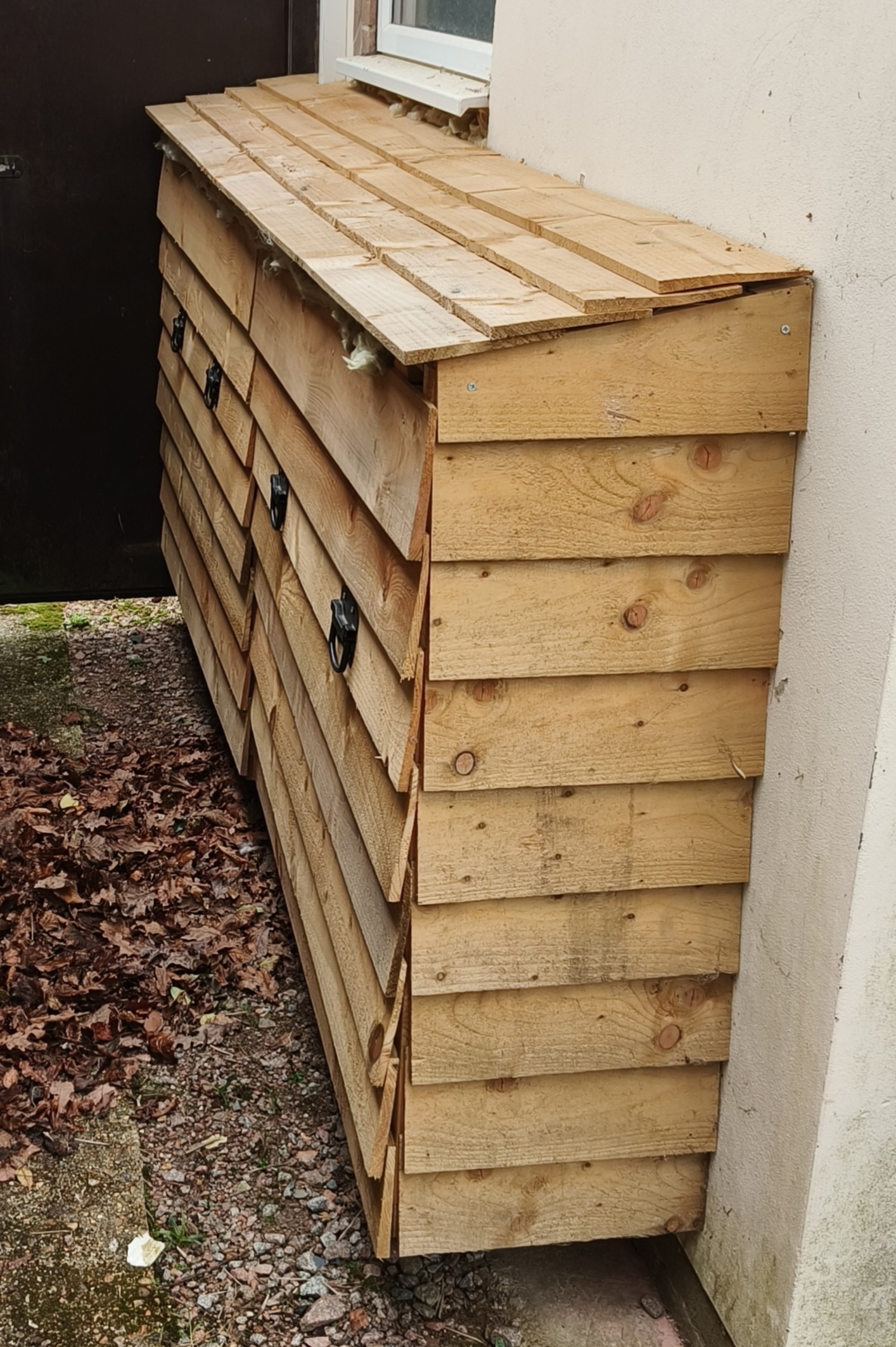
Could you build a small enclosure around it ?
On another forum, there's a thread about someone building a little shelter around their external battery, in Scotland. I'm afraid you seem to have to register to read it. (Other threads seem to work without a login - I just can't seem to find a way to access this one without it.)
For us it was simple really, outdoors for keeping garage space, safety and simplicity.
K
#8Karen
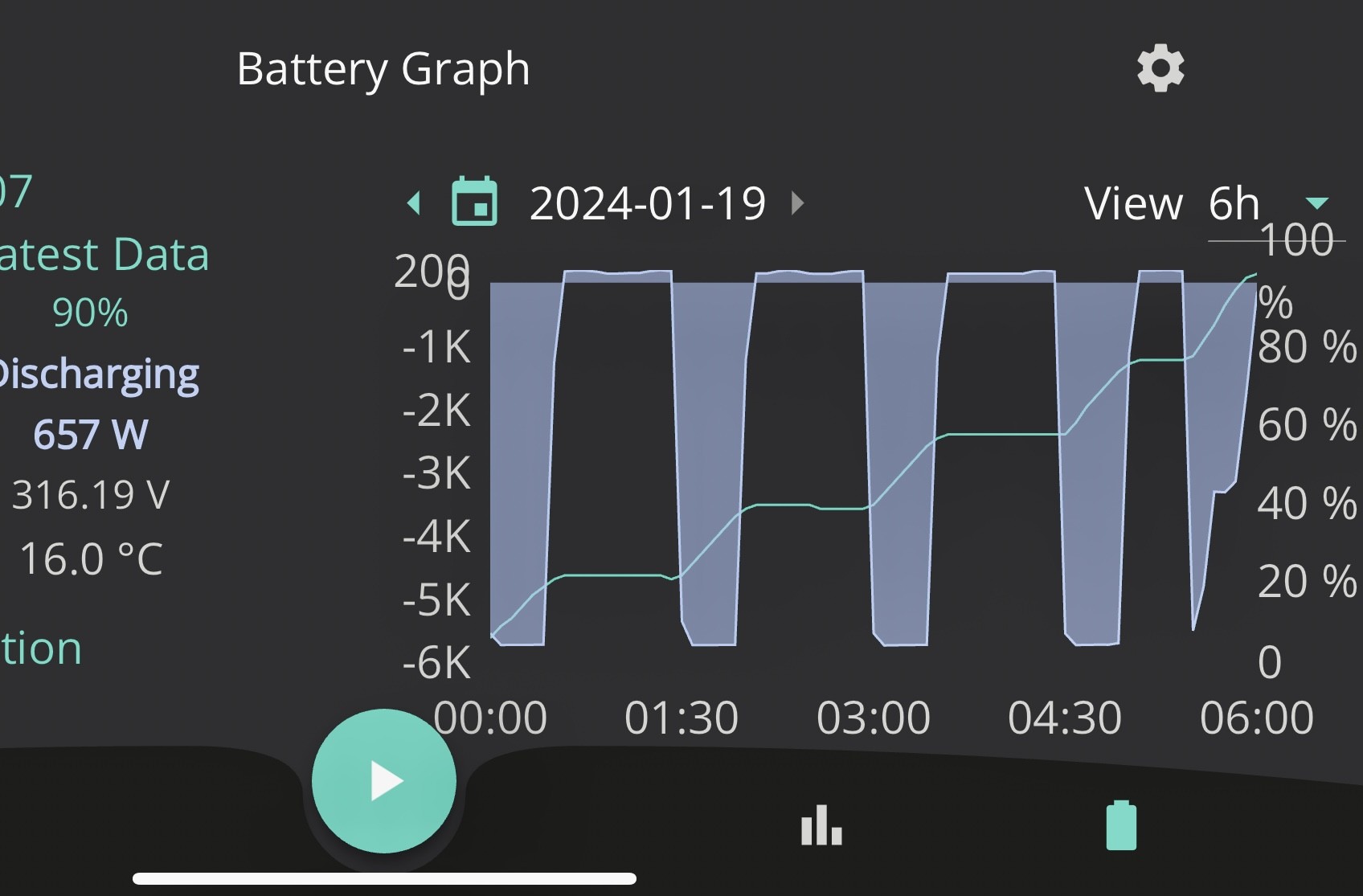
A working battery is a warm battery!! If you go into the portal and look at the inverter icon and then select the battery option from the list of headings at the top you can see the temperature of your battery over a 24hr period. Look at the temperature versus whether the battery is charging or discharging and you will see that when the battery is working it raises it's temperature. If you have Economy 7 the best way to keep the battery temperature up is to reduce your battery charge rate and do a longer gentler charge over the whole of the ECO 7 window. This usually covers the coldest part of the night. Then if you are running off battery during the day, this should keep the daytime temp up too.
Giv Energy now recommend putting a cover over the batteries and inverters even though they are IP65 rated. You will need to have some air flow around it in the summer - especially if on a south or west facing wall - so some people have built shelters with slatted sides. If you do build this type of shelter you can always insulate it by cutting the thick polystyrene insulation to size and pushing it inside the shelter frame. If you have electricity to the outside you could always install a very low power bar heater for the really cold periods. I've built a polystyrene box (5cm thick)that pushes over my battery to hold the heat in in the winter and I can just slide it off in the summer. This combined with slow winter charging works for my outside battery, but I am based in the south.
You can get an overall picture of battery temp from the portal, but not the temperature of each individual battery cell - I think this used to be available, but isn't visible on the portal anymore - the Giv Energy help desk or one of the "old timers" on the community may be able to advise if you can still get this. I believe that if the battery temp does fall below freezing the battery management system (BMS) should shut the battery down to prevent damage.
N
#9NickT
DD Thanks. For the benefit of other readers, here's some of that post: This post is for anyone considering getting a home battery and locating it outdoors as we did.
While our battery is rated for outdoor use, our installer failed to mention that the battery cuts down on its power output as the ambient temperature falls - 50% cut at 10c and no power at all at 0c. This is done to protect the battery, so no issue with that, but it does mean here in sunny Scotland that our battery would be an expensive brick for a good portion of the winter.
[edit: some batteries come with a built-in heater (e.g. Powerwall, I believe.) but ours has none.]
The solution is to enclose the battery in an insulated box. Our battery was installed (no enclosure) in late March, so while we saw a couple of weeks of reduced output as temperatures rose, other issues with the installation meant that wasn't our top priority. As summer drew to a close though, we realised we needed to do something about enclosing the battery.
The battery manufacturer gives recommended clearances for the battery, so that gave me the dimensions. I built a frame using 50mm square poles and then covered the frame with 5mm plywood (chosen for lightness during construction) and fixed 50mm thick insulation boards behind the plywood cover. I also bought a 120W greenhouse heater to use when the weather gets cold, but for now the temperature in the enclosure is not a problem as self-heating of the battery maintains a toasty 20C+ in the box. [Comment: This was posted in September]
N
#10NickT
Karen Thanks Karen, in my case I do not yet have a battery, so I have nothing to refer to for current performance/temperature data. Certainly adding insulation is within my capabilities, though this must be allowed for at time of installation, if I do go external. I wonder if there are any Scottish users who can access temperature data from their recent cold snap ? My preferred location is a NE-facing wall which never sees the sun in winter; in fact its in a bit of a frost-pocket. I have lived here in Northern Ireland for 14 years - and have not forgotten the first full winter, when temps dropped as low as -18°C over about 2 weeks !
R
#11RetSparky
NickT What are the clearances for the battery, I can only find clearances for the inverter.
TIA
I should also say that I have in the end decided to go for an indoor installation. Its not that I could not "manage" an external battery temperature-wise, more that I have more important things to do with my time. This way not only do I ensure the battery is almost always going to be in the ideal 10-25°C temp range for charge/discharge but also I get the "benefit" of gentle heat into my living space as opposed to it going to waste outdoors.
Thanks to all that responded. I may report in due course upon progress with installation & commissioning.
T
#13TX200
NickT the heat might be useful in the winter. Will it be useful in the summer when the sun is out?
N
#14NickT
TX200 I understand your point but 15 years of living in Northern Ireland has shown that a little warmth can be welcome at almost any time of year :-). Easy enough to open a window if required.
T
#15TX200
NickT ahh, I guess it’s unusual that my house stays cool in the hot weather. Opening the window usually lets the heat in not out. 😄
N
#16NickT
TX200 That used to be the way for me too when I lived in Cambridge, with a SW-facing property.
It can happen (but very rarely) here in NI, and then really only to the rooms that actually catch the sun.
#17Tenkaykev
It's 3 degrees at the moment and forecast to get colder. looking at the battery temperature as it is currently discharging 1.34kWh is 13.9 degrees. Our battery is in an out building. I have a small ceramic fan heater on a Smart plug pointing at the AIO enclosure. I tested it out earlier in the day and it took a while but the case felt just slightly warm to the touch. Unless the weather gets much much colder or the battery runs flat then the fan heater is superfluous, though it does give a bit of reassurance.
O
#18Ortwin
We live in the south of England and have our gen 2 5Kw inverter and 9.5Kw battery outside. Its in a sheltered area for which I have built a partially insulated cover over the top and sides. I find the heat from the inverter helps keep the battery temperature above freezing as does the overnight charging. it's been -1 overnight with the battery staying at around 6 degrees.
#19Tenkaykev
I mentioned that I had put a ceramic fan heater in the outbuilding where our AIO lives. It's set to 1kW and on a smart switch so I can switch it remotely should it get extremely cold. We've been out for the greater part of the day and looking at our data was surprised to see the battery down to about 10% at tea time.
I'd repurposed the smart plug from another device and forgot to delete the previous schedule so the heater has been running all day!
The out building is lovely and toasty warm though😮
EDIT: Just checked the data on the Smart Plug, 12kWh used today😁
O
#20Ortwin
It's -4 this morning and the battery has stayed at +3 with a little increase when charging overnight. I only have a wooden cover over the inverter and battery with a bit of insulation in the front and sides. The bottom is open as our installation is off the floor so might enclose it a little to help with the temperature but still allow airflow.
N
#21naltsta
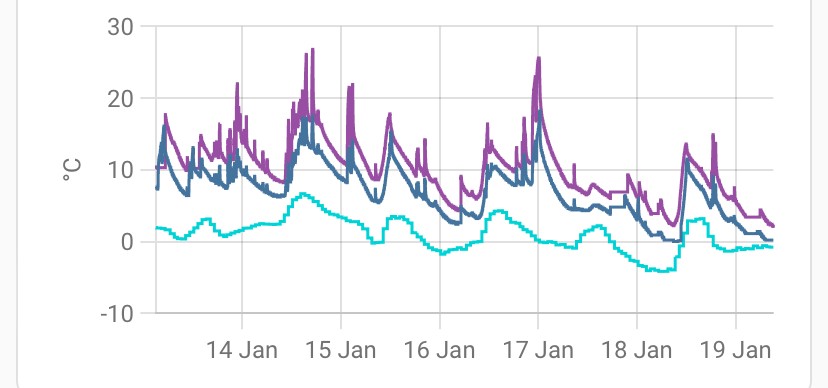
GivTCP is useful for keeping an eye on this. Bottom line is the outdoor temp which hit -7 the night before last. Other 2 lines are my battery temperatures. The batteries really warm up when they are charging so if I’m worried it was going to get really cold I’d do a long slow charge overnight. Many tariffs encourage this anyway but I’m on agile so short sharp bursts overnight.
I have some pretty minimal rain covering and insulation around them at the moment.
#22Tenkaykev
Minus 6 last night. I'm using Wonder Watt for overnight charging and choosing windows that are evenly spaced out.
H
#23Henry3rd
Some advice please. My battery is outside and so as per this discussion, I put a blanket over it to keep it toasty warm. I have noticed, however, that the temperature peaks above 50 deg when charging but quickly returns to on or around 12 deg.
Is this peaking an issue as it temporarily takes the battery out of its high spec of 50 deg?
A
#24anthonypar
This peak temperature you are seeing in the graph is for the Battery Management PCB and is normal. For detailed info of the battery cell temperature use the Rubikscube App or Home Assistant.
H
#25Hudson123
I built an insulated shed
H
#26Henry3rd
Nice.
I have ordered a lean-to, which will give me extra storage. Win-win 🙂
R
#27Robgy
Hudson123 Can we have a look inside your insulated shed please or with the flap/doors open 🙂
O
#28Ortwin
Hudson123
I have a similar for my inverter and batteries but it's open at the bottom to give plenty of air flow, especially during the summer.
#29Tenkaykev
Just popped down to B+Q aand collected 3 sheets of 50mm insulation board:
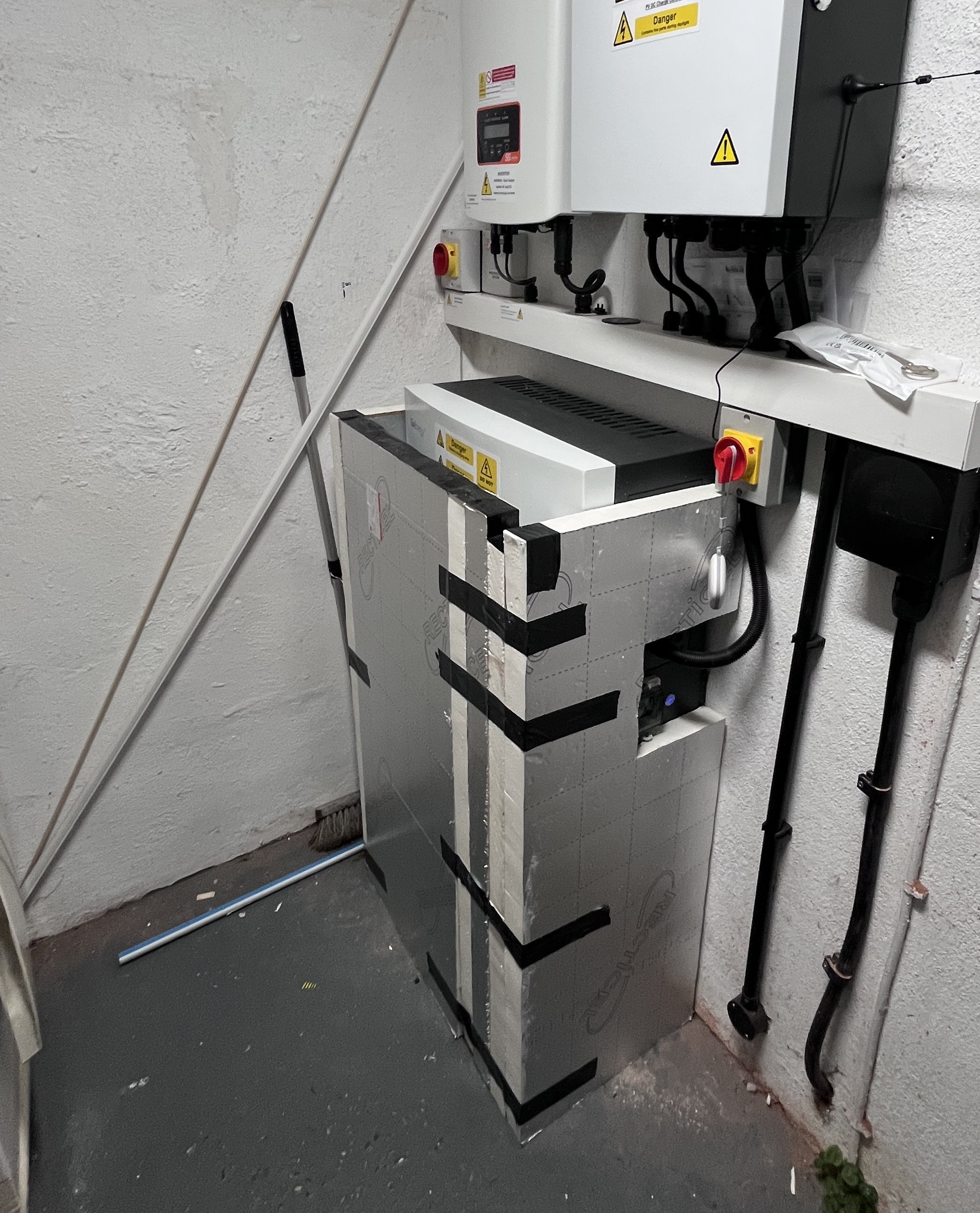
The stuff is really easy to cut, even a bread knife will do it. I fabricated a 3 sided box and used the offcuts to bridge a narrow gap. Not the prettiest of jobs as I used black fabric tape to join the pieces together, but hopefully will be effective. I have a wireless temperature / humidity monitor hanging in a corner void created by the curved front of the AIO.
H
#30Henry3rd
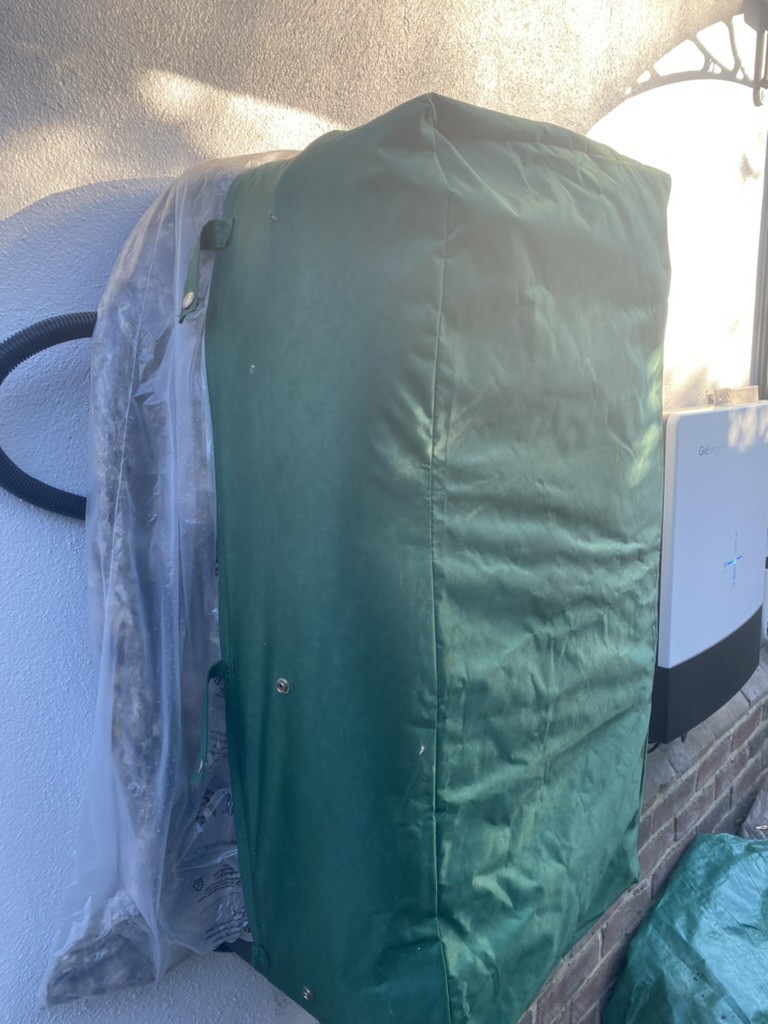
Loft insulation with a plastic tomato grow bag holding it all in place. It looks better than it sounds 🙂
G
#31geoffreycoan
TenkaykevHenry3rd Folks that have made home made solutions, do share photos.
I’d recommend using Aluminium foil tape to seal the joints of an insulated box, this is more thermally efficient than gaffer tape or similar.
geoffreycoan Folks that have made home made solutions, do share photos.
H
#33Henry3rd
Battery temp still got down to 4.6 last night.
O
#34Ortwin
Ours only reached 6.6 yesterday with an outside temperature of zero
G
#35geoffreycoan
My batteries are in the garage on the outside wall, uninsulated. Were between about 6 and 15 degrees overnight, but set to low charge and they charged up to 100% OK.
I did have to turn the battery temperature alert in Home Assistant off though as I kept getting warning alerts on my phone
O
#36Ortwin
geoffreycoan
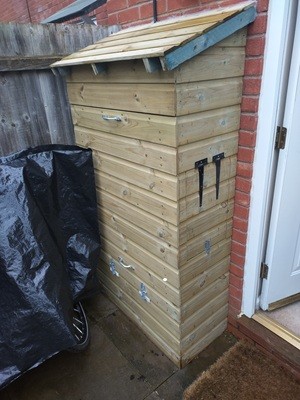
Here is my little cover for the inverter and batteries. In is insulated with 2" fire rated insulation slabs during the winter. The heat from the inverter helps keep the batteries warm but the gap at the bottom allows for plenty of air circulation.
O
#37Ortwin
#38Tenkaykev
Is there an award for the ugliest solution? Asking for a friend...
R
#39Robgy
Tenkaykev okay, let's see your effort
... Sorry I meant your friends solution. 🤪
R
#40Robgy
It would be interesting to see inside the housings
H
#41Henry3rd
Tenkaykev “Not much to look at, but as with all true beauty, it is what’s inside that counts.” 🙂
A work in progress, might bungee a heated throw to the body of the AIO, put the thermal panels back and run it off a temperature controlled plug 🤔
R
#43Robgy
Tenkaykev
Does your friend think the insulation alone has made a significant difference
#44Tenkaykev
Robgy
It has only been in a couple of days. Last night the outdoor temperature dropped to -2, lowest battery temperature was 10.5 and increased once my Agile charge slots kicked in. I have lowered the charge rate to 3.25kWh so there are more charge slots selected throughout the night when house draw is at a minimum.
V
#45Vestas
Tenkaykev Velcro strips work pretty well for holding PIR insulation to things.
#46Tenkaykev
Thank you, I hadn't thought of that. I have some velcro strip and some " Heavy Duty " Velcro patches too. Perhaps another trip to B+Q for another panel for the front and to make the aesthetics better, Oh, and sweep the floor and put the trunking and beading away.
V
#47Vestas
Tenkaykev Put the "rough" velcro tape on the battery/AIO while its warm and give it 6-12 hours for the adhesive to cure.
"Soft" velcro tape on the PIR insulation and again give it some time to cure at a reasonable temperature (15C or so). You need to cut away the foil coating on the PIR where you're putting velcro tape before applying it otherwise it'll rip the foil off the first time you remove the insulation from the battery/AIO.
Edit - don't go over the top on taping/patches. Basically you want 50mm of PIR attached to the battery/AIO with a gap of a couple of mm which the velcro will provide. Sealing it completely - eg tape on all sides of a panel will cause condensation issues. Obviously leave some gaps top and bottom for airflow, even if its just a battery rather than an AIO. If 50mm turns out not to be enough then another layer of 50mm PIR applied with double sided carpet tape between the layers will work. You want that second layer airtight with the first.
#48Tenkaykev
Vestas
The patches I have are 50mm. We have a chair with extra head cushioning that annoyingly keeps flopping forward away from the wooden frame. I purchased some " Extra Heavy Duty " Velcro patches, unfortunately they come away from the fabric after a couple of days. I'll use those tomorrow after I have popped down to B+Q for an extra sheet. Thanks for the advice on the gap at the bottom.
( I only recently learned that Velcro is a compound word, the " Rough " bit is the Crochet ( hook ) and the soft bit is the Velour ( velvet ) bit 😎 )
G
#49geoffreycoan
Tenkaykev its worth paying the extra for the proper Velcro branded stuff (there are loads of sellers on eBay), the heavy duty is mega strong.
To help with the adhesion to fabric you might try warming the velcro with a hair dryer or hot air gun before sticking it down. If it comes off then I find hot melt glue works very well at sticking velcro back down again
R
#50Robgy
With recent sustained low temperatures how is the insulation of everyones battery affecting the charge rate?
#51Tenkaykev
[unknown] I have a lower charge rate ( 3750W ) set for my AIO. We're on Agile and I alternate the charge overnight, 1/2 hour on, 1/2 hour off. Not seen any restriction in charge rate, battery is in unheated outhouse with an air temperature of 6 degrees and a battery temperature of 16.
G
#52geoffreycoan
Tenkaykev I think the AIO’s with high voltage batteries are much less susceptible to temperature related charging than the low voltage batteries with hybrid or AC 3 batteries.
Mine are in the garage so unheated. The 9.5 continues to charge at 2.4kWh on a Gen 1 hybrid, the 5.2 does suffer from temperature related charging reduction and charges at 1.8kWh until it eventually climbs above 20 degrees C.
Its not that often that this becomes a problem so I have lived with it and haven’t insulated the batteries at all.
C
#53CW
[unknown] I think the AIO’s with high voltage batteries are much less susceptible to temperature related charging than the low voltage batteries with hybrid or AC 3 batteries.
I think you could be right - I have an AIO in an unheated garage, although against an internal wall. I have never seen a reduction in charge rate, although I only charge at 3.2kW to try and keep it charging over the 7 hour period
C
#54CW
geoffreycoan I think the AIO’s with high voltage batteries are much less susceptible to temperature related charging than the low voltage batteries with hybrid or AC 3 batteries.
I think you could be right - I have an AIO in an unheated garage, although against an internal wall. I have never seen a reduction in charge rate, although I only charge at 3.2kW to try and keep it charging over the 7 hour period
W
#55Weasel
geoffreycoan i tend to agree. My AIO was installed last summer and is on NW facing outside wall and I have not installed any insulation so it is exposed to the elements. I have added a "roof" to keep off leaves etc and the unit is in a relatively sheltered position.
The gateway in in my loft so is not affected by the cold much. So far, I have not seen any reduction in either charge or discharge rates. I did enabled winter protection when it became available just in case. The lowest battery cell temperature i have seen so far is 4.6°C
H
#56Henry3rd
I have my battery covered in rock-wool and two blankets. Despite some pretty low temperatures, the batteries haven't dropped below 8 deg C. Max charging has been consistently 3/4 of max.
H
#57Henry3rd
I am making some tweaks to my battery charge adjustment curve in YAML as it doesn't match.
My battery is currently at 16deg and charging at a max of 75%.
The default predbat setting is 0.33 between 11 and 19 deg.
I am on firmware 3017 for my 9.52 kWh battery.
Can anyone confirm the correct battery temperature curve? thanks
G
#58geoffreycoan
Henry3rd Trefor created the curve based on what was published by GivEnergy (I think on a facebook forum). How accurate that is, don’t know, I don’t think anyone else has measured it.
Bear in mind the 0.33C is 0.33 x your battery capacity, so with a 9.5 its roughly 3.13kWh.
I get full rate on my 9.5 but my inverter is a Gen 1 so limited to 2.6kWh (2.4kWh in practice) so I won’t see temperature limiting.
On my 5.2 I do see temperature limiting (even though I’m on BMS 3015 which doesn’t supposedly have temperature limiting; it might be a side feature of the fast response gen 1 firmware).
Instead of charging at 2.4 it charges at 1.8
5.2 x 0.33 =1.716 so that’s about right.
W
#59wrighar
Henry3rd There is a Bug/Feature in BMS 3017 where between 10c and 19.9c it charges at 0.25C not 0.33C.
fixed in 3018 and 3019 so the 9.5's on later Gen inverters charge back at 3.5/3.6kWh rather than approx 2.6kWh
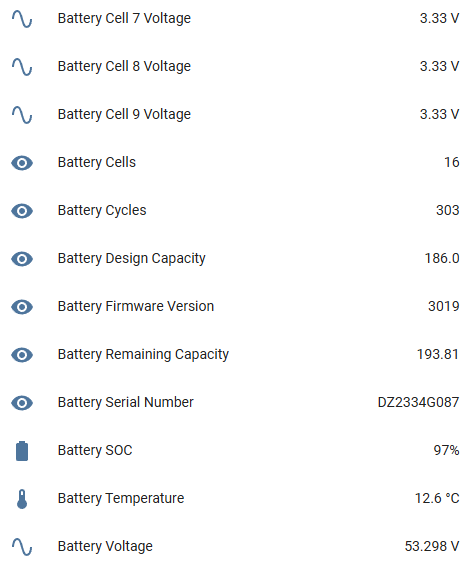
the 9.523kWh battery design of 186Ah actually has 200Ah of cells, so 10.24kWh at 51.2V
Mine at 97% (fully charged) shows 3.333v per cell, 53.3V for the battery so 10.66kWh
a 0.5C charge over 20c is 3.6kWh (inverter limited)
a 0.33C below 20c charge charge in cold weather is 3.5kWh
a 0.25C charge on BMS3017 was 2.66kWh