Question to those with hybrid + a/c coupled inverters

15 comments started 2024-01-22 last 2024-01-25
GivEnergy ProductsAC CoupledHybrid
L
#1 lukesarge

Good afternoon folks,

I've been running a Gen1 GivEnergy 3.6 inverter and 2 x 5.2 batteries for the past year. All is well however the house is often drawing more load than the battery can discharge (i.e. over 2.6kW) and also I am getting through the battery relatively quickly and having to run a secondary charge in the afternoon to offset against the 4pm peak time.

I've been in discussion with an installer about increasing my battery storage so as to try and last more through the day without having a secondary charge, but also how to increase my batteries output to the home. They've suggested adding an a/c coupled inverter that has a 3kW discharge linked to a third battery which will then allow for a total of 5.6kW discharge to the house when the demand spike (i.e. when the missus has the tumble dryer on).

My question really is how well does the GivEnergy app manage multiple inverters and whether there are any pitfalls or issues I should worry about, or does the system handle it relatively well? The installers have also recommended I upgrade the Gen1 inverter to a Gen3 as they can discharge at 3.6kW compared to the 2.6kW I can do currently. Not sure I want to go down this route as I've only had the initially inverter for a year and it feels wrong to simply just chuck it away after such a short (and relatively issue free period).

I'd really appreciate if anyone that has a couple of inverters (as I intend to go to) could just leave a message whether they are happy with the setup or if there are a myriad of issues that occur when upgrading in this fashion. In my head I want to try and keep it as simple as possible (i.e. one inverter + batteries) so it maybe that if there are issues around multiple inverters I look to remove the system entirely and start again with a PowerWall or something that is able to give greater discharge as well as extended battery storage.

Thanks for any comments in advance.

Sarge

#2 Watcher

lukesarge

I have the same issue as you, same kit, same timespan! I am considering the same options too.

Until I decide what to do I have gone on to Octopus Agile working alongside Wonder Watt which is loading my battery at night and with the option to boost mid afternoons to get through the evening, obviously it doesn’t answer your question or cover the higher load needs but might be a stop gap for you.
I will watch for feedback to follow you!

G
#3 geoffreycoan

lukesarge So you have two problems, battery capacity and inverter throughput.

And bear in mind that the 5.2 batteries are only 80% depth of discharge, so in reality 4.2kWh each.

You can add more batteries to your existing inverter setup, they are all seen as one giant battery so are still subject to the same inverter throughput limits and depending on what tariff you are on you may struggle to charge them fully within the cheap rate period.

You could swap the inverter from a gen 1 to a gen 3 for a slightly higher throughput rate, swap to an All in One (similar to a Powerwall), or add a second inverter.

I don't think GivEnergy recommend having a hybrid inverter and an AC coupled inverter connected together. I think you should talk to them to ask how well this works. I know of people that have an AC coupled inverter and an All in One and they can cross-charge so need extra balancing software to prevent this happening.

You could add another gen 1 hybrid inverter with a battery or move one of your existing batteries across. I have this setup, two Gen 1 hybrids (I have the 5kW model) and two batteries. They play very nicely together, give me double the charge/discharge rate and do not cross charge.
I understand multiple gen 2 or gen 3 hybrids don't play well together but the gen 1's do.

Frankly though I would do some maths and see what the cost benefit of adding an extra inverter and/or battery is. With the batteries and inverter you have you can set a timed charge from 2am to 4pm and Eco outside that and you will preserve your battery for the peak period.
Even if you do have a bit of peak import, have a look at how much it is costing you each day.

I have (at the moment) a single 5.2kW battery and an ASHP so high grid demand. The battery won't last the full peak period but it "takes the edge" off it. Spending £1000 for another inverter and £2-4000 for another battery is going to take a long time to pay back.

P
#4 paulwindy

lukesarge We have a gen 2 5kw inverter and 27.2kw of battery, discharge is 3.7kw we also have a heat pump which uses a lot of electric lately 50kw per day. we are on octopus cosy and charge 2 x per day max per session is 10.2kw. We do have a boil tap that is only 1.5kw and a heatpump dryer all comes in below the 3.7kw.
We run the heat pump on the sessions and the dryer on the second session charge batteries on 1st session and most times pause on second unless we are low. You could just change inverter for a 5.0kw gen 3 and maybe add a 9.5 battery then with a little offsetting should be fine.
Or you could just try and reduce what is used and certain time like boil tap, heat pump dryer etc.

G
#5 geoffreycoan

paulwindy Getting off topic slightly, it is reassuring to hear of other heat pump owners with high consumption. As you've got the battery storage then making use of it with Cosy makes sense.
I looked at my history for last year and based on 25kW a day for the heat pump I figured Agile would be about 2/3 of the price for me.
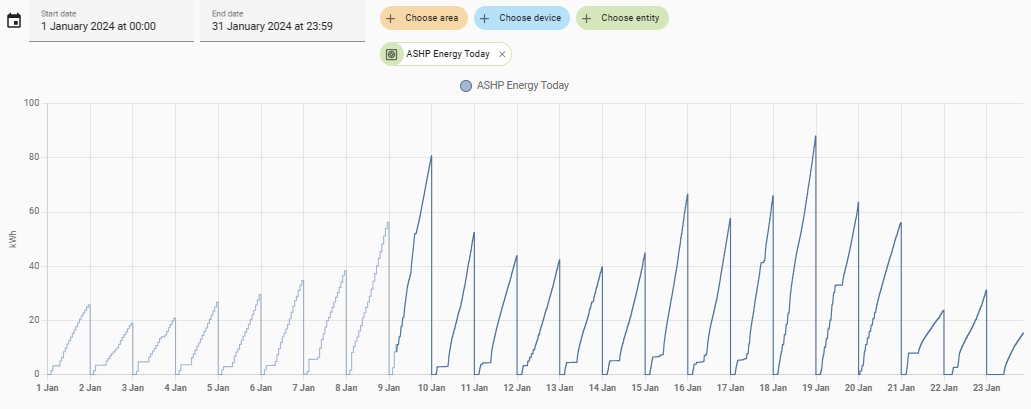
But with more accurate data in Home Assistant I find I am using more like 40kW a day on the heat pump. It sometimes hard to find evidence of whether this is normal, or not normal. Its only costing about £10 a day which is affordable so maybe I am worrying unnecessarily.

D
#6 DD

lukesarge I assume you've already looked into whether you can shift loads to run overnight rather than running from battery. What is a typical day's consumption, roughly?
You explicitly mentioned tumble dryer - have you considered upgrading that to a heat-pump model? I hear they're very efficient, and safer. Might be worth it if it saves having to upgrade inverter/battery. (We don't have a tumble drier - have just got ourselves a dehumidifier which works quite well for drying clothes.)
We also switched to a lower-powered kettle, to try to be a bit kinder to the inverter.

Presumably adding an inverter will require permission from DNO since it will take you over the 3.6kW limit.

V
#7 Vestas

geoffreycoan £300/month for heating doesn't sound that affordable to me! Do you live in a barn or something? 🙂

G
#8 geoffreycoan

Vestas Its in more like £200-250 a month in the winter but near to zero import and lots of export in the summer so net I am hoping that I'll be on zero over the year.

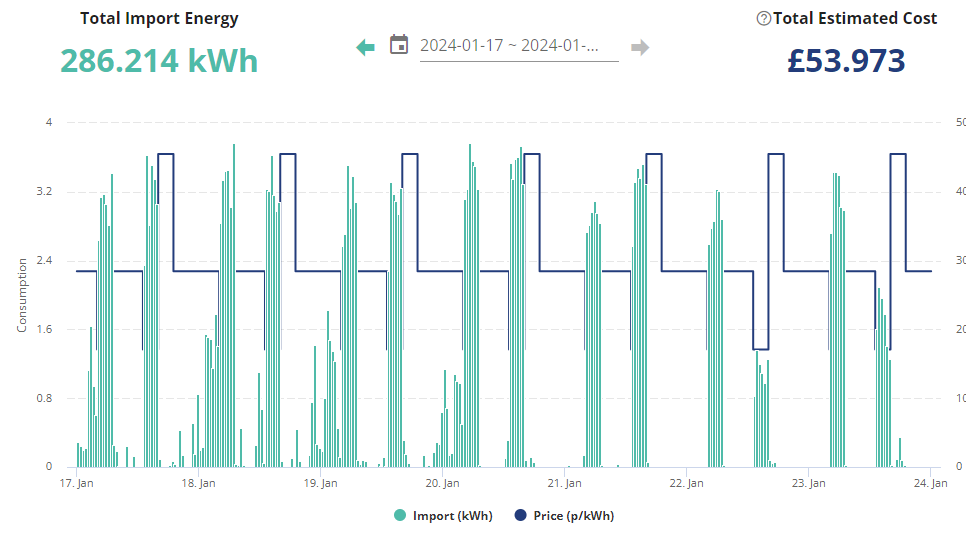
Its a 3 storey house, 1980ish built, 6 bedrooms which sounds a lot but two of them on the top floor the heating is turned off in. The weather makes a huge difference to the heat pump running costs. Looking back it has been £2.40, £2.70 and £4.20 so far this week, but around 14th-19th January it was £10-15 a day. Swings and roundabouts.
I've tried different heat pump strategies and at the moment its on 24x7 with an overnight temperature setback and weather compensation on. On year 1 it cost about the same as the previous oil boiler to run and that was largely on the SVT, so this year on Flux and then Agile I expect it'll be less.

V
#9 Vestas

geoffreycoan Given you're only heating 4 beds it doesn't sound even vaguely competitive with gas in terms of price.

Looks like you're averaging roughly 30kWh/day of energy on the heat pump? Assuming your COP is at least 3 then that's the equivalent of 100kWh of energy on heat/water a day? Even on the coldest days in Dec/Jan we didn't use more than 40kWh of gas - this is a 2022 build 4 bed but even so that seems a big difference.

P
#10 paulwindy

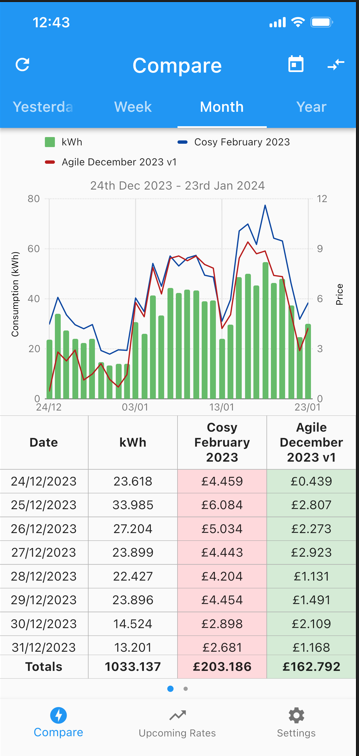
geoffreycoan Changed to the heatpump at beginning of Nov 23 so only had the worst months so far. we are getting cops overall of 3.8-4.0 so not to bad. This our last week below, Cosy is working well but looking back at the last month on compare the Agile Tariff would have been better for this time. see below


#11 Watcher

Vestas

You make an unassailable argument for mains gas.

Unfortunately as (assuming, as he had an oil burner before) @geoffreycoan and I don’t have grid access it makes no odds. A £10 a day heat pump would be better than the Calor gas bottles I am furiously burning atm both financially and ecologically for me. 😉

V
#12 Vestas

Watcher Oh I understand that, just surprised at the amount of energy geoffreycoan seems to use on the heat pump on some of the days on the graph.

S
#13 sponev

80kwh is a reasonable expectation to heat a 4 bed with "average" insulation on a very cold day. We actually run with a hybrid approach on very cold days when COP falls away on the heat pumps and our batteries are depleted. We simply turn the gas boiler on for a few hours. In the cold snap we were typically doing 15kwh from battery and 40 ish with gas. Batteries are charged at the 7.5p rate and gas is currently less than 4p per unit on Octopus tracker. So very cost effective, at least while those rates last. The ASHP (2) are A2A units so easy enough to use them more like a gas boiler rather than always on.

G
#14 geoffreycoan

Yeah, I'm surprised about how much electricity it uses sometimes. I realised earlier when I said we were using about £10 electricity a day and then gave some specific examples of daily consumption that they were all for the entire house and heat pump, not just the hot water and central heating.

When I did the "it costs about the same as our previous oil boiler in year 1", that was based on pricing up the consumption figures from the ASHP meter readings so it was a fair comparison, We reach the end of year 2 in a few days time so I will do another full year compare, but looking at the ASHP meters tonight, the heating and hot water consumption is on 5800kWh for year 2, slightly above the 5400kWh for year 1, but significantly below the 8800kWh MCS estimate.

Unfortunately as @Watcher points out, there's no gas in our village. Most of the homes are on oil heating. Our oil tank sprung a leak and the current rules for where you can site your tank meant the new one in the middle of the garden! The heat pump didn't have such restrictions and we got the RHI grant at the time so the installation cost wasn't quite so awful.

Very annoyingly my LG ASHP doesn't seem to have any way of find out what the COP value is, or how much heat it is generating. The control panel user interface and the manual were clearly written by engineers not technical authors or end users. I have finally learnt how to set weather compensation mode and how to control it, but finding out what the COP is, just can't get the data without (I believe) fitting a heat flow monitor in line with the heating system which even as a keen DIYer I baulk at.

Geoffrey