We only charge to car about once a week usually. When we added an AIO to the house, I replaced our aging, dumb, PodPoint charger with a the GivEnergy charger. The PodPoint was reliable and while its reporting sucked, the thing just worked. We came home, plugged in and the car just charged itself overnight using its internal schedule (The podpoint one never worked)
I've had to turn the GivEnergy charger off/on at the consumer unit switch multiple times now and my wife is getting very angry about it. I suspect that it is losing Wi-Fi access, and because of that it's refusing to charge. We have a new house, and even though the primary access Wi-Fi point is LITERALLY 5 feet away on the other side of the wall, the signal is very weak outside because of our insulation. The only way I can think of fixing this from my side is to put an external repeater on the house to blast out Wi-Fi.
So, here's a suggestion GivEnergy for a firmware update. Just put the charger into dumb-mode if it loses Wi-Fi and keep trying to regain connectivity. The default action should be that the charger does its job. Charging. At the end of the day it's a plug. The end-user's base expectation is to charge their car. We cannot do this when the unit is offline, and that is unacceptable.
S
#2SimonClarke
Sounds just like all the grief I had with my Hypervolt charger. Ended up with a powerline WiFi booster directly on the other side of the garage wall from the charger before it became reliable (ish). These things should be hard wired from day one. Seems obvious to add it while putting in 10mm armoured or whatever.
Just wait until the colour of the unit starts to yellow in under 18 months if it follows the Hypervolts quality….
J
#3John_R_H
I have a similar configuration with an AIO and Givenergy charger.
I also suffer from the charger going offline. That's not too big an issue for me yet as I don't have a car to charge (yet) but it can't me an acceptable behaviour. I also have a wifi repeater on the other side of the wall from the charger but in my case the signal at the charger is consistently "good" (c-50db).
The other oddity I have is that, since the charger was installed, I can't make the AIO take its overnight charge form the grid at less than the 6kW maximum. Before the charger was installed, I could set it to charge as slowly as I wished. Now, when I change the charge rate online, a minute of so later, the server resets it to 6kW via "EV Charger Inverter Control".
Do you see similar behaviour? Do you know how to control it?
J
#4JeffT4
I've not seen that behaviour. It might be something to do with your mains fuse, or limitations from your DNO. I've had both the car AND the AIO charging at the same time. We've pulled 13Kw from the grid overnight so, that's not been an issue for us.
D
#5downfield
John_R_H Now, when I change the charge rate online, a minute of so later, the server resets it to 6kW via "EV Charger Inverter Control".
Do you see similar behaviour? Do you know how to control it?
I've seen similar message in a different context. I use MyEO to control my house batteries on the Agile tariff. MyEO allows you to stop discharging the batteries during cheap Agile periods, below say 12p/kWh. But we found that as soon as MyEO issued a "Stop discharge" command, the "EV charger Inverter Control" would immediately reset the discharge power to 3600W.
I complained to the Support desk who made some changes and it went away, but not sure what they did. I couldn't understand why the EV charger software was trying to control the house batteries.
R
#6RichardDaniel
My GE EV Charger goes offline many times a day. Both GE and the Installer say this is an over-voltage problem.
The charger reports "26:GroundLeak. Charger failed to start every time." It then corrects itself roughly an hour later.
The AIO inverter samples and saves the grid voltage every few seconds to every few minutes ( I can't work out how it decides when to do this) The grid voltage upper limit is exceeded several times a day, the highest I have recorded is 254.6v.
The DNO is obliged to keep the voltage below 253v. I reported this situation to the DNO and they sent an engineer round the same day (at 8pm!) of course the voltage was OK at 248v when the engineer tested it, but to their credit they are going to lower the voltage at the local transformer on March 6th. We shall see if that fixes things - I have slight doubts about this as the over-voltage events have never exactly coincided with the EVC going offline.
(GE have an over-voltage code for this situation, it is 14 not 26 and why on earth is it called 26:GroundLeak?)
D
#7DD
RichardDaniel The AIO inverter samples and saves the grid voltage every few seconds to every few minutes ( I can't work out how it decides when to do this)
It might be that if you are running the app, which samples inverter status every 10 seconds, the info gets uploaded to the cloud at the same time. But if you're not running the app, the inverter sends it to the cloud every 5 mins.
K
#8killythebid
JeffT4 It could be WiFi which case a booster may help but I suspect it could also be overvoltage for the grid. It is easy to check if this is the case. You can see the grid voltage by going to the Givenergy dashboard and adding the grid voltage to the Powergraph view. Over 253 volts will be enough for the charger to trigger and shut down due to overvoltage. It is not the fault of Givenergy, they have to make the product do that due to regulations governing chargers these days. They will also trigger at low grid voltage too at below 216 volts but this is less likely.
If you are having overvoltage issues it is the responsibility of the DNO to fix them. They will most likely need to put a voltage recorder on your supply for a week or so and check the output but within a few weeks, they should be able to tweak down the voltage for you to be within spec.
R
#9RichardDaniel
killythebid
Thanks. Have added the grid voltage curve to the power graph. System only recorded over-voltage - 253.3v - once today but EVC has tripped 11 times so far. We will see after the DNO reduce the voltage on March 6th.
K
#10killythebid
RichardDaniel You may have had over 253volts more times than the graph records. The graph is in 5-minute intervals so a spike can come and go and not be shown.
K
#11Kerbo
Hi, I have the same issue 26-groundleak. Installer has been out and physically checked everything. My message seems to coincide with the peaks of the solar generation. 4 messages today alone.
Does anyone at GivEnergy read these forums?
Regardless whether it’s the DNO over voltage or solar array peak power the EV connection should not be displaying a ground fault.
The fault is with the inverter, the EV point or a software issue.
K
#12kram
If it’s not working and you want external scheduling support, maybe look at getting your installer to come back and fix it or replace it with something that works (Say a zappi)
K
#13killythebid
kram If the EV charger is tripping due to grid voltage spikes it won't make any difference what make of charger ones installs as they all operate in the same way in high or low grid voltages.
We have a Zappi and last year whn the grid voltage was high (usually when the sun shines brightly) it tripped although it did not report a ground fault but a voltage out of range error.
I would question if it really is an over voltage and yes you need to check that. That is definitely a DNO must sort and other chargers should behave the same.
If it was an over voltage the solar inverter and battery would be going offline too.
With all the bugs in software reported on the inverter I’d be getting the installer out to check, confirm and if it’s not that replace with a working product. In the first 6 months it’s up to them to prove it didn’t come faulty. After that it’s up to you to prove it did.
D
#15DrEvil
JeffT4 I set my inverter up as a reserved IP address via my router. Seems super reliable now.
K
#16killythebid
kram A grid over voltage issue is easy to check and certainly in my case it was exactly just that and the DNO fixed the problem via the local transformer.
It is not true that the inverter would go offline at the same time as the charger they are operating to different parameters/limitations. The chargers have a fairly hard stop over 253v but certainly the case of the GE inverters they will continue to operate up to 280v (it's there to see in the technical data) but will start doing some things to restrict output and solar production after 253v has been reached
Grid voltage is max 253 v so no inverter that meets UK standards should be providing power at voltage above that as they would be increasing the voltage down stream.
Regardless, as you say the next test is to check the grid voltage then talk to the DNO if it is high. If it’s not high, get the installer back asap.
K
#18killythebid
kram You don't have to believe me just check the specs of the GE inverter/Hybrid. They will not go offline but they will as I said operate differently. Shutting off solar production is one of them and no export. If you do you will see the upper limit is 270vAC
I also know this to be true by observation when the gird in my area was higher than 253v for significant periods not just spikes. During these periods it was only the Charger that reported over grid tolerance and would not operate. The Inverter stayed online but behaved differently.
T
#19TX200
Ironic? If the charger could operate it might help bring the grid voltage down? Maybe not one charger on its own, but if multiple ones on the area all shut off.
Maybe it needs to protect itself and/or the car though?
K
#20killythebid
TX200 When I spoke to Myenergi about the Zappi not allowing charging to occur when 253v is exceeded when I had the issue last summer they said it was a UK regulation that all chargers had to meet and could not be modified.
In regards to voltages above 253V - because it can be equally caused by a true PEN fault and also just network overvoltage their hands are tied (although perhaps the alarm wording could be more descript)
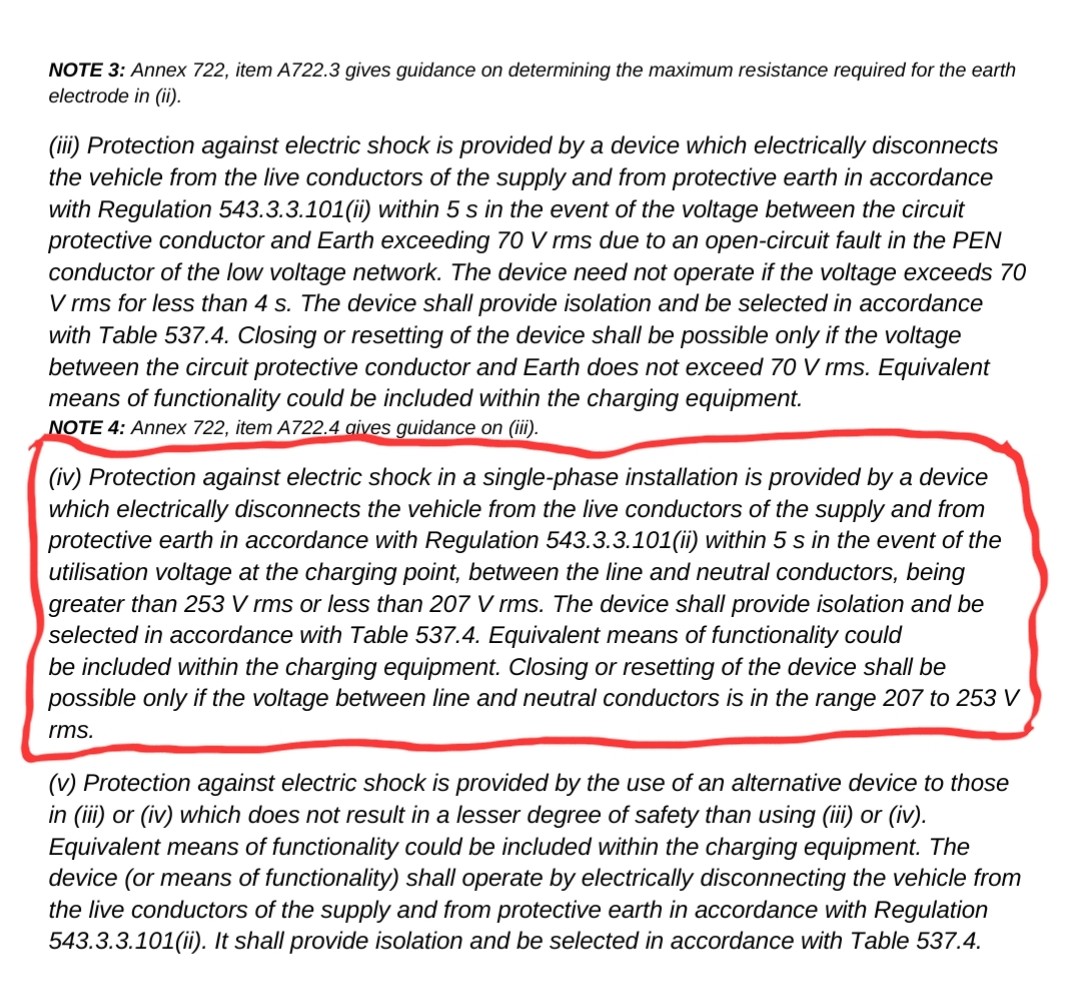
Edit: the 253V limit for EV chargers was from the ammendments to BS7671:
I
#23IJKIJK
I have had my Givenergy charger and AIO for 6 weeks and have seen the 26:Groundleek message 11 times (with 4 occurrences on the day i first charged my car - none on subsequent charges. Spoke to my installer on April 6th who said several customers have received this message and Givenergy said 'it's a known bug in the software which is affecting a number of their chargers and are working on a software update which will be released in the coming weeks'
A
#24amackayj
I've just noticed I get this error whenever the AiO starts to export to grid...
... possible cause of the voltage spike?
A
#25alan_johnston
hoggy My Ohme Pro charger had the same problem. Kept going offline (and not coming back online). Ohme said it was due to grid overvoltage and they sent through a CSV with dates, times and voltages. Told me to report it to the DNO.
M
#26MorganR
JeffT4 Hi Jeff, did you manage to solve your wifi issue in the end? We have exactly the same scenario with our new(ish) build house & insulation blocking signal.
We have a Hypervolt atm, and are considering getting a second charge point at some stage (for the 2nd EV) - The GE charger is a contender for that, since we have a GE inverter & batt atm.
We do already get “charger offline” issues with the Hypervolt, BUT it continues charging at least! So I wouldn’t want to install another charger that fairs even worse.
I thought I read somewhere that GE chargers can be wired directly via ethernet, too?