At what kWh should I expect to see clipping

35 comments started 2024-04-13 last 2025-05-04
Cloud Portal
#1 Midlands_Solar

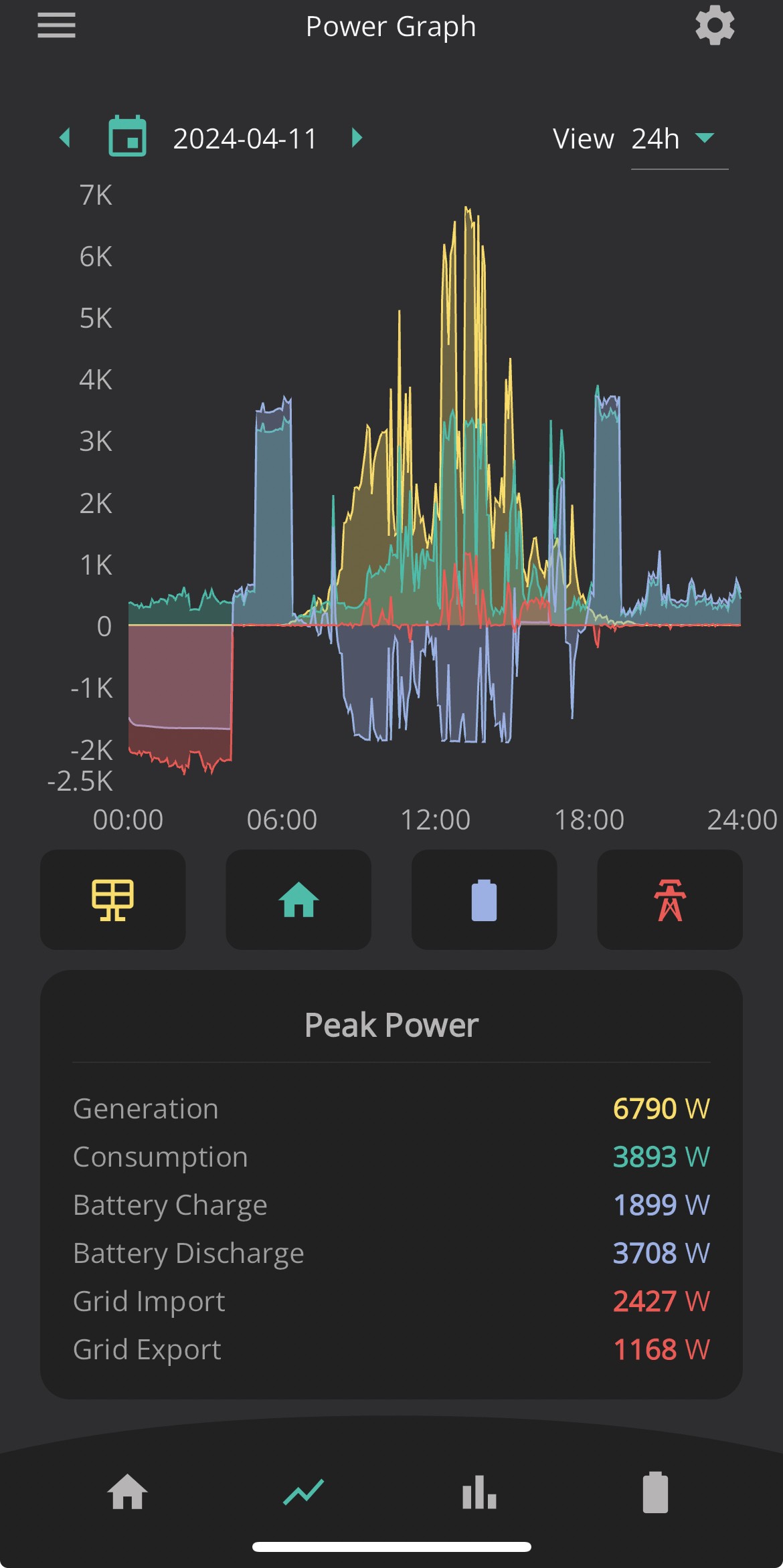
Observed my solar generation hitting 6.7kWh, yesterday, this is from 14 420w panels and a gen3 5Kwh inverter

My question is could in the later months could I see higher generation, and when clipping occurs what would this look like in the graph? I’m assuming a flat top on the generation output?

D
#2 DD

Midlands_Solar Yes, it would look like flat lines, probably on solar generation. Slightly harder to see it on the generation side - while the AC generation will be flat at 5kW, the domestic usage will fluctuate, and therefore so will the export, which is what the graph shows. (I've just started writing code to monitor the AC generation, which is available as a separate parameter, it's just not shown on the standard graphs.)

14*420W is 5880W, so 6.7kW is quite impressive. But note that the 420W rating is at a particular temperature (20 or 25 degrees or something ?). You'll get more on cooler days. So in fact in later months, when it's warmer, you may get less than you're seeing now. I've not yet had a full year on solar, but maybe around this time of year is peak power. (In the later months the days are longer, so you'll get more energy, from lower power spread over more hours. Maybe.)

Couple of other comments in passing... I see you're still doing that weird thing of charging battery from grid then immediately dumping battery into immersion heater. But the other thing is it looks like you are limiting the battery charging rate overnight, which is good, but you are not increasing it afterwards, which means it is still limiting the amount of solar charging - the flat lines along the bottom of the battery charging during the day. (But obviously I'm speculating a little.)

So I guess the first approx 1.7kW of solar was being sent to the battery, the remaining was going on AC, and then perhaps your solar diverter was taking 3kW, and the rest was being exported ? So you may have only just avoided any clipping here - if the battery was taking any less than about 1.7kW, the solar would have had to be clipped.

But there is another possible interpretation: you could have set your system to priotise grid. In which case the inverter would choose to turn the first 5kW into AC (of which again 3kW is being sent to immersion), and then the inverter sent the remaining power to the battery. This is how I'd like to operate my system, but unfortunately I can't get grid-first to work.

(Do you consume a lot of hot water - are you dumping battery to immersion again at around 6pm ?)

Simplest way to avoid clipping is to ensure there's plenty of space in your battery - you need to be able to split the solar power between AC generation and battery, since neither alone can accept 7kW. As long as you are happy to continue heating water with solar, limiting battery charging rate to around 2kW, as you have done here, should work just fine.

(I have different priorities, and want to dynamically tune battery charging rate to keep AC generation close to around 4.5kW. I don't really want/need to charge the battery from solar.)


J
#3 Josephiah

I've seen similar on our (similar) system. We have 16x 410W panels (6.56kWp) with a 5kW Gen 3 hybrid inverter and 9.5kWh battery. From what I can see:

  • if the battery is full, it'll clip at around 5.2kW;
  • other times, when the battery is not full, I've seen it do a consistent several-hour-long clip at around 5.5-5.6kW;
  • I've seen several instances where it's happily put out 6.5kW for shorter (but still reasonable) periods (combination of battery charge, house load and export);
  • I've seen short peaks of over 7kW. These are more often caught in home assistant's faster sampling rather than GivEnergy's 5min sampling. The highest I've seen is 7.5kW, and quite a few others around the 7.2-7.3kW mark.

The temperature derating (or uprating?) of -0.330%/˚C could just about account for the <7kW stuff, but the short higher peaks are a bit of a stretch for this. Don't know if it's things just performing a little higher than spec (everything's still pretty new, after all), or possibly just momentary transients getting picked up.

R
#4 Robgy

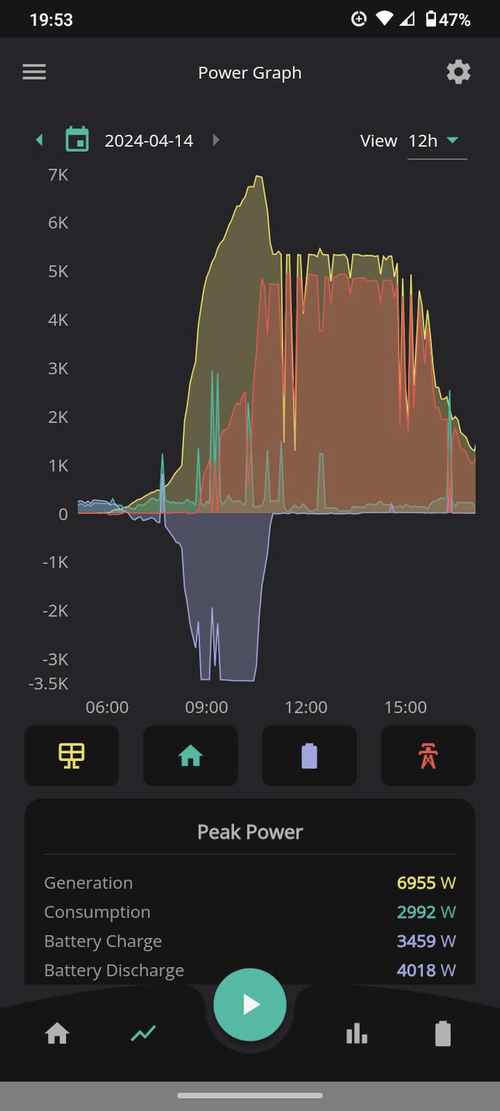
Still new to this but I think I have flat lines for generation clipping
5kW hybrid inverter, 9.5 kWh battery and 8.2kWp panels

#5 nophead

Never experienced clipping because that last cloudless day was in January, when the sun is too low to clip. Since then it has rained most days and is always cloudy.

R
#6 Robgy

You need to move to sunny Lincolnshire 😃

T
#7 TimHutchings

Robgy if you charge the battery at a lower rate, the battery will take longer to charge, and you'll avoid the clipping. I had this problem a year or so ago and finished up charging the battery between about 10.30am and 2.30pm at about 2.5 kw. You need a sunny day but it does work.

R
#8 Robgy

Forecasting a sunny afternoon is the main issue

R
#9 Robgy

TimHutchings
Do you turn the battery off before the 10:30 lower charge rate?

D
#10 DD

There is a parameter on the portal remote control page which is supposed to prioritise grid over battery, so that it would first max the export, and send only the rest to the battery. Unfortunately I've not got it to work on my system (gen-3 hybrid with 305). Would be quite interested to know if it works for anyone.

D
#11 DD

Robgy there is a timed-pause available via portal. So you can configure it to pause-charging between, say, 0700 to 1030. Then I use fairly dumb API scripts to step charge power up at fixed intervals, without worrying about forecasts.

Given that the max input is 7.5kW, clipping will be inevitable for you on sunny days. At these levels, my inverter consumes around 500W itself, and I suspect this comes out of the DC input before AC generation and battery. Which means you only need 2kW to the battery plus 5kW of AC generation to minimise clipping.

T
#12 TimHutchings

Robgy As DD says you can use the portal, or as I did, use the quick set buttons to pause on the app, or turn the the charge rate right down until around 10.30am then up it at that point to a rate of say 1500w, 2000w or 2500w using the slider in the App, or whatever rate is likely to compensate the amount of clipping you will be getting. You can see in your chart roughly the amount of clipping you get in your system. It's really only when you get clear blue skys, and of course as the panels get hotter in the summer, your solar output will reduce and your clipping will be less.

T
#13 TimHutchings

Robgy of course the advantage you have by having a solar array bigger than your inverter can deal with is the extra power you get in the winter or on cloudy days in the summer. Swings and roundabouts really!

D
#14 DD

Robgy Forecasting a sunny afternoon is the main issue

What's your tariff and daytime consumption?
I'm on IOG and get 7.5p overnight import and 15p export. So I basically want to export as much of my solar as I can, and run house from overnight import. Even on a dull day now, solar covers daytime consumption and 40% in the 9.5kW battery should be enough to cover evening use.

So my strategy is basically to export all solar, and only solar-charge the battery if I have to, to avoid clipping. This way, I don't really worry about the solar forecast - if it's a sunny day, the excess will fit in the battery then get dumped to grid in the evening ; if it's a dull day, I just won't export much.

R
#15 Robgy

TimHutchings
Winter months and cloudy days was the main reason for over paneling our system, plus generation tends to start earlier in the mornings when the voltage reaches around 120w to start the inverter and that appears to be working well.
Clipping has only happened for short time periods 26 times this year so far, yesterday was the most I've seen, whilst I'm not too bothered by it I do feel slightly sad seeing all that potential generation not doing anything, but I think as you put it, the swings are beating the roundabout.

R
#16 Robgy

DD
We're on Octopus Flux, our daytime use is currently around 8 kWh and 4 kWh from 7pm to 7am
this will change when we get the heat pump installed in the next month or so.

N
#17 NickK

I've got 7kW of panels (12 South facing, 6 East facing) with a 5kW hybrid inverter, 9.5kWh battery and a DNO export limit of 4.75kW. I fully charge overnight (7.5p Octopus Intelligant Go) and start discharging at 1kW from 8am to 2:30pm (15p Octopus export)

By 10am, I'm regularly been generating over 5kW by 10am and the excess starts charging the battery. I'm regularly generating 7kW with all the excess going into the battery. When clouds reduce generation below 5kW, the battery discharges. On cloud free days I will increase the discharge rate and/or start earlier.

I now need to work out how to use solar forecasting to automate the discharging.

D
#18 DD

NickK I'm intrigued... Sounds you have it configured to discharge, but it automatically changes over to charging (rather than clipping) any time the solar would bring it up over the limit. That's exactly what I'm after. How have you configured that, and what firmware revision is running.

I wonder if that's a feature of having the export limit set below the AC capability. (My export limit is 6kW which I think is the default.)

Only downside I can think of is you put the kettle on in the morning, while the discharge is limited to 1kW and the sun isn't up, it would import rather than increase battery discharge, because eco is off?

M
#19 Marren2016

Whats wrong with clipping? My inverter is Gen1 3.6 so it clips at 2.6kw which is all the time. Will clipping break it?

D
#20 DD

Marren2016 no, it certainly won't break it. Merely a missed opportunity to get even more lovely free energy.

It shouldn't clip at 2.6kW, though - that's the battery's max charge/discharge rate, but additional solar should get exported..?

#21 nophead

No it won't break it. It is just wasted solar energy.

My Gen3 inverter can output 5kW to the mains but it can also charge the battery with about 2.5kW at the same time I believe. I.e. it can convert about 7.5kW from solar. So if it was ever sunny enough (which is it hasn't been since install so far) it is best to leave the battery uncharged so it can absorb the excess energy that can't be converted to mains power for the load, or export.

M
#22 Marren2016

DD yeah it gets exported.

D
#23 DD

nophead So if it was ever sunny enough (which is it hasn't been since install so far) it is best to leave the battery uncharged so it can absorb the excess energy that can't be converted to mains power for the load, or export.

Unfortunately, I can't get it to work (automatically) that way round. It prioritises the battery after meeting the load, and sends excess to the grid only when the configured max battery charging rate is reached.

R
#24 Robgy

DD in the phone app there is a button at the bottom where you can pause the battery, with mine it doesn't stop the battery completely but reduces the charging from 3.5 kW to 250w priority is then home sending surplus to the grid

R
#25 Robgy

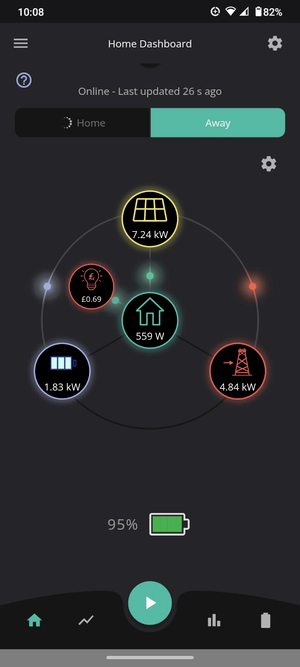
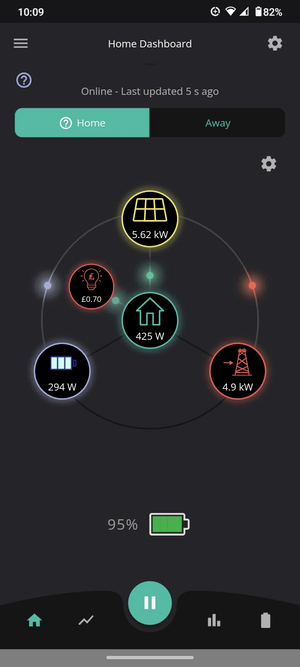
This morning in sunny Lincolnshire around 10am my panels showed:
7.24 kW production with 559w to the house, 1.83kW to the battery and 4.84kW to grid
I then tapped the play button and then paused the battery, generation dropped to:
5.62kW production with 425 to house, 294w to battery and 4.9kW to the grid

I then tapped the little button and changed the battery back to run and generation increased again, I repeated it several times with the same results until the battery reached 97% and then charging slowed down.


I understand that this could be automated but forecasting the sun isn't foolproof.

#26 nophead

DD Yes I would have to pause the battery manually but so far I have never experienced clipping. There are always clouds that just stop it short of clipping.

D
#27 DD

Robgy This morning in sunny Lincolnshire around 10am my panels showed:
7.24 kW production with 559w to the house, 1.83kW to the battery and 4.84kW to grid
I then tapped the play button and then paused the battery, generation dropped to:
5.62kW production with 425 to house, 294w to battery and 4.9kW to the grid

Yes, that's clipping in action... If you don't allow the battery to take more than 300W, it has to clip generation to the max it can send to AC (plus about 10% losses).

R
#29 Robgy

DD that sounds interesting, please could you explain in simple terms how your automation works, if you have previously explained it could you point me in the right direction please.

R
#30 Robgy

Robgy sorry, I've just found it on GitHub, I should have realised it's a script and not something to do with the givenergy app.
It's a bit beyond my comfort zone with my new system at the moment.

D
#31 DD

Robgy I've just found it on GitHub, I should have realised it's a script and not something to do with the givenergy app.

My script isn't yet on gitub, but I think it's a bit simpler than the one mentioned in the link in the previous post. There is supposed to be an inverter parameter which is supposed to do it, AFAIK, but as described in that thread, I can't get it to work for me.

R
#32 Robgy

DD oh, I assumed you had later got it to work.

D
#33 DD

Robgy No, the graph is a result of my external script operating, not the inverter doing its thing.

N
#34 NickK

DD My inverter is GIV-HY5.0 firmware D0.913-A0.913

This is how I had it on a bright day with intermittent clouds.
No cloud, generation 7kW, export 4.7kW (my max determined by DNO and set by my installer) rest going into my battery.
Clouds pass by, generation 3kW, battery discharging at 1.0kW, export 3.7kW (rest is house load)

Early use of the kettle? Yes, you're right, I get some grid import....

H
#35 hktelfords

Late entry ...
I have east facing panels, peak generation 7.5 kW about 10am, inverter can handle 5 kW
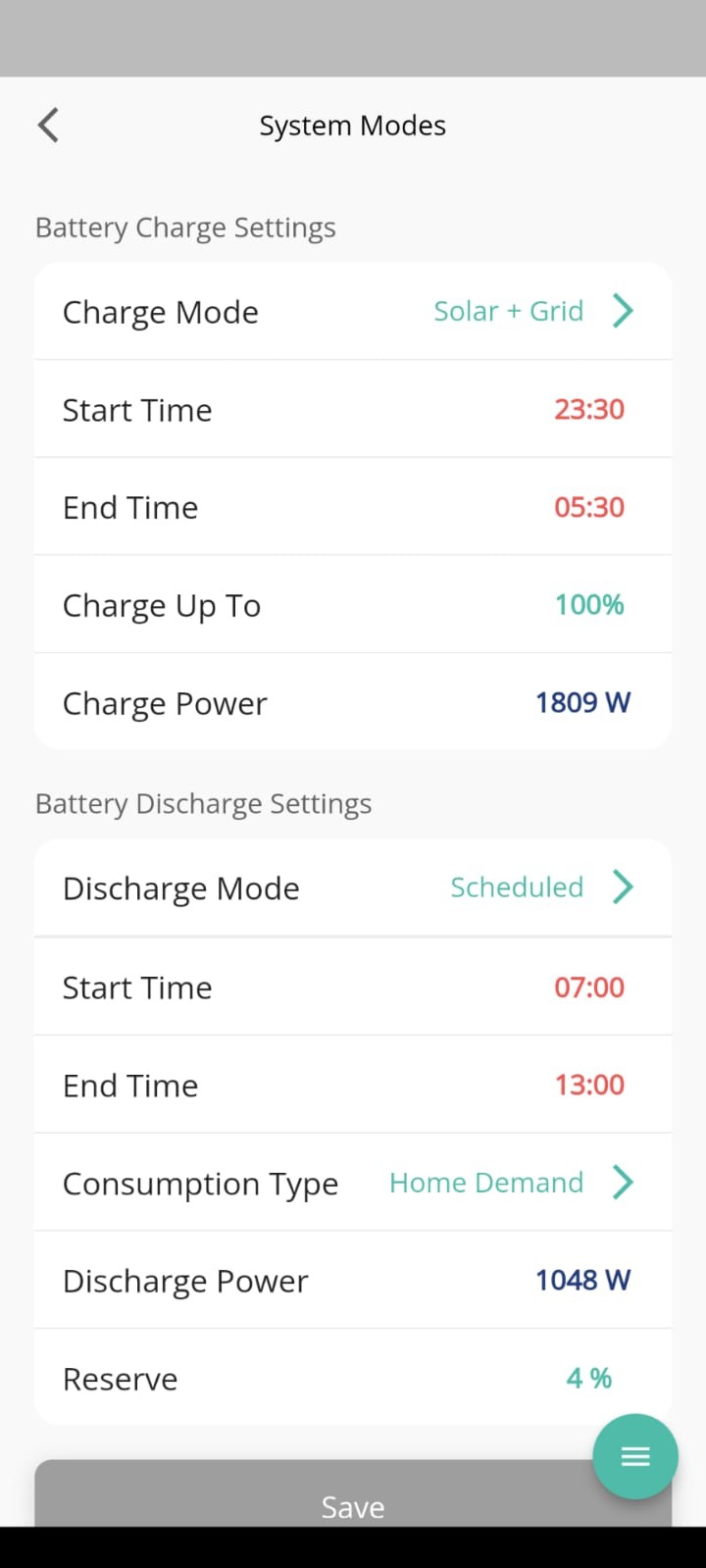
My anti clip strategy has been Timed Export down to 4%
I've had it activated between 6am and 1pm, because after that generation is below 5 kW anyway
An inefficiency is that on part-sunny mornings the battery doesn't fill, and I don't get much afternoon kW
So I've recently refined the Timed Export to be: down to 4% until 9am, down to 17% until 9.30, down to 32% until 10 ... etc ... down to 95% (!) until 1pm
The idea is: ensure that whenever the sun comes out and stays out, the battery can take the rest of the morning's excess over 5kW; subject to that, the battery is allowed to fill