BMS Over Voltage

63 comments started 2024-04-15 last 2025-06-05
GivEnergy ProductsHybridBattery
C
#1 CGoode

Hi all.
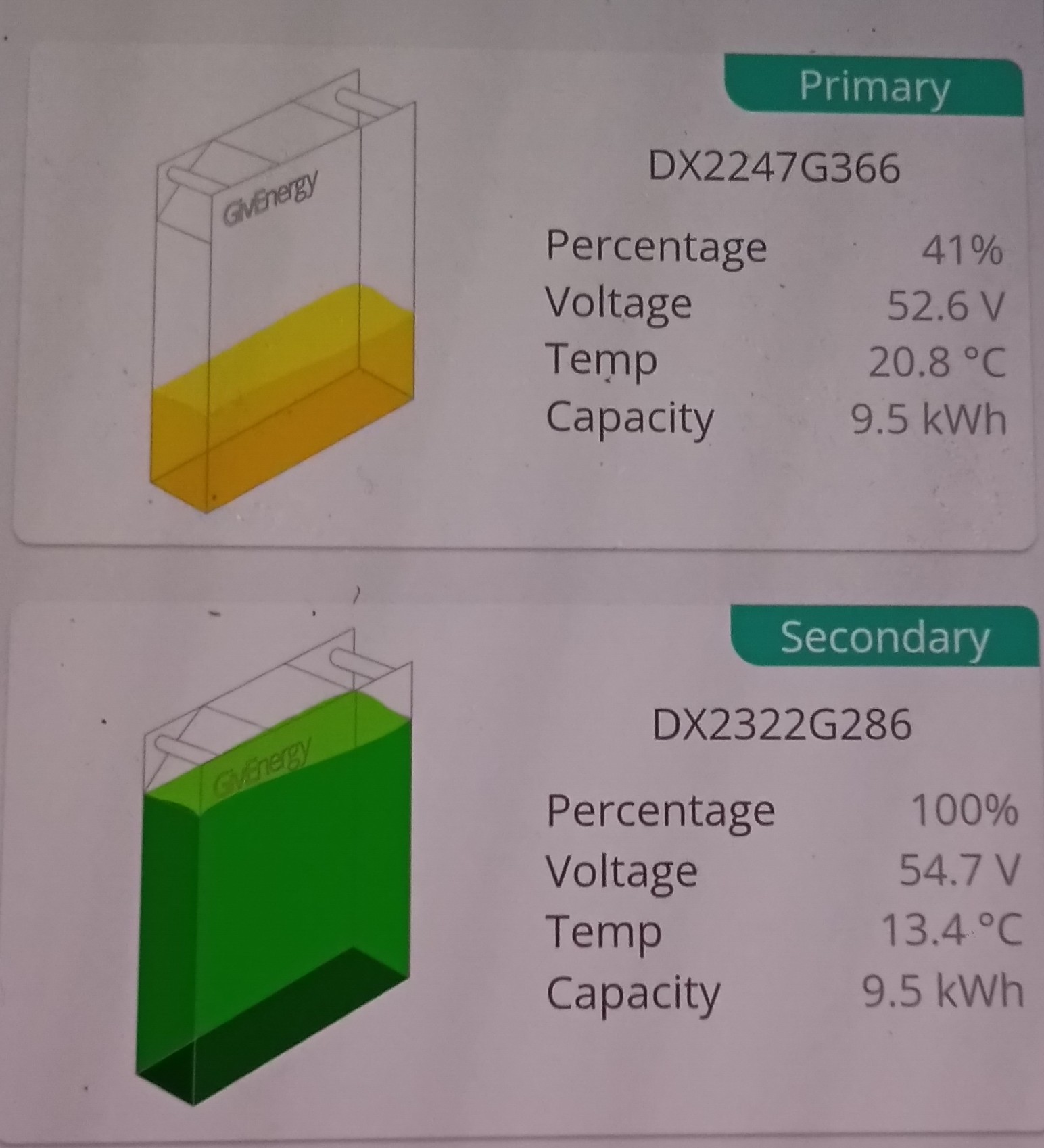
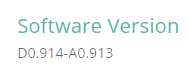
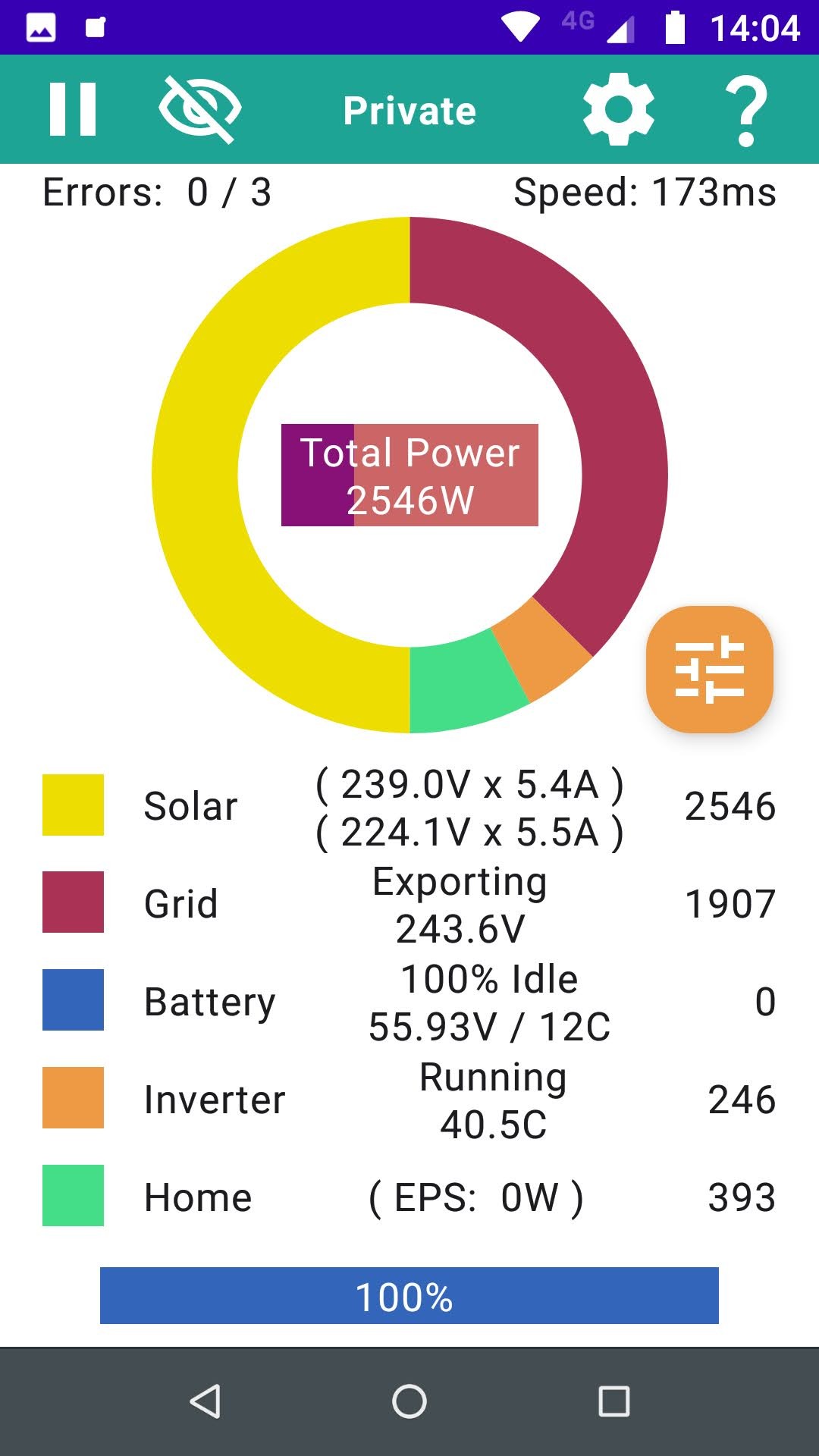
GIV-HY3.6 Gen 2 Hybrid inverter, 3015 battery firm, Inverter firm D0.913-A0.913, 2 x 9.5kWh batts one of which was fitted & commissioned recently. 10 x 415w panels (original) & 5 x 425w panels (recently fitted).
I have been getting quite regular BMS Over Voltage notifications whilst charging overnight. These have been popping up before & after the latest battery & panel installation. The latest notifications are shown below.
Raised Cleared
BMS Over Voltage 2024-04-15 04:37:47 2024-04-15 04:42:49
BMS Over Voltage 2024-04-15 02:32:02 2024-04-15 02:37:03
BMS Over Voltage 2024-04-15 01:31:40 2024-04-15 01:36:42
BMS Over Voltage 2024-03-29 14:06:29 2024-03-29 14:11:31
BMS Over Voltage 2024-03-29 13:26:14 2024-03-29 13:31:16
BMS Over Voltage 2024-03-29 12:40:58 2024-03-29 12:46:00
BMS Over Voltage 2024-03-29 12:05:45 2024-03-29 12:10:47
BMS Over Voltage 2024-03-29 11:30:32 2024-03-29 11:35:34
BMS Over Voltage 2024-02-29 02:01:02 2024-02-29 02:06:03
BMS Over Voltage 2024-02-26 02:15:04 2024-02-26 02:20:05
BMS Over Voltage 2023-09-08 14:44:40 2023-09-08 14:49:42
BMS Over Voltage 2023-09-01 01:41:36 2023-09-01 01:46:38

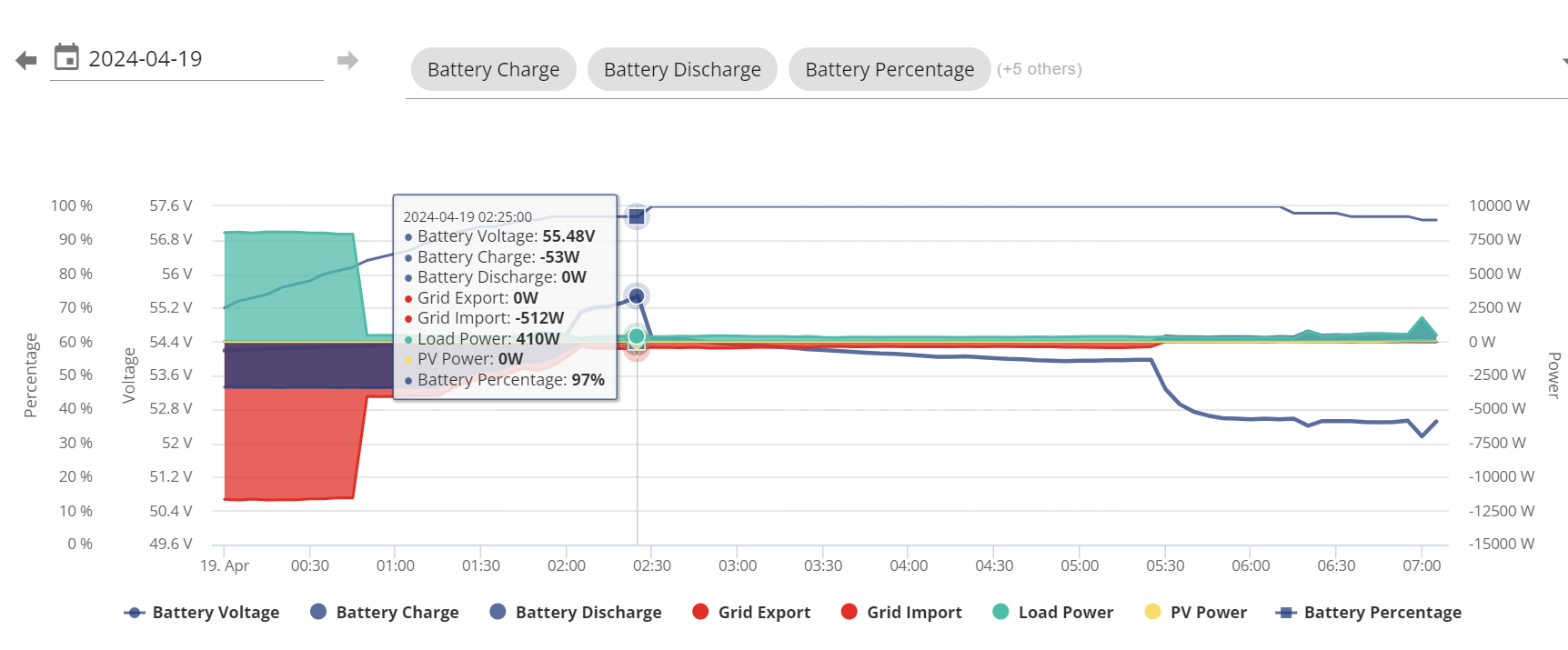
These seem to be flagging up when the batteries are nearing their full SOC.
The Inverter & batteries are installed in an unheated attached garage which is quite cool.

Other than this the system is working fine.

Any ideas or suggestions?

Thanks Colin

V
#2 Vestas

CGoode GE screwed up the firmware AGAIN and 3015 charges batteries past their calibration limit. Been going on since the release last December, there's bodges/fixes/whatever for G2/G3 inverters, none for G1.

There's later firmware for your inverter, you should ask GE to install it if it doesn't appear on the portal.

C
#3 CGoode

Vestas Thanks.
There's nothing showing on my portal pages so I guess I need to contact GE.

C
#4 CGoode

I contacted GE & they are going to do a remote "low rate" 30% speed discharge / re-charge calibration to correct the apparent battery "alignment" issue. Not sure what this means or how long this will take but fingers crossed it solves the problem.
TBH I'm not altogether hopeful because my system has been re-calibrated twice in the last two weeks. Once when the additional battery was installed & again when the 5 new panels were connected. Plus, I've been having these BMS Over Voltage messages before any of the recent changes.
Fingers crossed it works.
No mention of any updated firmware. Hmm.

V
#5 Vestas

CGoode It won't make any difference IMHO. Edit - it'll take 18 hours or so as they'll be doing the charge/discharge at 1000W.

I'd recommend just setting a maximum charge level (SoC) of 95% or so and play around with that until you don't get notifications when the over-voltage is caused by PV input (which you've increased recently). In most instances you're not going to actually lose anything much in capacity by doing this.

I use GivTCP/HA to monitor cell voltages and that way I can usually manage things when GE come up with "interesting" firmware, 3013 took battery cells WAY too low, 3015 is too high. NB - that's on a G2 9.5 battery and as far as I can tell it's not faulty in any way.

Edit2 - https://kb.givenergy.cloud/article.php?id=91&oid=23 says there's a later f/w.

F
#6 Fridgeman

Same happening to mine, (Hybrid 5 gen 1, 3015 battery) but only get the 1 alarm per day when the battery finishes charging overnight, never seems to happen when charging by solar. GE did the calibration to mine also and made no difference what so ever, was then told to monitor it for any other issues??

D
#7 danerf

Funnily enough I contacted them today about the same issue. Told me I need a calibration. I don't it will help.

C
#8 CGoode

Well, it's been 22hrs since the "low / slow" calibration started yesterday & after discharging for most of that time the battery is now back up to 24%. 3kW of solar is helping a bit at the moment until it clouds over so it looks like it's going to take a while. Still not sure if this is going to solve the issue. Time will tell.

V
#9 Vestas

CGoode Still not sure if this is going to solve the issue.

If it solved the issue GE wouldn't have been automatically rebooting systems with overvoltage warnings back in January. Nor would they have made a crude attempt to hide the portal warnings for a time.

Of course I could well be wrong...

O
#10 Ortwin

I have a Gen 2 5Kw inverter and 2 x 9.5 Gen 2 batteries, one of which was fitted a month ago. I'm running 913 and 3015 on both batteries and had to get GE to do a couple of battery discharges and calibration as the second battery apparently had not got version 3015 but 3013 which initially caused the second battery to stop working. Now getting the BMS OV errors when the batteries are reaching full SOC. I will contact GE tech if it continues.

C
#11 CGoode

My "low / slow" calibration finally finished at 1.30pm today after 27hrs. Everything is normal ATM. I will monitor tonight when the batteries charge up & when the BMS overvoltage errors normally occur, fingers crossed.

C
#12 CGoode

Ortwin Sounds very familiar.

T
#13 TimI

I've been noticing an increase in BMS over voltage notices on our G1 3.6 recently, the batteries are 3015 but the inverter is on the same firmware it arrived with.

D
#14 danerf

Instant BMS over voltage alert when completing the first calibration. It's been happening for ages, so I'm not worried. But as it alerts, it must be a problem

V
#15 Vestas

TimI I predicted this would happen a few months ago. More PV power = more people with full batteries = more overvoltage warnings.

GE know about this -

D913-A913 (11 Dec 2023)

  1. BMS 3015 Support - Fix over voltage error

That's about a month after the release of the 3015 battery firmware - new G2 inverter f/w to fix shonky battery f/w - or to suppress errors?

So if you have a G1 inverter and the battery is giving overvoltage errors then don't worry. Its ALL on GE if your battery dies/has an issue because they know about this and have done nothing.

V
#16 Vestas

If you have a G1 and use GivTCP/HA then its possible to get around the issue.

Create an automation which sets the battery charge power to zero if the battery voltage exceeds 55.2V. That pretty much does it although its better to also monitor individual cell voltages as the G1 is pretty slow to react.

I set the trigger to run if the battery voltage exceeds 55.2V or any cell exceeds 3.47V. That doesn't stop all the overvoltage notifications but its close and none of the cells go as high as they used to when I just let v3015 rip....

O
#17 Ortwin

So following the BMS OV the secondary battery has decided not to be part of the system. I can see it but it will not discharge with the primary battery. This has happened before when the two batteries were on different versions of software and GE had to remotely change the secondary battery software to 3015. So tomorrow I'll give GE technical a call and see if they have to force a discharge and calibration again. Just in case I will stop the overnight charge as there is no point if they are going to discharge them.

O
#18 Ortwin

I've just seen an email from GE technical to say my inverter firmware is out-of-date which may be what is causing the issue. GE have managed to upload 914 to the DSP but unable to upload it to the Inverter ARM. This will have to be manually uploaded. So I am now waiting for the software and instructions to sort this out. Unfortunately I cant get this done till late tomorrow and probably will not be able to get them to trigger a discharge and battery calibration until Friday.

G
#19 geoffreycoan

Vestas If you have a G1 and use GivTCP/HA then its possible to get around the issue.

Create an automation which sets the battery charge power to zero if the battery voltage exceeds 55.2V. That pretty much does it although its better to also monitor individual cell voltages as the G1 is pretty slow to react.

I set the trigger to run if the battery voltage exceeds 55.2V or any cell exceeds 3.47V. That doesn't stop all the overvoltage notifications but its close and none of the cells go as high as they used to when I just let v3015 rip....

Interesting how different people have different behaviour with 3015.

I have 3015 on both my 9.5 and 5.2 battery, which are on two different Gen 1 5kW inverters.

The 9.5 went to 55.95v during calibration when the battery was installed on 28/2/24, but there’s no BMS over-voltage notification that day. Highest the voltage got in March was about 54.89v and there’s no over-voltage notifications in March or April.

The 5.2 went to 54.91v during the same calibration and I did get an over-voltage notification. In March the voltage has peaked at 55.2 and 55.1 (once each), and in April peaked at 56.57v (once), but no over-voltage notifications for any of these.

So for me I am just not getting 3015 driving the voltage too high or any unexepected notifications during use.

Using predbat to automate the battery charging etc but nothing monitoring the voltage at present.

V
#20 Vestas

geoffreycoan Indeed. It'd be interesting to know how many of the people affected previously had v3013* installed.

*this is the firmware which got pulled as it killed batteries - lots of them by all accounts.

C
#21 CGoode

I'm on v3013 & no update options are showing on my Portal.
What replaced this version & how was it communicated?
Gen2 3.6Hybrid & 2 x 9.5kWh Gen2 batts.

C
#23 CGoode

Vestas Arrgh. Fat fingers. I'm on v3015. Thanks.

O
#24 Ortwin

I have now been sent the inverter software 914 and instructions to upload as i am currently on D914-A913 and they cant upload the ARM side. Here is the details of the 414 update.

Note the App and cloud will only show the software version for the primary battery not the secondary!

A914-D914 (09 Feb 2024)
Software changes:

  1. Optimise SOC Calibration, relating to stopping at 5%
  2. Export Limit Overflow error Fix.
  3. Optimize the battery removal mechanism when sleep function used
  4. Fixed error with OffGrid Mode
  5. Optimise PV MPPT Logic
  6. Added the quick protection function of battery overvoltage interruption
#25 EricIoW

I have been getting overvoltage notifications this month, 3 in last 2 hours
BMS Over Voltage 2024-04-18 13:35:52 2024-04-18 13:40:59
BMS Over Voltage 2024-04-18 13:05:10 2024-04-18 13:10:17
BMS Over Voltage 2024-04-18 12:08:53 2024-04-18 12:14:00
3.6Hybrid G3 A308-D308 (latest) 9.5v2 Batt 3015
I had a normal calibration a month ago and a slow one a week ago.
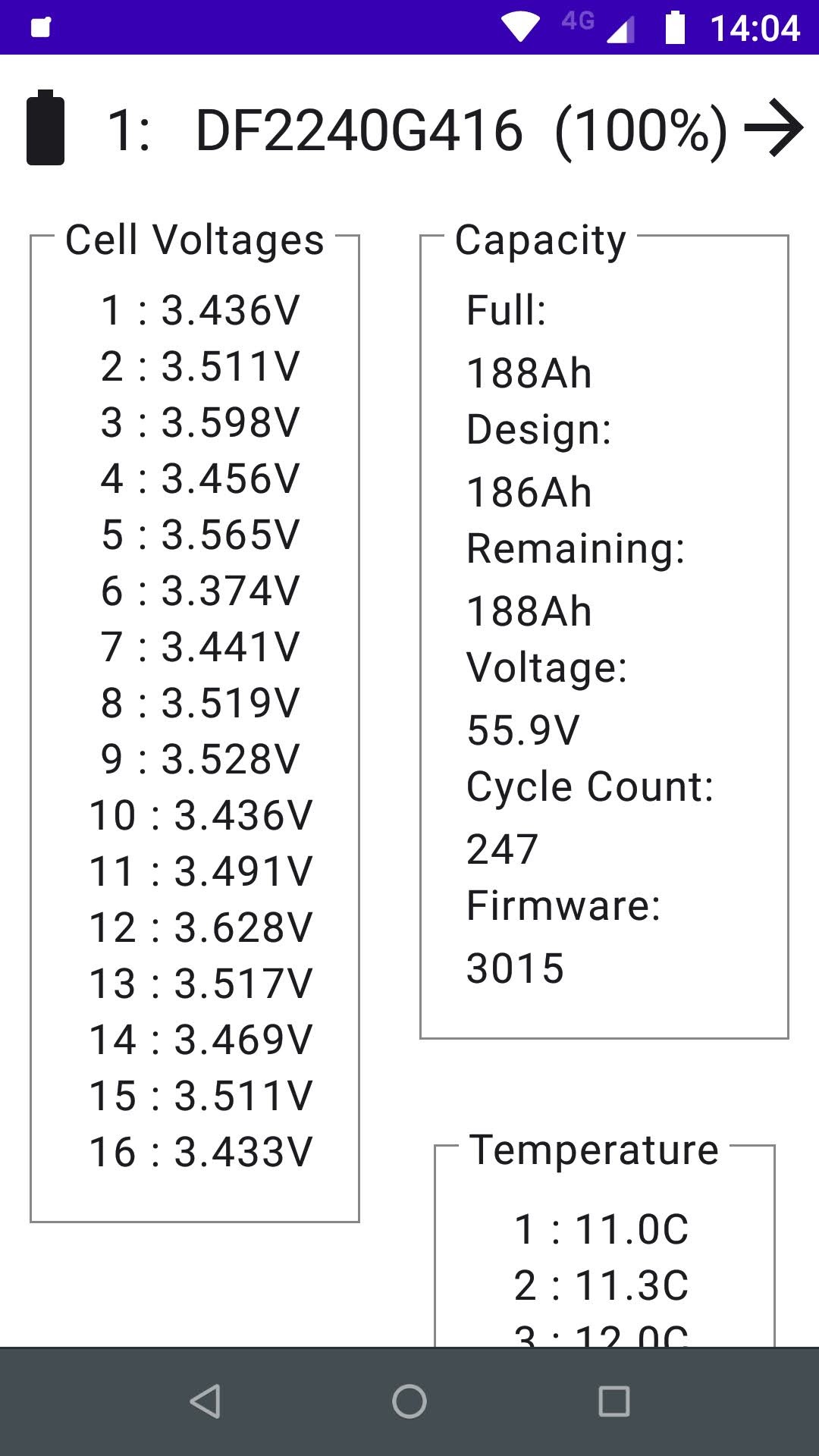
With regard to voltage that causes overvoltage notification as I understand the BMS has 16 voltage sensors and that these monitor cells (can be paired) not the whole string. So if the total voltage was say 55V it could be that 1 cell was 3.8V and causing the notification.

T
#26 TimI

Vestas Yeah, I'm not overly worried - it's spiked and cleared within a 5 minute reporting cycle, its not hanging high - which is always towards the end of the charge cycle (overnight from the grid).

But as its a G1, it appears to be not getting any more firmwares even though when it was new there was several developments in progress... ah well. it'll do. no doubt at some point i'll move house and want to set up again - knowing what i know now, would do it differently anyway for power provisions etc.

O
#27 Ortwin

My issue is now the system is not using the secondary battery and have been told that the inverter ARM software update will cure that. However I'm not holding out much hope as it did not work the last time my system had a software update and needed two discharges and calibrations.

S
#28 sponev

We're still on 3012 as when we tried to update to 3015 months ago, the update failed and corrupted. We then needed to wait weeks for a GE engineer to attend to unstick USB sticks which were glued in and wouldn't budge. Fortunately we were able to get the batteries and inverters running on 3012 and the corresponding inverter firmware. The system works reasonably well but we cycle with a low level discharge every few weeks to calibrate the bottom end. We don't see any over voltage warnings. Am i right in thinking that it's best to stick with what we have and not update? What are we missing out on? Faster response times had been mentioned but I'll forgo that if an update means the risk of over charging. GE don't cover themselves in glory with this stuff unfortunately.

V
#29 Vestas

sponev v3013 was a bit of a disaster - took the batteries way too low (45V).

v3014/3015 takes them a bit too high.

The "faster response times" are inverter updates, not battery.

I'd stick with what you have were I you.

O
#30 Ortwin

Well I finally managed to update the ARM to 914 and the secondary battery is now discharging. Lets wait and see if any more BMS OV issue occur.

S
#31 sponev

Vestas Tend to agree, I'll hold for now. Cheers.

C
#32 CGoode

Well after the "slow" re-calibration & the first night battery recharge it looks like the battery voltage topped out at 55.58v with no OV errors. I'll see how it goes again tonight. Fingers crossed.

O
#33 Ortwin

Well no OV errors so far. The battery voltages are close but the battery levels are a bit apart and GE have said I didn't need a battery calibration, but let's wait and see.

O
#34 Ortwin

Well GE have initiated a battery calibration to hopefully sort out the difference between primary and secondary battery SOC. hopefully with all the software update to date and battery calibration done I can sit back and let the system do its thing

O
#35 Ortwin

Finally the battery calibration has been completed. However as the system switched from discharge to charge I got a battery under voltage error and as the batteries finished charging an over voltage error. Not sure if that is normal for a battery condition or continued software issue.

G
#36 geoffreycoan

Ortwin its a software issue. The inverter firmware should keep the battery within its max and min levels without any invervention or alerts to you.

Might be worth asking if GE are working on a further fix as it shouldn’t keep doing this for people

C
#37 CGoode

So a few days after my "low/slow" recalibration my batteries only charged to 98% last night, despite being set for 100%.
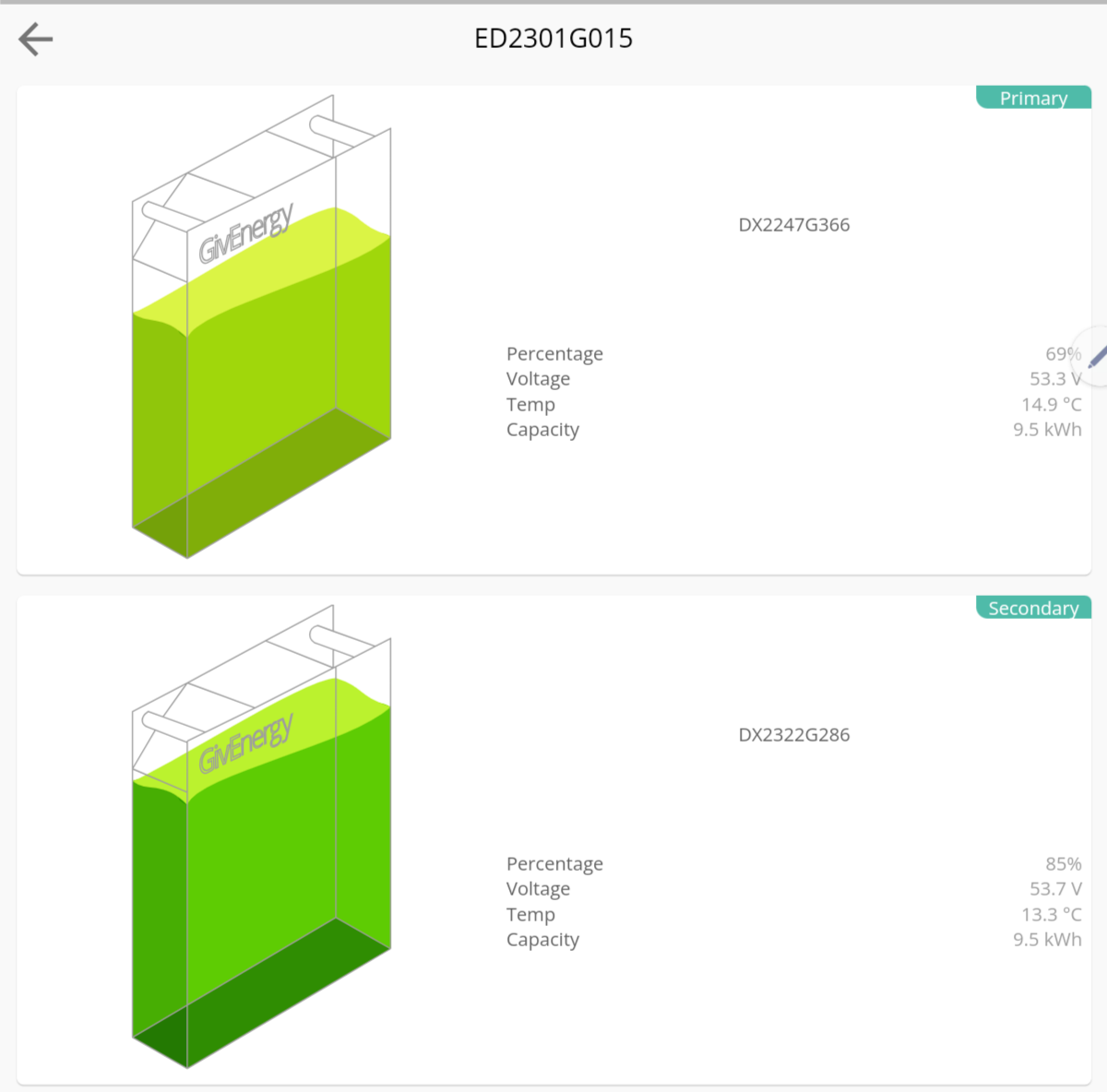
Upon closer inspection I currently have a total charge of 95% with a 97% (primary) & 89% (secondary) split. The battery voltages seem to be quite far apart as well. Anyone have any ideas or am I getting a bit too anxious?

G
#38 geoffreycoan

CGoode I think others that have two batteries connected to the same inverter have reported that when one battery gets fully charged, the other stops charging as well. Also SoC between the two batteries can drift, 10-20% is not uncommon.

There was a recent EVM video for GivEnergy on YouTube about adding a second battery and there were comments from other people making these points. IIRC someone with 3x 9.5 batteries who was only getting circa 24kWh usable because of this.

So you’re probably about as good as it gets. Disappointing and not as advertised

R
#39 Rbor

I have two 8.2 kWh batteries daisy chained to a GE AC coupled inverter.
I regularly see the SOC of the batteries drifting apart by up to 10% with the secondary slipping behind the primary. When approaching 100%, the secondary manages to catch up.
I am running 3015 with D0.535-A0.535.

Every 2 or 3 days I receive a BMS over voltage notification. Battery data usually shows that the over voltage is marginal (this morning, it was 57.02 V when I believe the trigger is 57 V).
From 'battery data', the last 2 or 3% added often increases the voltage up to 1V overall. I wonder if this reflects the secondary battery catching up to a fully charged primary battery.
Also my battery cells all have very similar voltages.
I am not too worried about this. I don't see how yet another calibration would solve this.

Rob

V
#40 Vestas

Rbor The trigger isn't 57V for an overvoltage notification. 57V is actually the battery charged to beyond the calibration limit (all cells above 3.55V) - that's your last "2-3% added". Shouldn't be happening but has been since day 1 of v3015.

The SoC inaccuracy is the root cause of the problem. Discharge battery/batteries to 4% every night and let them idle for an hour before charging and you're unlikely to see any overvoltage notifications because the SoC is now correct(ish) before charge begins.

It's not likely to be fixed on most G1 inverters IMHO.

#41 hoggy

In a chained battery setup either one hitting an OV makes the inverter halt output to the batteries full stop (meaning the lagging one remains at whatever soc it is) the better way would be for the BMS itself to disconnect the higher pack and let the other one catch up but it just doesn't seem to do this, instead relying on the inverter for OV protection features.
I do feel that wiring methods don't help here as I've mentioned before (chained vs loop) but alas it is what it is.
You can presumably see-saw packs themselves by switching the high one off physically via the button but I've never tried.

P
#42 Pete UK

hoggy

I agree that would make far more sense and help each battery reach its top and bottom end, aiding a more accurate SOC indication for each.

This is happening to my batteries even though I’m not seeing any OV notifications!

At the moment, one battery of a pair reaches where it thinks it’s full and stops the second one. Then when the second one hits where it thinks is its bottom it stops the first one. So the first one doesn’t know it’s lower limit and the second one doesn’t know it’s upper limit. Causing all sorts of problems. The main one being trapped capacity.

T
#43 TimI

hoggy Interesting, I can't say I'd noticed that effect... but i have an unmatched pair (5.2 and 8.2)

W
#44 wrighar

Just had my first BMS overvoltage today on a calibrate. on 3015 firmware.

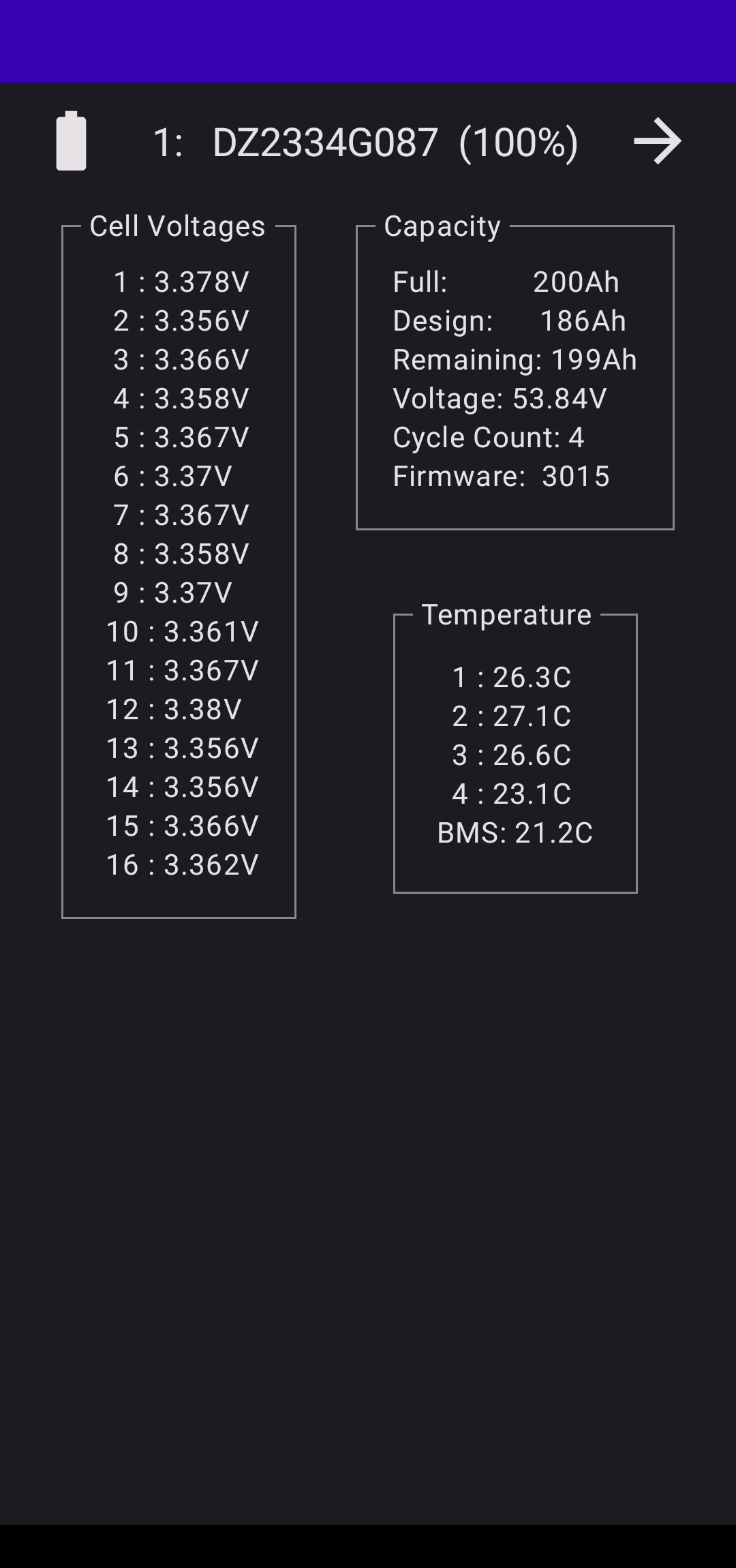
Battery shows as 200Ah available thought, not 186Ah...
Does this look normal? Newbie here.

G
#45 geoffreycoan

wrighar I wouldn't worry too much about an over voltage during the calibration as the calibration process is fully filling and emptying your battery so it should be "pushing the boundaries". I got an over voltage from one of my inverters on the last calibration, but not the other

#46 hoggy

The Undervolt and Overvolt alarms from the battery are precisely how the inverter knows its hit bottom and top limits and can therefore move to the next step of the calibration - so they would be expected to show up in that instance.

V
#47 Vestas

geoffreycoan The f/w you're on apparently adds "BMS 3015 support" according to GE. At some point Paul Landregan is going to install it on my inverter so that'll be interesting given I know how to force an overvolt situation.

O
#48 Ortwin

So the system has been behaving itself (sort of) since the 20th April. On the odd occasion I would see one of the batteries SOC15-20% different but the voltage was within 0.5v. Then I have seen it just under 0.9v different but the SOC within 1% and only charging to 95/97% but the app saying its 100%. Now 7 days later the secondary battery has stayed at 100% and the primary is down at 55%. Looks like another (3rd) battery discharge and calibration and a call/email to GE is needed to balance the batteries.

W
#49 wrighar

geoffreycoan
Well my overvolt situation and later only being able to charge at 1200W max to not get overvoltage has been fixed.

The link bus bars between pack 1 and 2 and pack 3 and 4 were loose (well not tight enough) causing resistance and high/low voltages.

Engineers was suspicious as it was cells 5 and 13 (1st cells of pack 2 and 4) and confirmed by being able to waggle bus bars by hand.

20 mins later all fixed (hopefully).

O
#50 Ortwin

So my BMS OV errors clear for about a week after a battery calibration and then start again. Twice yesterday as the system reaches 100% SOC. GE Technical are once again carrying out a slow battery discharge and calibration. This is the fifth time our system has needed a discharge and calibration. Our 2 x 9.5Kw batteries were fitted 10 months apart and I wonder if the same issue would be happening if the batteries were manufactured/fitted at the same time?

O
#51 Ortwin

Well the slow discharge and calibration seemed to go well as the voltage and SOC readings were the closest they have ever been. However as the system reached 100% SOC it triggered another BMS OV error. Whilst I understand that calibrating the two batteries for optimal performance is good, the fact that the BMS OV error is still happening must be pointing to another cause. So I will go back to GE technical and see what they say (again).

T
#52 TimHutchings

Think you'll find that because calibration checks both ends of the battery range, it will trigger a BMS overvoltage warning at the top end. Wait to see if it happens on normal charging.

O
#53 Ortwin

Apparently they will be releasing a fix for 3015

V
#54 Vestas

Ortwin Source for that?

Its been over 6 months since 3015 was released and GE have known about the overvoltage issue and how it affects batteries on G1 inverters for at least 20 weeks, as that's when they tried automatically rebooting G1 inverters from the portal every time an overvoltage occurred - oh and "hiding/moving" overvoltage notifications about on the portal too. They've done zero about "fixing" it.

You can probably see why I have my doubts about what you're saying 🙂

C
#55 CGoode

New Firmware on my Portal this morning.

V
#56 Vestas

CGoode You have a G2 inverter and the f/w "fixing" overvoltage on G2's was released in February. Edit - specific 3015 fixes for G2 happened in December - a matter of days after 3015 was released.

O
#57 Ortwin

I have done the software update on my gen 2 inverter, however it looks like only one side has updated (D0.915-A0.914) so will have to check with GE technical to see if the need to send me the A side software to update myself like last time.
Now my GE app charge/discharge values have gone crazy.

O
#59 Ortwin

Well my primary battery has stuck at 98% SOC and my secondary battery is now at 78% and over 1v difference.

S
#60 SteveCook

Gen1 Hy5.0 9.5Kwhr battery
Reply from GIvEnergy support yesterday

"There is a new firmware coming out that will rectify this issue, we have been told its release will be very soon".

G
#61 geoffreycoan

SteveCook sounds like it's the 191/193 gen 1 beta release that a number of us are on. It definitely fixes the over voltage errors and has other improvements (see other thread).

Looks like it's getting close to production release

G
#62 Gruff

Inverter Giv Hy5.0 (D0.450-A0.451)
Battery 9.5 kWh 3020

Sorry about raising this thread from the dead but hey, here goes

As with many folks in this thread, I had the overvoltage error at 97/8% SOC after updating from 3015 to 3017 (causal or coincidence I don’t know). I had a firmware roll back to 3015 but issue persisted. In October last year I got an email saying battery was healthy, aware of the issue, fix would be coming blah, blah, blah

I didn’t get any overvoltage errors over winter - battery was cycled 4% to 100% everyday (heatpump use and EV charging)

Now we have sun, overvoltage (93-98%) is back with a vengeance. Work around has been limiting SOC when overnight charging. As I have no control over pV charging I have to remember to export to stop the over-voltage and subsequent inverter “freezing”

I’ve updated to 3020 (after checking with GivEnergy that it would work) and it’s made bugger all difference. I’ve contacted support, but I’m waiting for a response

Has anyone managed to get this fixed? Any suggestions as to what I could try.

G
#64 Gruff

Finally, after playing the worst version of snakes and ladders with customer support, technical support team got on the case.

Inverter firmware has been updated to DO.199-AO.199.

After 2 weeks all seems good. Have had warning on 2 occasions but system has dealt with it, no freezing up of inverter

Hopefully that’s it and I won’t have to necromance this thread