Slave Batteries not fullly charging to 100%

27 comments started 2024-04-21 last 2024-05-11
GivEnergy ProductsBattery
L
#1 Lorne

Hi everyone, I have a 3 battery array and a 5kw inverter. Primary battery =9.5kw, Battery (1) = 9.5kw and battery (2) 5.2kw (total 24.2kw). Only the primary charges to 100%. Both batteries 1 & 2 only ever charge to 90%. They have been installed for 4 weeks. I have been through all the settings and can't find why 1 & 2 are only charging to 90%. maybe they are faulty? any other ideas?

G
#2 geoffreycoan

Lorne I think this is a GivEnergy “feature”. Once one battery reaches 100% the others stop charging.

There’s a recent EVM video for GivEnergy on adding additional batteries on youtube. People in the comments have highlighted that this happens to them as well.

K
#3 killythebid

geoffreycoan It does look like that if we think the BMS is reporting the SOC of both batteries accurately. I am not so sure that is the case lithium batteries are not so easy to manage and when my two batteries have reached, so say 100% the secondary battery is most often reported as 90% but the voltages are the same in total and individual cells, with the exception of when they are recharged to full at the end of a calibration.

Either way, I do not think anything is wrong with the batteries and if the system is working as expected and running things why worry?

G
#4 geoffreycoan

killythebid Agree if its working perfectly then there are more important things to worry about than whether the soc is reported accurately.

My two batteries are connected to two different inverters so I don't have the chained configuration and no personal experience of how well it works, but from what I remember of the youtube video comments, was saying that they weren't getting the full capacity from their chained batteries.

I just found the video, its https://www.youtube.com/watch?v=2sRCyqDnLEM

P
#6 Pete UK

Lorne

(2x 5.0 hybrid inverters, 4x 9.5kW batteries here)

Hi, yes that’s the exact experience I have. Very very frustrating when you’ve spent a fortune and can’t seemingly get all the capacity you’ve paid for! When charging; one’s “indicated SOC” hits 96% (or perhaps 100%) both stop charging. Same for discharging. Sometimes the voltages are similar, other times not so much.
ie one day primary might hit “96% SOC” at 54.0v and both stop charging (secondary could be at 77%). Next day it might be “full” at 53.0v or 55.5v ! Primary is indicating 96% and secondary could be anywhere from 70% to 90% !
Then when they discharge the secondary hits 4% first and stops both discharging. Primary could be at 38% and secondary at 4% voltages at 51.7v or so. So can’t get near the full advertised 19kW capacity out of each pair on an inverter.

The other inverters battery pair does something similar but different altogether as well !

The primary battery seems to work much harder than the secondary or at least responds first and for longer until it’s nearly exhausted and the secondary tries to catch up (as evidenced by looking at the very different temps of the batteries)

Tried all the latest software versions, fast calibrations, slow calibrations. Had 2 replacement secondary batteries. Numerous engineer visits. Same problem since install last July. On the balancer beta trial. I’m not regularly seeing any BMS over voltage messages though. Maybe a bad batch? Although I’m not so sure.

I’m also not sure that most people understand that this indicated “SOC” issue is trapping usable battery capacity and making the usable capacity much less than advertised ! It’s not as bad when it’s only 10% (still possibly mildly annoying though) but when it’s 40 or 45% its infuriating.

Currently got a ticket open.


[upl-image-preview url=https://givenergy-community-forum-uploads.s3.eu-west-


P
#7 Pete UK

geoffreycoan

If that really is a deliberately built-in GE “feature” then that is ridiculous! Do you have a reason to believe that’s the case?

Once one is battery is full, you want that one to stop charging and the other one to continue to fill up; same as those £10 4xAA battery chargers that plug into the 240v wall socket !
Same for discharging. Why would you possibly program a feature like that in deliberately?

Thats like going out to dinner with 4 mates, one scoffing his main course and desert first before anyone else is half way through the main course and the waiter coming out, removing all the food and saying “everyone is full, everyone ate 4 mains and 4 deserts - Here’s the bill for 4 full meals and 4 deserts” !

G
#8 geoffreycoan

Pete UK I’m not saying its something that GE deliberately designed it to work this way as “wouldn’t it be a good idea if …”, more its a consequence of the way the system works. As @hoggy highlights on https://community.givenergy.cloud/d/4340-bms-over-voltage/40 its that the decision to stop charging is done at the inverter level not the battery level.

Taking your analogy further, the waiter isn’t looking to see whether everyone has eaten both the main course and desert, its just looking for the first empty desert plate as a sign that the meal is over and assuming that everyone has eaten food at about the same rate.

I’d hope that this can be fixed in software between the inverter and the batteries, but I dunno. Be interesting to see if the CEMS fixes this but (my understanding) its focussed on replacing the inverter charge/discharge comms to stop cross charging which is another lovely side effect of the GE inverters, I’d think that the CEMS wouldn’t necessarily resolve the issues with individual batteries on the same inverter chain.
But who knows.

P
#9 Pete UK

geoffreycoan Taking your analogy further, the waiter isn’t looking to see whether everyone has eaten both the main course and desert, its just looking for the first empty desert plate as a sign that the meal is over and assuming that everyone has eaten food at about the same rate.

geoffreycoan

-Yep. That’s exactly what I said. Basically it sees that “one is full” and incorrectly assumes “therefore all are full”.

This happens under normal operating conditions. NOT just for a BMS over voltage alert !

This feature would be acceptable in the ‘rare’ over voltage alert situation talked about in the other thread (although not ideal). Because you don’t (or shouldn’t) be getting Overvoltage alerts every day. So a few occurrences of this happening over a year to ‘protect the system’ would be minimal.

The problem is, this is how the system functions on a day to day basis under normal operation with no BMS errors or alerts! Which causes the unusable capacity problems.

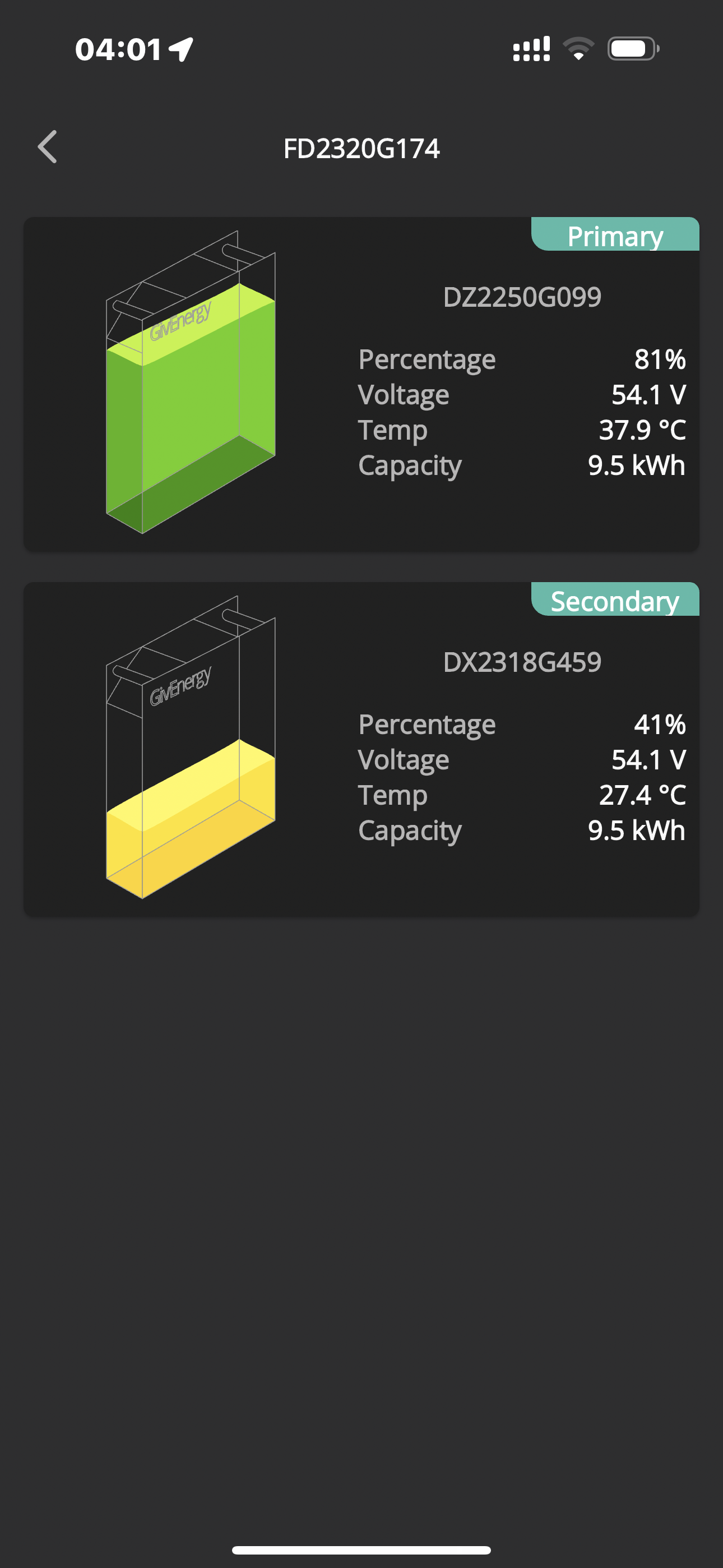
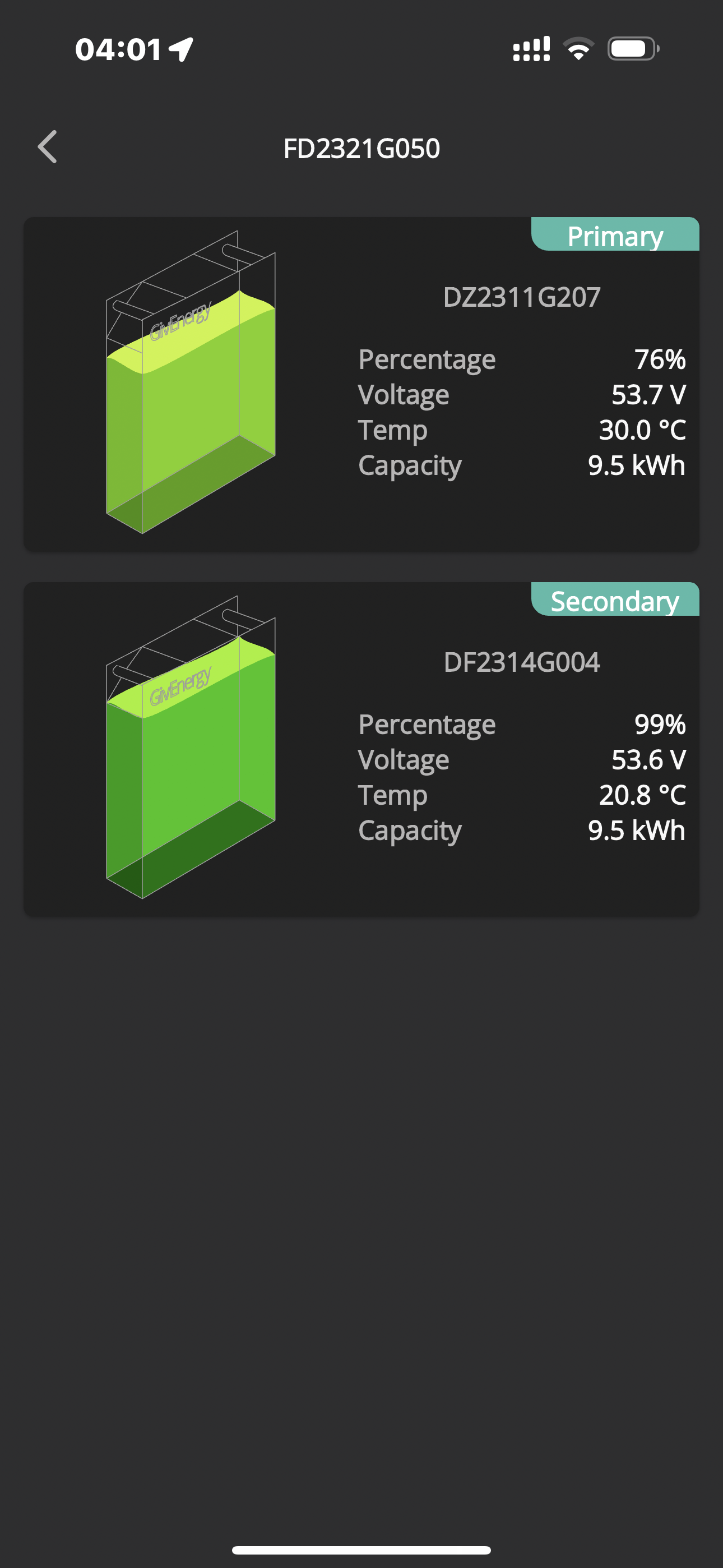
Here are my batteries this morning for example, after a full nights charge from when one cuts off both of the pair (-assumed to both be “empty”) and NO alerts/ errors;

Note the voltages and percentages. 34.2kW has been added overnight (excluding losses,) from the system being “empty” so more like 32.5kW (-5% losses) was added to the batteries (out of the full potential 38kW). Thats only 85% of its advertised 100% !


P
#10 Pete UK

That aside. I would expect that the CEMS will fix both the imbalance in individual batteries on an inverter problem AND the cross charging problem. Otherwise what’s it for?

Anything less won’t allow the system to work normally as expected.

L
#11 Lorne

Many thanks for taking the time to reply guys. On one hand it is good to know I am not alone.... On the other hand it's not good that this issue exists.

K
#12 killythebid

I am still unconvinced the issue is as distinct as people are saying. The SOC percentage is not that reliable to be able to bank what it says at any one time.

The reason I say this is that I have observed more than once on our own system with two batteries that despite the secondary saying it was 90% charged when the primary was 100% when it came to the batteries being discharged to 4% after a while they came back online with more charge. I do not mean during the day when the sun had charged them a bit but at night. I have seen this happen more than once in a single night.

The point is the system cannot find what is not there according to the SOC percentage but the BMS wakes up and supplies what was there all along.

P
#13 Pete UK

killythebid

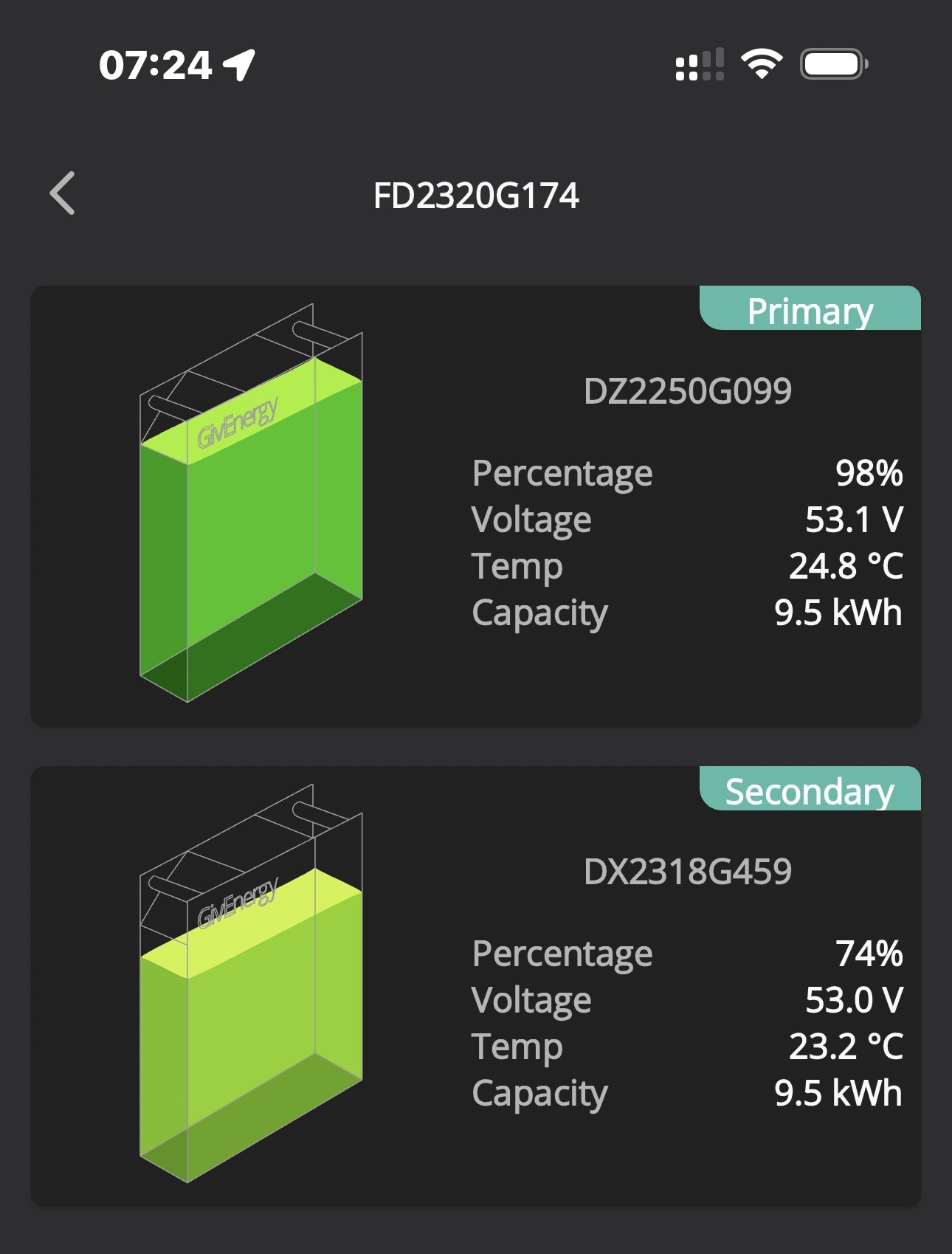
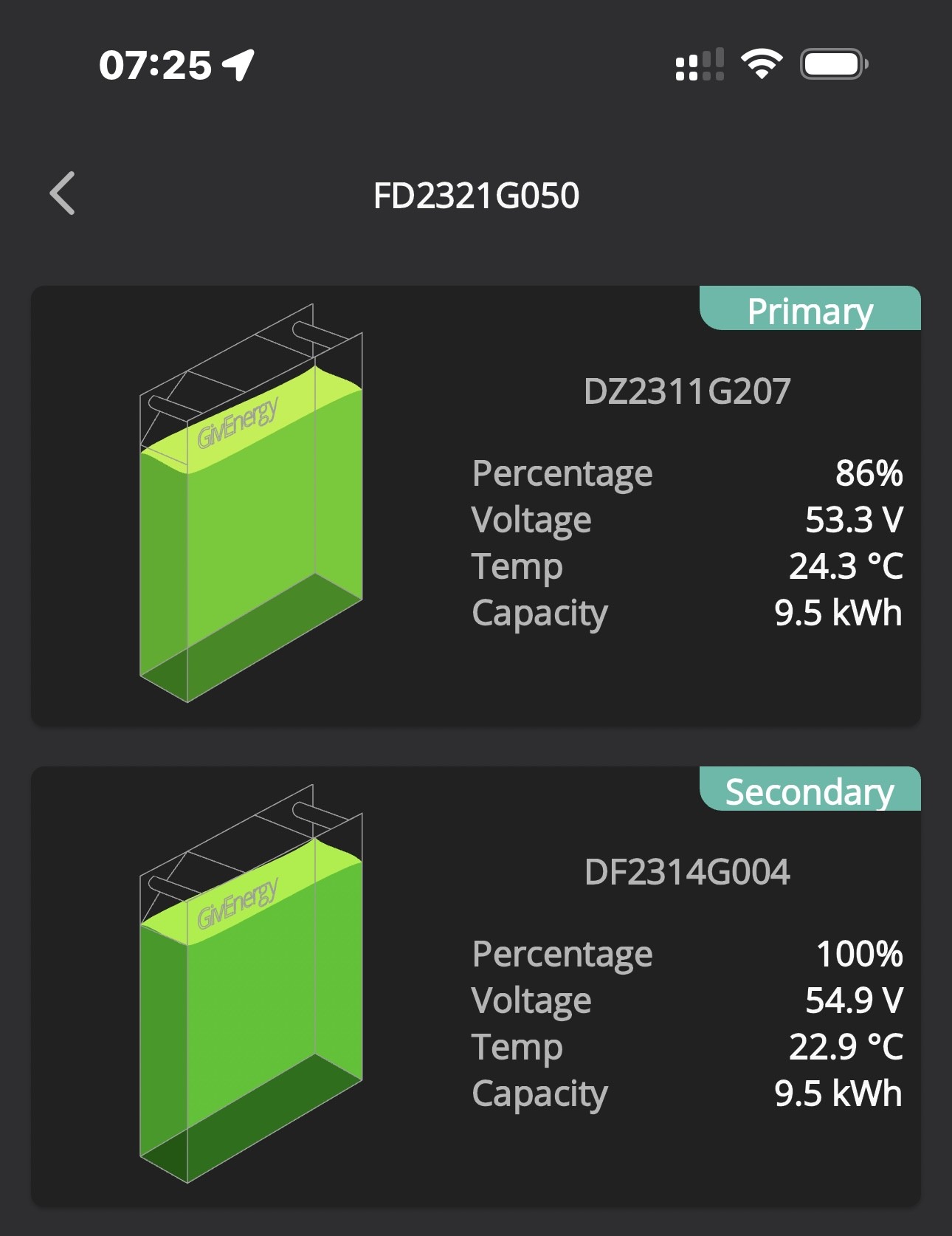
Hmmm. Well how do you explain the two pictures I posted above then?

In the top picture; (on the first inverter pair) the primary hit 98% (53.1v), and stopped the secondary charging at 74% (53.0v).
Then when they discharged the secondary hits 4% at maybe 51.7v and the primary stops discharging at 46% and 51.7v? I’ve seen them go up to 57v and down to 49v. But not together. The first one to hit the “SOC limit percentage” always stops the other despite the voltage ! - Leaving either extra capacity that could be added or extra capacity that isn’t used in the OTHER battery or both. Sure the voltage and percentage might change a bit after they have rested a bit and are just covering base load that’s normal but the two batteries SOC never converge! and you can’t force charge more or force discharge more out of the one with capacity left because one of them thinks it’s at the max or minimum and assumes BOTH are; even if the first one isn’t even at its max or min (just the erroneous SOC indicates it might be). But clearly they aren’t because 53.1v isn’t full. And 51.7v isn’t empty. And the measured throughput isn’t 19kW it’s more like maybe sub 16 or 17 and that’s excluding losses, so you could take 5%+ off that as well.

Basically, I don’t think they can charge individually - either they are both charging or they are both discharging (just never at the same rate). Also I’m never seeing the pair on the first inverter idle. It’s always discharging at 200w recently (when it’s not charging or discharging more under load), While the other inverter pair will idle occasionally when full. I don’t recall either pair idling when “empty” either.

The other inverter pair, has the secondary battery hitting the upper limit first. But this time it’s at 54.9v (100%) and the primary is at 53.3v (86%).

This is after 6 hours of overnight charging. So they have opportunity to converge but don’t seem to want to and I can’t get the full 19kW capacity in or out of each pair when it’s like that.

Maybe yours are working ‘normally’ / better?

If mine were only going out by 10%, idling, and the percentage jumping to correct and I’m getting the full throughput I’d be happy. But they just aren’t.

Been like it for 10 months since install. And both the secondaries have been replaced. I reported it on day one and basically it’s been a weekly email or so asking for rectification. But the huge SOC split is still there on the first inverter pair. On the second inverter pair it’s better - usually only 10-15% different every day, which will sometimes converge at the top end eventually (within 10%) but never at the bottom end.

I’m pressing for a replacement primary battery, as I’m sure there is some defect with it but it’s been a long struggle because INDIVIDUALLY everything looks more or less fine with each battery (so I’m told); cell voltages, capacity etc. but working together as a pair; that’s a different story! You might expect that sort of battery behaviour after 10 years but not on day one of a new install.

Ho hum…

K
#14 killythebid

Pete UK Hmmm well, why do you believe the SOC percentage is accurate?

I am not saying your system (or rather battery) does not have an issue it could easily do, I don't know your system well enough but I know how my system behaves and I know enough to doubt the reported SOC in some scenarios. As I described above finding extra charge from a battery that the BMS has previously reported as spent down to 4% after a while at night is a telling event. It indicates the BMS only has an approximate grasp on how much charge there is in the actual battery.

I think the connection of the batteries is in parallel so they should be charging and discharging together with a pair or more acting as one larger battery. However, how the individual batteries BMS work together is another matter. A concept of a primary and secondary unit suggests there is more going on than just a parallel connection.

If we were dealing with the symptoms you describe in a lead acid battery system I would suspect the charging/discharge cables were placed poorly in the parallel bank causing an imbalance in the individual battery sets ( I have seen that happen and been able to correct it) but there isn't much potential if at all of getting the connection wrong in the Givenergy setup.

The battery sets are OK as individual batteries but do not play well together makes me think the issue is in the BMS not the battery itself and so potentially a software/firmware issue.

B
#15 Beebod

I agree, I think it's the capacity figure that's being incorrectly reported although I don't know whether that comes from the battery BMS or the system firmware. I don't think percentage battery capacity for Li-Ion is an exact science. Looking at the pictures posted earlier of status for two batteries, one of which was apparently at 40% cannot be correct as the voltage clearly shows that it's almost fully charged. I've never seen that much disparity on my system though (2 x 5.2 kW). I think it's expected that multiple batteries will charge and discharge at different rates but there will be balancing going on in the background. This would explain why the system stops when the lowest hits 4% but then a little later after the batteries have re-balanced themselves the system will fire up again.

#16 Hook

Isn't the easy way to track exactly how much energy goes in and out of them?

C
#17 CGoode

Currently my 2 x 9.5kWh Gen 2 batteries are at 97 & 81% (Primary / Secondary) & show a combined SOC of 91% - which by my maths is not even an average of the two.
Despite being set for 100% charge level they will not currently charge beyond 94% using solar today. Both are currently at 53.4volts.

P
#18 Pete UK

Yep. Thats exactly what I’m seeing too.
Are you seeing the primary get much hotter than the secondary as well? And then when “near empty” or “near full” the temp of the primary drops off and the secondary shoots up? - But the secondary never catches up to the primary because the charge/ discharge power to both is dropped down significantly?

killythebid

I think your system sounds like it is probably working “ok” if you’re not seeing the problems others are describing. I understand what you’re saying and why but the unusable capacity in the other battery (or both) at top and bottom end is the issue here.

We know;

1) The SOC percentage isn’t reliable and can adjust itself up and down at times, hence gaining a few % when “at rest”, to be able to give a bit more later on. Thats all well and good and a characteristic of the batteries or BMS. That isn’t the issue being discussed here.

2) The voltage isn’t a reliable indicator (especially under load) but after a rest the voltage settles and can become a bit more reliable and discharge more later.

3) The voltage isn’t a linear function. It’s very flat over approx 70% of the range.

4) individual batteries have slightly different characteristics.

The problem is why does the system use the inaccurate SOC indication of ONE battery to stop BOTH batteries charging or discharging in that case??

This is trapping energy and rendering it unusable in the OTHER battery (or worse both) at the lower AND upper end.

They are advertised as being 100% DOD and multiple batteries on an inverter to “act as one big battery” - but they just don’t seem to work like that; Well not in a lot of cases. It seems that 10% is an acceptable difference between batteries that seems to “sort itself out” by itself. Problem is the rest of us, where they don’t correct themselves. It’s pretty frustrating.

I guess it’s a combination of factors - but if you are sold 100% DOD (19kW), and a 10 year warranty but you can only get 85% (16kW) out of a pair on day one it’s not great. For me with 4 batteries that’s 6kW that I’ve paid for that I don’t have available to me. Excluding losses.

I think most people just want to see the battery needle (or batteries) go from 0% to 100% like on your phone; with 100% of what they paid for going in and out. The mechanics behind it is irrelevant to us end users. I’ve learned a lot about batteries over the last 10 months but I shouldn’t of had to. We just want the capacity we’ve paid for available to us that’s all. Not a big ask. Or maybe it is?

I hope they can rectify the problem for those of us with this issue.

#19 nophead

Are the batteries simply wired in parallel? That would explain why both have to stop at the same time.

C
#20 CGoode

Pete UK I've not seen any wide variations in temperatures - yet. My batteries are in a cool attached garage so no external factors that could increase their temps at this time of year.
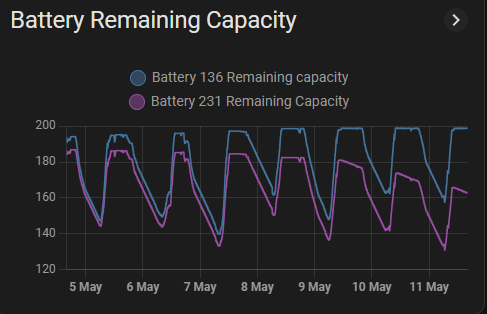
Prior to my recent 27hr factory induced "slow calibration" (because of over voltage errors) the batteries regularly charged to 100% so it's a mystery as to why now they only charge to 94-96% without a Batt Firmware change which is still showing 3015 since it was uploaded in Dec last year. Behind the scenes changes perhaps? My 3.6HY Gen 2 Inverter is running on D0.913-A0.913.
An extra 9.5kWhr Gen 2 batt was added earlier this month so prior to that I only had the 1 battery to look at so all these twin battery issues & comparisons are new to me. However, judging by the comments on this forum, these are not new issues to many others.

P
#21 Pete UK

nophead

I don’t know for sure but the secondary hangs off the primary, so perhaps?

O
#22 Ortwin

I have 2x 9.5 GE batteries and have the same issue with SOC varying between the two and not reaching 100%. Twice my secondary battery staying charged and the solar system using the primary only (battery voltage greater than 0.8 to more than 1v. Most of the time the voltage is within 0.5v. Now GE are saying I need a third discharge and calibration of the batteries but it will be done at slow rate to maximise the battery cell balance.

C
#23 CGoode

Ortwin Be prepared, my slow discharge / re-charge took 27hrs!! Not sure if I'm any better off other than I'm no longer getting Over Voltage battery errors when charging overnight.

C
#24 CGoode

If I believe my portal / App SOC indication, for the first time since a Low / Slow factory re-calibration 10 days ago, my 2 x 9.5kW batteries have charged last night to 100% (100% primary & 96% secondary). Prior to this they would never charge beyond a combined figure of 96% (even when set to 100%) & there was at least a 10-12% difference between the primary & secondary battery SOC.
Not sure if this was in anyway due to me discharging excess battery capacity last night before recharging or, if there are other forces at play here.

O
#25 Ortwin

Well it took almost a day to do a slow discharge and slow calibration, however the voltage readings between the batteries is better and the SOC has only varied by 5% so far. Only Tim will tell if the charge and discharge values have improved.

#26 Windy Miller

Same here. After a long slow calibration my 2x 5.2KwHr batteries seem to be a lot closer to each other under 3015 firmware than 3012. Three discharges have worked as follows...

100% resting = 91% 89Ah 53.19V + 99% 92Ah 53.29V
4% resting = 12% 12Ah 51.59V + 16% 14Ah 51.69V
Delivered 4034WHr + 4094WHr = 8.1KWHr

100% resting = 94% 91Ah 53.27V + 96% 89Ah 53.32V
4% resting = 14% 14Ah 51.7V + 17% 18Ah 51.79V
Delivered 4041WHr + 3730WHr = 7.8KWHr

100% resting = 93% 90Ah 53.17V + 97% 90Ah 53.26V
4% resting = 12% 11Ah 51.33V + 16% 14Ah 51.43V
Delivered 4128WHr + 3978WHr = 8.1KWHr

Figures come from the Inverter app.

I was quoted 8.3KwHr usable so after a year of use I am quite happy with only just being under what was quoted.

P
#27 Pete.J

I seem to have the same issue. The secondary battery is not fully charging and the available capacity appears to be reducing. Both batteries seem to have been stable (consistent capacity) until a couple of days ago. Since this was a new install last week both batteries have been updated and calibrated recently and at the same time.