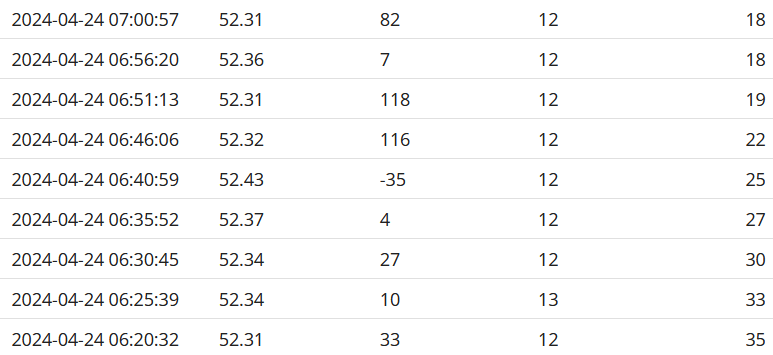
This morning at 6:20 my battery dropped from 35% to 18% in 35 minutes when there was no load.

The system is 1 month old and I've never seen this before.
I have no automations enabled and 18% is above the battery reserve so I'm baffled as to why it would do this, does anybody have any ideas?
Battery dropped 17% in 35 minutes under no load
Paul H Does your battery regularly visit the high (100%) and low (4%-ish) limits of range ? If not, the BMS doesn't get much opportunity to synchronise its tracking of state of charge - LFP chemistry has a very flat voltage curve, so it's hard to tell charge level from the voltage.
When the battery is idle, and at a relatively low state of charge, it takes the opportunity to have a good think about how full it thinks it is. This can result in quite large changes.
If this is the cause, then basically it decided that 35% was an over-estimate of how full the battery was. It's arguably better that it happened here, rather than for you to believe the 35%, try to use it, and then have it suddenly run out when it previously thought that there was still 15% available.
I now typically run system down to around 8% at 11pm, and allow it to idle for an hour before starting the overnight charge. Sometimes the reported soc spontaneous rises by a few percent while it sits there. My system seems underestimate SoC - jumps tend to manifest as it approaches full, and jumps from about 90% to 100%.
If you do a search for "soc jump" there are quite a few threads talking about it.

Paul H This is to do with the battery state of charge (SOC). You don't say what size battery you have, but you first need to make sure you're battery firmware is up to date, then it's a good idea to run your battery till it's empty, then fully recharge it. That way the BMS knows what the endpoints are of your battery, so this doesn't happen so often in the future, and it can keep you SOC accurate.
If it becomes a persistent problem, then it's probably worth getting in touch with GE support.
TimHutchings it's a good idea to run your battery till it's empty, then fully recharge it. That way the BMS knows what the endpoints are of your battery, so this doesn't happen so often in the future
Isn't that the purpose of the formal calibration cycle that happens on installation and after some firmware updates ? That tends to visit more of the voltage range (eg it goes below the normal 4% fixed reserve.)
The battery hits 100% daily and typically has around 50% at it's lowest point, 35% was unusually low last night so this is interesting info, thank you.
DD It probably is DD. I'm afraid I'm not too knowledgeable about battery technology, but the OP didn't say what size his battery is or how he charged his battery or whether the battery was only kept between say 20% and 80% where maybe the SOC had not reached the limit points where it could self adjust, and yes, of course it should have been calibrated on installation.
Hopefully 'stretching' his battery limits will help.
Paul H Unless the battery is regularly (daily or near enough) discharged to the minimum then the SoC will not be accurate - it won't even be close as you've found.
Other manufacturers don't appear to have the same issues tracking SoC....
BTW the detail about it being idle is that when it's either actively charging or discharing, that affects the voltage. You can probably see from the app's detailed view of the battery how the voltage jumps about when charging or discharging.
Useful discussion in https://community.givenergy.cloud/d/4201-battery-appears-to-charge-when-it-isnt and https://community.givenergy.cloud/d/4066-giv-energy-battery-charge-to-capacity
It's the 9.5 battery.
I'm a bit obsessive about not wasting battery charge so it gets back to 100% the next day asap and starts paying me for export 😆
I'll be implementing predbatt in the next few weeks so at least that will take battery management out of my hands.
Paul H I'm a bit obsessive about not wasting battery charge so it gets back to 100% the next day asap and starts paying me for export
Hmm... I also strive to get to export as much as possible, but I purposfully don't charge to 100% first. My other obsession is avoiding solar clipping, and for that, I need to ensure there's space in the battery to accept any solar in excess of the AC generation capacity. So I have battery-charging paused for most of the day, except during peak solar.
Do you charge to 100% overnight, or from solar? If the latter, surely better to export it directly, than to first use it to fill the battery, then export from the battery to the grid ? Obvously depends on your evening energy consumption, of course.
DD Guess it also depends on what tariff he is on.
Agile import and Octopus fixed export
I haven't charged overnight since the Agile prices went up to be inline with my fixed export
Paul H Hmm - that does make it a bit harder to get down to a low state of charge and idle... if you do that overnight, you'd have run from grid next morning until the sun is up.
What I don't understand is why the battery calibrates, gets its upper and lower limits etc., then apparently proceeds to ignore or forget them! My battery is sitting at 100% most of the day at the moment and rarely going below 50%. Its voltage, idle at '100%', drops over time (weeks), obviously reflecting the fact that's its not really at 100%. Why does it do this? I can see it's not full, its calibration should tell the BMS that too. Sure enough, I have had it quit at an indicated 40%, when the voltage starts dropping below 50v -- I can see it's tens of percentage points out, why is it so far out in its own calibration?
In my case thae battery was more reliable on firmware 3008, which it came with, than 3012 which it is now on after a forced upgrade by GivEnergy because of a fault condition (which was nothing to do with the BMS version). I could upgrade to 3015 but have heard bad things about that and the upgrade process...
SimonP Perhaps the problem is that the cells are out of balance? It has to stop charging when any one cell has reached its maximum. But the total voltage (because the cells are in series) is lower.
It presumably similarly has to stop discharging when the lowest cell gets down to its minimum.
If you have rubikcube's app, you can see the individual cell voltages. Or you can also get them via modbus, such as with home assistant.
DD Don't think so, they always look pretty close (a few mV) when I check. I understand what you're saying, but it's a drift over time when the pack isn't cycled more or less fully. I'll check tomorrow when it's at 100% and idle again.
DD Well balanced, all within 4mV at 90% this morning. I paused it last night at an indicated 50% when it was obvious it was about to quit, voltage dropping rapidly and under 49 at 200 watts draw. It sat there for a while then started adjusting it's calibration, ending up at 3% an hour or so later! I then un-paused it, and it correctly just sat there until it started charging in my cheap period. (The cell balancing didn't ever get really bad, just drifted apart at very low charge level.)