I have a Gen 3 5KW hybrid converter, with an AOI (AC-coupled) recently installed. The kWp of each array is 4.45 (so 8.9 kWp in total) with the two arrays being SE and NW facing.
I intend to monitor my output this year to see whether or not it would be worthwhile purchasing a DC-coupled battery to store excess solar, but am not sure how to easily get the data for the year.
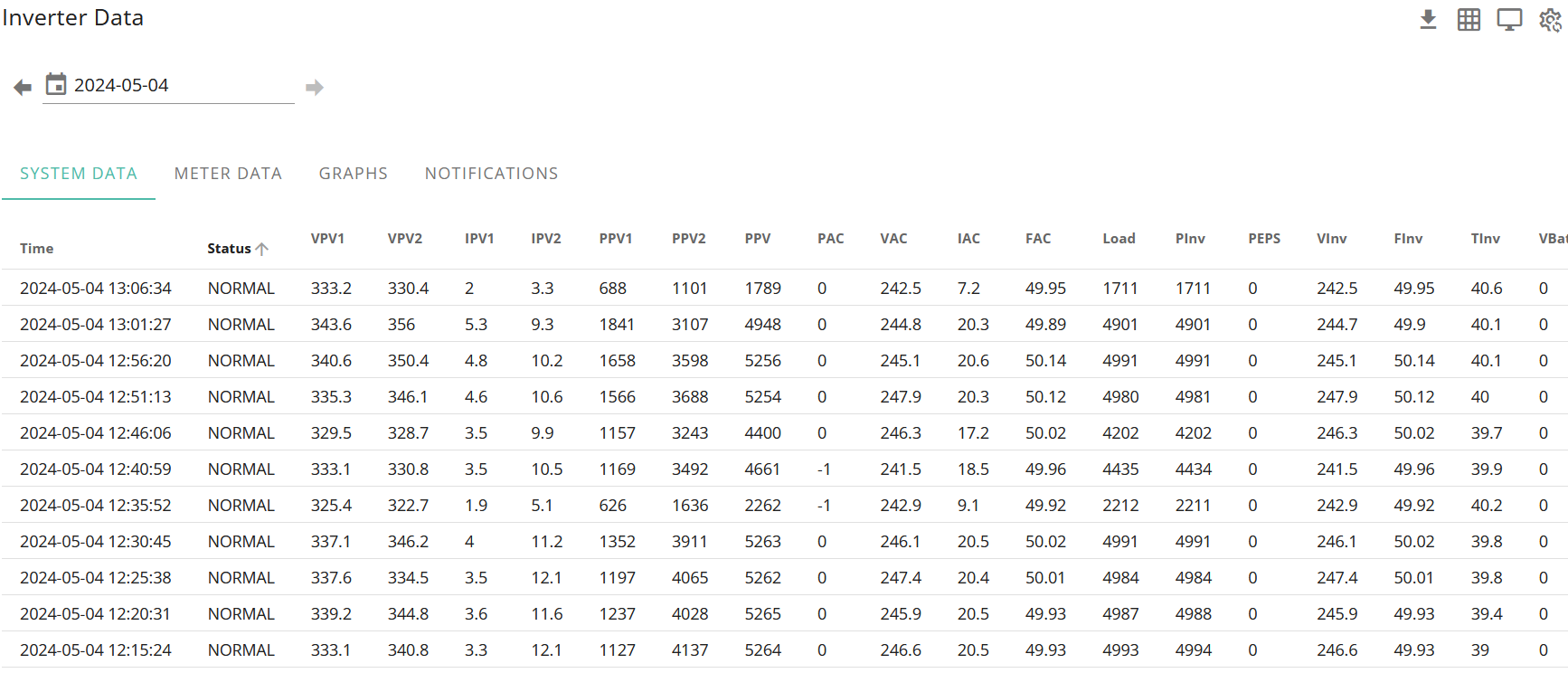
I can see from the inverter a generation figure by string and total, but only for each day.
Is there a way to produce a report that will give me this for a year (to download to a spreasheet) so I can analyse total clipping over 12 months?
D
#2DD
CW not sure how you measure clipping - it's generation that didn't happen.
I think intra-day data Is available, but you may have to download each day and produce your own report.
CW My observation is that the inverter losses are around 10%. So it takes about 5500W of generation to reach 5000W AC output.
But when it reports 5500W, you can't tell whether it would have been 5501W, or 7500W, if it wasn't clipping.
Just now, my local script is having to adjust charging power when AC generation maxes out. But it has no way of knowing whether I need to add 200W of charging, or 2kW of charging. It just gradually ramps it up until the AC generation falls away slightly,
T
#5TimHutchings
CW Think you'll find even without charging a battery, your max practical inverter output would be around 4700w ish. due to the conversion from dc to ac and the power used by the inverter.
C
#6CW
DD Good point! I think for my purposes though, if I could get a years worth of data, I could at least see how many times the combined output was greater than a value (lets say 5500)- that at least would give me a metric of the number of times the inverter clipped output.
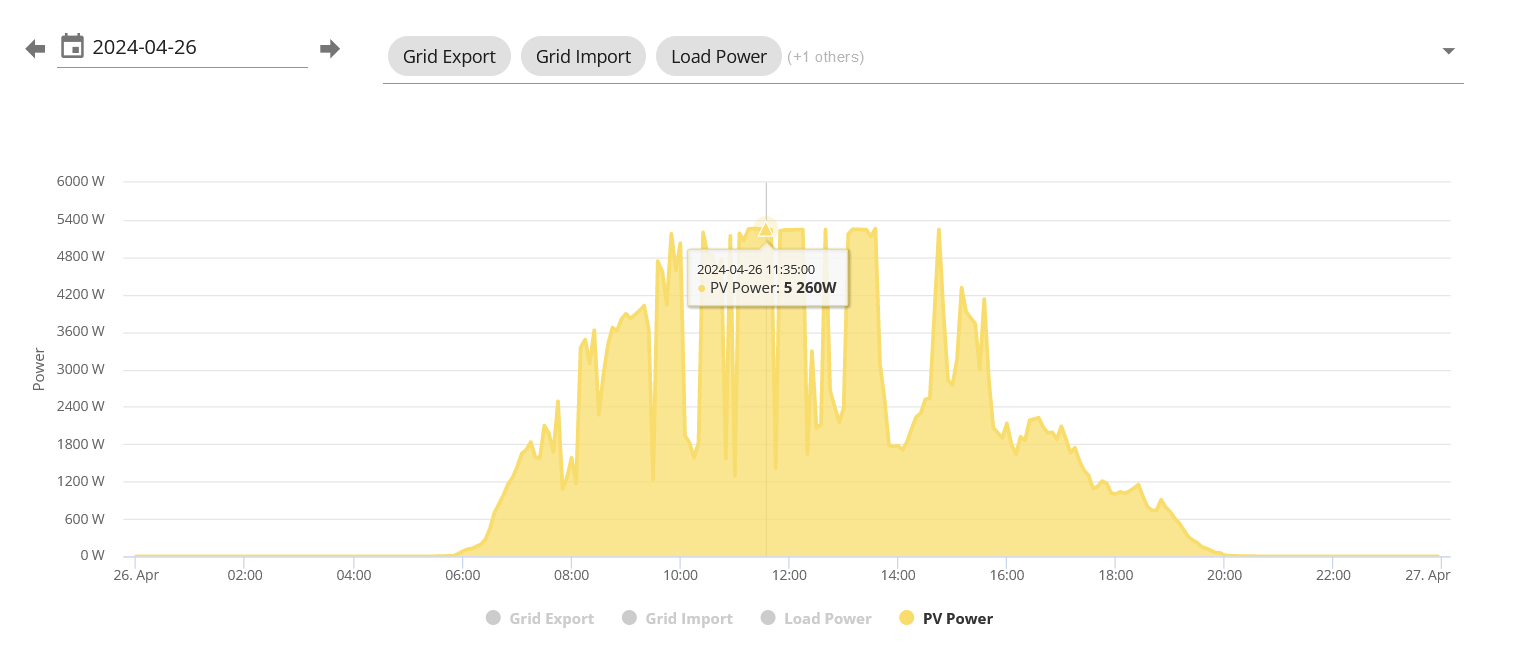
Looking at the graph I can see the curve flattens at around 5260
So you are right I cannot see how much energy was "lost" but I can see how often it occured. But I think the only way I can get this information is to download every day's data to analyse !! I guess then it is a leap-of-faith as to whether or not enough energy was lost to make a battery worthwhile
C
#7CW
TimHutchings Then does that suggest if I am regularly seeing generation up in this range that a DC-coupled battery could make sense?
T
#8TimHutchings
CW Not necessarily as solar is 12v. So it still has to be converted to ac to go into the house or grid so you will still get losses. Also with solar to 12v battery there'll be less losses as its 12v to 12 v.. You'd win out importing and exporting to/from the grid!
Clipping isn't normally too much of an issue depending how big your solar array is compared to your inverter output, as during the heat of the summer your panels are likely to produce only 2/3s of their max output. Cooler days with clear blue skys in spring and autumn is when you're more likely to see it.
I also note that one of your strings is northerly facing, and from what I've read, they will only produce around 60% of their max per annum.
Best way to avoid clipping, if it looks like it's becoming an issue, is to slow the charge rate down of your battery through the peak solar periods to allow the the inverter to output around 5kw to the grid and put the remainder of the 12v solar into the battery having made space.
D
#9DD
TimHutchings Think you'll find even without charging a battery, your max practical inverter output would be around 4700w ish. due to the conversion from dc to ac and the power used by the inverter.
The impression I get is that the inverter losses come out of the DC input, rather than the AC budget. So rather than generating 5kW then subtracting the inverter power from that, it seems to be deducted before conversion. Certainly I routinely get (almost) 5kW AC generation.
D
#10DD
TimHutchings Not necessarily as solar is 12v. So it still has to be converted to ac to go into the house or grid so you will still get losses. Also with solar to 12v battery there'll be less losses as its 12v to 12 v.. You'd win out importing and exporting to/from the grid!
? I thought the solar was around 150V and (hybrid) battery around 50V ? (The AIO battery is higher voltage, though.) Starting PV string voltage is 130V on my system.
Best way to avoid clipping, if it looks like it's becoming an issue, is to slow the charge rate down of your battery through the peak solar periods to allow the the inverter to output around 5kw to the grid and put the remainder of the 12v solar into the battery having made space.
OP doesn't have a battery on the solar inverter - that's the issue. The battery is the AC-coupled AIO. So the analysis is whether to also get a DC battery to avoid the clipping.
#11hoggy
PV can be anywhere between 120-580V depending on Number of panels.
Battery is 51.2V DC
Both feed into the same DC bus at around 300V so PV is either pulled up/down depending on what it's running at. Battery is pulled up to the same.
Then passes across to AC conversion stage which is where the 5kW cap comes in - everything before this on DC side has ample over capacity hence why you should always get advertised AC output (5kW or 3.6kW) on export even with clipping.
T
#12TimHutchings
DD You may be right DD. Best I've had out of my inverter which is a gen1 is 4832w, but regularly get in the 4700's. Maybe it's a quirk of gen1's or just my particular inverter.
T
#13TimHutchings
DD woops! Clearly the red wine 🍷 I opened yesterday afternoon was having an effect on the gray matter. For 12v read DC. I still tend to think of batteries as car batteries and 12v DC. Obviously that's not the case and I should probably refrain from posting while getting gently sozzled in the sun waiting for friends to arrive. Apologies to all!
C
#14CW
TimHutchings How would that work? - if the solar array is producing more than 5kW of power, which is the max the inverter convert, then I still would lose that power (unless I have a DC coupled battery added) - or am I missing something?
T
#15TimHutchings
CW Apologies to you! I misread your original post. Yes a DC battery would soak up excess solar and avoid clipping if set to charge by the same amount as your likely clipped loss. How that would be configured with your AIO I'm not sure and DD or someone with more knowledge may be able to help.
However, whether the cost /payback of another battery would be worthwhile for the amount of clipping you're likely to encounter I think is questionable, especially with one string facing northerly. You're probably best off just keeping an eye on the charts each day for the next 6 months to see how much clipping occurs over the summer. It may just be a case of winning out big time in the winter months and loosing a few quid in the summer. Sorry for the confusion.
C
#16CW
TimHutchings Thanks Tim - I suspect that will be the case - the array is quite large at 8.9 kWp so I'm hoping that during the winter months they system will at least keep the house going during the day and possibly mostly charge the battery (although last Thu I actually had to go to the grid to charge the think up). It's just whether it would be worthwhile collecting lost solar - assuming there is some - hence the original post. But as someone upstream pointed out I won't actually know how much was lost as it was never there!!!
T
#17TX200
Do you need the extra battery? Do you import during peak in the winter?
If not I suspect you'd not break even, so it's a case of do you want to break even?
E.g. for some it isn't about money. It's the environment and or shiny tech 🤣
Plus in the short term there may be issues running an AIO and a hybrid with a battery - not sure it's officially supported, but can be avoided using scripting in home assistant or other 3rd party solutions. Plus GE working on a hardware solution too (EMS).
C
#18CW
TX200 At the moment I don't know (the system only went in last month) so I need a years worth of data to review.
My original thinking was, if there was enough excess solar, I would store that in a battery and then force discharge that at peak time, knowing that the AIO is sized enough to power the house for 24 hours.
As to the question about break even, I'm not too fussed by that (I look at the purchase as a sunk cost and just "enjoy" the fact that I am selling excess power back to the grid!!).
The AIO and DC battery working together is a good point - at the moment I don't think you can get 2 AIO working together, so there is still a long way to go down that path I think.
But split NW/SE, so power will be spread over the day. I think max inverter input is 7.5kW. Not sure if there's a per-string limit.
G
#20geoffreycoan
CW Battery storage is great but the pay back isn’t great, especially if you are buying it principally to cover solar clipping that your current inverter looses.
Wonder whether you’d get more for your money with a second inverter (or a bigger one) and moving the strings across the two to maximise generation?
C
#21CW
geoffreycoan That's an interesting thought. Not sure how that would affect my DNO cosent though (currently restricted to 8KW export)
G
#22geoffreycoan
CW Not sure how that would affect my DNO cosent though (currently restricted to 8KW export)
In the opening message you said
The kWp of each array is 4.45 (so 8.9 kWp in total) with the two arrays being SE and NW facing.
The 4.45kWh is the ‘theoretical maximum’ under a set of specific optimal conditions (can’t remember them, but fully South facing, sun directly overhead, 20 degrees centigrade, etc) so most of the time you are not likely to get to that output, especially with panels not directly South facing. Having said that on cooler days (April and October) you can exceed that theoretical maximum output.
But since your panels are on opposite sides of the roof you are never going to get peak generation and peak export on both sets of panels at the same time, but you’ll get a decent long solar day as the sun moves round. What separate inverters would enable you to do is to get the best you can out of your panels.